
TL;DR: what is cside
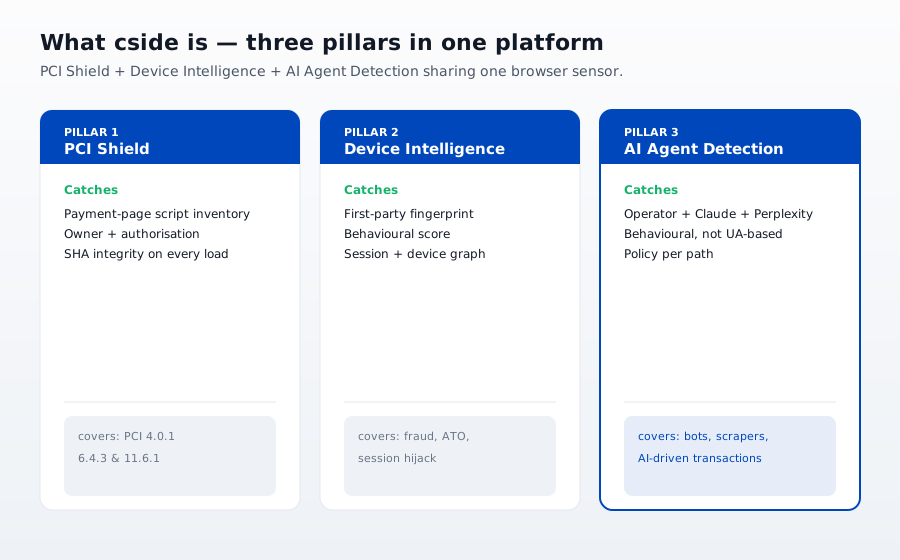
- What it does: Browser-layer visibility for every visitor, human or agentic. It watches what scripts execute and what data they touch, then turns that into verdicts and audit evidence.
- What it covers: Four problems, one deployment: client-side security, bot and AI-agent detection, fraud prevention (ATO, chargebacks, new accounts), and privacy and compliance (PCI DSS 4.0.1, GDPR, CCPA).
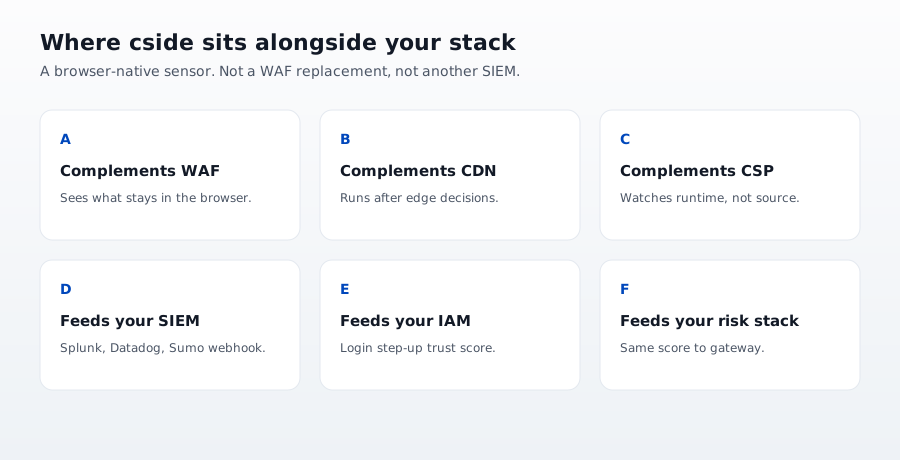
- Where it fits: It sits alongside your WAF, CDN, and identity stack, not instead of them. Your WAF cannot see what a script does inside the browser. cside can.
Short on time? See the cside platform. It covers everything below in one deployment.
What is cside?
cside is the tag you deploy on your site to see what actually runs in your visitors' browsers.
Every modern website loads 15 to 40 third-party scripts on the pages that matter most: checkout, login, signup, account settings, admin dashboards. Your analytics platform loads. Your tag manager loads. Your chat widget loads. Your A/B testing tool loads. Each of them can be compromised upstream, exfiltrate form data, or push malicious code into your users' sessions without ever touching your server.
Server-side security (WAFs, network firewalls, DDoS protection) cannot see any of that. Neither can your CDN. Neither can an outside-in scanner that visits your site once an hour from a datacenter IP. All of them miss the moment where a modern client-side attack happens: inside a real user's browser, mid-session, on a page your existing controls already trust.
cside sits at that layer. A lightweight JavaScript observer runs in every visitor's browser. The Script method fetches third-party scripts and analyses their payload on cside infrastructure. Together they capture runtime signals (which scripts load, what they touch, where they beacon to, how the user interacts, what the device and browser fingerprint look like, whether the session is human or an AI agent) and stream those signals to a platform that turns them into detection verdicts, forensic timelines, and QSA-ready audit evidence.
Client-side security: what cside monitors in the browser
The client-side security module catches attacks that execute in the browser after the page loads. The what is client-side security primer covers the discipline in depth; the categories cside detects are below.
Magecart attack detection and web skimming
Magecart is a family of at least seven attacker groups that inject or replace JavaScript on payment pages to steal card data as it is typed. The full mechanics are in magecart attacks explained. Named incidents include British Airways (2018, 380,000 cards), Ticketmaster UK (2018), Newegg (2018), Warner Music (2020), Segway (2022), Kaiser Permanente (2024), and the Polyfill.io 2024 supply-chain event that affected 490,000+ sites. cside detects the browser-side behaviour in real user sessions and produces the exact evidence a QSA can accept for PCI DSS 4.0.1 §6.4.3 and §11.6.1.
Formjacking detection
Formjacking is code that reads form fields as the user types, before the form is submitted or encrypted. CSP and WAFs do not stop it because the skimmer runs in the browser after both checks pass. cside observes which scripts touch input fields and where they beacon to, in real user sessions.
Credit card skimming and e-skimming
Online card skimming copies payment-card details from checkout pages before tokenisation. The Visa Spring 2025 Biannual Threats Report identifies digital skimming as one of the most prolific and consistent threats in the payments ecosystem. cside is the browser-side control that catches it.
JavaScript security vulnerabilities and CSP evasion
JavaScript security vulnerabilities that bypass Content Security Policy source allowlists (through obfuscation, dynamic loading, or trusted-host injection) execute in the browser without violating a single policy directive. cside observes what scripts actually do at runtime, not only which sources they load from.
Supply chain attack visibility
A supply chain attack compromises a component you already trust so the compromise reaches downstream users. In the browser context, that means poisoning a script, CDN, or third-party service already embedded in your site. cside inventories every source of executable code your visitors' browsers reach and detects when their behaviour changes.
Script monitoring for third-party scripts
Script monitoring is the practice of continuously observing every external JavaScript file that loads and executes in a user's browser. cside monitors script activity, data access, network destinations, and behavioural drift across sessions. The Script method can also block unauthorised script execution outright when configured to do so.
Bot detection and AI agent detection
Traditional bot management inspects network-level signals: user-agent, IP reputation, request rate. Modern automated threats defeat all three. The AI agent detection solution reads browser-layer signals that agents cannot easily forge.
How to detect bots and AI agents on your website
The operator's guide on how to detect AI agent traffic on your website covers the four signal categories cside uses: identity, network, browser environment, and behavioural signals. The bot detection product page maps each signal to a specific detection.
Bot detection techniques cside uses
Effective bot detection techniques combine cursor dynamics, browser fingerprinting, canvas rendering, WebGL parameter capture, and session-timing analysis. cside instruments each of these in every visitor session. See the definitive 2026 device fingerprinting guide for the technique-level breakdown.
AI agent security in 2026
AI agent security is the practice of detecting, monitoring, and managing autonomous AI agents that operate websites through real browser sessions. Tools like OpenAI Operator, Claude for Chrome, Playwright, and Puppeteer drive real browser engines, so they produce human-looking fingerprints at the network layer. cside catches them at the browser runtime.
Anti-bot software and captcha alternatives
The anti-bot software category is being renamed by Forrester to "Bot and Agent Trust Management" to reflect that the problem is no longer blocking automation but governing a mixed traffic environment. cside is aligned with that shift and works as a captcha alternative that catches automation without adding user friction.
Block web scraping and detect bot traffic
The how to block AI-agent content scraping bots guide covers the four-layer detection stack cside deploys against AI content scrapers. For general bot traffic detection, the browser-runtime signal set gives higher confidence than network-level heuristics alone.
Bot farms and laptop farms
Laptop farms are the industrial-scale evolution of bot farms: real Chrome on real hardware defeats naive device intelligence. cside catches them through behavioural signals (mouse dynamics, typing cadence, session pacing) and network-layer anomalies (ASN clusters, browser fingerprinting anomalies, geo-time mismatches).
Fraud prevention and account takeover prevention
The same browser-layer signals that stop client-side attacks also stop most modern fraud.
Account takeover prevention and account takeover fraud prevention
Account takeover prevention is the discipline of stopping unauthorised access to a legitimate account. Account takeover fraud prevention is the discipline of stopping the monetisation of that access. cside's Signup Shield module covers both, catching signals like credential stuffing, session hijacking, and post-authentication takeover before monetisation.
New account fraud
New account fraud is abuse of the signup flow itself: attackers create accounts using stolen, synthetic, or bot-generated identities to claim promos, seed multi-accounting rings, or set up long-lived cash-out infrastructure. cside combines device intelligence, behavioural signals, and network reputation at the signup submit event.
Credential harvesting and credential stuffing
Credential-stuffing attacks replay username-and-password pairs leaked from past data breaches. See how to detect and stop credential stuffing at the login and the definition on what is credential stuffing. cside catches the browser and session signals credential-check controls at the login endpoint alone miss.
Device fingerprinting and device intelligence
Device fingerprinting generates a stable identifier for every device from 250+ browser and hardware properties. Device intelligence uses that identifier to catch fraud across sessions. See also browser fingerprinting for fraud prevention for the technique-level detail. cside's device fingerprinting product is a full deployment.
VPN detection
VPN detection is required by an increasing number of jurisdictions (Texas HB1181, Florida HB3, the UK Online Safety Act) and by fraud teams that need to flag high-risk traffic. cside's browser fingerprinting and network-layer signals catch VPNs that static IP lists miss. The VPN detection product is the full deployment.
Chargeback fraud prevention and Compelling Evidence 3.0
Chargeback fraud prevention depends on evidence captured during the checkout session, before any dispute is filed. cside's device fingerprint captured at checkout qualifies as Compelling Evidence 3.0 evidence in card-not-present disputes. See merchant chargeback prevention for the merchant-side playbook and the Chargeback Evidence product for the deployment.
Fraud detection API
The cside fraud detection API exposes device fingerprint, AI-agent flag, VPN and proxy status, incognito flag, and a composite risk score to any application layer that consumes it. Pairs with existing fraud stacks (Sift, Forter, Sardine, SEON) rather than replacing them.
Ecommerce fraud prevention and payment fraud detection
For merchants, ecommerce fraud prevention software needs the browser-layer signal cside adds to catch AI-agent card testing and post-authentication takeover. Payment fraud detection software that only inspects transaction data misses the browser-side evidence needed to prove Compelling Evidence 3.0 disputes.
PCI DSS compliance and privacy
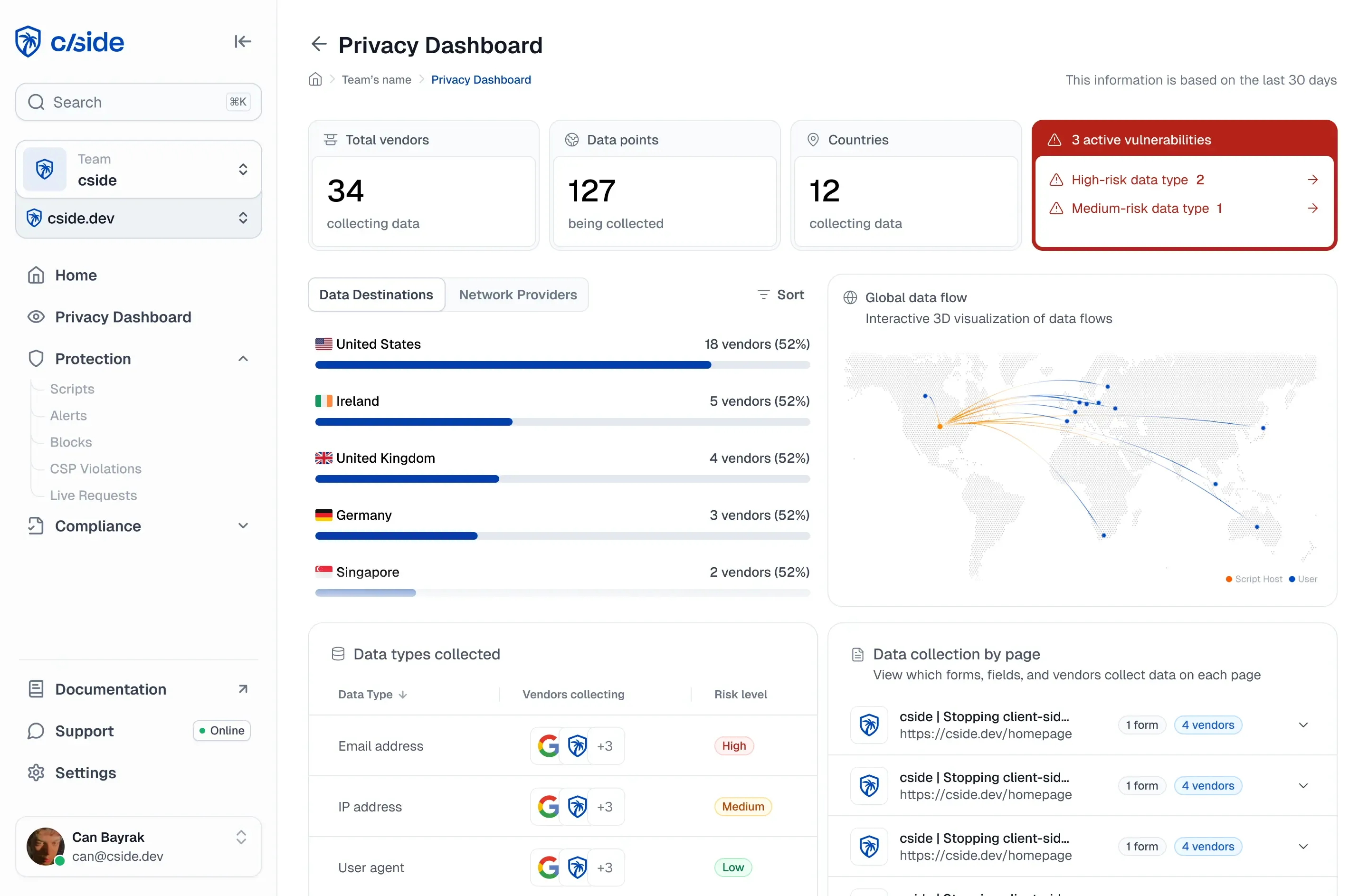
The PCI Shield deployment covers PCI DSS 4.0.1 script controls; the Privacy Watch module covers pixel and tracker monitoring for GDPR and CCPA. See the what is PCI DSS primer for the framework overview.
PCI DSS 6.4.3 and PCI 11.6.1
How to comply with PCI DSS 6.4.3 and PCI 11.6.1: the two client-side controls mandatory since 31 March 2025. Requirement 6.4.3 covers script inventory, authorisation, and integrity. Requirement 11.6.1 covers payment-page tamper detection. cside satisfies both with a single deployment. See also the free tier comply with PCI DSS 6.4.3 and 11.6.1 for free.
PCI DSS compliance software, checklist, and cost
- PCI DSS compliance software: the tooling category cside participates in as the browser-layer control.
- PCI DSS compliance checklist: the 12-requirement checklist for merchants entering their first audit.
- PCI DSS compliance cost: the cost model per merchant level.
Cardholder data and what is PCI compliance
The what is PCI DSS primer covers cardholder data (CHD), sensitive authentication data (SAD), the cardholder data environment (CDE), and the six goals and twelve requirements of PCI DSS 4.0.1.
Magento PCI compliance and platform-specific compliance
- Magento PCI compliance: the Magento-specific attack chain (Cosmicsting, CVE-2024-34102) and cside's coverage.
- Shopify PCI compliance
- Stripe PCI compliance
- Adyen PCI compliance
- Braintree PCI compliance
What is CSP, and how CSP fits with cside
Content Security Policy is the browser standard for restricting where scripts, styles, and media may load from. The what is CSP guide covers directive syntax, nonces, hashes, Report-Only mode, sample violation payloads, and 8 copy-paste header examples. CSP controls where a script can load from; cside observes what the script does once it loads. Both matter; neither alone is sufficient.
How cside compares to Feroot, DataDome, Fingerprint, and other alternatives
cside is the only platform that unifies client-side security, bot and AI-agent detection, and device intelligence in one browser-layer deployment. The 25 head-to-head compare pages cover the technical differences vendor by vendor. Money queries:
- cside vs Feroot: client-side security
- cside vs Reflectiz: client-side security
- cside vs Jscrambler: client-side security
- cside vs Akamai Page Integrity Manager: client-side security
- cside vs Imperva Client-Side Protection: client-side security
- cside vs Source Defense: client-side security
- cside vs Cloudflare Page Shield: client-side security
- cside vs otto-js: client-side security
- cside vs DomDog: client-side security
- cside vs F5 Client-Side Defense: client-side security
- cside vs Report URI: client-side security
- cside vs DataStealth: client-side security
- cside vs Trusted Knight: client-side security
- cside vs DataDome: bot detection
- cside vs HUMAN Security: bot detection
- cside vs Arkose Labs: bot detection
- cside vs CHEQ: bot detection
- cside vs IPQualityScore: bot and VPN detection
- cside vs Fingerprint: device intelligence
- cside vs Castle: fraud detection
- cside vs Forter: fraud detection
- cside vs Sardine: fraud detection
- cside vs SEON: fraud detection
- cside vs Sift: fraud detection
- cside vs ThumbmarkJS: device fingerprinting
Who uses cside
- E-commerce merchants for PCI DSS compliance, Magecart defence, and checkout fraud prevention.
- Fintech and payment platforms for account takeover, credential harvesting, and chargeback evidence.
- iGaming and gaming operators for multi-accounting, bonus abuse, and KYC bypass.
- SaaS platforms for admin-panel client-side security and session-hijacking defence.
- Recruiting and HR tech for the applicant-check use case that catches fraudulent job applicants using device intelligence.
Compliance teams, security teams, fraud-ops teams, and privacy teams each pull different signals from the same deployment. That is what makes browser-layer visibility a platform, not a point tool.
How cside works technically
Deployment is a single first-party script tag on your site, with no CDN or DNS change required. The script observes what runs in each visitor's browser without reading form-field contents or personal identifiers. cside fetches and analyses third-party scripts on our side, so it catches malicious behaviour before the code executes rather than only afterwards.
cside's client-side security is designed to fail open, so if cside is unavailable for any reason, your site continues to function normally. The Script Method does not sit in the critical path for site traffic. Deployment typically takes days, not months.
Why browser-layer visibility matters in 2026
Two trends make browser-layer visibility structurally necessary in 2026:
- AI agents now transact on websites. OpenAI Operator, Claude for Chrome, Perplexity Shopper, and dozens of niche automation frameworks drive real Chromium browsers with residential IPs. They defeat traditional bot management by design. The only way to catch them is at the browser runtime, watching how the session behaves, not at the network edge.
- Client-side is now a regulated attack surface. PCI DSS 4.0.1 §6.4.3 and §11.6.1 (mandatory since March 2025) are the first payment-industry regulations to specifically name client-side script controls. NIS2, DORA, and the EU AI Act follow the same pattern in adjacent categories. Browser-layer visibility is no longer optional for regulated industries.
Getting started with cside
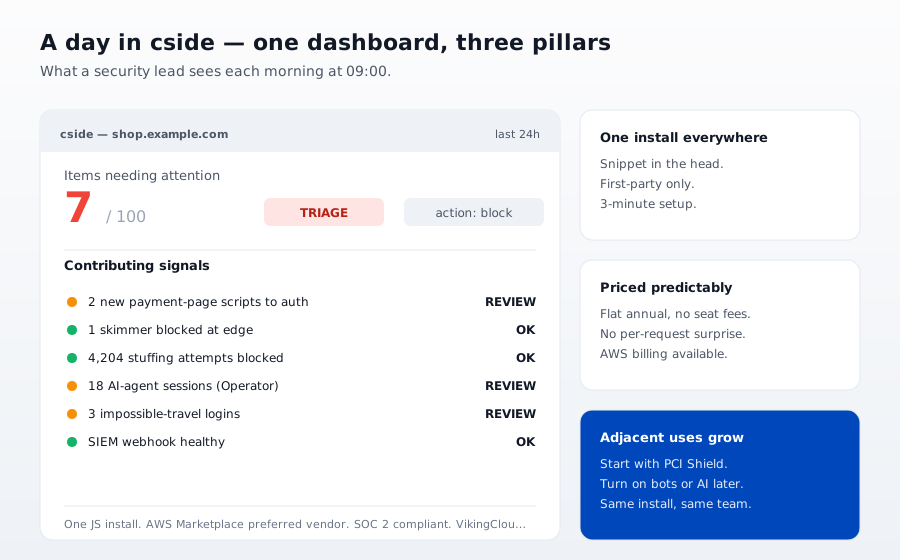
The free tier covers the two PCI DSS 4.0.1 controls (6.4.3 and 11.6.1) with no engineering integration required. Paid tiers add fraud, privacy, and AI-agent detection. Deployment is a single script tag; audit evidence is generated automatically.
- Free PCI Shield: meet 6.4.3 and 11.6.1 with no engineering time.
- Book a demo: 30 minutes with a security engineer to scope your specific use case.
- Read the launch of cside on AWS Marketplace.