AI brought us the Business to Agent (B2A) era. Brands are racing to win over millions of new website "shoppers". Defending against millions of AI website attackers will be left for security teams as an after-thought.
And the technical instruments to deal with this do not exist yet. Traditional bot detection checks "are you a human". Now teams need to check "are you acting on behalf of a human" - and validate if those actions are with good intention (to purchase) or bad intention (scrape content, find vulns., test credit cards).
We're a team of veteran security engineers. After specializing in the client-side space (monitoring what happens in the browser) for years, we're applying a unique detection engine to this "agentic trust" challenge.

$3 trillion+ in new revenue
McKinsey predicts global revenue orchestrated from agentic commerce hit $3 to $5 trillion by 2030.
VISA & Mastercard Accept Agents
In 2025, both VISA and Mastercard launched infrastructure to accept agentic payments.
AI agents are already on your website
Good "consumer" agents need guidance on your website. For example, on a checkout page, how should an agent handle selecting upsells?
Proper optimization leads to more revenue. Poor optimization leads to angry calls to the bank saying "your website tricked my AI agent into buying more than I asked for".
We tested bot detection tools. None of them worked for AI agents.
8/10 times they failed to detect our malicious AI agents. And we were barely trying. In fact we intentionally tried to get caught and still slipped through most times.
This made it clear to us that "bot detection" tools are not ready for:
- → Pirates: Scraping premium content at scale (video streaming, music, art)
- → Payment Fraudsters: Credit card testing, chargeback abuse
- → Hackers: Brute force scanning for vulnerabilities, creating false accounts
Monitor browser-layer signals
to understand agent intent
See every agent on your website. Decide who to trust.
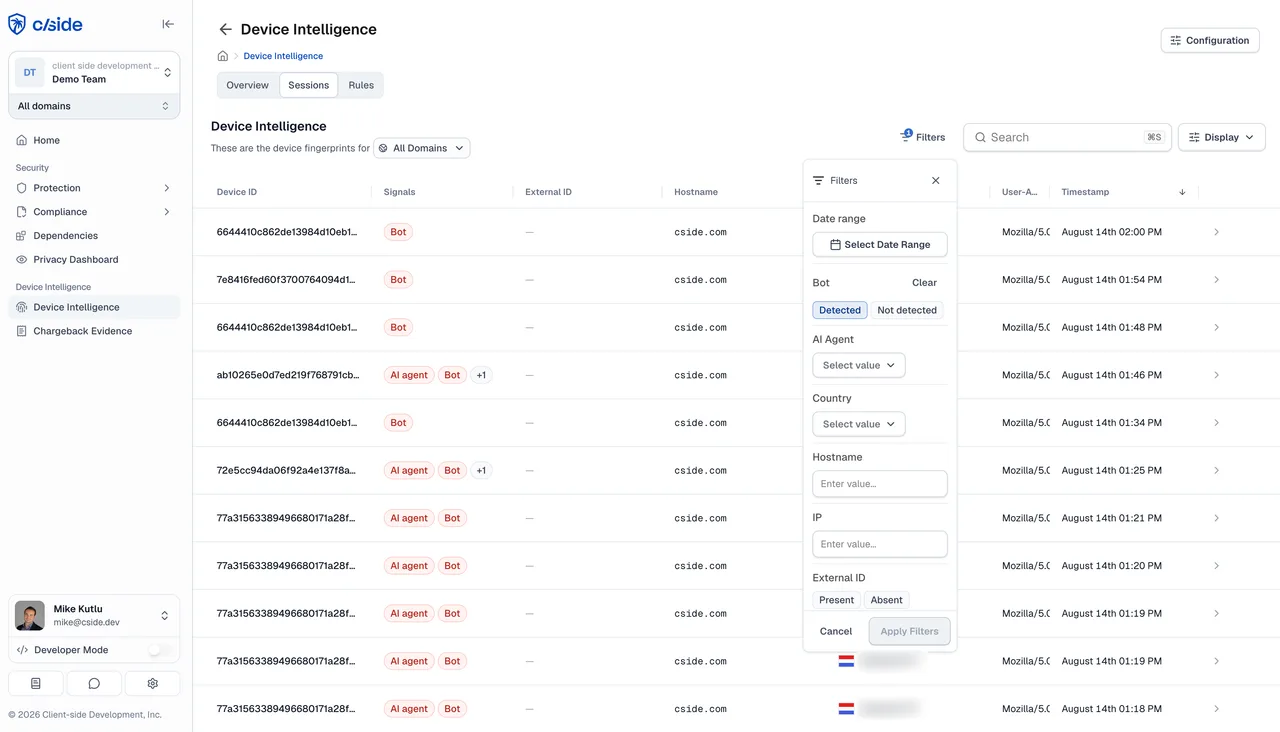
AI agents reveal themselves in the browser, where traditional bot detection tools have weak visibility. cside reads those signals in real time, as the agent acts, so browser-layer (or client-side) monitoring keeps agents within safe boundaries.
With cside:- Deanonymize AI sessions: See agent origin (ChatGPT, Amazon, unknown) and what actions they're performing.
- Monitor browser-layer signals: Spot suspicious VPN/proxy usage, plus in-session behavior, mouse-movement patterns, scroll behavior, typing cadence, and UI interactions, that exposes false-identity agents.
- Stop abusive activity: Block, allow, or guide interactions based on agent trust score and perceived purpose.
Make your website easier for consumer agents to use
Agents interface with APIs and MCPs, but many of them rely on a "browser" to complete tasks. Just like humans, the easier the experience is, the more they come to you.
With cside:- Guide agent behavior: Apply page level logic that tells agents what's allowed (upsells, discounts, account edits, or checkout actions).
- Measure agentic performance: Track which agent interactions drive conversions or failed actions.
- Set escalation rules: Define event triggers pause or redirect agent flows for human approval.
Designed for industries that face AI-driven website fraud
e-commerce
Fraudulent agents simulate real buyers to abuse coupons, test stolen credit cards, and distort analytics.
Streaming & Media
AI agents scrape premium content to feed piracy networks or train other LLM models without permission
Airlines & Transit
Agents automate refund arbitrage and seat-blocking attacks.
Banks & Fintech
Autonomous agents attempt to submit deepfaked KYC info and micro transfer fraud.
Defend against AI agent threats
Content Scraping
Automated agents can scrape content from streaming or art marketplace platforms at scale. Content is republished or used to train LLM models without permission undermining the exclusive content revenue model.
Ticket Scalping
LLM powered bots now reason around CAPTCHAs and queue systems, securing tickets faster than humans. Scalpers resell those tickets at a premium to genuine fans, damaging your consumer trust.
Fake Profile Creation
Synthetic agents generate real identities, creating fake accounts that poison analytics or abuse sign-up rewards. Agents can maintain their identity by responding to messages or interacting with your platform as if they were human.
Card Testing & Payment Fraud
AI agents test thousands of card numbers across domains using reasoning to avoid detection. Spacing requests, rotating proxies, and using human-like timing keeps them hidden from traditional fraud tools.
Enable agentic commerce, safely
Checkout page guardrails
When an AI agent encounters a checkbox or button for an upsell, it needs clear guidance on how to proceed. You can define escalation rules that require human approval, preventing unintended cart changes that customers will dispute.
Boundaries for agent actions
Set governance rules for what actions AI agents can perform. Allow safe actions such as browsing or cart additions, while switching agents into read-only (or no access) mode on sensitive pages.
Gain data to improve agentic experiences
Instead of blocking every bot that isn't Google, identify AI agents with commercial intent. Track where their actions fail and use that insight to improve agentic conversions for new revenue.
Start free, scale when ready
No credit card required. Free plan stays free.
Free
Up to 1,000 API calls/month. Device fingerprint ID, cross-session recognition, and basic intelligence signals.
- Up to 1,000 API calls per month
- Device Fingerprint ID
- Cross session recognition
- Basic intelligence signals
- 7-day data retention
Business
Full browser fingerprinting that holds across sessions, VPNs, and incognito mode. All intelligence signals including AI agent detection and VPN detection.
- All intelligence signals
- AI agent detection
- VPN and proxy detection
- 30-day data retention
- IP enrichment and threat intelligence
Enterprise
For high-volume traffic and organisations that need chargeback fingerprinting, custom data retention, SSO, and dedicated support.
- Chargeback Evidence (CB911)
- Custom data retention
- 99.9% uptime SLA
- SSO and organisation layer
- Dedicated account manager
- Source data fields
Need more? See the full pricing breakdown.
View all plansQuestions, answered
01 How is client-side monitoring for AI agents different than securing APIs or MCPs?
Some agents interact with APIs and MCPs. These are systems where agents access your site through code, sending questions to your server and receiving responses. Many agents will also interact with your website through a "browser" in the same way a human would. This is known as the client-side. The client-side includes visual interface elements along with code interaction. Client-side monitoring from tools like cside look at code execution and behavior in browser sessions, which reveal clues and grant control that API, MCP, and server-level security tools miss.
02 How do I detect AI agents on my website?
Agents reveal themselves through browser layer signals. Often times they show known IPs or signatures from major LLM platforms (ChatGPT, Anthropic, Amazon). Fraudulent agents may try to hide their identity but can be caught by looking at timing patterns, fingerprint mismatches, suspicious network requests, and behavior on your web pages. A common goal is account abuse; see our guide to stopping AI agents from creating fake accounts. The easiest way to identify agents is through an AI bot detection solution like cside; for a wider view, see how the leading bot detection tools compare. This platform shows you a dashboard of known and unknown agents on your site and what they are doing.
03 How do I block AI agents on my website?
If you auto block anything that looks automated, you'll also block legitimate agents. A better approach is to use a tool like cside that can block AI agents based on behavior; for guidance on picking one, see how to evaluate and choose an AI agent detection solution. You can set rules that adapt according to where an agent is coming from, if their identity is known, and a perceived trust score from their behavior. Behavior-based rules matter most against payment fraud; see how AI agents probe payment flows to test stolen cards.
04 Can cside detect AI-generated text submitted by agents?
Yes. Alongside behavioral signals, mouse-movement patterns, scroll behavior, and typing cadence read from your own first-party JavaScript, cside includes an AI-generated-text detection engine. Pass the contents of a form field an agent fills in (a message, a review, a profile bio) and cside returns whether the text was written by a human or generated by AI, giving you another signal to separate trusted agents from abusive ones.
05 Will consumers really use AI agents to make purchases?
Yes. They already are. Tools like Amazon Buy For Me are processing purchases end to end for consumers. Mastercard and VISA both launched infrastructure in 2025 to accept agentic payments. While some consumers might be hesitant to allow agents full buying power, agents are also comparing prices, checking stock availability, doing research, and performing other tasks in the "buying journey".
Didn't find what you were looking for?
Talk to our teamBlock agentic attackers, welcome agentic shoppers
Detect and control agentic traffic in real time. Free plan, no credit card required.