TL;DR: cside vs Akamai Page Integrity Manager
- Page Integrity Manager applies behavioral monitoring to third-party scripts inside Akamai's CDN. Requires an Akamai CDN contract, no public pricing.
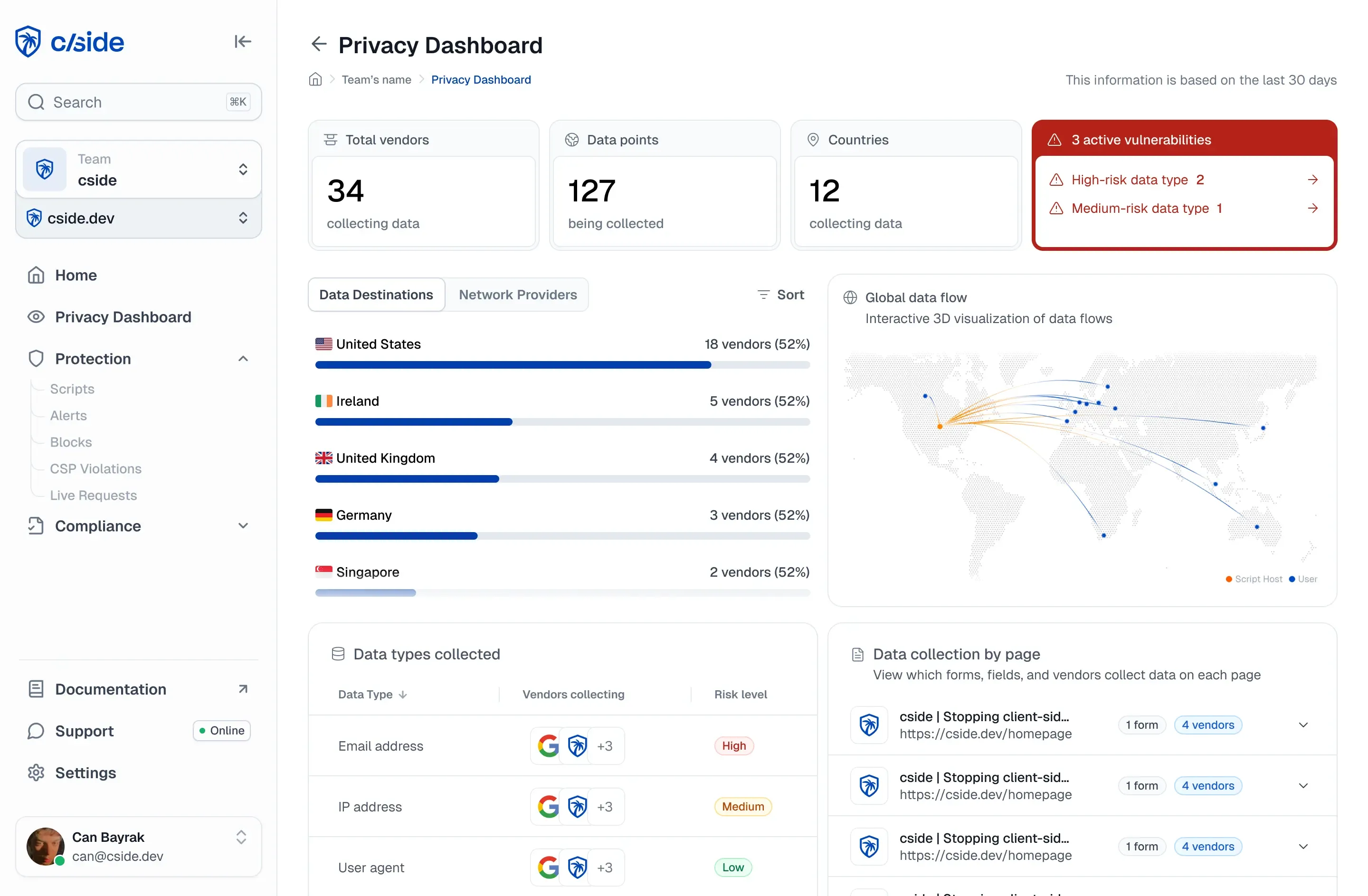
- cside runs on any CDN, in 100% of real user sessions with no sampling, and produces QSA-grade evidence for PCI DSS 4.0.1 requirements 6.4.3 and 11.6.1. Every script is downloaded to cside's own infrastructure for server-side analysis, and the raw attack code is archived. Free tier available.
- Already deep in Akamai and want the native add-on: Akamai. Want CDN-agnostic deployment, full session coverage, and QSA-grade payload evidence without the enterprise minimum: cside.
What is Akamai Page Integrity Manager?
Akamai Page Integrity Manager solely competes with cside's Client-side security solution and PCI Shield. Other services like VPN detection, AI agent detection and Privacy Watch are not in their scope.
Akamai Page Integrity Manager is a client-side security solution that monitors and analyzes JavaScript running in users' browsers to detect malicious activity, like digital skimming, formjacking, and Magecart-style attacks. It focuses on identifying suspicious behavior from third-party scripts and alerting when potentially harmful actions are found.
Is it a good idea to buy a client-side security solution from a firewall vendor?
Large security vendors sometimes have a stab at shipping a quick side product. They do this as they know that their buyers are bought into their platform. The easy choice is to simply buy their solution. However, many users notice quickly that these products did not get the attention they needed and often simply do not work or address the requirements. Browsers as an attack surface are totally different from looking at a network packet as firewall.
How Akamai Page Integrity Manager works
Akamai's Page Integrity Manager is mainly able to list, allow, and block scripts based on previous intel and known issues. They offer great visibility of the script sources, but no insight into the actual payload of a script. This means they can't block scripts in real-time, before needing confirmation after alerting you.
Akamai Page Integrity Manager injects a JavaScript file into the of a website, which runs in the user's browser during live sessions. The script monitors the execution of all other scripts on the page.
Users need to set up a policy management system that allows them to allowlist or block specific scripts or domains. This is combined with a threat feed to check which sources are deemed safe and malicious.
This is a reactive solution. Akamai Page Integrity Manager can not actively block malicious scripts before they execute. Blocking relies on predefined allow/block policies or manual response after detection, meaning new attacks need to be found, understood, and adjusted for so they can be properly detected and blocked next time.
How cside goes further
Akamai's Page Integrity Manager runs JavaScript agents inside the browser. Every attacker who visits your site can see that code, study it, and reverse-engineer the detection logic. cside runs a first-party script in the page too, like any product that observes the session, and ships anti-tamper protection to make those detections harder to manipulate. What an attacker cannot quietly rewrite is the evidence: every behavior cside records is keyed to a content hash of the script that ran, and cside holds its own server-side fetched copy of that script to diff against, so a payload that behaves differently when it is watched still leaves a hash and a version diff.
This isn't theoretical. Attackers routinely inspect in-browser monitoring code and design their payloads to avoid triggering alerts. A large part of cside's analysis does not run in the browser at all: our detection engine downloads each script server-side and analyzes the payload there, against the archived copy.
Akamai detects and alerts after a script has already been delivered. cside enforces blocks at runtime in the browser, alongside CSP, so a script or a specific capability you have not authorized is stopped in the session rather than only reported afterwards. Business plans also include script rollbacks.
Akamai also requires you to be an Akamai CDN customer. cside works with any infrastructure. Add one script, and you're protected. No CDN lock-in, no minimum contract. Pricing starts at $99/month with a 14-day free trial.
For compliance, cside archives each script payload it observes and keeps a per-script revision timeline, covering both PCI DSS 4.0.1 requirements 6.4.3 and 11.6.1. Retention is tiered by plan. Akamai's behavioral alerts don't produce the kind of evidence QSA auditors expect during assessments.
Try cside before you buy. cside has a free plan, so you can sign up, deploy, and explore the platform yourself, with no sales calls or procurement process. And our support team is one message away whenever you need a hand.
Sign up or book a demo to get started.
Akamai PIM alternatives: how cside compares
Akamai Page Integrity Manager (Akamai PIM) is a client-side security add-on that runs a JavaScript agent in the browser and requires an Akamai CDN contract. If you are looking for an Akamai PIM alternative, cside is CDN-agnostic: it works on any infrastructure, runs in 100% of real user sessions with no sampling, downloads every script to its own infrastructure for server-side analysis, and archives the raw payload as QSA-grade evidence for PCI DSS 4.0.1 requirements 6.4.3 and 11.6.1. Pricing starts at $99/month with a free tier, with no CDN lock-in or enterprise minimum. Choose Akamai PIM if you are already committed to Akamai's CDN and want the native add-on; choose cside for CDN-agnostic deployment, full session coverage, and payload-level evidence.
Related resources

Founder and CEO of cside. Previously a product manager on Cloudflare Page Shield (now Cloudflare Client-Side Security). Co-chair of the W3C Anti-Fraud Community Group and a Forbes 30 Under 30 honoree. Building accessible security against client-side attacks, web security is not an enterprise-only problem.