TL;DR: cside vs Feroot
- Feroot runs client-side agents that flag behavioral anomalies after scripts have loaded and executed, and samples a fraction of sessions rather than observing all of them. Feroot's own PageGuard configuration sets samplingRate: 0.1, roughly 10% of real user sessions, so about 90% run unmonitored. It tells you what happened, on the sessions it looked at.
- cside downloads every script to its own infrastructure for server-side analysis, in real time, from 100% of real user sessions with no sampling. That gap matters most on conditional attacks: a payload served only to one geo, one device class, or logged-in users can sit inside the unsampled majority indefinitely. Every payload is archived for forensics and PCI evidence.
- Want a JavaScript-agent behavioral monitor: Feroot. Want more coverage per dollar spent, server-side payload analysis, and forensic-grade QSA evidence: cside.
User Reviews: Feroot vs cside
Here's how real users rated cside and Feroot based on their experience with detection accuracy, support quality, and overall reliability.
| Platform | cside | Feroot |
|---|---|---|
| Google Maps | ★★★★★ (5/5) | ★★☆☆☆ (2.3/5) |
| G2 | ★★★★★ (4.8/5) | ★★★★☆ (4.6/5) |
| SourceForge | ★★★★★ (4.9/5, 37 reviews and ratings shown) | No reviews |
You can see cside reviews on Sourceforge (25 native SourceForge reviews plus 12 additional verified third-party ratings surfaced there, 37 total reviews and ratings) or G2.
"I'm glad we found their product and it's helped us in meeting PCI compliance goals that previously seemed a bit overwhelming. cside's product was exactly what we were looking for at a fraction of the price that other competitors were offering." - Anonymized Review, Sourceforge (Quote from Sourceforge Review of cside)
What is Feroot?
Feroot solely competes with cside's Client-side security solution and PCI Shield. Other services like VPN detection, AI agent detection and Privacy Watch are not in their scope.
Feroot was founded to create a client-side security solution protecting dependencies, similar to cside but founded back in 2017. They combine two approaches to deliver their security claims.
How Feroot works
Feroot's offering is split into two products: “PageGuard” and “Inspector”.
Feroot PageGuard
Their PageGuard page reads:
“PageGuard deploys security permissions and policies to JavaScript-based web applications to continuously protect them from malicious client-side activities, malware, and third-party scripts.”
And:
“PageGuard overwrites certain main and core JavaScript code to protect your web application from client-side cyber threats.”
It’s clear they largely follow the same approach as most of our competitors. They use permissions and a form on an allow-list where you pre-approve which scripts are allowed to run on which pages.
There are a few problems with this approach.
If only the source of the script is checked using an allow-list, it has no clue which code get's served.
PageGuard would not have caught the biggest client-side attack of 2024, the Polyfill attack. Here a domain changed ownership and suddenly the script code changed. If only the source of the script is checked using an allow-list, it has no clue which code gets served. Solely relying on this is not safe.
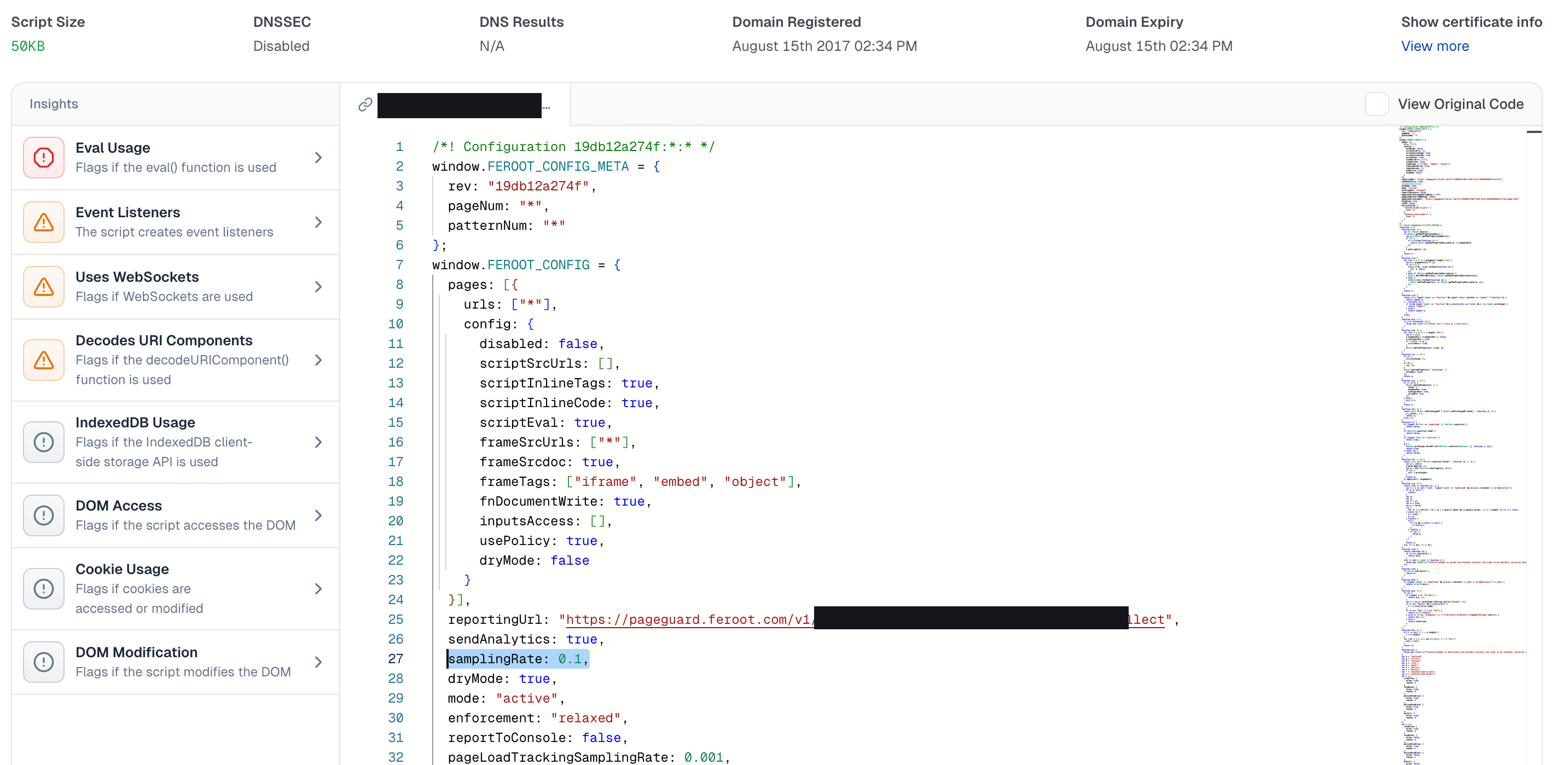
PageGuard only monitors a sample of your traffic. A live Feroot PageGuard configuration we observed sets samplingRate: 0.1, meaning PageGuard reports on roughly 10% of real user sessions and leaves about 90% unmonitored (its pageLoadTrackingSamplingRate is lower still, at 0.001). A client-side attack that fires in an unmonitored session is an undetected attack.
Feroot Inspector
Their "Inspector" deploys synthetic users disguised as honeypot customers, to simulate real user behavior. Inspector’s synthetic users are able to complete real user tasks and are able to identify malicious scripts and unauthorized actions on JavaScript web assets. This is a somewhat similar approach to Reflectiz.
This is effectively a scanner/crawler that does periodic checks on pages. A crawler can easily be avoided by only serving malicious scripts to residential IP adressess. Based on various parameters, like different user agents, different client-side scripts are served.
A crawler on its own can not meet PCI DSS requirements since one of the requirements is implementing 'a mechanism to prevent unauthorized scripts'.
How cside goes further
cside records what each third-party script actually does in the page, across six classes of behaviour: form-field access, permissions, network requests, storage, key event listeners, and DOM manipulation. Every one of those records carries a call-stack trace naming the script URL, its content hash, the line and column, and the vendor, so a finding reads as this script on your checkout page read the CVV field, not as something on this page looked suspicious. cside pairs that with its own server-side fetched, hashed and archived copy of the same script, so what happened in the session can be diffed against the payload we hold.
Our approach lets us spot advanced, highly targeted attacks and alert on them, and cside can also enforce a block at runtime in the browser, alongside CSP, so an unauthorised script or capability is stopped in the session. It also checks the box for multiple compliance frameworks, including PCI DSS 4.0.1, HIPAA, GDPR, CPRA...
We even provide deep forensics, including if an attacker attempts to bypass our detections. We even store data on missed attacks allowing us to make detections better. Giving you the control you need in an easy to use format.
Dealing with the limitations of browsers, we know this is the most secure way to monitor and protect your dependencies across your entire website. We've spent years in the client-side security space before we started cside. We know the limitations on browsers and invest time contributing to standards bodies to natively supported make security capabilities better and more easy to use.
Try cside before you buy. cside has a free plan, so you can sign up, deploy, and explore the platform yourself, with no sales calls or procurement process. And our support team is one message away whenever you need a hand.
Sign up or book a demo to get started.
Feroot alternatives: how cside compares
If you are evaluating Feroot alternatives for client-side security and PCI DSS 4.0.1 requirements 6.4.3 and 11.6.1, cside is the option built around full coverage rather than sampling. Feroot splits into PageGuard, a browser agent that flags behavior after scripts execute and, in a configuration we observed, samples roughly 10% of sessions, and Inspector, a synthetic-user crawler that a skimmer can evade by serving clean code to non-residential IPs. cside downloads every script to its own infrastructure for server-side analysis across 100% of real user sessions with no sampling, and archives the raw payload as forensic and QSA evidence. Choose cside for full session coverage, server-side payload analysis, and forensic-grade evidence.
Feroot competitors
Feroot competes with client-side security and PCI DSS script-monitoring tools including cside, Jscrambler, Akamai Page Integrity Manager, Imperva, and Cloudflare Client-Side Security. Teams most often shortlist cside when they want 100% session coverage instead of sampling, and archived payloads for QSA review rather than behavioral alerts alone. The reviews and approach sections above compare the two head to head.
Related resources

Founder and CEO of cside. Previously a product manager on Cloudflare Page Shield (now Cloudflare Client-Side Security). Co-chair of the W3C Anti-Fraud Community Group and a Forbes 30 Under 30 honoree. Building accessible security against client-side attacks, web security is not an enterprise-only problem.