GDPR Compliance Made Simple with Client-Side Security
Keeping personal user data safe on the client-side. There are clear rules set by GDPR for protecting personal data. Third-party tracking cookies remain a major compliance issue, because even without consent, they can continue to monitor people. Server-side safeguards are not enough. With a lot of things happening in the browser today, client-side visibility and control are important for your business. Cside offers both with an addition of audit-ready reporting.
GDPR in a Nutshell
The General Data Protection Regulation defines people's rights and organization's accountability when collecting and using personal data. Regardless of the country where your organization is based, as long as you process personal data of individuals in the EU/EEA, the GDPR is applicable to you. Its simple goal is to make sure that users can trust that their data is handled securely and respectfully.
Any information that can identify someone such as name, address, photo, email address, IP address, device identifiers, biometrics, health details, payment data, etc. are considered as personal data or Personally Identifiable Information (PII). Third-party cookies count as personal data too because they can tie individuals to their behavior across websites. People can control that data. It can be accessed, corrected, tracked how it's stored and used, and requested for deletion. The GDPR defines that the responsibility to safeguard this sensitive information is on the organizations that handle it. They should collect only what's necessary, be transparent, and implement appropriate security measures. GDPR is not a suggestion. Fines of up to €20 million or 4% of global annual turnover, whichever number is higher, if non-compliance or violations are committed. Misuse of tracking tools such as third-party cookies is where GDPR fines make headlines.
What GDPR means for you
Every organization must be able to demonstrate and prove compliance at any moment. Encryption and access control on the server-side are essential, but not sufficient.
Tracking pixels, marketing tags, analytics, and third-party scripts often collect data in user's browser. That's why client-side visibility and control, backed by monitoring, logging, and reporting are critical.
How cside blocks your client-side GDPR risks
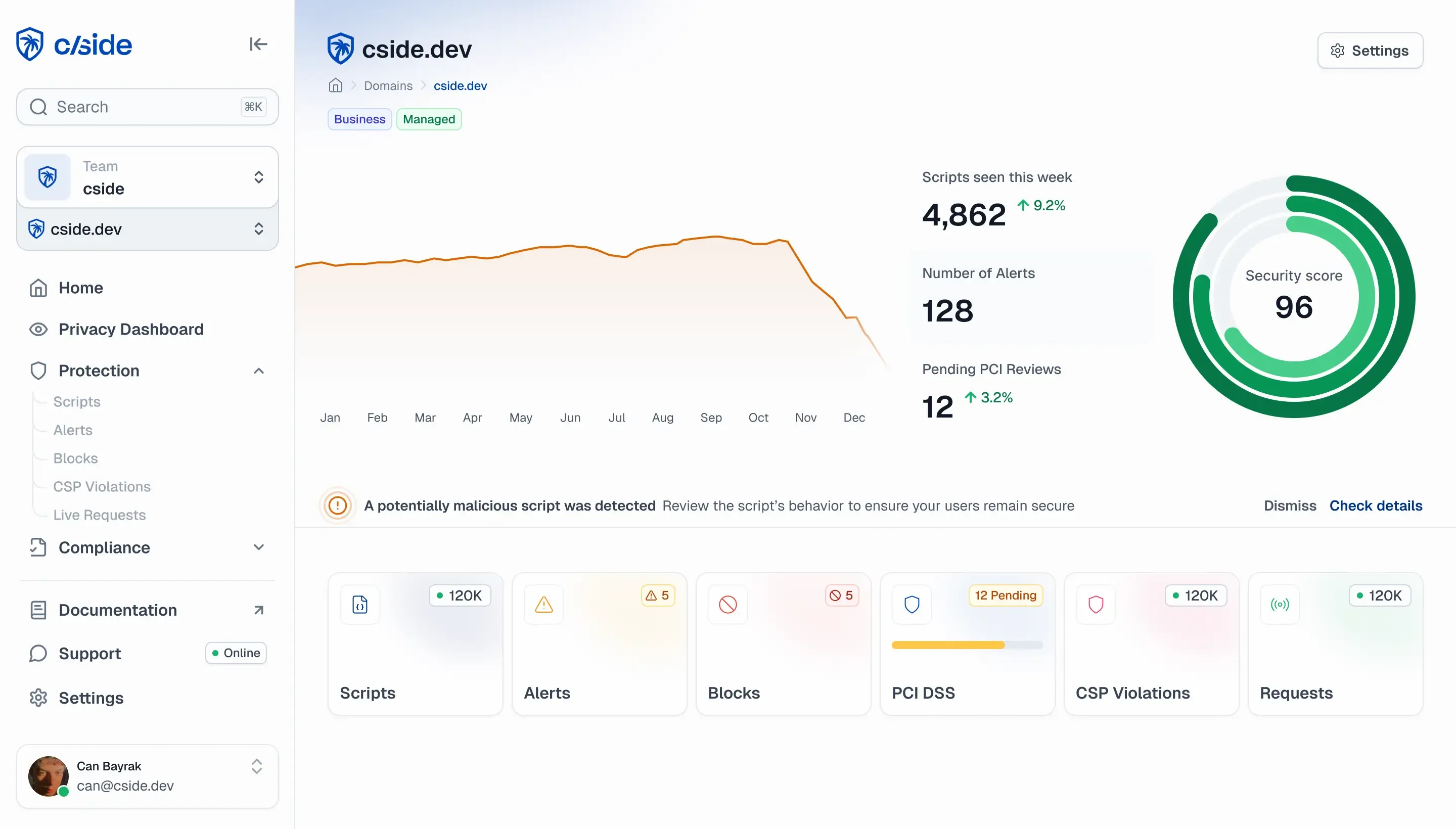
cside streamlines GDPR compliance. You see every scripts, not just the domains, that run in the browser. And on top of that, you monitor the data touched by scripts with instant alerts on violations. You get pre-execution control and forensic proof. You have full control and audit-ready reports for incident investigation or reviews.
Understanding GDPR requirements
Cookie consent enforcement (Art. 7)
Until consent is obtained or granted, scripts must remain blocked. Cside can detect and intercept third-party scripts before execution and block unauthorized data collection.
Data processing transparency and logging (Art. 12-14, 30)
Visibility on which scripts run, what data is accessed, and where it's sent. Keep track of records with audit-ready reports in line with RoPA/DPIA.
Client-side data minimization (Art. 5)
Only adequate, relevant, and necessary data should be collected. With cside, payloads are inspected, and the extraction of cookies and form data to unexpected endpoints is also prevented. We can stop the unnecessary collection of data in real-time.
Cross-border transfer controls (Art. 44-46)
Cside can track data transfers and show you when the data leaves the EEA, and geo-restrict or reroute it to compliant endpoints.
Incident detection and forensics (Art. 33)
Catch extraction attempts in real-time. Review the impact right away with full script version history and request-level logs.
Real World Example
The Scenario
A visitor clicks 'reject all cookies'. Even with that selection, an analytics script will still fire and read the email field at checkout if there's no client-side control in place.
With cside
cside fetches and analyses the script on our side and tracks its actions. The event is recorded, complete with the script version, touched fields, and endpoint.
The Result
Unauthorized data collection or processing is avoided, plus you get a complete audit-ready log for review. These are all in line with the goal of GDPR: building trust with users and auditors.
Leading companies trust cside

















Built for security teams who need visibility inside the browser, cside defends against modern client-side attacks while supporting major compliance frameworks. We are your trusted partner for securing the last mile of the web.
Visit our Trust Center GDPR
GDPR  SOC 2
SOC 2  PCI DSS
 We're one message away
As your partner for web security, we want you to be able to reach us easily. Every customer gets 1:1 access to our team over Slack and Microsoft Teams. We respond in minutes, whether you have a feature request, questions, or ideas.
*This page describes product capabilities and how they may support your compliance program. It is not legal advice. Requirements vary by organization and jurisdiction.