
TL;DR: how to detect credential stuffing
- What it is: Bulk-testing leaked username and password pairs against your login endpoint. It works because roughly 65% of users reuse passwords.
- How to detect it: Attackers throttle to 2-3 attempts per hour per IP from residential proxies specifically to beat rate-limiting. Cross-account correlation is what catches it.
- The decision: Act on session trust score: allow 0-30, step up 31-70 with MFA or magic link, block 71-100. Intervene before login is granted.
Short on time? See cside's account-takeover detection. It covers everything below in one deployment.
What is credential stuffing, and why does it work?
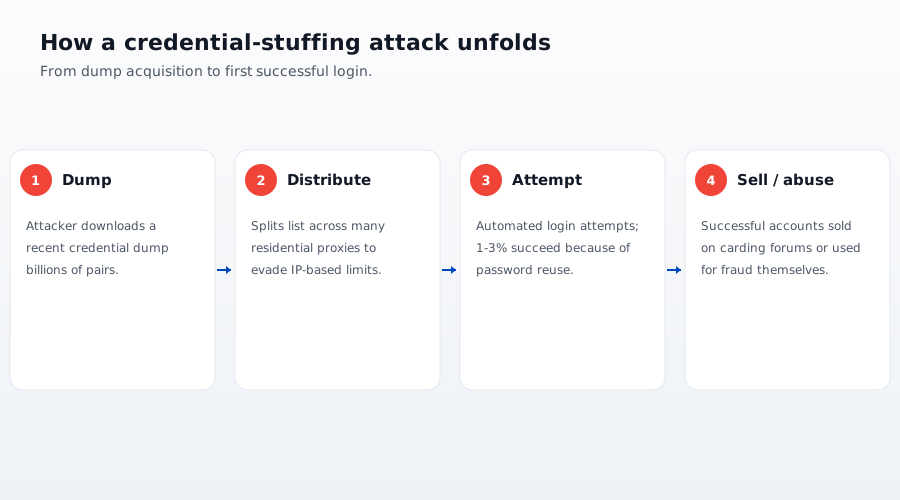
The mechanics are simple. Attackers assemble combolists of leaked username and password pairs, then run them through automated tools against a target's login API. They do not need a high hit rate. Even a fraction of a percent across millions of attempts yields thousands of working accounts.
It works because people reuse passwords. Two out of three Americans reuse passwords across accounts, per security.org, which means a single breach compromises far more than the breached service. That reuse is the entire economic basis of the attack.
Credential stuffing is distinct from brute force, and the difference matters for detection:
- Brute force guesses many passwords against one account. The traffic is noisy and easy to rate-limit.
- Credential stuffing replays known-valid pairs across many accounts. The traffic looks closer to normal logins, with higher success rates and lower per-account volume.
Because the credentials are real and the volume per account is low, stuffing blends into legitimate login traffic. That is why a single threshold rarely catches it.
How do AI-agent bots make credential stuffing worse?
Older stuffing tools were blunt: high request rates from a handful of IPs, default user agents, no real browser. Rate limits and basic bot detection handled most of it. That era is ending.
The new wave runs through stealth browsers and AI agents that behave far more like people. They:
- Rotate device and browser fingerprints across attempts to avoid being grouped together
- Solve CAPTCHAs, including image and behavioral challenges
- Mimic human timing, mouse movement, and navigation patterns
- Distribute traffic across large residential proxy pools to defeat IP-based limits
- Adapt in real-time to how your defenses respond
Stealth browser kits are now part of the standard automation toolkit. Installs of playwright-stealth, one of many stealth-browser kits, rose 10x through 2025 according to cside research. The tooling to run convincing automated logins is cheap and widely available.
Defenses that only inspect network-layer signals miss half the picture. The browser is where the bot operates, and where the clues live.
What login signals reveal credential stuffing?
Detection works best as a combination of signals, not one rule. The OWASP Credential Stuffing Prevention Cheat Sheet recommends layering controls rather than relying on any single check, because attackers tune their behavior to slip past individual thresholds.
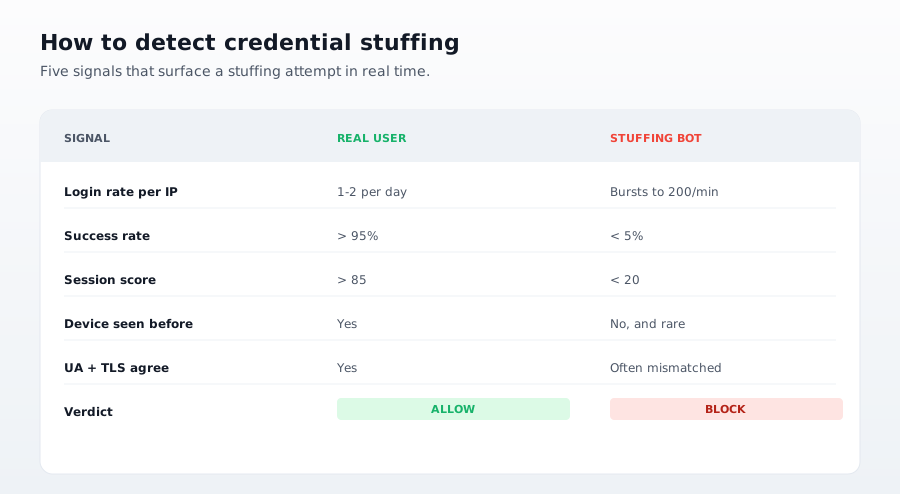
The table below maps the highest-value signals to what they indicate and how to act on them.
| Signal | What it indicates | How to act |
|---|---|---|
| Login burst / velocity spike | Scripted replay of many credential pairs against your endpoint | Rate-limit and throttle per IP, per account, and per fingerprint; step up challenges |
| Headless or stealth-browser fingerprint | Automation posing as a real browser | Block or challenge the session; route to bot and AI-agent detection |
| Many accounts from one device or browser | One actor testing a combolist across accounts | Flag the device and require step-up verification on each attempt |
| Impossible travel | Same account logging in from locations not reachable in the elapsed time | Force re-authentication and review recent account changes |
| Breached-credential match | The submitted pair appears in known breach data | Force a password reset before access; block the credential at reset |
| High failed-then-success ratio | Probing that eventually lands on a valid pair | Quarantine the session and require phishing-resistant MFA |
| VPN, proxy, or known-malicious IP | Traffic routed to obscure origin or reuse a flagged source | Raise the risk score; combine with other signals before blocking |
No single row is proof on its own. The strongest detection appears when several fire together in one session, for example a stealth-browser fingerprint plus a login burst plus a breached-credential match. A real user almost never produces that combination.
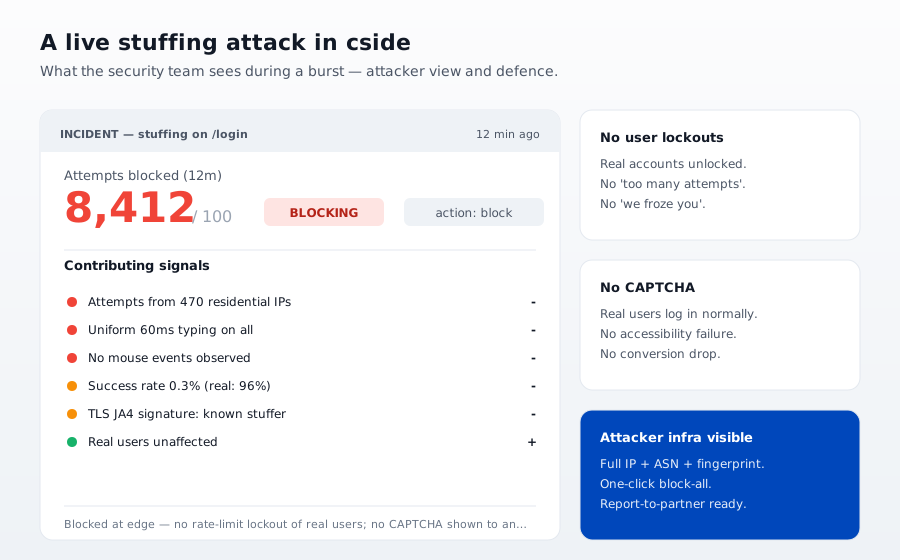
This is also where browser-layer visibility matters. Login bursts and IP reputation show up server-side, but stealth browsers, fingerprint rotation, and AI-agent behavior only surface when you can read what the browser is actually doing.
How do you stop credential stuffing?
Detection tells you an attack is underway. Stopping it takes layered controls so that a bypass of one does not hand over the account. Work through these in order:
- Enforce phishing-resistant MFA on high-value logins. Passkeys and hardware security keys are phishing-resistant and defeat replayed credentials outright, because a valid password alone is not enough. OWASP names MFA a primary defense against credential stuffing. SMS and email one-time codes are weaker, so reserve the strongest methods for sensitive flows.
- Block known-breached passwords. Check passwords against breach databases at sign-up and at reset, and reject matches. If a current credential later appears in a breach, force a reset before an attacker can use it.
- Rate-limit and throttle login endpoints. Apply limits per IP, per account, and per device fingerprint, not just per IP, since attackers distribute across proxy pools. Add progressive delays and challenges as risk rises.
- Add fingerprinting plus bot and AI-agent detection. Use browser and device fingerprinting to identify automation, stealth browsers, and the AI agents that rotate fingerprints and solve CAPTCHAs. Filter that traffic before it reaches authentication.
- Respond fast when a session looks compromised. Revoke active sessions, invalidate tokens, and force re-authentication. Review account changes made after the suspicious login, such as updated email, phone, or payout details.
MFA is foundational, and it is not sufficient on its own. Attackers can still abuse stolen sessions, adversary-in-the-middle phishing proxies, and weak recovery flows. Pairing MFA with browser- and device-level signals closes those gaps. The same layered approach underpins broader account takeover defense, since credential stuffing is the most common path into ATO.
Where does the browser layer fit?
Real users, fraudulent users, and bots all reach your login through a browser. That makes the browser both a delivery channel for malicious code and a rich source of signals about who is really logging in.
Two browser-layer realities shape credential-stuffing defense:
- The browser exposes automation that the network hides. Stealth browsers, headless runtimes, fingerprint rotation, and AI-agent behavior are visible in the browser environment, not in a network packet. Reading those signals separates scripted logins from human ones.
- The browser can be the attack surface itself. A compromised or injected third-party script on your login page can skim credentials before your server ever sees the request, or redirect users to a spoofed login. Client-side security monitoring catches script tampering that network controls miss.
cside is a client-side security platform built for the browser layer. It combines AI-agent detection with device and browser fingerprinting to surface the signals in the table above, then delivers them as raw signals via API so developer-led teams can plug them into their own login and recovery risk logic. Because the analysis is grounded in the browser, it catches stealth browsers and AI-agent bots that legacy, network-only tooling does not see.
What should teams do first?
You do not need to deploy every control at once. A practical sequence:
- Turn on breached-password blocking at sign-up and reset. It is low-effort and removes a large share of usable credentials.
- Enforce phishing-resistant MFA on your highest-value logins before rolling it wider.
- Instrument your login with the detection signals above, then tune thresholds on combinations rather than single rules.
- Add browser-layer fingerprinting and AI-agent detection so you can see the automation that network signals miss.
Credential stuffing succeeds on password reuse and cheap automation. Counter the first with MFA and breached-password checks, and the second with rate limiting and browser-layer detection.
To see the browser-layer signals in action, book a demo or review cside pricing.