
TL;DR: iGaming browser-layer prevention against named AI assistants and VIP wallet ATO
- The gap: Traditional bot management cannot stop OpenAI Operator or Claude for Chrome on your registration page. AI agents run inside real browser engines with legitimate TLS fingerprints and human-plausible cadence, so the distinguishing signals never reach the HTTP request.
- What cside sees: cside analyzes more than 250 browser signals per session and names AI agents including OpenAI Operator, Claude for Chrome, Playwright, Puppeteer, and Selenium client-side before the registration hits your server. It also correlates multi-accounting with high accuracy across incognito, VPN, and cookie clearing.
- The decision: If VIP wallet balances are your loss centre, use cside device-ID-change detection at login with TLS handshake fingerprinting to require step-up before login completes. If deposit-page skimming is the exposure, deploy PCI Shield for VikingCloud-validated 6.4.3 and 11.6.1 monitoring.
Short on time? See cside's account-takeover detection. It covers everything below in one deployment.
iGaming fraud prevention has to cover three threats that standard e-commerce fraud tools were never built for: AI agent promo abuse, account takeover on player accounts, and PCI DSS 4.0.1 compliance on deposit pages. All three operate at the browser layer, where server-side tools, WAFs, and network-layer bot management see them too late or not at all. iGaming draws a heavier concentration of these attacks than any other vertical because the payoff is immediately liquid: bonuses, cashback, free spins, and player balances all convert straight to cash.
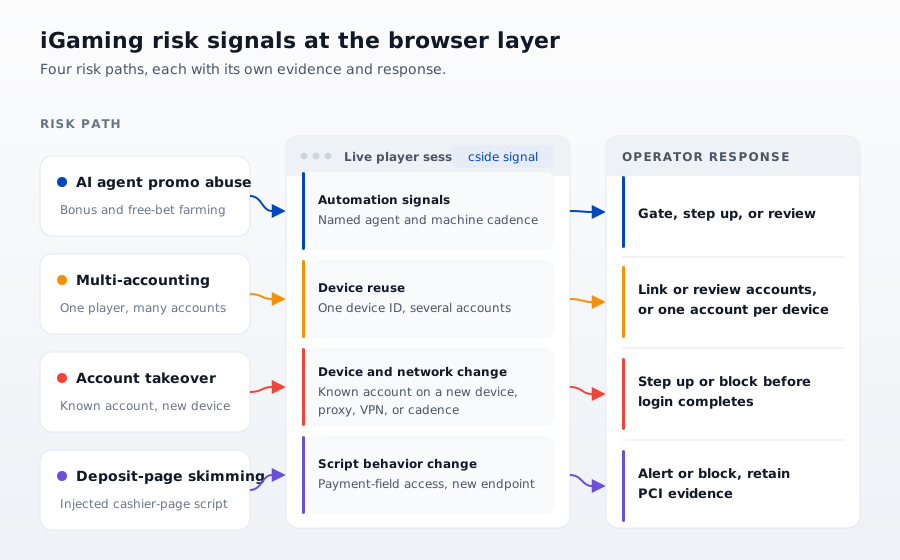
| Risk | Browser-layer evidence | Response |
|---|---|---|
| AI agent promo abuse | Named-agent or automation signals inside a real browser | Gate the bonus, require step-up verification, or send the account to review |
| Multi-accounting | One device ID appears across several accounts despite incognito mode, VPN use, or cookie clearing | Link and review the accounts or enforce one account per device |
| Account takeover | A known account appears on a new device with proxy, VPN, or automated cadence signals | Require step-up verification or block the session before login completes |
| Deposit-page skimming | A new or approved script changes behavior, reads payment fields, or sends data to a new endpoint | Alert or block and preserve the evidence needed for PCI review |
AI agent promo abuse: the attack server-side tools miss
AI agents can complete every step of a bonus claim with no human involved. An agent driving OpenAI Operator or Playwright can open a registration page, fill in player details, verify an email address, pass lightweight KYC steps, claim a welcome bonus, and start a withdrawal, all inside a session that looks, at the network level, like an ordinary new player.
Traditional bot management misses this because of architecture. AI agents run inside real browser engines. They produce legitimate TLS fingerprints, move through pages at plausible speeds, and interact with form elements in ways that pass JavaScript challenge detection. The distinguishing signals live in the browser environment: fingerprint entropy, session cadence patterns, WebGL rendering characteristics, and the absence of expected human micro-interactions. None of them appear in the HTTP request.
cside detects named AI agent sessions including OpenAI Operator, Claude for Chrome, Playwright, Puppeteer, and Selenium. Detection happens client-side, before the registration request reaches your server. The platform analyzes more than 250 browser signals per session and returns a real-time verdict that flags AI-agent and automated sessions, which your platform can use to gate the bonus claim, require additional verification, or silently flag the account for review.
iGaming operators that have leaned on email verification or phone OTP as their fraud gate are finding those controls insufficient against agents that can automate the entire verification workflow. Browser-layer fingerprinting is the control that operates earlier in the chain.
Multi-accounting and ATO on player accounts
Multi-accounting and account takeover are the two most financially damaging fraud vectors on iGaming platforms, because both exploit real player accounts with real balances rather than creating new synthetic identities.
Multi-accounting
Multi-accounting is a single attacker creating multiple player accounts to abuse per-account bonuses, exploit referral schemes, or launder winnings across accounts. It is one of the oldest iGaming fraud vectors and remains one of the most costly.
The detection mechanism is device fingerprint correlation. If the same device creates five player accounts with five different email addresses, a browser-layer fingerprinting tool recognizes the device even when the attacker uses incognito mode, clears cookies between registrations, or routes through a VPN. cside recognizes the returning device with high accuracy across these evasion methods.
Per-session verdicts mean your fraud team can flag every account linked to a device ID for manual review, or your platform can enforce a one-account-per-device rule in real time at the point of registration. For the full mechanics, see multi-accounting detection.
Account takeover on player accounts
Account takeover on iGaming accounts is especially damaging because high-value player accounts (VIP tiers, large balances, accumulated loyalty points) are attractive targets. Attackers pull credentials from breach databases, run credential stuffing across thousands of IP addresses, and log into accounts where the email and password combination was reused.
The most costly variant is ATO followed by immediate account mutation: changing the registered email address, adding a new payment method, and starting a withdrawal before the legitimate player notices. VIP accounts are singled out because their withdrawal limits are higher and the account history makes the activity look plausible.
cside detects ATO at the browser layer by identifying device ID changes at login (a known device replaced by an unknown one), VPN and proxy connections via TLS handshake fingerprint TLS fingerprinting, and session cadence anomalies consistent with automated credential testing. The verdict is returned before the login completes, so your platform can require step-up authentication or block the session.
The Verizon Data Breach Investigations Report 2026 found that stolen credentials appear in 39% of all data breaches. The credential database that fuels ATO on your platform is almost certainly already in circulation. Javelin Strategy & Research put US account takeover losses at $13.5 billion in 2025, an 18% increase year on year. iGaming accounts, with their directly withdrawable balances and high-value VIP tiers, sit at the higher-risk end of that total. See how account takeover prevention works.
PCI DSS 4.0.1 on deposit pages
PCI DSS 4.0.1, mandatory since April 2025, introduced two requirements that any iGaming operator with real-money deposit pages has to address.
Requirement 6.4.3 requires that every script running on a payment page is authorized, has a documented justification, and has its integrity verified. Operators must maintain an inventory of all scripts on payment pages and confirm they have not been tampered with.
Requirement 11.6.1 requires a change-and-tamper detection mechanism that alerts personnel to unauthorized modifications of HTTP headers and page content on payment pages.
Both requirements exist because client-side skimming attacks, where a malicious script injected into a payment page silently exfiltrates card data, are a persistent and growing threat. The PCI SSC introduced them specifically to address Magecart-style attacks.
cside is VikingCloud PCI DSS 4.0.1 validated for Requirements 6.4.3 and 11.6.1. The platform provides continuous script inventory and monitoring on payment pages, with real-time alerting on script changes and tamper events. See PCI DSS compliance and client-side script monitoring for detail.
Why iGaming is the highest-risk vertical
iGaming platforms face a heavier concentration of browser-layer fraud than e-commerce, fintech, or SaaS. The reason is incentive density. In most verticals, a fraudulent account still has to be monetized through a secondary step: reselling access, committing payment fraud, or extracting data. In iGaming, every fraud vector is directly liquid. Welcome bonuses pay out as withdrawable cash, free spins convert to balance, and VIP account balances can be withdrawn immediately after an ATO.
That creates a return-on-effort profile that attracts sophisticated, automated attacks. Attackers invest in AI agents and residential proxy networks because the per-account return justifies the infrastructure cost. Operators that catch these attacks early pay far less in chargebacks, bonus liability, and player-trust damage than those that only find fraud after the payouts have cleared.