TL;DR: cside vs DataStealth
- DataStealth does real-time tokenization to reduce PCI scope, primarily in Canada. It stops cardholder data reaching your infrastructure.
- cside covers what happens after tokenization: what third-party scripts do on the page. Tokenization does not stop a malicious script reading a card number from the form field before it is tokenized. cside runs in 100% of sessions with no sampling, downloads every script for server-side analysis, and archives payloads for 6.4.3 and 11.6.1.
- Complementary, not competing. DataStealth reduces scope. cside monitors what still executes inside the scope that remains.
What is DataStealth?
DataStealth, from Datex Inc. (Mississauga, Ontario), is a network-layer data-security platform offering eSkimming protection, tokenization, encryption, and data masking with no code changes, SDKs, or integrations. eSkimming and PCI DSS 6.4.3 / 11.6.1 script protection is one module on a tokenization-first platform. It sells enterprise-direct into banks, insurers, hospitals, retailers, and payment processors, and is a PCI DSS Level 1 Service Provider and a member of the PCI SSC Board of Advisors, credentials worth taking seriously.
How DataStealth works
DataStealth operates transparently at the network layer via inline / protocol-layer insertion. It intercepts and inspects data flows and validates scripts and security headers before code reaches consumer browsers, with no agents and no browser-side JavaScript. The same platform also tokenizes payment data, applies dynamic masking and encryption, and runs data discovery and classification. Customers describe deployment as setting up routing rules, and report that it's a smooth process.
Because DataStealth validates the served response in the delivery path rather than running inside the browser, the useful question to put to them is how the platform handles attacks that only manifest for real users: conditional skimmers gated by geography, time, or victim profile, and tampering that happens after the page renders. That's the scenario client-side monitoring is purpose-built to see.
How cside goes further
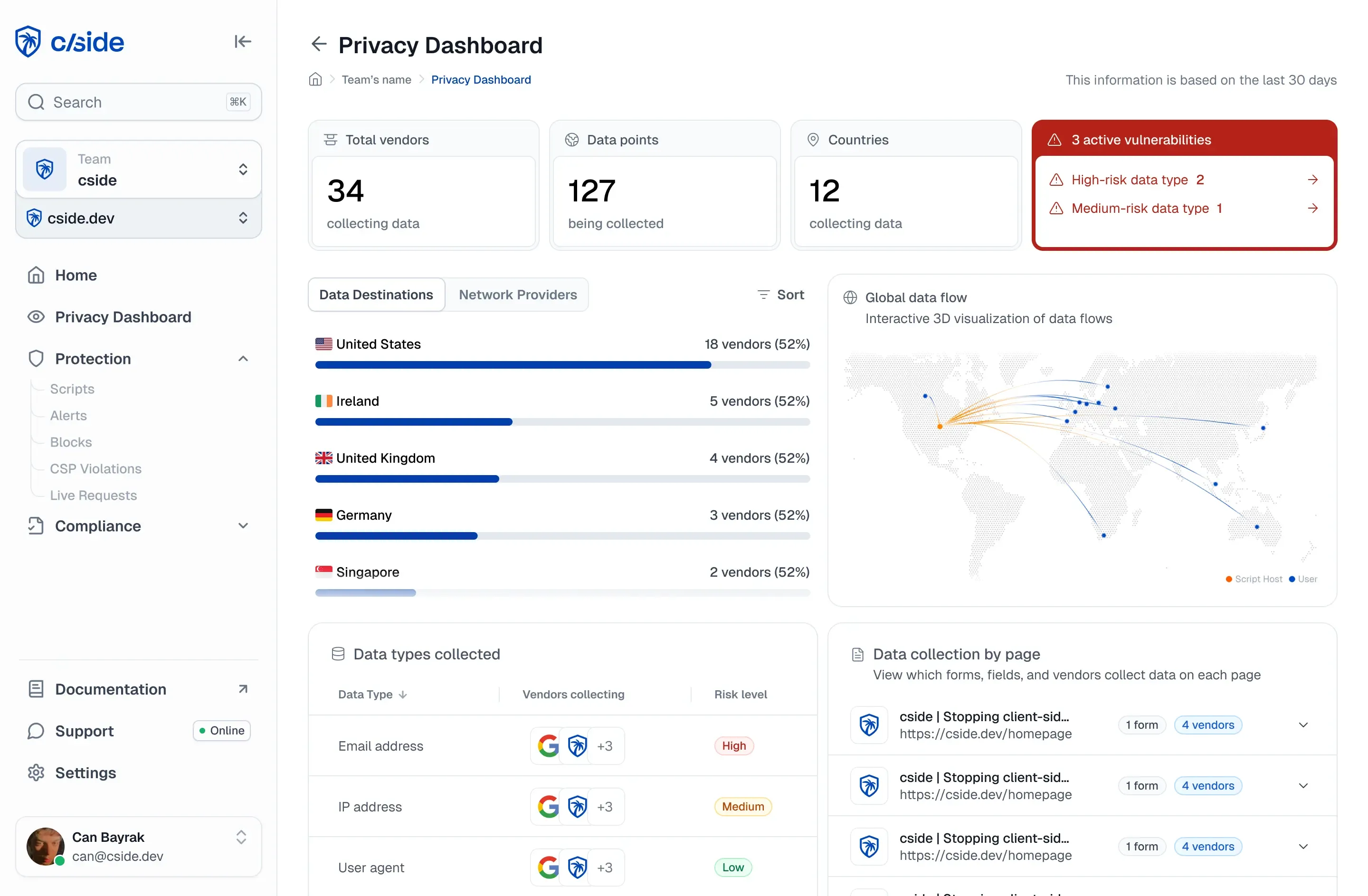
cside watches what third-party scripts actually do inside each real visitor's browser, in the rendered DOM, the exact place a skimmer has to run to steal data. That per-visitor vantage point is built for conditional, evasive attacks that show clean code to crawlers and network-path checks but fire for targeted shoppers.
cside also publishes the attacks it catches and keeps immutable archives of every script payload, so detection is something you can see and prove, not an absolute you have to take on faith. And cside adds a dedicated fingerprinting product (device fingerprinting, bot and AI agent detection), transparent self-serve pricing with a free tier, a public status page at status.cside.com, and a QSA-validated PCI dashboard.
If your core need is client-side script security with evidence you can hand an auditor, that focus is the difference.
Try cside before you buy. cside has a free plan, so you can sign up, deploy, and explore the platform yourself, with no sales calls or procurement process. And our support team is one message away whenever you need a hand.
Sign up or book a demo to get started.
Related resources

Founder and CEO of cside. Previously a product manager on Cloudflare Page Shield (now Cloudflare Client-Side Security). Co-chair of the W3C Anti-Fraud Community Group and a Forbes 30 Under 30 honoree. Building accessible security against client-side attacks, web security is not an enterprise-only problem.