Back to comparisons

otto-js vs cside

otto-js (formerly DEVCON) and cside are both client-side security tools built around PCI DSS 4.0.1 requirements 6.4.3 and 11.6.1. This is an honest look at how the two compare on approach, evidence, and independent validation.

Jun 19, 2026 Updated Jun 19, 2026
Simon Wijckmans
Simon Wijckmans Founder & CEO
otto-js vs cside

This article takes an honest look at the features of otto-js (formerly DEVCON).

Since you're on the cside website, we acknowledge our bias. That said, we've built our case honestly and based our analysis on publicly available information, industry information, and our own or our customers' experiences.

If you want to verify their claims yourself, please go to their product page.

otto-js is one of the closest products to cside on the market: a client-side JavaScript security tool built around PCI DSS 4.0.1 requirements 6.4.3 and 11.6.1, with a one-line integration and transparent, low pricing aimed at SMB and mid-market e-commerce. We think it's a legitimate tool. This page is about where the two products differ once you look past the compliance checkbox.

Criteria cside otto-js Why It Matters What the Consequences Are
Approach Client-side monitoring + AI-driven payload analysis Client-side JavaScript agent Both run in the browser; the difference is depth of analysis
PCI DSS 6.4.3 & 11.6.1 Both products are built to meet the requirement Compliance is the floor, not the differentiator
AI-driven script analysis Detects novel or evolving threats by analysing script content, not just listing it Reliance on manual review and rules = slower, error-prone detection
Device fingerprinting + bot / AI agent detection One vendor for client-side security and visitor identity A separate vendor is needed for fraud and agent traffic
Forensic payload archive & historical tracking Not documented Needed for incident response, auditing, and proving what an attack did Without a payload record you have alerts, not evidence
Independent peer reviews (G2 / Gartner / Capterra) Sparse public reviews Enterprise procurement checks third-party validation A thin review profile is a question mark in security reviews
QSA-validated PCI dashboard Not found An independent QSA audit is the most reliable proof a tool is PCI compliant Without it you rely on marketing claims, which could result in failing an audit
Public status page & uptime SLA Not found You can independently verify reliability and incident history before you buy No independent view of availability
Transparent public pricing Both vendors publish pricing — a genuine strength of otto-js Predictable cost before procurement
Yes / Full support Partial / Limited No

What is otto-js?

otto-js, formerly DEVCON, is a client-side JavaScript security platform focused on PCI DSS v4 compliance and malvertising protection. It monitors first-, third-, and Nth-party script behaviour at runtime and markets a one-line integration to automate PCI DSS 6.4.3 and 11.6.1 evidence, alongside SOC 2 and third-party-risk reporting. It targets SMB and mid-market e-commerce teams that need a fast, affordable PCI solution without a dedicated application-security team, and it integrates with GitHub Advanced Security and common e-commerce platforms.

Credit where it's due: otto-js publishes its pricing openly (starting around $30/month), which is rare in this space, and it is genuinely a like-for-like client-side tool rather than a checkbox feature bolted onto a larger platform. We don't think price is the right axis to compete on here.

How otto-js works

otto-js deploys a client-side JavaScript agent that observes and analyses scripts as they load and execute in the visitor's browser, surfaces them in a dashboard for review, and offers features marketed as real-time mitigation. It generates Content Security Policy and access-control configurations and integrates runtime vulnerability scanning through GitHub Advanced Security.

The honest open question, and the one we'd encourage any buyer to put to both vendors, is about depth and coverage: how complete is each tool's view of what a script actually does across real user sessions, and what can it show you afterwards? That is the question that separates a compliance dashboard from a security tool.

How cside goes further

otto-js is built to satisfy PCI DSS 6.4.3 and 11.6.1. cside is built to stop client-side attacks, with compliance as a by-product of real security.

cside monitors every script executing in the real browser and performs AI-driven analysis on the script's actual content, not just a list of which scripts are present. That catches novel and evolving threats, including targeted attacks that only activate under specific conditions such as certain geographies, time windows, or device types.

For forensics, cside keeps immutable archives of every script payload with full version history. When an auditor or an incident-response team asks what happened, you have the actual code and a complete timeline, not a behavioural change log.

cside also goes beyond client-side script security with a dedicated fingerprinting product: device fingerprinting, bot detection, and AI agent detection, so you can cover both client-side security and visitor identity from one vendor. And cside publishes a public status page at status.cside.com, a public trust portal at trust.cside.com, and a QSA-validated PCI dashboard, so you can verify our claims for yourself.

Sign up or book a demo to get started.

Simon Wijckmans
Founder & CEO Simon Wijckmans

Founder and CEO of cside. Previously a product manager on Cloudflare Page Shield (now Cloudflare Client-Side Security). Co-chair of the W3C Anti-Fraud Community Group and a Forbes 30 Under 30 honoree. Building accessible security against client-side attacks — web security is not an enterprise-only problem.
Developer Experience

Public Developer Documentation

cside is the only client-side security solution with publicly accessible developer documentation. You can explore our complete technical docs, API references, and integration guides without requiring a sales call or demo.

cside provides full public documentation at docs.cside.com

otto-js does not offer publicly accessible developer documentation. You'll need to contact their sales team or request a demo just to understand how their product works.

FAQ

Frequently Asked Questions

They are close. Both run as a client-side script that monitors first-, third-, and Nth-party JavaScript in the browser, and both are built to satisfy PCI DSS 4.0.1 requirements 6.4.3 and 11.6.1. The differences are in what each tool does beyond the compliance checkbox: cside adds AI-driven payload analysis, device fingerprinting with bot and AI-agent detection, and immutable forensic archives. otto-js is a focused, transparently priced client-side compliance tool aimed at SMB and mid-market e-commerce.

Both products are designed to meet requirements 6.4.3 and 11.6.1, so passing the audit is the floor for either. The more useful question for a security team is what you can see and prove when a third-party script is compromised: cside keeps a full forensic record of what each script did in real user sessions and provides a QSA-validated PCI dashboard, where otto-js's publicly documented capability centers on dashboard review and alerting.

As of June 2026, otto-js has roughly one public review on G2 and no presence on Gartner Peer Insights, Capterra, or TrustRadius, and its GitHub Marketplace app shows a small install base. cside publishes its own third-party validation and a public Trust Center. For an enterprise procurement team, independent peer evidence is part of the evaluation, so it is worth checking the current review counts for both vendors yourself.

Based on otto-js's public materials, no. otto-js is focused on client-side script monitoring for PCI and malvertising. cside ships a separate fingerprinting product that includes device fingerprinting, bot detection, and AI agent detection alongside its script-monitoring product, so you can cover both client-side security and visitor identity from one vendor.

Monitor and Secure Your Third-Party Scripts

Gain full visibility and control over every script delivered to your users to enhance site security and performance.

Start free, or try Business with a 14-day trial.

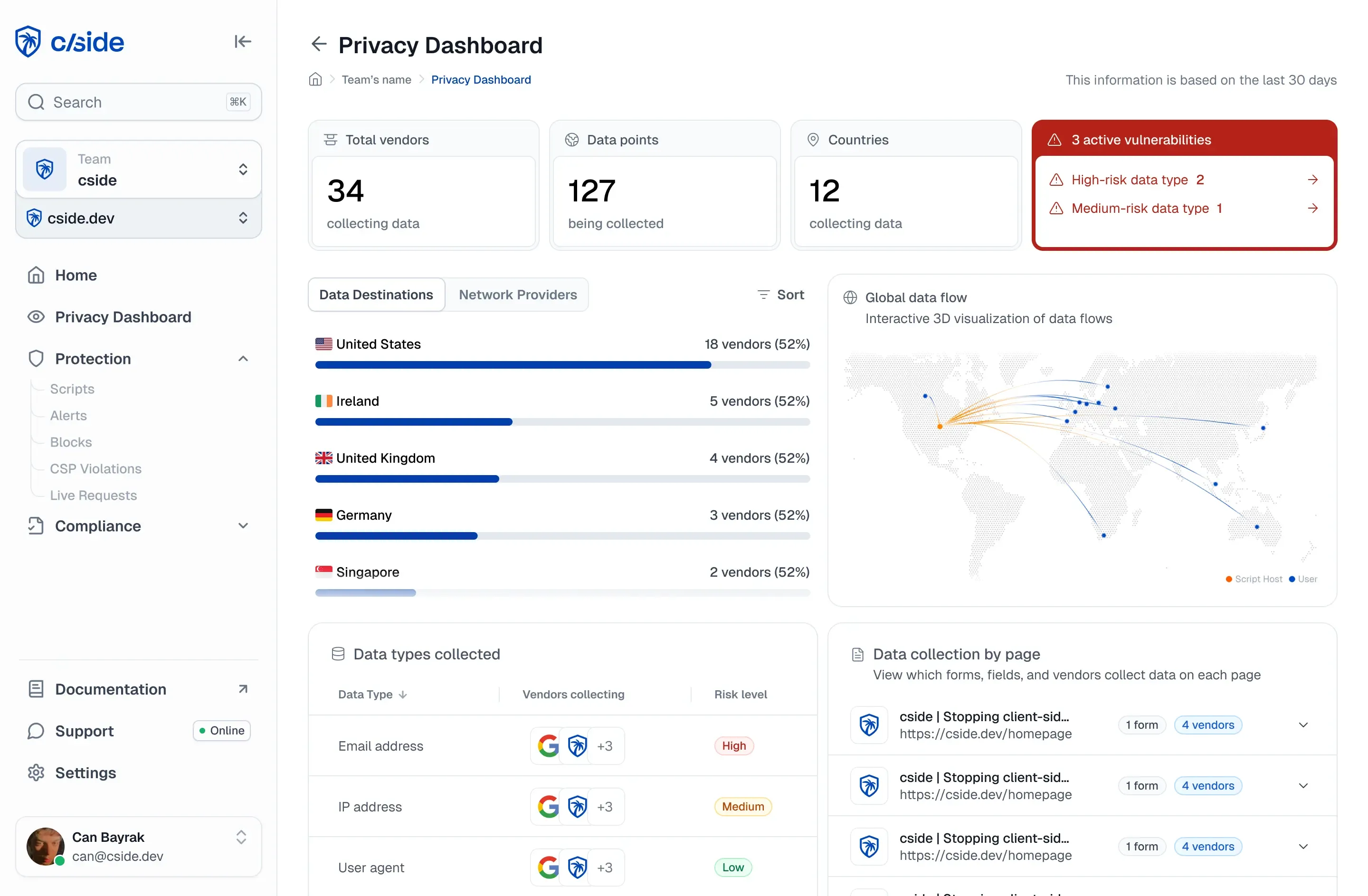
cside dashboard interface showing script monitoring and security analytics
YOUR SOLUTION

How we shape up to competitors in detail

Book a demo