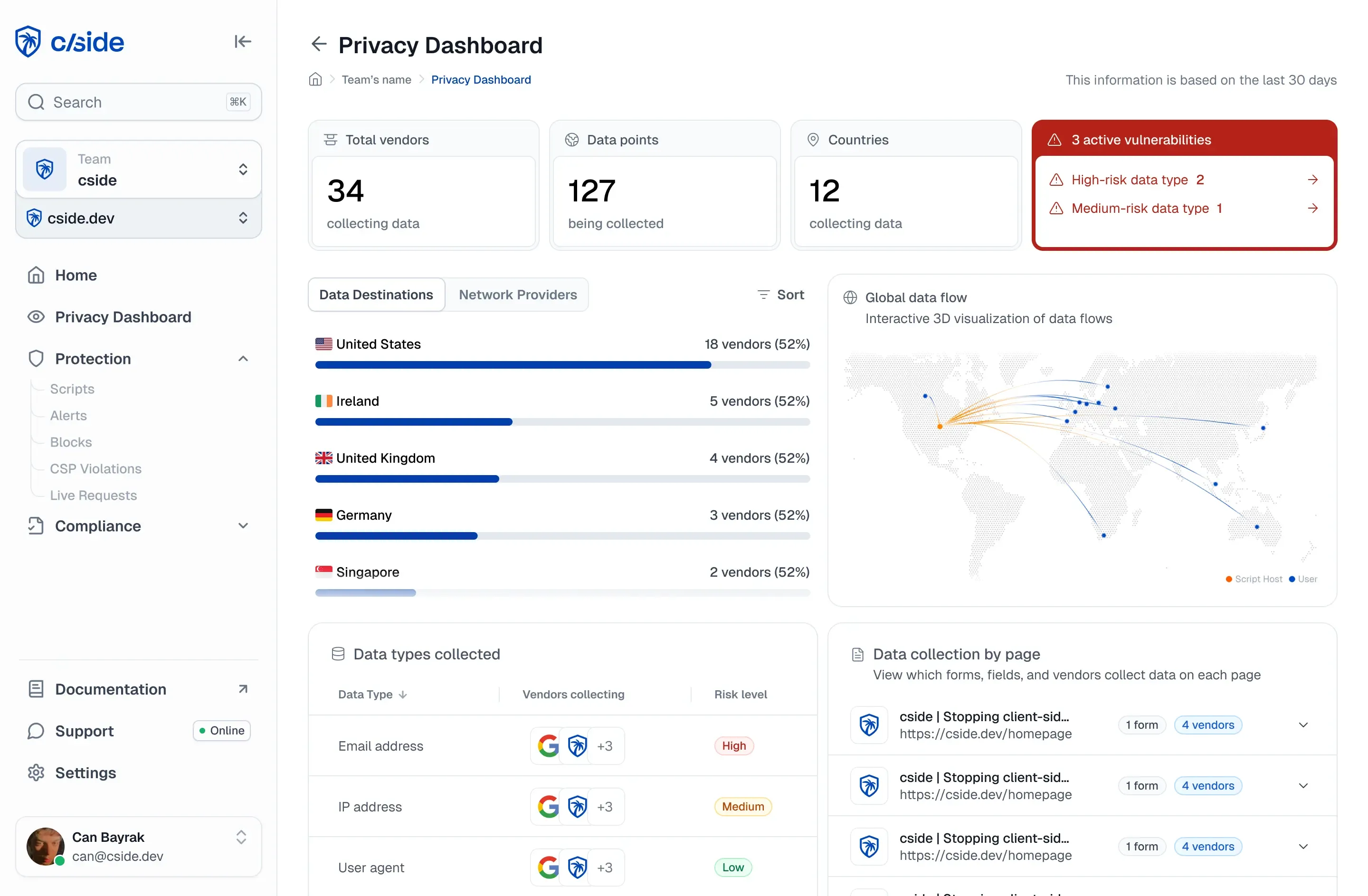

TL;DR: device fingerprinting software
- What you are actually buying: Every vendor reads broadly the same browser and device attributes. The difference is how stable the resulting identifier stays under adversarial conditions, incognito, a cleared cookie jar, a VPN, or an anti-detect browser.
- An ID is not a decision: Most tools hand back a visitor ID and leave the risk logic to you. cside collects 250+ signals per session, hashes 40+ of them into the device ID, and returns a fraud verdict alongside it from the same first-party script.
- The shortlist: Nine options ranked, cside first, then Fingerprint, SEON, IPQualityScore, TransUnion TruValidate, SHIELD, Sardine, Incognia and the open-source ThumbmarkJS.
Short on time? See cside device intelligence. It covers everything below in one deployment.
If you are comparing the best device fingerprinting software for 2026, the shortlist is not really about who can generate a device ID. Most of these tools can. The real question is what arrives with the ID: is this visitor a human, an AI agent, or a bot? Is the connection hidden behind a VPN or proxy? Can you use the signal to win a chargeback or pass a PCI DSS audit? This guide ranks nine device fingerprinting tools for 2026, with cside first, and it is honest about when a cheaper library or a broader fraud suite is the better call.
Two distinctions sort the market before you read a single review. First, some tools are pure identification (a raw device ID you feed into your own rules), and some return a verdict you can act on the moment it arrives. Second, some are first-party (the collector loads from your own origin) and some ship a third-party collector that privacy filter lists can block. Both distinctions decide how much signal you actually keep. For the fundamentals behind all of this, see what is device fingerprinting.
What device fingerprinting software actually does
Device fingerprinting software reads browser, hardware, and network properties during a live session and combines them into a stable identifier. Because that identifier comes from the device itself rather than a stored cookie, it keeps working when a user clears cookies, opens an incognito window, or routes through a VPN, which are the exact conditions fraudsters operate in. The signals typically include canvas entropy, WebGL and GPU output, installed fonts, screen metrics, CPU and memory hints, and the TLS handshake fingerprint.
The thing that separates one tool from another is not whether it reads these signals, but how stable the resulting identifier stays under adversarial conditions, and what the software does with it.
How to choose the best device fingerprinting software
Before the ranking, here is the checklist that separates the options. Score any candidate against these and your shortlist writes itself:
- Does the fingerprint survive incognito, cookie-clearing, and VPN? This is the pass/fail test. On the same laptop, the identifier should stay identical across all three in a live demo. If it changes when the user opens an incognito window, you are buying tracking, not fraud evidence.
- Do you need identification, or a verdict? A raw ID feeds your own rules engine. A verdict (AI agent, VPN/proxy, incognito, bot) is usable the moment it arrives.
- Is the collector first-party or third-party? A third-party collector origin can sit on privacy filter lists (uBlock Origin, AdGuard, Brave), so it produces no signal for privacy-conscious visitors. A first-party script loaded from your own origin has no third-party domain to block.
- How does per-call pricing behave at your volume? Per-call pricing punishes per-page-view usage. Check the included volume and the overage rate, not just the entry price, and whether there is a free tier to validate on real traffic.
- What do you need next? If AI agent detection, chargeback evidence, or PCI DSS 6.4.3 and 11.6.1 script monitoring are in scope, a fingerprinting library does not address them and you will be buying a second tool.
- Web only, or mobile too? Confirm platform coverage and whether mobile SDKs are generally available or in beta.
The 9 best device fingerprinting software in 2026
Ranked for teams who want more than a device ID. If all you need is a raw identifier, skip to the open-source entry.
1. cside, the best all-in-one device fingerprinting software
cside is a single first-party JavaScript snippet that returns a high-accuracy device fingerprint and a real-time fraud verdict, so you replace a fingerprinting library and the extra tools you would otherwise bolt on around it. It is the strongest pick for teams whose threat model has outgrown pure identification.
What makes it the top pick:
- Identification that stands up to evasion. cside builds its device identifier from 250+ browser, device, and network signals per session rather than a stored cookie, so the identifier holds across incognito sessions, VPN connections, and cookie-clearing. It layers TLS handshake fingerprinting on top of standard browser attributes, which is what keeps the identifier stable when a user rotates through VPNs or clears cookies.
- First-party by design. Because the snippet loads from your own origin as one first-party JavaScript tag, there is no third-party collector domain for a filter list or an attacker to block, so you keep signal on privacy-conscious visitors that a blockable third-party origin loses. cside does not sit in front of your traffic and needs no DNS change.
- A verdict, not just an ID. Alongside the fingerprint, cside flags AI agents and automated sessions (OpenAI Operator, Claude for Chrome, Playwright, Puppeteer, Selenium), VPN and proxy connections including residential proxies, and incognito mode. It runs separate machine-learning models for cursor movement, typing cadence, and broader behavioural signals, then combines their verdicts.
- Chargeback evidence and PCI DSS coverage. cside exports chargeback evidence (CE 3.0) keyed to the same fingerprint ID, and its script-monitoring product satisfies PCI DSS 4.0.1 requirements 6.4.3 and 11.6.1, which a fingerprinting library cannot address.
- Privacy posture built in. No cookie is set, so no consent banner is required, and legitimate interest under GDPR Article 6(1)(f) is the legal basis. cside is SOC 2 Type II certified.
- Mobile in beta. cside has native iOS and Android SDKs in beta (early access), running the same engine as the web client with app-only signals such as jailbreak, root, and emulator detection on top.
Best for: any fraud, account takeover, or PCI use case where the fingerprint has to survive adversarial conditions and you want a fraud verdict in the same call. Watch out for: cside is a first-party signal and verdict layer, not a full case-management platform. Bring your own rules engine. See cside device intelligence. Pricing: free tier of 1,000 API calls/month, paid plans from $99/month.
2. Fingerprint (Fingerprint.com), the identification incumbent
The commercial product formerly known as FingerprintJS Pro, and the tool most fraud engineers reach for first. Its server-augmented identification accuracy is the highest of the pure identification options here, and for high-value flows that difference is the entire argument: if a wrong identification means a fraudulent chargeback or a locked-out real customer, paying per call is rational. Fingerprint publishes a "100+ signals" figure for its own capture, ships Smart Signals (bot, VPN, anti-detect browser, browser tampering, incognito), and holds a 4.7/5 rating on G2.
The reasons people leave are cost at scale, particularly when identification is called on every page view rather than at a few decision points, and the fact that the standard integration loads from a third-party origin that privacy filter lists block. For the direct head-to-head, see the best FingerprintJS alternatives.
Best for: teams where raw identification accuracy is the whole requirement, you need generally available mobile SDKs across Android, iOS, React Native, and Flutter, and per-call cost is not a constraint.
3. SEON
SEON's device intelligence module sits inside a larger fraud platform that also does email, phone, and IP enrichment plus KYC and AML workflow. Buying it for device fingerprinting alone is unusual; buying it because you want the device signal to sit next to digital-footprint enrichment in one decision is the normal path. SEON does not pool your data into a consortium, which is a deliberate contrast with the older enterprise platforms.
Best for: growth-stage fraud teams that want device signals, enrichment, and a rules engine in one suite rather than a focused first-party signal layer. Watch out for: if you already run your own rules engine, you are paying for pieces you may not use.
4. IPQualityScore (IPQS)
IPQS is a fraud-prevention API that combines device fingerprinting with proxy and VPN detection, email and phone validation, and bot scoring, delivered as a risk score rather than a raw ID. It advertises "300+ data points" in its own enrichment and prices on usage with a free tier for evaluation. It is a reasonable pick when you want a scored fraud signal from a hosted API and are not tied to first-party delivery or script monitoring.
Best for: high-volume, top-of-funnel deployments (registration screening, IP scoring) where a hosted fraud-scoring API and cost per call matter more than first-party signal depth. Watch out for: the device fingerprint is one input among many, so treat it as part of a wider score rather than a standalone device truth on high-value transactions.
5. TransUnion TruValidate
TruValidate (the former iovation product, now part of TransUnion) is the legacy enterprise device-reputation standard, with a long history in account takeover defense, gaming, and iGaming. Its edge is a large device reputation database built from years of consortium data collection.
Best for: enterprises with an existing TransUnion relationship that want device reputation backed by a large shared data set. Watch out for: enterprise-only procurement, and consortium data-sharing that competitors also feed into. Ask for a live demo before assuming the fingerprint holds under incognito plus VPN.
6. SHIELD
SHIELD is a device-first fraud platform built around a persistent device identifier (SHIELD Device ID), with particular strength in mobile and in high-fraud markets across Asia-Pacific. It is used heavily in fintech, e-commerce, ride-hailing, and gaming, where mobile device intelligence is the primary signal.
Best for: mobile-heavy businesses and marketplaces that need a persistent device ID with strong coverage in mobile-first regions. Watch out for: if your traffic is predominantly web, confirm the web signal depth matches your fraud model rather than assuming the mobile strengths carry over.
7. Sardine
Sardine leads with behavioral biometrics (typing rhythm, cursor movement, device handling) layered on device fingerprinting, and is especially strong in fintech and crypto where behavior is often a stronger signal than device state alone. It bundles fingerprinting into a broader risk and compliance platform.
Best for: fintech and crypto merchants where behavioral signals add real lift on top of the device fingerprint. Watch out for: it can be more platform than you need if all you want is a stable device hash.
8. Incognia
Incognia specializes in mobile and combines device fingerprinting with location behavior over time, so it can reason about where a device usually is. That location dimension is a distinctive fraud signal for the right use cases.
Best for: mobile-first apps where location behavior is part of the fraud story (delivery, ride-share, gig work, mobile banking). Watch out for: it is not the right pick if your traffic is mostly web, where the location advantage does not apply.
9. ThumbmarkJS (open source)
The most direct open-source device fingerprinting library: MIT licensed, actively maintained, and browser-only with no server component and no account to create. Integration is a script tag or an npm install and a single call. If your requirement is "we need a device identifier, we are not paying per call, and we can tolerate collisions", this is the first thing to try.
Best for: developers who want a free library they host themselves and do not need a fraud verdict, evidence archiving, script monitoring, or a managed service behind it. Watch out for: open-source libraries trade identification accuracy and the surrounding fraud signals for cost, so do not rely on one alone to block a payment or lock an account.
Device fingerprinting software compared
The head-to-head that most buyers actually care about. This is where the "device ID plus a verdict, first-party" difference shows up concretely. Signal counts are each vendor's own published figure for its own capture and are not directly comparable across tools.
| Software | Model | Fraud verdict | First-party collector | Best for |
|---|---|---|---|---|
| cside | Device ID + real-time verdict | Yes (AI agent, VPN/proxy, incognito) | Yes | All-in-one device ID plus verdict and PCI DSS |
| Fingerprint | Identification API | Partial (Smart Signals) | No | Highest raw identification accuracy |
| SEON | Fraud suite | Yes | No | Fingerprinting inside a full fraud/KYC suite |
| IPQualityScore | Fraud-scoring API | Yes (risk score) | No | Hosted scoring at high volume |
| TransUnion TruValidate | Device reputation | Yes | No | Enterprise consortium reputation |
| SHIELD | Device-first platform | Yes | No | Mobile-heavy and APAC markets |
| Sardine | Behavioral + device | Yes | No | Fintech and crypto behavioral signals |
| Incognia | Mobile + location | Yes | No | Mobile apps where location matters |
| ThumbmarkJS | Open-source library | No | Self-hosted | Free, self-hosted device ID |
Where cside goes beyond a device ID
This is the reason cside tops the list rather than sitting mid-pack with the pure identification tools. A device ID tells you who is here. cside returns the same kind of stable ID and then answers what is happening:
- AI agent and bot detection. The verdict flags automated sessions, including agentic browsers like OpenAI Operator and Claude for Chrome and automation frameworks like Playwright, Puppeteer, and Selenium, on your login and checkout flows. See AI agent detection.
- VPN and proxy detection. cside flags connections routed through VPNs and proxies, including the residential proxies that evade IP reputation lists, so you can enforce geographic rules or raise risk on hidden connections. See VPN detection.
- Chargeback evidence. The chargeback evidence export packages device-level proof keyed to the fingerprint ID, so you can prove a fraudster used a specific device when disputing under CE 3.0.
- PCI DSS script monitoring. cside's script-monitoring product inventories and verifies the integrity of the scripts on your payment pages, which is what PCI DSS 4.0.1 requirements 6.4.3 and 11.6.1 ask for, and which fingerprinting alone never sees.
Bundling these under one first-party snippet is the practical argument: one vendor, one integration, one contract, instead of a fingerprint library plus a bot tool plus a chargeback tool plus a script monitor.
Which device fingerprinting software should you choose?
- Need a device ID plus a fraud verdict, chargeback evidence, or PCI DSS scope from one first-party snippet: cside.
- Need the highest raw identification accuracy and generally available mobile SDKs, cost no object: Fingerprint.
- Want device signals inside a full fraud or KYC suite: SEON, IPQualityScore for a hosted scoring API, or TransUnion TruValidate for enterprise consortium reputation.
- Mobile is the primary surface: SHIELD for device-first coverage in mobile-heavy markets, or Incognia when location behavior is part of the fraud story.
- Behavioral signals are your edge: Sardine, especially in fintech and crypto.
- Want a free, self-hosted library and can accept the accuracy gap: ThumbmarkJS.
If you are specifically replacing FingerprintJS, the best FingerprintJS alternatives guide covers that migration in detail.
If you want the open-source libraries (ThumbmarkJS, FingerprintJS, and ClientJS) ranked next to the commercial platforms, with verified pricing for each, see the 10 best browser fingerprinting tools.