FingerprintJS or Fingerprint Pro? Know which one you are replacing
This trips up most evaluations, so it is worth thirty seconds.
FingerprintJS is the open-source library. It runs entirely in the visitor's browser, reads what signals it can, and hashes them into an identifier. It is free, self-hosted, and yours to modify.
Fingerprint Pro is the commercial product from the same company. It adds server-side processing and identity resolution on top of the browser signals, which is where its substantially higher identification accuracy comes from.
They share a name and a lineage, not a capability set. If you are replacing the free library because you hit an accuracy ceiling, your realistic options are other libraries or a commercial product. If you are replacing Fingerprint Pro because of per-identification pricing, dropping to any open-source library means accepting the accuracy gap you were paying to close. Those are different shortlists, and conflating them is how teams end up rebuilding twice.
The options in detail
ThumbmarkJS
The most direct open-source substitute, MIT licensed and actively maintained. It does what the free FingerprintJS does: computes a browser-side fingerprint with no server component and no account to create. Integration is a script tag or an npm install and a single call.
If your requirement is "we need a device identifier, we are not paying per call, and we can tolerate collisions," this is the first thing to try. It is also the option a lot of the developer conversation around this question actually converges on.
Choose ThumbmarkJS over cside when you want a free library you host yourself and you do not need script monitoring, evidence archiving, or a managed service behind it.
FingerprintJS (open source)
Worth stating plainly: if your complaint is with Fingerprint Pro's pricing rather than with the library, you can keep running the open-source library. It is still free and still maintained. Switching to a different OSS library gets you a different set of tradeoffs, not obviously a better one.
The reason to move off it is usually accuracy, and in that case another browser-only library will not solve your problem either. Be honest about which constraint is actually binding before you migrate.
cside
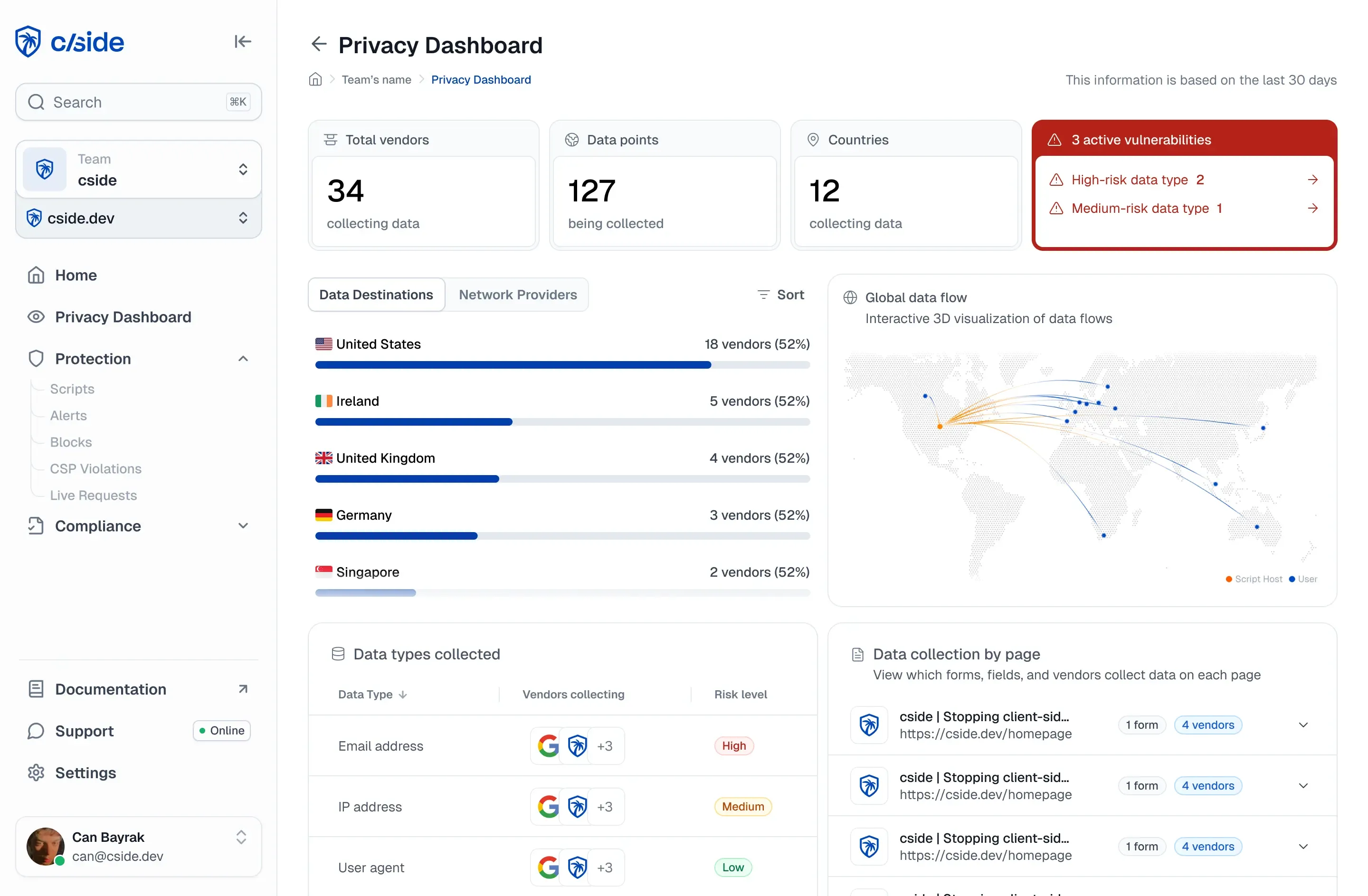
cside is a single first-party JavaScript snippet with two operating models. It produces device and behavioural signals from your own origin, and because it is first-party there is no third-party domain for a filter list to block. It also inventories and monitors the third-party scripts running on your pages, hashing and analysing each one on cside infrastructure and recording what it does in the real session, which is what PCI DSS 4.0.1 requirements 6.4.3 and 11.6.1 ask for.
That combination is the reason to look at it. If you are replacing FingerprintJS purely to get a visitor ID and nothing else, cside is more product than you asked for. If you were going to need script monitoring anyway, it is one snippet instead of two vendors. It has a free plan and public pricing, so you can evaluate without a sales call.
Choose cside over Fingerprint Pro when you need device signals and client-side security, and would rather not run two vendors to get them.
Castle
Castle uses device and behavioural signals in service of account security specifically: login risk, account takeover, registration abuse. The fingerprint is an input, not the product.
That focus is the point. If your actual problem statement is "we are losing accounts to credential stuffing", Castle is aimed at that in a way a general identification library is not.
Choose Castle over cside when account-lifecycle security is the whole requirement and PCI script scope is not.
SEON Device Intelligence
SEON's device module sits inside a larger fraud platform that also does email, phone, and IP enrichment plus KYC and AML workflow. Buying it for device fingerprinting alone is unusual; buying it because you want the device signal to sit next to digital-footprint enrichment in one decision is the normal path.
Choose SEON over cside when you want fraud decisioning and compliance workflow in one suite rather than a focused signal layer.
Fingerprint Pro
The incumbent, and worth keeping on the list honestly. Its identification accuracy is the highest of the options here, and for high-value flows that difference is the entire argument. If a wrong identification means a fraudulent chargeback or a locked-out real customer, paying per call is rational.
The reason people leave is cost at scale, particularly when identification is called on every page view rather than at a few decision points. Before switching, check whether calling it less often solves the problem more cheaply than switching does.
Open source vs commercial: what you actually give up
The gap is not ideological, it is structural. A browser-only library can use only what the browser will tell it, and browsers keep narrowing that surface. It has no server-side view, so it cannot resolve the two hard cases: two different devices that produce identical browser signatures, and one device whose signature changes after a browser update. Commercial products add server-side signals and identity resolution to handle exactly those.
So the practical question is what a mistake costs you. For analytics de-duplication or soft rate limiting, OSS accuracy is usually fine. For blocking a payment or locking an account, a false match has a real cost and the commercial gap starts to pay for itself.
How to choose
- Which product are you replacing, the library or Pro? Answer this first; it halves the list.
- What does a wrong identification cost you? That number, not the sticker price, tells you whether OSS accuracy is acceptable.
- How often will you call it? Per-identification pricing punishes per-page-view usage. Sometimes the fix is calling it at fewer points, not switching vendor.
- Do you also need to know what is running on your pages? If PCI DSS 6.4.3 and 11.6.1 are in scope, a fingerprinting library does not address them and you will be buying a second tool.
If you want the direct head-to-head instead of the survey, the cside vs Fingerprint comparison puts the two side by side.
Related resources

Client-side security consultant at cside. 10+ years of experience implementing technology solutions for enterprises (previously at Oracle, Cloudflare, and Splunk). Now helping teams use client-side intelligence to catch & reduce fraud.