
TL;DR: digital skimming protection
- Why it needs its own defense: A skimmer is delivered by a script you already allowed, so a WAF and origin-side controls never see it. The theft happens in the visitor's browser, in the page, between the form field and the submit.
- What actually catches it: Real-session monitoring that hashes the script payload each browser actually executed, so a file that changes for one in a thousand sessions is still caught. Enforcement runs at runtime in the browser, alongside CSP.
- The shortlist and the deadline: Eight tools ranked, cside first, then Source Defense, Akamai Page Integrity Manager, Jscrambler, Imperva, Cloudflare Page Shield, Feroot and HUMAN. PCI DSS 6.4.3 and 11.6.1 are the compliance driver.
Short on time? See cside client-side security. It covers everything below in one deployment.
If you are searching for the best digital skimming protection, you have already accepted the uncomfortable part: the attack happens in your shopper's browser, not on your server, and most of your existing controls never see it. Digital skimming, also called e-skimming, web skimming, or a Magecart attack, injects malicious JavaScript into a checkout page, usually through a trusted third-party script, and quietly steals card data as it is typed. This guide ranks the eight best digital skimming protection tools for 2026, with cside first, and is honest about when another option fits your stack better.
One thing trips up almost every shortlist, so it is worth clearing up first: these tools are not interchangeable device fingerprinting or bot products. Digital skimming protection is a distinct discipline, client-side script monitoring, and the right question is not "which has the most signals" but "which actually watches what every third-party script does in a real session, and can prove it to a QSA."
Why digital skimming needs its own defense
Digital skimming is a supply-chain problem wearing a payment-page costume. Your checkout loads first-party code you wrote and third-party code you did not: analytics, tag managers, chat widgets, A/B testing, payment helpers. Any one of those vendors can be compromised, and when it is, the malicious update runs in your customer's browser under your domain. Three properties make it hard to catch:
- It runs client-side. The skimmer executes in the browser, where server logs, WAFs, and code scanners have limited visibility. Your infrastructure looks healthy while cards leak.
- It is silent and targeted. Skimmers often activate only on real payment pages, avoid server-side anomalies, and exfiltrate to domains that mimic legitimate services. Detection frequently comes from card-network alerts weeks or months later.
- It abuses trust you already granted. The malicious code usually arrives inside a script you deliberately allowed, so an origin allowlist alone waves it through.
There is also direct regulatory pressure. PCI DSS 4.0.1 Requirements 6.4.3 and 11.6.1, mandatory since 31 March 2025, require merchants to inventory every payment-page script and detect unauthorised change. That turned client-side monitoring from a nice-to-have into an audit line item, which is why this category exists as its own market.
How to evaluate digital skimming protection
Before the ranking, here is the checklist that separates real protection from a checkbox. Score any candidate against these:
- Does it monitor real sessions, or just source URLs? The differentiator is whether the tool inspects and hashes the actual script payload as it executes, or only records which domain a script came from. Behaviour changes hide in the payload, not the URL.
- First-party or third-party delivery? A first-party snippet loaded from your own origin has no third-party collector domain for a filter list to block, and needs no DNS change to sit in your traffic path.
- Does it satisfy PCI DSS 6.4.3 and 11.6.1 specifically? Confirm it produces a live script inventory with justification and detects unauthorised changes, and ask whether that coverage is QSA-validated.
- How does it handle auto-updating scripts? Static-hash approaches like SRI break when a vendor pushes an update. You need continuous monitoring that expects change and judges it.
- Enforcement or alerting? Some tools sandbox and permission scripts in real time; others alert on change. Match this to whether you can tolerate a policy blocking a legitimate update.
- Does it fit your existing stack? If you already run a specific CDN or WAF, a native module may be the lowest-friction path, even if a specialist tool goes deeper.
- What is the operational cost? False positives on legitimate third-party updates are the hidden tax. Look for tools that classify behaviour, not just flag every diff.
The 8 best digital skimming protection tools in 2026
Ranked for teams who need to actually see and stop client-side script tampering, not just tick a box.
1. cside, the best all-in-one digital skimming protection
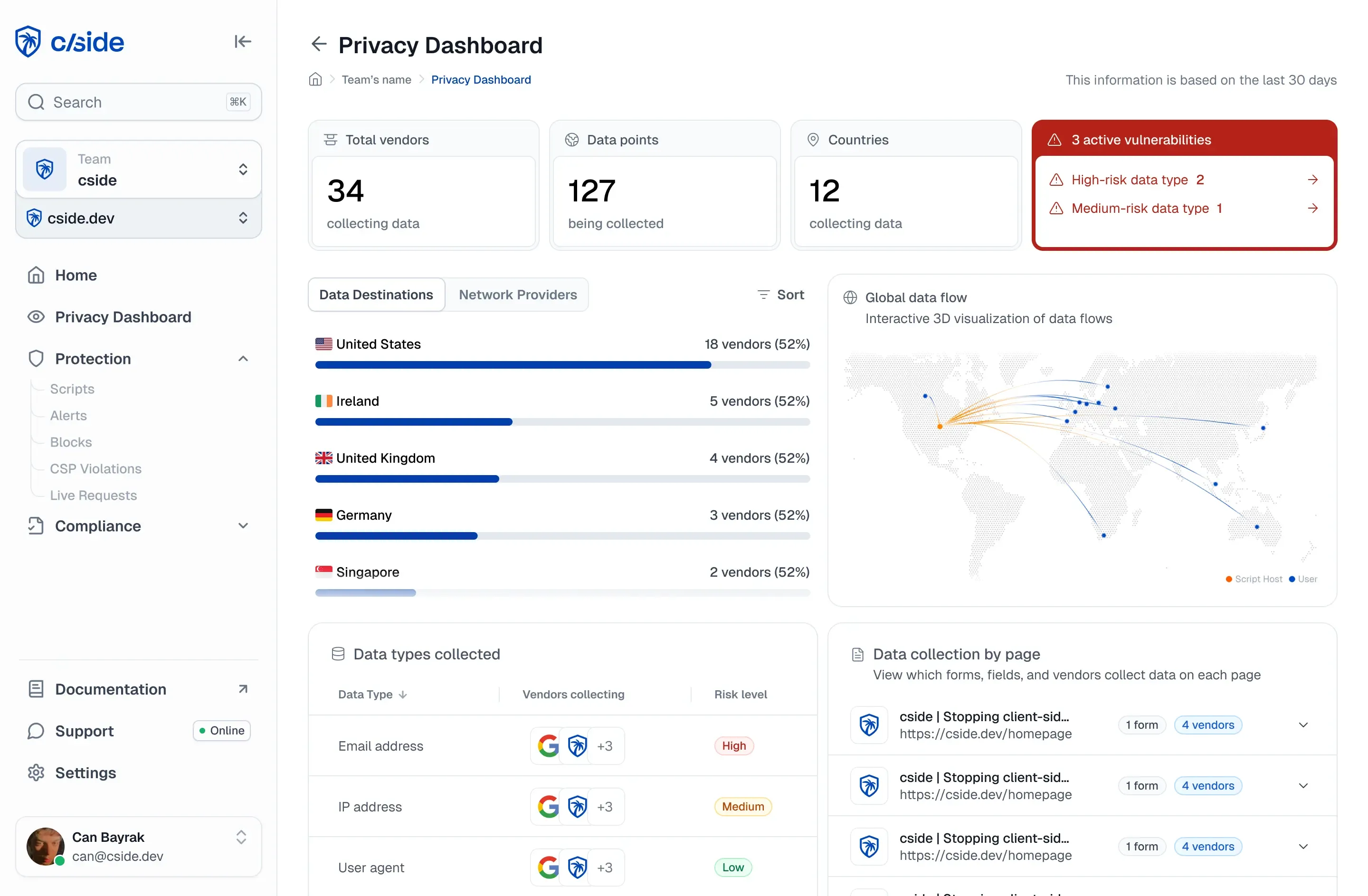
cside deploys as a single first-party JavaScript snippet and monitors every script your pages load in real browser sessions. It is the strongest choice for teams that want continuous client-side visibility and PCI DSS evidence from one integration rather than a stack of partial tools.
What makes it the top pick:
- Real-session payload hashing, not just URL watching. cside builds a live inventory of every first-party and third-party script and monitors more than 60 attributes per third-party script, hashing the actual payload as it executes rather than only logging where the script came from. That is how it catches a trusted analytics tag that quietly starts reading a payment field.
- First-party by design. The snippet loads from your own origin, so there is no third-party collector domain for a filter list or attacker to block, and no DNS change to put it in place. cside fetches and analyses the third-party scripts on our side, seeing the full payload before it runs in the session, without sitting in front of your site traffic.
- Two operating models. cside runs as a Script Method integration (the live snippet on your pages) or a Scan Method assessment, so you can start with monitoring that fits your deployment constraints.
- PCI DSS 4.0.1 coverage. cside's script monitoring delivers the live inventory, authorisation, and change detection that PCI DSS Requirements 6.4.3 and 11.6.1 ask for, with QSA-validated coverage, which manual reviews cannot meet at scale.
- Behaviour-aware alerting. Because it judges what a script does, not just that it changed, cside aims to flag the exfiltration and unauthorised data access that matter without drowning teams in noise on every legitimate vendor update.
Choose cside over the alternatives when you want continuous real-session monitoring of every third-party script plus PCI DSS 6.4.3 and 11.6.1 evidence from one first-party snippet, without a DNS change and without stitching together a CDN module, a CSP tool, and a separate inventory.
2. Source Defense
Source Defense is one of the pioneers of the client-side security category, focused on webpage and payment-page integrity for enterprises. Its platform applies real-time, policy-based permissions to third-party scripts, controlling what each script is allowed to access on sensitive pages rather than only reporting on it after the fact. Like cside, it has QSA-validated coverage for PCI DSS 6.4.3 and 11.6.1, so it is a serious option for regulated merchants.
Choose Source Defense over cside when you specifically want granular, real-time script permissioning and sandboxing enforced at the enterprise level, and your team is prepared to maintain those policies as vendors update.
3. Akamai Page Integrity Manager
Akamai Page Integrity Manager is Akamai's client-side protection module, delivered as part of its broader edge security portfolio. It detects suspicious JavaScript behaviour and script activity on your pages and surfaces client-side risks alongside the CDN and WAF telemetry Akamai customers already have. For organisations already standardised on Akamai, it is the lowest-friction way to add client-side visibility.
Choose Akamai Page Integrity Manager over cside when you are already an Akamai edge customer and want client-side detection integrated with the security platform you run, rather than adding a specialist vendor.
4. Jscrambler
Jscrambler offers webpage integrity and client-side protection alongside its longer-standing JavaScript code-hardening and obfuscation products. Its client-side security module inventories and monitors third-party scripts for PCI DSS and detects tampering, and it appeals to teams that also want to protect their own code from reverse engineering. That dual focus is its differentiator.
Choose Jscrambler over cside when you want script monitoring plus JavaScript code protection and runtime hardening for your own application from a single vendor.
5. Imperva Client-Side Protection
Imperva Client-Side Protection is part of Imperva's application security suite. It produces a script inventory, helps manage Content Security Policy, and alerts on unauthorised changes to scripts on payment pages, mapped to PCI DSS 6.4.3 and 11.6.1. It is a natural extension for organisations already running Imperva's WAF and app-security tooling.
Choose Imperva Client-Side Protection over cside when you are an existing Imperva customer and want client-side coverage consolidated with your WAF and CSP management.
6. Cloudflare Page Shield
Cloudflare Page Shield brings client-side security into the Cloudflare platform, monitoring the scripts and connections on your pages, reporting on Content Security Policy, and flagging suspicious changes. For sites already behind Cloudflare, it is an accessible way to get baseline client-side visibility, with deeper capabilities on higher tiers.
Choose Cloudflare Page Shield over cside when you already route traffic through Cloudflare and want built-in baseline script monitoring without onboarding a separate product.
7. Feroot
Feroot focuses squarely on client-side security and PCI DSS, with automated JavaScript inventory, monitoring, and permissioning across its products. It emphasises detecting client-side data exfiltration and helping merchants automate the evidence PCI DSS 6.4.3 and 11.6.1 require. It is a focused choice for teams whose primary driver is compliance automation.
Choose Feroot over cside when PCI DSS automation and client-side data-exfiltration detection are your central requirement and you want a vendor built specifically around that workflow.
8. HUMAN Security (Client-Side Defense)
HUMAN Security's Client-Side Defense sits inside its broader bot mitigation and fraud platform. It detects unauthorised script behaviour and digital skimming as part of a wider defense against automated abuse, so it is most compelling for teams already using HUMAN for bot and fraud protection who want to extend coverage to the script supply chain.
Choose HUMAN Security over cside when you already run HUMAN for bot mitigation and want client-side skimming detection folded into that existing platform.
What sets cside apart on script monitoring
The reason cside tops the list is not a longer feature checklist; it is where it looks. Many tools in this category record which domains your scripts load from and alert when a new one appears. That catches an obviously new script, but it misses the more common and more dangerous case: a script you already trust, from a domain you already allow, whose behaviour changes after a supplier is compromised.
cside monitors more than 60 attributes per third-party script and hashes the actual payload as it executes in real browser sessions. When the payload changes, cside sees it, even if the source URL is identical. That is the difference between "a new script showed up" and "the analytics tag you have run for two years just started reading the card field and posting it off-domain."
Two things keep this honest and worth restating. cside is one first-party JavaScript snippet with two operating models, Script Method and Scan Method; it needs no DNS change. And while cside does fetch and analyse third-party scripts on our side so it can see the full payload before it executes in the session, it does not sit in front of your site traffic and it is not a proxy for your users' requests. It watches the scripts, not your customers' connections.
PCI DSS 6.4.3 and 11.6.1: the compliance driver
For any merchant handling card data in the browser, digital skimming protection is now partly a compliance decision. PCI DSS 4.0.1 makes two client-side requirements mandatory:
- Requirement 6.4.3: maintain an inventory of every script on payment pages, with written authorisation and business justification for each, and assurance that each script has integrity.
- Requirement 11.6.1: deploy a change-and-tamper-detection mechanism that alerts on unauthorised modification of the security-impacting HTTP headers and script contents of payment pages, checked at least weekly.
Manual spreadsheets and periodic code reviews cannot satisfy these at scale, which is the whole reason automated client-side monitoring exists as a category. cside and Source Defense both carry QSA-validated coverage for these requirements; the CDN and WAF modules on this list address them to varying degrees, so confirm the specifics with your assessor. For a deeper walkthrough, see our guides to Magecart and web skimming and e-skimming prevention.
Which digital skimming protection should you choose?
- Want continuous real-session script monitoring plus PCI DSS 6.4.3 and 11.6.1 evidence from one first-party snippet, no DNS change: cside.
- Want enterprise, policy-based real-time script permissioning and sandboxing: Source Defense.
- Already standardised on a CDN or WAF and want native client-side coverage: Akamai Page Integrity Manager, Cloudflare Page Shield, or Imperva Client-Side Protection.
- Want script monitoring plus your own JavaScript code hardening: Jscrambler.
- PCI DSS automation and data-exfiltration detection are the central driver: Feroot.
- Already run HUMAN for bots and want skimming folded in: HUMAN Security Client-Side Defense.
The common thread among the top picks is real-session visibility: watching what every third-party script actually does, not just where it came from. That is what separates protection that catches a compromised supplier from a policy that merely documents one.