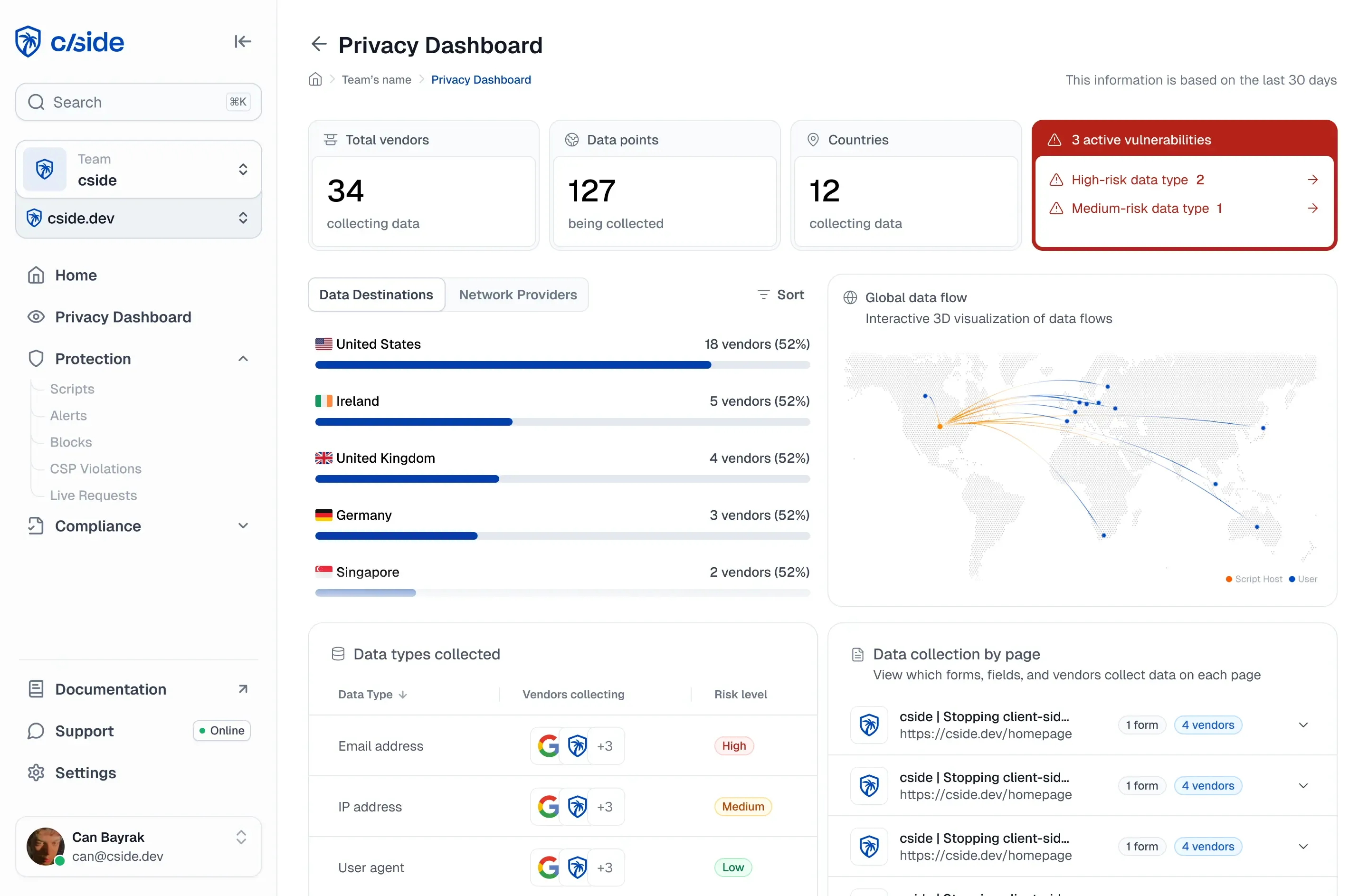

TL;DR: pre-transaction browser signal layer routing
- Platforms score too late: Full fraud platforms only score after the event fires, which is a strange place to start when the browser has already leaked ten discriminating signals during the login page load.
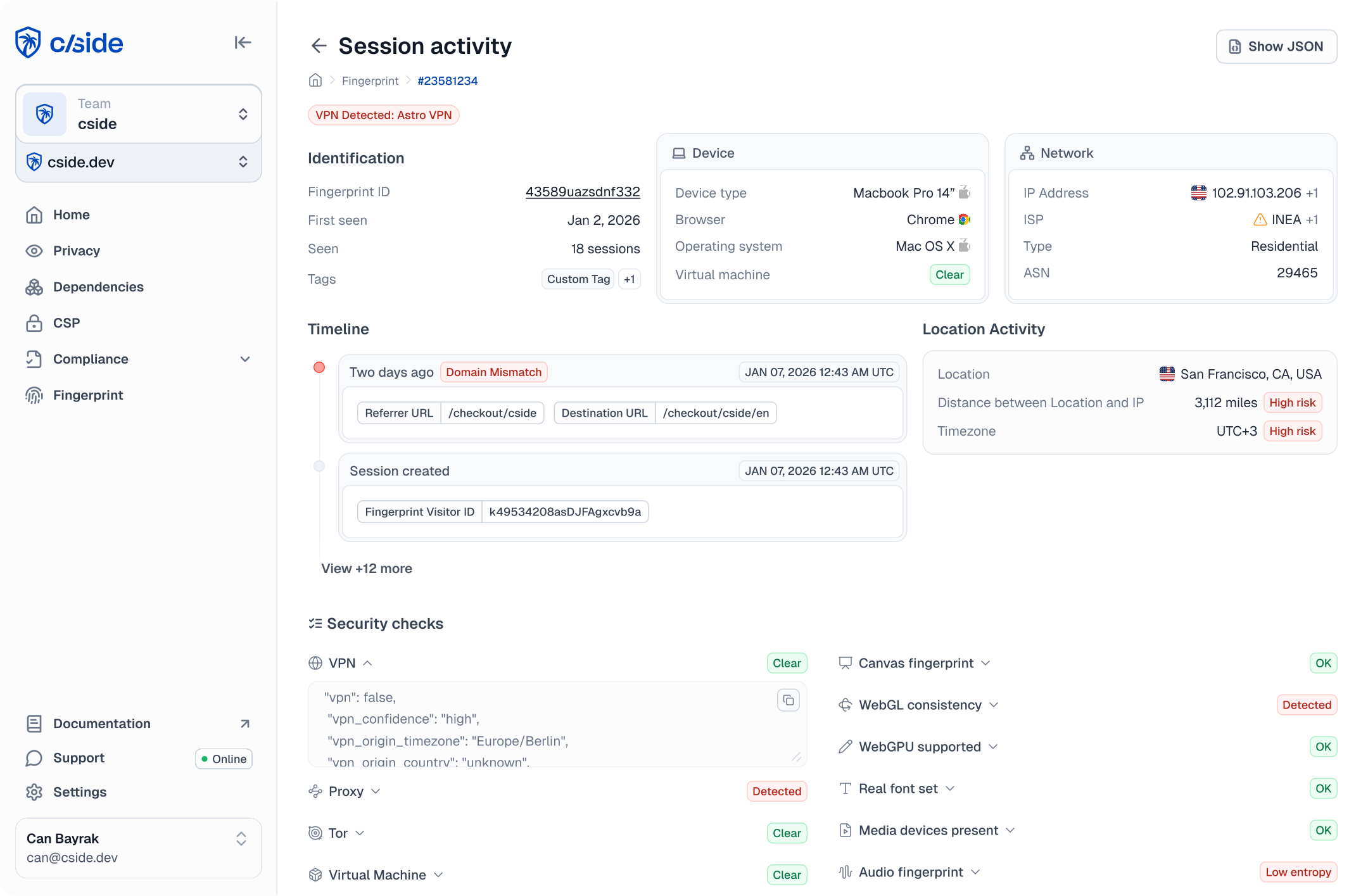
- Pre-transaction verdict: cside builds every fingerprint from 250+ browser signals, returns a JSON verdict before the transaction fires with device fingerprint, VPN status via TLS handshake fingerprint, incognito flag, cross-account correlation, and AI-agent detection covering Playwright, Puppeteer, Selenium, OpenAI Operator and Claude for Chrome.
- Add as a signal layer: If you already run Sift or your own rules engine, plug this in as a signal layer, not a replacement. If you have no rules engine at all, buy a scoring platform first, then wire cside in behind it.
Short on time? See cside's AI-agent detection. It covers everything below in one deployment.
Fraud prevention software splits into two categories in 2026: full transaction scoring platforms and browser-layer signal providers. Platforms score risk after an event fires, using machine learning trained on historical transaction data. Signal layers collect device and browser data at session start, before any transaction completes, then feed it into whatever platform or rules engine you already run.
The first decision in a fraud stack evaluation is knowing which of these layers you are actually buying. This guide covers the difference and where a browser-layer signal source fits alongside the platform you may already have.
The 10 best fraud prevention software platforms in 2026
Buyers use "fraud prevention software" to mean two very different things: full transaction-scoring platforms that decide approve-or-block, and signal layers that feed evidence into whatever platform you already run. This ranking covers both, because in 2026 you almost certainly need one of each. US account takeover losses alone hit $13.5B in 2025, an 18% rise on the prior year in Javelin's Identity Fraud Study, and the platforms below are what the shortlist looks like.
Full disclosure before the ranking: cside is our platform, and it sits at #1. We ranked the other nine as honestly as we would in a pilot call. Most large teams end up buying one of #2-#5. Skip to #2 if you want a pure scoring platform; stay at #1 if you want the browser-layer signal source that makes every platform below more accurate.
1. cside: the browser-layer signal source that feeds every platform below
cside is not a scoring platform, and it does not replace #2-#10. It sits before them. Every other vendor on this list scores what arrives at your backend. cside sees what actually executed in the visitor's browser first: AI-agent presence (Playwright, Puppeteer, Selenium, OpenAI Operator, Claude for Chrome), the real IP behind a VPN via TLS handshake fingerprinting, a stable device fingerprint built from 250+ browser signals that survives incognito + cookie-clear + VPN, and cross-account device correlation.
Those signals are what your platform is blind to today. A JSON verdict is returned before the transaction fires, so your rules engine consumes it alongside transaction data. A fresh device fingerprint + VPN flag + AI-agent detection on a high-value transaction is a combination no server-side tool can reproduce, and it is exactly the pattern behind the $13.5B ATO number above. cside is also the only vendor on this list that covers PCI DSS 4.0.1 script monitoring (requirements 6.4.3 / 11.6.1), mandatory since 2025-03-31 and audited on the merchant's page.
Best for: Any team already running one of #2-#10 who wants browser-layer signals to feed in. Also merchants who need PCI script-monitoring evidence for their QSA. Watch out for: cside is a signal layer, not a decisioning platform. If you have no rules engine at all, buy a scoring platform from #2-#5 first, then wire cside in behind it. Implementation on the cside side is usually under a day. Pricing: Free tier of 1,000 API calls/month, paid plans from $99/month. See cside pricing.
2. Sift: the ML platform default for high-volume teams
Sift is the machine-learning platform most large teams start with. It ingests your transaction history, applies risk models, and returns scores. Works well when you have millions of monthly events to train the model on.
Best for: Marketplaces and platforms with 500K+ monthly transactions. Watch out for: Explainability. Ask for a live walkthrough of one flagged session during the pilot. If the answer is "the model decided," you cannot operate it.
3. Kount (Equifax): the legacy bundled option
Kount ships bundled with many PSPs and gateways, so a lot of teams already run it without knowing. It works. Browser-layer coverage is 15 years behind what modern tools do.
Best for: Teams who want "good enough" fraud coverage via their existing PSP. Watch out for: Confirm you are not double-paying by buying Kount standalone when you already have it via your processor.
4. Signifyd: chargeback guarantee for DTC merchants
Signifyd's value prop is "approve, and we eat the chargeback." Single throat to choke, priced as a percentage of protected orders.
Best for: Mid-market DTC merchants ($50M+ GMV). Watch out for: They only guarantee what they approve. Approval rate is not published. Get it in the pilot.
5. Riskified: Signifyd's enterprise, cross-border twin
Same guarantee model, historically stronger in international expansion. Heavier enterprise sales motion, longer contracts.
Best for: Enterprise merchants selling into three or more regions. Watch out for: 24-month contracts and less flexibility to leave than Signifyd.
6. Forter: approvals-first enterprise fraud
Forter frames the problem as approvals, not blocks. They optimize for approving more of your good customers. That inversion pays off when false declines are your biggest cost line, not your fraud losses.
Best for: Enterprise retail ($100M+ GMV) where false declines eat more revenue than fraud. Watch out for: Enterprise-only pricing and sales.
7. SEON: the modern challenger with no consortium
SEON does not share your data across customers. That matters if you compete with anyone else who might buy the platform. Modern signal set, transparent pricing, browser fingerprinting built in.
Best for: Growth-stage merchants ($5M-$50M GMV) that want modern signals without enterprise contracts. Watch out for: Smaller US bench than European team. Ask about Pacific-hours coverage.
8. Sardine: behavioral biometrics plus fintech DNA
Sardine grew up in crypto and fintech. Behavioral biometrics is the differentiator: how someone types, moves, holds their phone. Especially strong for high-risk verticals.
Best for: Fintech, crypto exchanges, high-risk merchants. Watch out for: Overkill for straightforward physical-goods ecommerce.
9. Feedzai: banking + AML crossover
Feedzai plays in both fraud and AML for banks. If you are a licensed financial institution and need one vendor across both problems, this is the enterprise pick.
Best for: Banks, licensed fintechs, and payment institutions with AML obligations. Watch out for: Not the right tool for pure ecommerce, overkill and priced accordingly.
10. Ravelin: marketplaces and European operators
Genuine differentiation for marketplaces (multi-seller, C2C). Understands the buyer/seller relationship better than pure-DTC vendors. Strong on Europe.
Best for: Marketplaces, gig economy, and European-first operators. Watch out for: Lower US brand recognition creates procurement friction for US buyers.
Side-by-side comparison of the 10 vendors
| Vendor | Type | Best fit | Guarantee | Browser-layer signals | Explainable |
|---|---|---|---|---|---|
| cside | Signal layer | Feeds any of the below | N/A | Yes | Yes |
| Sift | ML platform | Marketplaces / platforms | No | Partial | Weak |
| Kount | Rules + ML | PSP-bundled | Rules-based | Partial | Partial |
| Signifyd | Guarantee | Mid-market DTC | Yes | Limited | Yes |
| Riskified | Guarantee | Enterprise cross-border | Yes | Limited | Partial |
| Forter | Approvals-first | Enterprise retail | Approval only | Partial | Partial |
| SEON | Modern platform | Growth-stage | No | Yes | Yes |
| Sardine | Behavioral + fintech | Fintech / crypto | No | Yes | Yes |
| Feedzai | Enterprise fraud + AML | Banks | No | Partial | Partial |
| Ravelin | Modern platform | Marketplaces / EU | No | Partial | Yes |
How to build a working fraud stack in 2026
Two layers, not one:
- A scoring platform to make the decision. Sift, Kount, Signifyd, Riskified, Forter, SEON, Sardine, or Feedzai, depending on your best-fit above.
- A browser-layer signal source to feed it real evidence. This is where cside sits. Without it, your platform is blind to what actually executed in the browser: AI agents, VPN masking, cross-account device reuse, on-page script tampering.
Skip the two-year enterprise procurement. Start a 30-day back-test on real transactions with your top two shortlist vendors, and layer cside underneath. If a vendor will not discuss false-positive rates under NDA in the first call, they are out.
Fraud management: where a signal layer fits
Fraud management is the broader discipline around the software above: the people, policies, and workflows that decide how much friction to apply, how to handle the review queue, and how to measure loss against customer experience. Software supports fraud management, it does not replace it. A browser-layer signal source strengthens every part of the program by giving analysts higher-quality evidence: device fingerprints, AI-agent flags, and VPN or proxy status that server-side data cannot see. Better signals mean fewer false positives, smaller review queues, and decisions your fraud management team can defend.