
TL;DR: choosing a fraud detection API
- What it returns: A fraud detection API returns a real-time risk score at login, signup, or checkout from device, network, behavioral, and identity signals.
- Client-side signals matter: Server-side APIs miss the client-side signals that matter: browser fingerprint, mouse dynamics, headless artifacts. Modern APIs stream those from a JS SDK.
- How to judge: Judge on signal breadth, sub-200ms latency, false-positive rate on your funnel, evidence exports, and price per request.
Short on time? See cside's AI-agent detection. It covers everything below in one deployment.
The problem server-side fraud checks cannot solve
Most web applications already run some fraud protection. Rule engines, IP reputation lists, and velocity checks are common. They share one limit: they operate on the transaction, not the session.
By the time a transaction reaches a server-side rule, the useful signals are already gone. The device that made the request, the browser environment it ran in, the network connection it used, and whether a human or an automated script drove the interaction do not survive the HTTP request in a form a server-side rule can read.
Stolen credentials appeared in 39% of all data breaches in 2025, according to the Verizon Data Breach Investigations Report. In most account takeover attacks the attacker already holds valid credentials. The email and password match, the server sees a successful credential check, and access is granted. The signals that would have flagged the session as suspicious, an unrecognized device, a VPN connection, an AI agent driving the browser, live in the browser and are never read.
US account takeover losses reached $13.5 billion in 2025, affecting 6 million consumers, according to Javelin Strategy & Research.
| Year | US account takeover losses |
|---|---|
| 2024 | ~$11.4B |
| 2025 | $13.5B |
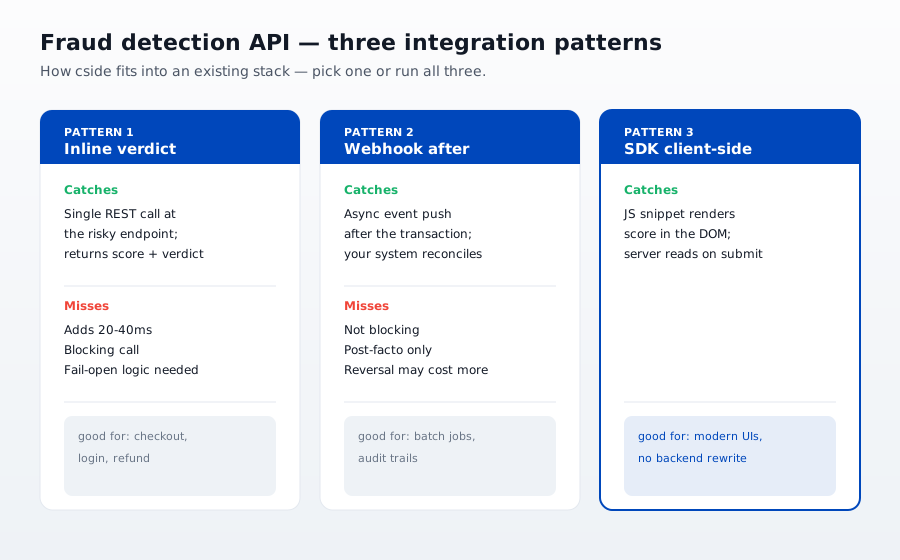
A browser-layer fraud detection API closes this gap by reading those signals before the request reaches your server, then returning a structured verdict your application can act on in real time.
What a fraud detection API returns
A well-designed fraud detection API returns more than a single risk score. The individual signals matter, because different fraud patterns need different responses.
A stable device identifier. The most important signal is a device fingerprint ID that persists across sessions, cookie clearing, incognito mode, and VPN connections. This identifier is what lets you recognize a returning device and compare it against the device history associated with a given account. A known account logging in from an unrecognized device is one of the earliest detectable signals of an account takeover attempt. Each verdict is built on a baseline of 250+ browser, device, and network signals cside collects per session, tying every request to the device behind it.
An AI agent flag. Automated attacks in 2026 are increasingly driven by AI agents rather than traditional scripted bots. Named agents including OpenAI Operator, Claude for Chrome, Playwright, Puppeteer, and Selenium each leave detectable traces in the browser environment. A flag for AI agent activity tells you whether the session is being driven by a human or an autonomous program.
A VPN and proxy status flag. A VPN connection is not inherently fraudulent, but it is a meaningful context signal. A returning customer who usually connects from a residential address and suddenly appears behind a commercial VPN node warrants closer scrutiny. This signal is most reliably detected using TLS handshake fingerprint TLS fingerprinting, which reads the TLS handshake rather than relying on IP reputation lists, which are always incomplete.
An incognito flag. Private browsing mode is not evidence of fraud on its own. Many legitimate users prefer incognito for privacy reasons. It becomes a relevant signal in combination with others: a new account creation from an incognito session on an unknown device behind a VPN is a materially different risk profile from a known customer who uses incognito habitually.
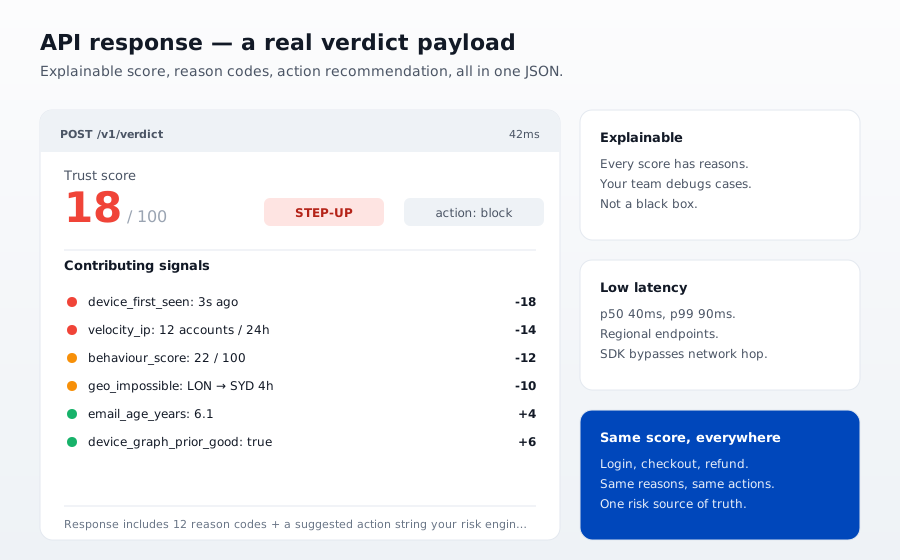
A composite risk score. A single number from 0 to 100 that combines all of the above is useful for routing decisions. Low scores pass without friction. Mid-range scores trigger a step-up challenge such as an SMS OTP or a CAPTCHA. High scores go to a block or a manual review queue. The value of a composite score is that it abstracts the signal-combination logic, so your application reads a number rather than implementing its own weighting model.
In practice a single call returns all of these together. A session that shows a stable device, no automation, but a VPN connection and a mid-range risk score can be passed with a step-up challenge before it reaches sensitive account functions. Your application reads the verdict and routes the session; it does not have to compute the weighting itself.
What to look for when evaluating a fraud detection API
Not every fraud detection API is built to the same standard. These are the criteria worth examining before committing to one.
Signal breadth. An implementation that reads five or ten browser attributes produces a less stable device ID than one that reads 100 or more. The device fingerprint's accuracy degrades if the underlying hash has too few inputs to tolerate minor browser version changes. Look for documentation on how many signals the API analyzes.
Accuracy across privacy modes. The device ID must stay stable when users operate in incognito mode or behind a VPN. If the implementation breaks in either condition, it fails precisely in the situations where fraud is most likely to occur. Ask the vendor what their fingerprint accuracy is across incognito and VPN specifically.
Latency. A fraud check must not add perceptible delay to your login or checkout flow. Sub-50ms from API call to response is the practical benchmark. Anything slower risks degrading conversion for legitimate customers.
AI agent detection. The ability to distinguish AI agents from human sessions in real browser contexts is what separates 2026-ready implementations from older ones. Headless browser detection has existed for years, but detecting AI agents operating in standard browser environments requires additional signal analysis.
A free tier without a sales process. If an API requires a sales call before you can evaluate it on real traffic, that is a friction cost. The strongest fraud detection APIs offer a free tier with no credit card requirement, so developers can validate signal quality and integration effort before making a purchasing decision.
How a fraud detection API is integrated
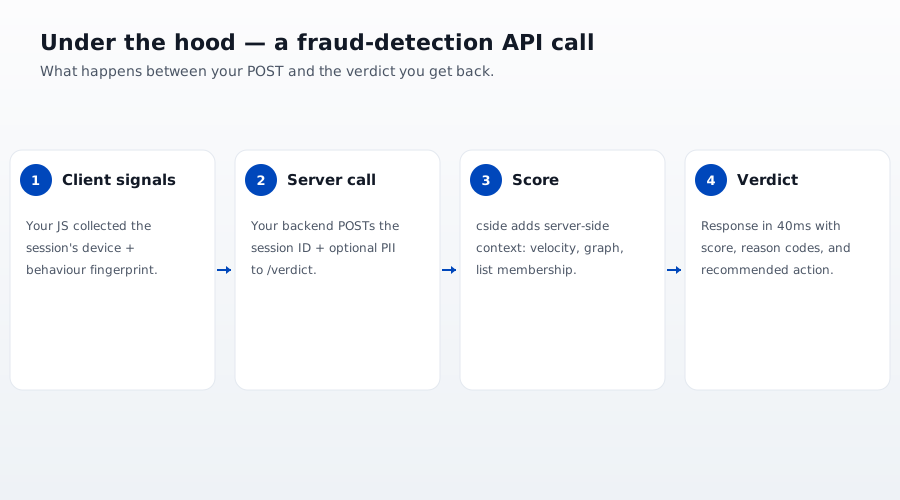
Integration follows a three-step pattern regardless of which API you choose.
Step 1: Load the client-side script. A small JavaScript file is added to the page head. It starts collecting browser signals passively in the background while the user interacts with the page. This step needs no user interaction and does not block page rendering.
Step 2: Call the API endpoint on the protected event. When the user submits a login form or starts a checkout, the application calls the fraud detection API. Because signal collection began when the page loaded, the API has already gathered the browser environment data it needs, so the call itself returns quickly.
Step 3: Apply risk logic in your application. Your backend reads the verdict and routes the session accordingly. You define the thresholds that fit your product: what risk score triggers a challenge, what flags cause an automatic block, what combination of signals sends a session to a review queue.
The integration does not require changes to your authentication or payment infrastructure. It adds a read step before your existing logic runs.
cside's fraud detection API
cside returns these signals in a single call through its device fingerprinting API: a stable device fingerprint, a verdict that flags AI-agent and automated sessions, VPN and proxy status detected via TLS handshake fingerprint TLS fingerprinting, an incognito flag, and a composite risk score. Fingerprinting stays high-accuracy across incognito and VPN, and the verdict returns with low latency, so it lands before your login or checkout logic completes.
The free tier includes 1,000 API calls per month with no credit card required, which is enough to validate signal quality on real production traffic before committing to a paid plan. For AI agent detection specifically, cside identifies named automation including OpenAI Operator, Claude for Chrome, Playwright, Puppeteer, and Selenium.
API versus full fraud platform: when to use each
A fraud detection API and a managed fraud platform serve different teams with different needs. Understanding the distinction helps you choose the right starting point.
An API is the right choice for development teams who want to fold risk signals into their existing application logic. You control how the signals are used, what thresholds trigger what actions, and how the verdict integrates with your authentication or payments flow. The API delivers data. Your team writes the rules.
A full fraud platform is the right choice for teams who want alerting, dashboards, session replay, and managed rules without building the logic themselves. The signals come pre-interpreted, and decisions are configured through an interface rather than code.
The two are not mutually exclusive. cside offers the API standalone for developers who want programmatic access, and a full dashboard with session replay, device ID history, and chargeback evidence export for teams that need the investigation and compliance layer on top. Pricing runs from a free tier through a $99/month business plan to custom enterprise pricing.