
TL;DR: best bot protection and mitigation software in 2026
- The bar in 2026: effective bot protection means stopping classic automation at the network edge and catching LLM agents that pass IP and fingerprint checks at the browser layer. These are two different problems that require two different detection approaches.
- The contenders: Six platforms make a serious shortlist: cside, DataDome, Cloudflare, Imperva, HUMAN Security, and Arkose Labs. Each operates at a different layer.
- What matters: Judge on multi-layer detection, agent trust scoring, 6.4.3 coverage where applicable, and transparent pricing.
Short on time? See cside's AI-agent detection. It covers everything below in one deployment.
How to read this comparison
Choosing bot detection software starts with understanding which layer each tool operates on, because that layer decides which threats it can physically see. The sections below cover where each tool sits in the detection stack, who it is for, and where its limits are. No accuracy figures are quoted from competitor sources; capability descriptions reflect publicly known product positioning.
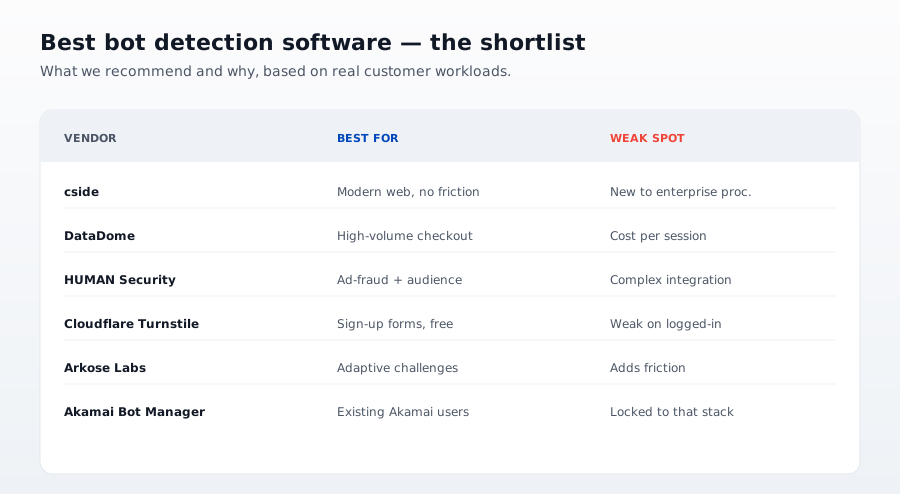
| Tool | Best for | Detection layer | Free tier | Paid pricing |
|---|---|---|---|---|
| cside | Browser-layer device intelligence + AI agent detection | Browser (client-side) | Yes, 1,000 API calls/mo | From $99/mo |
| DataDome | High-volume network-layer bot mitigation | Network (reverse proxy) | No | Enterprise, contact sales |
| Cloudflare Bot Management | Sites already on Cloudflare CDN | CDN + JS challenge | Included in Pro/Business | From $20/mo |
| Imperva Advanced Bot Protection | Enterprise WAF + bot management | WAF + edge | No | Enterprise, contact sales |
| PerimeterX / HUMAN | Credential stuffing at scale | CDN edge (behavioral) | No | Enterprise, contact sales |
| Arkose Labs | High-value account flows needing challenge-based friction | Browser signals + challenge | No | Enterprise, contact sales |
1. cside
Detection layer: Browser, client-side Best for: Fraud teams and developers who need bot detection, AI agent signals, and device intelligence from a single integration
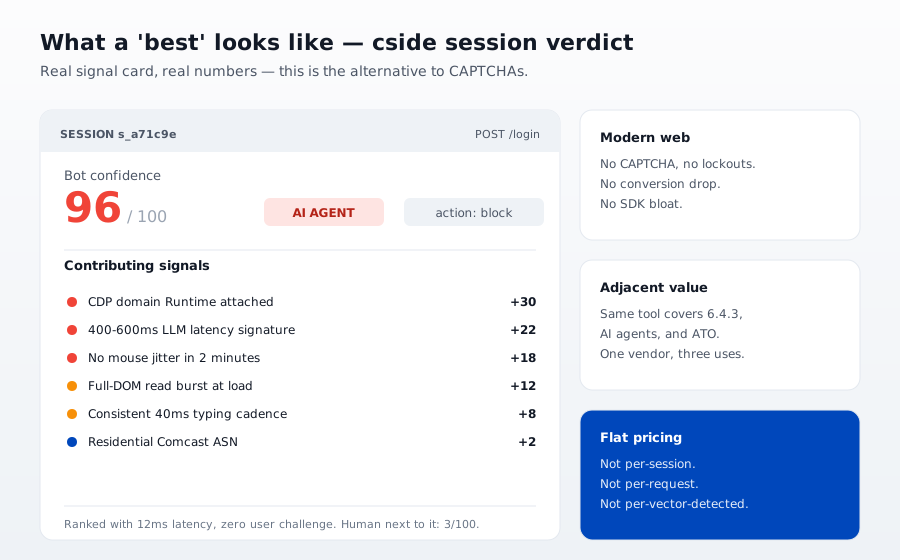
cside runs a lightweight script in the visitor's browser before any request reaches your server. It analyzes more than 250 browser signals per session: canvas fingerprint, WebGL renderer, font enumeration, audio context, battery API, and dozens more. It combines those signals into a per-session risk verdict delivered via API. The output is an actionable signal your application can use to gate, challenge, or flag the session, rather than a silent block you never see.
What cside detects:
- Traditional headless browsers and scripted bots (Puppeteer, Selenium)
- AI agents operating inside real browser engines: OpenAI Operator, Claude for Chrome, Playwright
- VPN and proxy connections via TLS handshake fingerprinting
- Credential stuffing sessions marked by device ID anomalies and session cadence
The differentiator is fingerprint persistence. cside recognizes a returning device with high accuracy across incognito mode, VPN connections, and cookie clearing, so a device is still identified when the user has taken deliberate steps to appear new.
For fraud teams dealing with AI agent promo abuse, multi-accounting, or account takeover on login pages, this is the layer that catches what server-side tools miss. The live fingerprinting demo shows the signals collected in a real session.
cside is also VikingCloud PCI DSS 4.0.1 validated for Requirements 6.4.3 (script inventory on payment pages) and 11.6.1 (tamper-detection alerts), which matters for e-commerce and iGaming platforms with compliance obligations on checkout. See how AI agent detection fits into authentication workflows.
Pricing: Free tier includes 1,000 API calls per month, no credit card required. The Business plan is $99 per month. Enterprise pricing is available on request.
Account takeover driven by bot credential stuffing now accounts for billions of dollars in US losses each year, according to identity-fraud research from Javelin Strategy & Research, which is why the login page is a priority surface for browser-layer detection.
2. DataDome
Detection layer: Network, reverse proxy Best for: High-volume bot traffic mitigation at CDN level
DataDome operates as a reverse proxy that sits in front of your infrastructure. Traffic routes through DataDome's network before reaching your origin server, which allows detection and blocking at the network edge based on request patterns, headers, and IP reputation.
This architecture works well against volumetric bot attacks, credential stuffing at high request rates, and scraping from data center IPs. It is a strong fit for organizations that need to protect APIs and web properties from bulk automated traffic.
The reverse proxy model means detection happens at the network layer. AI agents operating inside real browser engines at human-equivalent speed, with legitimate residential IPs and valid TLS fingerprints, sit outside what network-layer analysis catches reliably. Pricing is enterprise-only with no self-serve tier.
3. Cloudflare Bot Management
Detection layer: CDN edge, JavaScript challenge Best for: Sites already running on Cloudflare's CDN
Cloudflare Bot Management is an add-on for sites already proxied through Cloudflare's network. Detection combines IP reputation, request analysis, and JavaScript challenges (including managed challenge and Turnstile), and it benefits from Cloudflare's network-wide threat intelligence.
Cloudflare's pricing model is more accessible than enterprise-only vendors. Bot Management is included in Business and Enterprise plans, and Cloudflare Pro ($20/month) includes basic bot protection. For organizations already on Cloudflare, this is a low-friction path to baseline coverage.
Detection is network and JS-challenge based. For sophisticated threats using real browser engines with human-like behavior, CDN-layer detection carries the same limitations as other network-layer approaches.
4. Imperva Advanced Bot Protection
Detection layer: WAF and edge Best for: Enterprises that want WAF and bot management from a single vendor
Imperva combines web application firewall capabilities with bot protection in one platform. The integrated model appeals to enterprises that want a consolidated security stack rather than point solutions. Traffic analysis happens at the edge via reverse proxy.
Imperva's bot protection adds behavioral signals on top of the standard WAF rule-based approach, which improves detection quality over pure signature matching. The platform covers web, mobile, and API channels. Pricing is enterprise-only.
5. PerimeterX / HUMAN Security
Detection layer: CDN edge, behavioral analytics Best for: Large-scale credential stuffing protection across web and mobile
PerimeterX merged with HUMAN Security in 2022. The combined entity positions around behavioral analytics at the CDN edge, with particular strength in detecting credential stuffing at scale across web and mobile applications.
The behavioral analytics model analyzes session patterns rather than only request signatures, which improves detection accuracy against distributed attacks using residential proxies. The platform is enterprise-focused with no self-serve tier, and integration requires contract negotiation.
6. Arkose Labs
Detection layer: Browser signals plus interactive challenge Best for: High-value account creation and login flows where step-up friction is acceptable
Arkose Labs risk-scores a session from device and behavioral signals collected in the page, then steps up to a targeted puzzle when that score looks suspicious. The enforcement, not the detection, is what sets it apart: sessions that fail repeated challenges are stopped by friction rather than by a silent network rule.
This model works for account creation and login flows at companies where some user-visible friction is acceptable on suspicious sessions. It does not fit API endpoints or checkout flows where any user-facing challenge reduces conversion. The challenge model assumes bots will give up on repeated friction, which holds for low-sophistication automation. Pricing is enterprise-only with no self-serve tier.
Replacing Arkose rather than shortlisting it? Our survey of Arkose Labs alternatives compares eight options by use case and public pricing.
Bot protection, bot mitigation, and bot management: what each term means
These three terms appear in vendor documentation and security RFPs, often used interchangeably. They describe related but distinct capabilities.
Bot detection identifies whether a session originates from automated software. A detection tool returns a verdict: bot or human, and often a risk score or bot type classification. Your application decides what to do with that signal.
Bot mitigation is the set of actions taken on detected bots: blocking requests, rate-limiting, or serving a challenge page. Mitigation can happen at the network edge (before a request reaches your origin) or inside your application after a session verdict arrives via API. Network-edge bot mitigation is the standard approach for stopping volumetric scraping, credential stuffing at high request rates, and data center IP floods. For Q3 2026, this layer handles the majority of bot volume but misses the category growing fastest: AI agents operating inside real browser environments.
Bot management is the operational layer on top of detection and mitigation. It covers traffic analytics, rule configuration by bot type and risk level, exception handling for known-good crawlers, and reporting. A bot management platform lets a security or fraud team tune responses: allow benign crawlers, challenge medium-risk sessions, block high-confidence bots, rather than applying a binary block to all automated traffic.
Bot protection is the term vendors use for the full stack. When evaluating a tool, the questions that matter are: which layer does it detect at (network or browser)? Does it return an API verdict your application can act on, or only silently block at the edge? Can you configure different responses for different bot types?
The detection layer shapes what any tool can catch. Network-edge and CDN tools handle high-volume, low-sophistication bot traffic: volumetric scraping, data center IP floods, and simple headless browser attacks. Browser-layer bot protection catches threats that reach the network layer cleanly: AI agents running in real browser engines, credential stuffing from residential proxies, and session replay attacks. The two approaches are complementary. Network-layer bot mitigation handles the bulk of inbound bot volume; browser-layer tools catch the threats that pass through it.
What to look for: a buyer checklist
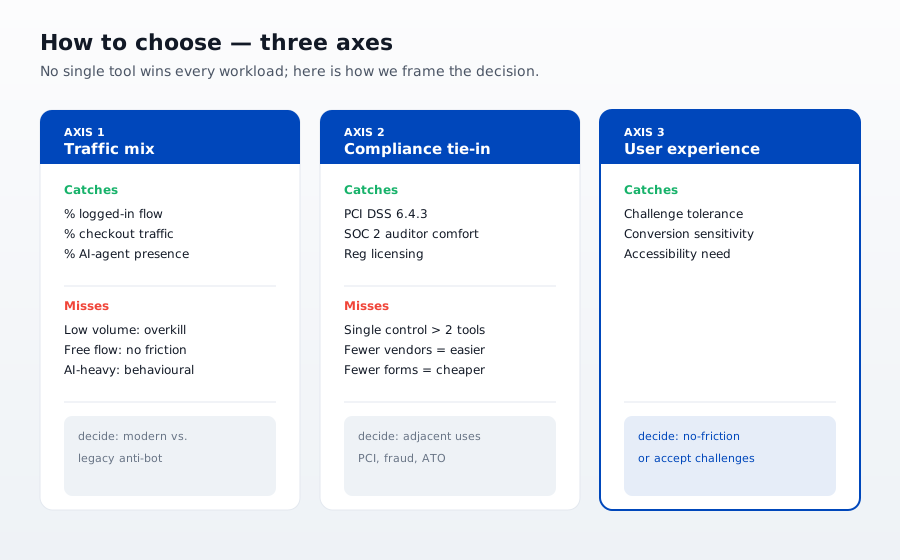
Choosing bot detection software in 2026 is about more than blocking known bot signatures. These are the questions worth asking before you commit to any vendor.
Does it detect AI agents in real browser sessions? Tools that work at the network layer will not reliably catch OpenAI Operator, Claude for Chrome, or Playwright running inside a genuine browser engine at human-equivalent speed. Ask vendors specifically how they handle this.
Is there a self-serve tier? Enterprise-only contracts mean you cannot evaluate the tool against your real traffic before signing. Look for a free tier or trial that lets you run the integration in production before committing budget.
Does it return a per-session verdict or just block traffic? If the output is a blocked request, you lose the signal. A per-session API verdict lets your fraud stack act on the risk score with step-up authentication, rate limiting, silent flagging, or a hard block depending on the risk level.
Does it integrate with your existing fraud stack? Bot detection is one input into a broader fraud decision. A tool that returns a structured API response integrates with fraud orchestration platforms, identity verification workflows, and SIEM tooling. A tool that only blocks at the edge does not.
Further reading