TL;DR: cside vs Forter
- Forter is transaction fraud decisioning with chargeback guarantee options for enterprise merchants. Strong at what it does.
- cside is not a transaction fraud vendor. It collects device and behavioral signals from your own first-party JavaScript at checkout, capturing the Visa CE 3.0 device continuity evidence Forter does not preserve at the browser layer, plus PCI DSS 6.4.3 and 11.6.1.
- Want a transaction fraud guarantee: Forter. cside sits alongside it, not against it. Most enterprise merchants run both.
Key Points
- Forter decides whether to approve or decline a transaction at checkout. cside monitors the browser runtime to produce signals that feed into your anti-fraud workflows.
- Both products protect against account takeover and multi-accounting. cside also detects account sharing, which Forter does not. Forter offers dispute representation and a chargeback guarantee, which cside does not.
- Pricing and accessibility are very different. cside starts at $99/month with self-serve signup. Forter is an enterprise only product with no public pricing. cside is a better fit for mid-market or small business teams that want a lighter tool with quick implementation.
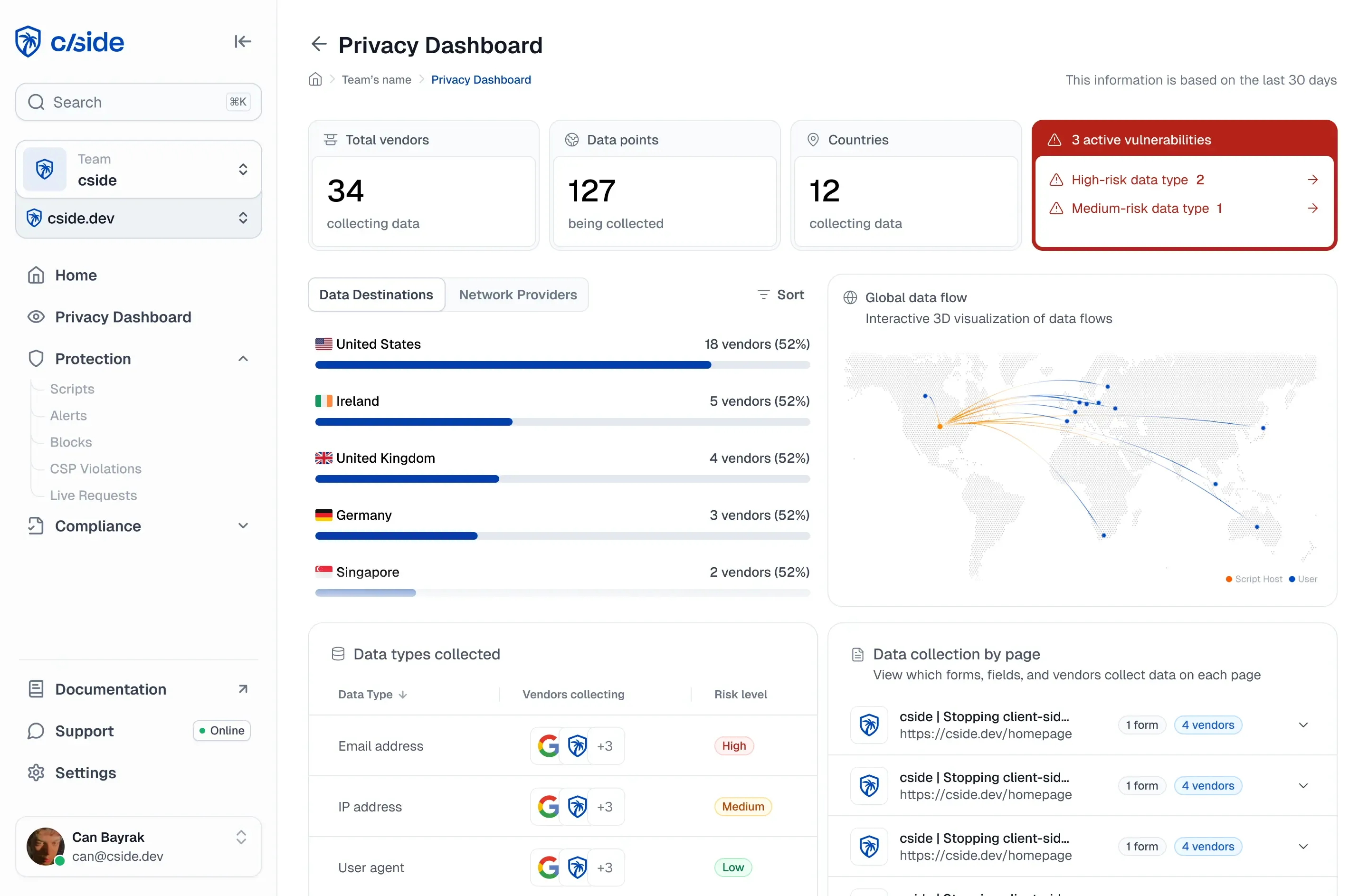
- cside ships a separate client-side security product for PCI DSS 4.0.1 compliance and payment page protection. Forter does not cover client-side security.
Introduction
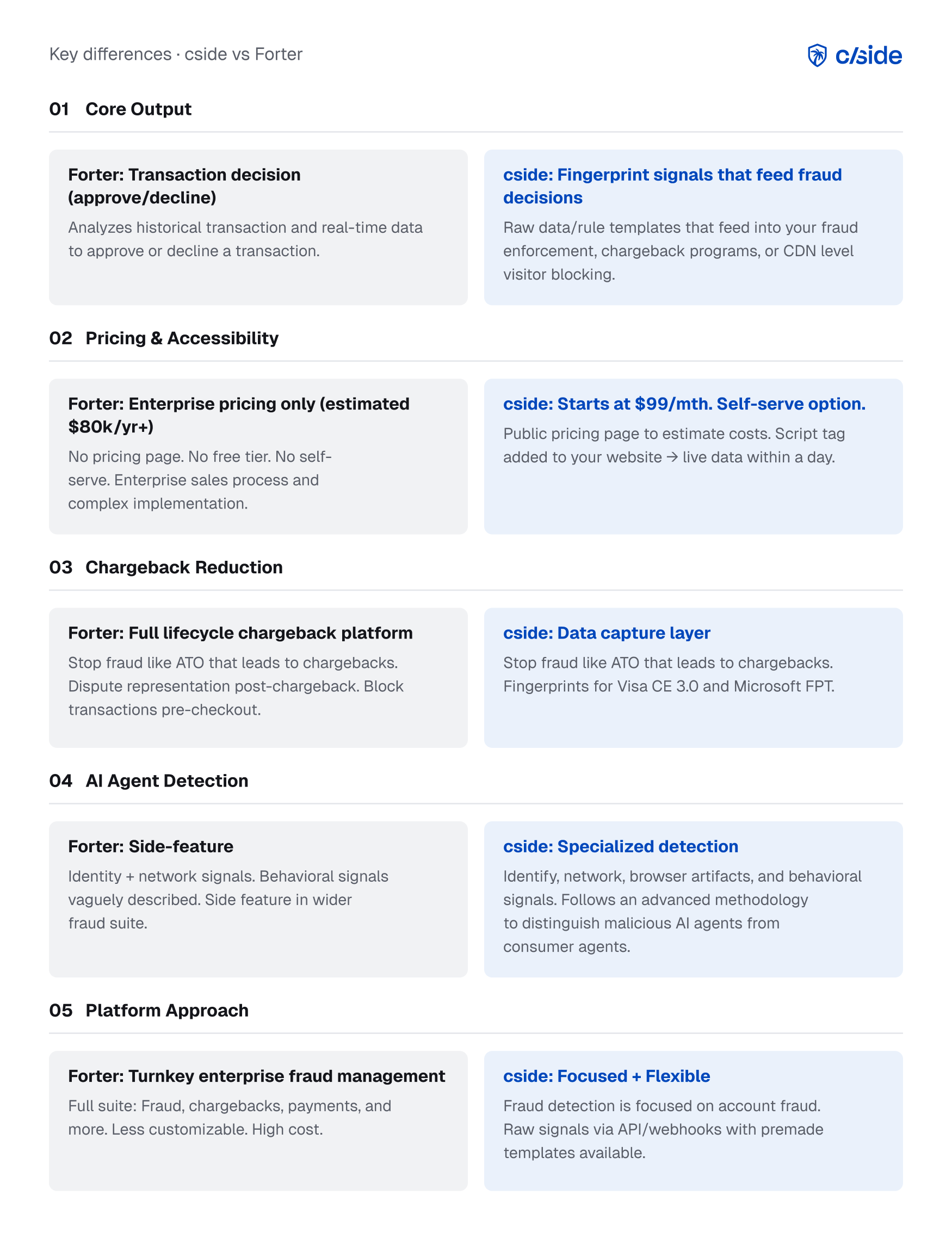
Forter and cside both help businesses fight fraud but they work at different layers. Forter is a transaction decisioning platform. It sits at checkout, analyzes transaction data and returns a verdict: approve or decline. Forter also offers chargeback representation that helps merchants win chargebacks after a dispute has been made.
cside collects signals from your website that feeds into chargeback reduction programs and multiple account fraud prevention use cases. cside sits on your website capturing device fingerprints, behavioral signals, and security signals before a transaction ever happens.
Both products help merchants fight against account takeover and fake account creation. Forter recently added features to detect AI agents to combat AI agent fraud. cside specializes in AI agent detection and leverages deeper detection capabilities against these new attackers.
Disclosure from the author: cside is an adjacent competitor of Forter. Many teams use cside in unison with their anti-fraud suite. This comparison aims to be factually accurate about both products. It's based on public information and is updated periodically.
How cside differentiates its device intelligence
The core difference is machine learning. On top of the 250+ browser, device, and network signals cside collects in each session, it runs separate models for cursor movement, for input and typing patterns, and for broader behavioural signals, then combines their verdicts, rather than scoring a session with a single general model.
cside is also specialised rather than generalistic. Instead of one broad platform stretched across every fraud category, it is tuned for specific use cases: account takeover, account sharing, chargeback evidence, and AI agent detection. That focus is what keeps the behavioural models accurate on the attacks that matter to your team.
Forter vs cside: Pricing & Accessibility
| cside | Forter | |
|---|---|---|
| Pricing | Starts at $99/mo | Not public. Enterprise only. |
| Free tier | Yes | No |
| Self-serve Onboarding | Yes. Dashboard can be accessed in minutes. | No. Enterprise sales process required. |
| G2 rating | 4.8/5 | 4.5/5 |
| Implementation | Script tag added to your website. Live in under a day. | Payment stack + server side integration + website script. |
| Industries served | E-commerce, SaaS, FinTech, Crypto, Gambling websites | Heavy focus on e-commerce and online merchants. |
| Public status page & uptime SLA | Yes. Live status page + 99.9% uptime SLA. | Publishes compliance attestations. |
Free plan
cside: Free forever. Basic fingerprinting fraud detection signals. Free trial for the Business plan if you want to test advanced signals.
Forter: No free tier. Forter offers a free trial for evaluation.
Pricing
cside: Starts at $99/month. Estimate pricing on cside's pricing page. Fraud detection signals include impossible travel, VPN/Proxy detection, browser tampering, multi-device access and more.
- Enterprise: custom quote.
Forter: Does not publish pricing. Average enterprise pricing for comparable products is $80,000+/yr with annual contracts.
Reviews
- cside: 4.8/5 on G2. 4.9/5 on Sourceforge.
- Forter: 4.5/5 on G2.
Implementation
- cside: Self-serve onboarding available with dashboard access in minutes. Add a script tag to your website (similar to analytics tools). Can be live in under a day. Guided onboarding available for enterprise use cases.
- Forter: Enterprise sales process required. Implementation involves three steps: a payment stack integration, a server-side integration, and a client-side JavaScript tag. Full deployment typically requires engineering resources across payments, backend, and frontend.
Forter vs cside: Fraud Use Cases
| cside | Forter | |
|---|---|---|
| Account Takeover (ATO) | Yes (credential stuffing, suspicious access detection) | Yes |
| Multi-accounting | Yes | Yes |
| Account Sharing Detection | Yes | No |
| Friendly Fraud Chargeback Evidence | Yes (through partnership with Chargebacks911) | Yes |
| Anti-Scraping | Yes | No |
| Chargeback Representation | No | Yes |
| Transaction Decisioning | No | Yes |
| Client-side script monitoring | Yes. Core focus. Valid for PCI DSS Requirements 6.4.3 & 11.6.1 | No |
This is where the coverage difference becomes clear. Forter and cside look at different data. Forter sees the transaction: card details, order history, identity signals from a cross-merchant network. cside looks at browser signals, device fingerprints, and on page behavior.
cside Fraud Use Cases:
- Account takeover: Detect when a new device, location, or browser environment appears on an existing account. Correlate device fingerprints against known session patterns.
- Account sharing: Identify when a single account is accessed from more devices than your policy allows. Trigger enforcement actions like MFA challenges or upgrade prompts.
- Multi-accounting: Catch users who create multiple accounts from the same device or browser. Useful for bonus abuse, referral fraud, or policy circumvention.
- Compelling Evidence programs: Device fingerprints are the strongest evidence piece in Visa CE 3.0 and Mastercard First Party Trust. cside integrates with Chargebacks911 to submit fingerprint data into these programs.
cside also has a separate award winning client-side security product that protects your website from payment page skimming (sometimes referred to as Magecart).
Forter Fraud Use Cases:
- Transaction decisioning: Every purchase runs through Forter's model before it clears. The output is a binary approve/decline, backed by a chargeback guarantee. If Forter approves a transaction that turns out to be fraudulent, they cover the loss.
- Dispute management: Forter handles the full chargeback lifecycle after a dispute is filed. They pull Ethoca and Verifi alerts, gather evidence, and submit representments.
- Account protection: Forter flags fake signups, credential stuffing, and ATO using cross-merchant identity data. Where this diverges from cside: Forter does not detect account sharing (a SaaS and streaming problem more than an ecommerce one), and their signals are consumed internally by the decisioning engine rather than exposed as raw data you can route into your own logic.
When cside is the best fit
- You want to solve account sharing, multi-accounting, or chargeback evidence without buying a full fraud suite. For example, a SaaS platform losing revenue to account sharing, or a head of fraud at a mid-market e-commerce company who needs device fingerprints for Visa CE 3.0 but doesn't need transaction decisioning or dispute representation.
- You are a mid-market or small business that wants an accessible tool, not an enterprise platform: cside has usage based pricing, self-serve signup, and a dashboard in minutes. A head of fraud at a 50-person e-commerce company can pilot test cside to reduce chargebacks within a few weeks before asking for permanent implementation budget.
- You need to move fast on a realistic budget. cside starts at $99/month with self-serve signup and a free tier. A single engineer can drop in a script tag and have live data the same day. Forter requires an enterprise sales process, a three-step integration across your payment stack, backend, and frontend.
When Forter is the best fit
If your primary goal is to offload fraud liability at checkout and you have the budget for an enterprise platform, Forter is built for that.
- You need end-to-end dispute management, not just prevention: Your fraud ops team is spending hours gathering evidence and filing representments manually. Forter handles the full lifecycle of chargebacks including evidence gathering and dispute representation.
- Your fraud problem is primarily at the transaction layer: You're an e-commerce company where the core question is "should we approve this order?" and you want a single platform that covers decisioning, chargebacks, and payment optimization together.
Forter vs cside: Detection Features
| cside | Forter | |
|---|---|---|
| Coverage | Website | Website (checkout pages) |
| Device + browser fingerprinting | Yes (250+ signals) | Yes. Part of decision models but not provided to you. |
| AI agent detection | Yes (behavioral signals) | Partial |
| Stealth browser detection | Yes | Partial |
| Custom Rules | Yes | Limited. Users report difficulty in setting custom rules. |
| Raw data available | Yes (webhook, API) | Limited |
| Transaction data analysis | No | Yes |
| Cross-network analysis (data from other merchants) | No | Yes |
AI Agent Detection
Forter launched "Identity Monitoring for Agentic Commerce" in August 2025 as an addition to its existing fraud suite. Their detection relies on identity signals (user-agent strings, cryptographic hashes) and network signals. Behavioral analysis is mentioned but not described in detail.
cside's AI agent detection is a core capability. Detection works across four layers: identity, network, browser environment, and behavioral signals. The behavioral layer is where the approaches diverge most. cside monitors browser artifacts and interaction patterns at the execution level. The signals and the method are described on our AI agent detection page.
cside's deep behavioral analysis follows the same general approach used by other specialized agent detection vendors like DataDome and HUMAN Security. Forter is a transaction fraud platform that added agent detection. cside is a browser runtime monitoring platform where agent detection is a natural extension of what the product already observes.
Both vendors recognize that "blocking all bots" is not the right approach in the agentic era. Instead agentic traffic should be categorized and enforced accordingly:
- Consumer agents like Perplexity Comet, Claude Computer Use, and OpenAI Operator. They represent legitimate demand through a new channel.
- LLM crawlers and model trainers from major AI platforms.
- Malicious agents running automated fraud.
We broke down some of the exact signals our team looks at in our guide How to Detect AI Agent Traffic On Your Website.
Persistent Visitor ID
cside's fingerprinting produces a persistent visitor ID that follows a visitor across sessions. You can access that ID through an API or no-code rules builder. This is the foundation for use cases like account sharing detection, multi-accounting, and chargeback evidence. It gives you flexibility for enforcement or custom tuning your own models for fraud detection.
Forter uses device fingerprinting internally to power its decision models, but does not expose a persistent visitor ID as an API output you can build identity workflows around.
What is cside?
cside is a web security platform that prevents fraud on your website by monitoring the browser runtime. The fingerprinting product collects 250+ signals and focuses on four use cases: account takeover, account sharing, chargeback evidence (CE 3.0 through Chargebacks911), and AI agent detection. The script monitoring product watches every script executing on a page, catching injections, tampering, and skimming attacks that fingerprinting alone does not see.
What is Forter?
Forter is a fraud prevention platform that makes real-time approve/decline decisions at checkout by analyzing transaction data. The platform covers transaction decisioning, dispute management, payment optimization, and account protection.
What cside covers that Forter does not
- Account sharing detection: cside's persistent visitor ID tracks how many distinct devices access a single account and flags when usage exceeds your policy. This is primarily a SaaS and streaming problem. Forter's platform is built around ecommerce transactions and does not offer account sharing detection.
- Client-side security: cside's script monitoring product watches every script executing on your pages. This catches payment page skimming, formjacking, and malicious code injections that can lead to session hijacking and account takeover. It satisfies PCI DSS 4.0.1 requirements 6.4.3 and 11.6.1. Forter does not offer script monitoring or client-side security coverage.
- Operational transparency: cside publishes a public status page at status.cside.com, a public trust portal at trust.cside.com, and a 99.9% uptime SLA, so you can verify our reliability and incident history for yourself. Check each vendor's own trust site for the equivalent.
Related resources

Researching & writing about client side security.