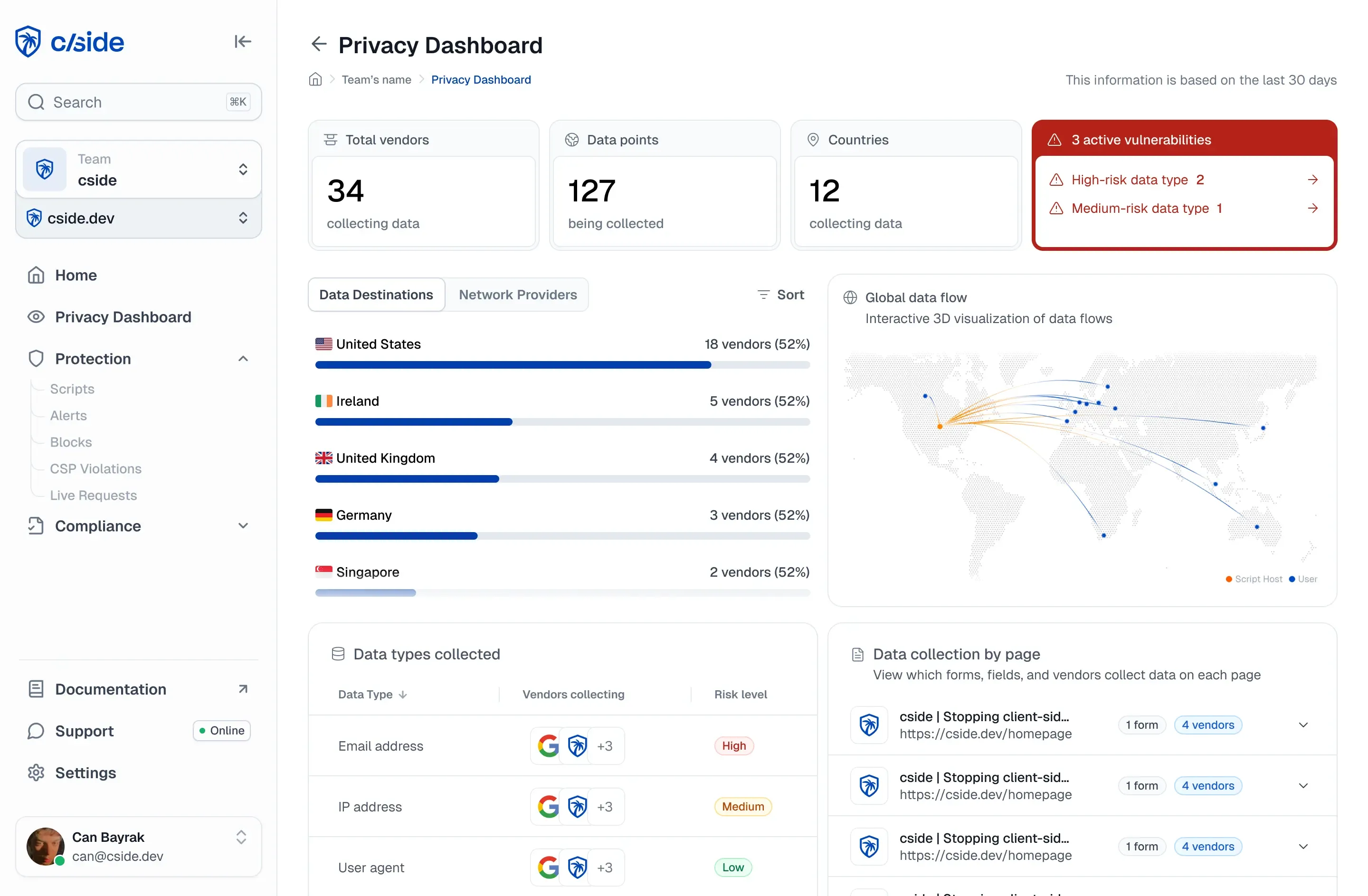

TL;DR: compare bot and AI agent platforms
- Two different jobs: Your bot vendor is not your AI agent vendor. Forrester renamed the category to Bot and Agent Trust Management in Q4 2025 because scripted-bot detection and browser-native agent detection are architecturally different jobs.
- Classify at the browser: In cside's controlled testing, traditional tools missed AI agents in 81 out of 100 scenarios. Gartner predicts 80% of product searches will be agentic by 2030. cside classifies agents at the browser layer where network tools cannot see.
- Ask before extending: Before you extend your existing bot vendor, ask whether they read canvas entropy, session cadence, and cursor geometry, or only IPs. If the answer is only IPs, you are buying a rename, not coverage.
Short on time? See cside's AI-agent detection. It covers everything below in one deployment.
Traditional bots were scripted. They hit your endpoints in predictable patterns, carried telltale headers, and behaved nothing like real users. The detection tooling built to stop them was fit for that fight: network-layer, rule-based, IP reputation driven.
AI agents are a different kind of problem. They run inside real browsers, move through your UI the way a human would, and are backed by LLMs that can reason through CAPTCHAs, adapt to friction, and complete checkout flows without tripping a single legacy rule. In cside's controlled testing, traditional tools missed AI agents in 81 out of 100 test scenarios. As of early 2025, 63% of websites were already seeing traffic arrive via AI chatbot interfaces, according to Ahrefs research, and Gartner predicts that 80% of product searches will be conducted through agentic AI by 2030, with 20% of online purchases completed by AI agents.
This article compares the leading bot and AI agent detection platforms across detection layer, capability, and fit. It covers what separates legacy bot management from purpose-built agent trust tools, where each vendor sits today, and what security leaders should be asking before they extend their existing tooling to cover AI agent traffic.
If you want the broader category view rather than the bot-versus-agent split specifically, see our companion guide to the best bot and agent trust management platforms compared.
What is the difference between a bot and an AI agent?
Quick answer: A traditional bot follows a fixed script built for a single task. An AI agent is goal-directed, autonomous, and capable of adapting its behaviour based on what it observes on screen. That adaptability defeats most bot detection approaches, which rely on the predictability that bots used to guarantee.
Traditional bots: scripted, predictable, disposable
Classic bots are rule-driven. A scraper hits the same URL at regular intervals. A credential-stuffing bot cycles through a username and password list and submits the same form repeatedly. A scalper bot monitors a target page and fires a purchase request the moment stock appears. These patterns are repetitive and, once identified, relatively straightforward to fingerprint.
Bot detection platforms were built around this predictability. They look for anomalies in request rate, user-agent strings, IP reputation, TLS fingerprints, and HTTP headers. When a bot repeats the same request signature from the same IP range too many times, it gets blocked.
AI agents: adaptive, goal-directed, and browser-native
AI agents operate differently. Tools like OpenAI Operator, Amazon Buy For Me, and Perplexity Shopper receive a task from a human user and execute it autonomously inside a real browser context. They render JavaScript, interpret page layouts, fill out forms, resolve ambiguities, and navigate multi-step flows.
Because they run in a real browser and interact with the UI the way a human would, they do not produce the blunt signals that legacy detection depends on. The requests look legitimate. The timing is variable rather than robotic. The fingerprint may match a standard Chrome instance. From a network-layer perspective, they are nearly invisible.
Why this distinction matters for detection architecture
The difference is architectural, not only behavioural. Detecting a bot that floods an API endpoint requires different tooling than detecting an AI agent that moves through your product page, adds an item to a basket, and attempts checkout on behalf of a remote user. The latter is a browser-layer problem. Network-layer tools do not have the visibility to solve it.
Why traditional bot detection misses AI agents
Legacy detection applies heuristics built for scripted, high-volume, low-sophistication attacks. AI agents invalidate several of those heuristics at once.
- Real browser fingerprints: Agents often run inside Chromium-based browsers, producing fingerprints that match legitimate user sessions.
- Variable timing: LLM-driven decision cycles introduce natural pauses, scroll events, and hover actions that look human.
- Clean IPs: Agents can be routed through residential proxies or cloud infrastructure that has no prior abuse reputation.
- CAPTCHA adaptation: Modern AI agents can reason through text-based challenges or delegate them to human-in-the-loop services, one of the reasons CAPTCHAs are no longer a reliable bot defense.
- Semantic form completion: An agent reading a checkout form can complete it coherently, not with random garbage inputs that trip anomaly rules.
The result is that detection logic optimised for bots routinely lets AI agents through. If you are starting an evaluation from scratch, our guide on how to choose an AI agent detection solution walks through the criteria that matter.
Signal comparison: traditional bot vs. AI agent
| Signal | Traditional Bot | AI Agent |
|---|---|---|
| Request timing | Consistent, clock-like | Variable, human-like |
| Browser fingerprint | Headless or spoofed | Real Chromium instance |
| IP reputation | Often flagged | Residential or cloud, clean |
| Form completion | Repetitive or malformed | Semantically coherent |
| JavaScript execution | Often skipped | Full render, full execution |
| CAPTCHA response | Fails or bypasses crudely | Adaptive reasoning or delegation |
| Interaction pattern | No scroll, hover, or focus events | Scroll, hover, focus, click present |
| Adaptability | None (script-bound) | High (LLM-driven reasoning) |
How bot detection platforms work (and where they fall short)
Quick answer: Traditional bot detection operates at the network layer. It inspects IP addresses, HTTP headers, request rates, and TLS fingerprints. These signals are useful against scripted bots but do not capture what an AI agent actually does inside the browser, which is where the meaningful behaviour happens.
The network-layer approach
Legacy bot management platforms, including Imperva, Akamai, AWS WAF Bot Control, and Cloudflare, sit in front of your origin server at the CDN or WAF layer. When a request arrives, they check it against a set of signals:
- IP reputation and ASN classification
- Known bot user-agent strings
- Request rate and velocity thresholds
- HTTP header ordering and TLS fingerprint (TLS handshake fingerprint and TLS handshake fingerprint)
- Behavioural rules based on session-level request patterns
This approach works well for high-volume, low-sophistication attacks. It stopped most of the scraping, credential stuffing, and layer-7 DDoS that dominated the bot landscape for the past decade.
Where it falls short against AI agents
The network layer has no visibility into what happens inside the browser after the initial request is served. It cannot see how a user interacts with the page, whether scroll events and mouse movements look human, or whether the timing between actions follows a plausible human decision cadence.
AI agents operate at exactly the layer that network tooling cannot see. They receive a fully rendered page and act on it. The requests they send back look like ordinary form submissions, add-to-basket clicks, or checkout initialisations, because they are. The agent completed those actions through the UI, not through a raw API call.
As of early 2025, 63% of websites were already seeing traffic arrive via AI chatbot interfaces, according to Ahrefs research, and the volume has only grown since. In cside's controlled testing, traditional tools missed AI agents in 81 out of 100 test scenarios.
What this looks like in practice: A Perplexity Shopper agent is tasked with finding and purchasing a specific laptop model at the lowest available price. It routes through a residential proxy, opens the product page in a real Chromium browser, and navigates naturally through product filters, comparing three SKUs before selecting one. At the CDN layer, the request looks identical to a human session: standard Chrome headers, clean IP, session timing within normal parameters, no rate anomalies. The network-layer tool passes it without a challenge. Inside the browser, cside detects the characteristic LLM reasoning pause before each UI interaction, identifies the IP range as associated with Perplexity's known infrastructure, and flags a pattern of direct element targeting that bypasses surrounding page content. The agent is identified, classified as a shopping agent, and routed through the site's configured checkout guardrail. The network tool saw a clean session, while the browser layer caught the intent.
The arms race problem with rule-based detection
Rule-based systems require someone to observe a new attack pattern, write a rule to match it, and deploy that rule before the next wave arrives. Against traditional bots, this cycle worked because bot authors had limited ability to adapt quickly.
Against AI agents, the model is inverted. An LLM can be prompted to change its interaction pattern in milliseconds. A rule deployed this week may be ineffective against the same agent running a different approach next week.
As AI agent traffic grows, rule-based platforms face increasing signal noise and diminishing marginal effectiveness against the most sophisticated sessions, a core reason legacy bot detection tools miss AI agents.
How AI agent detection platforms work differently
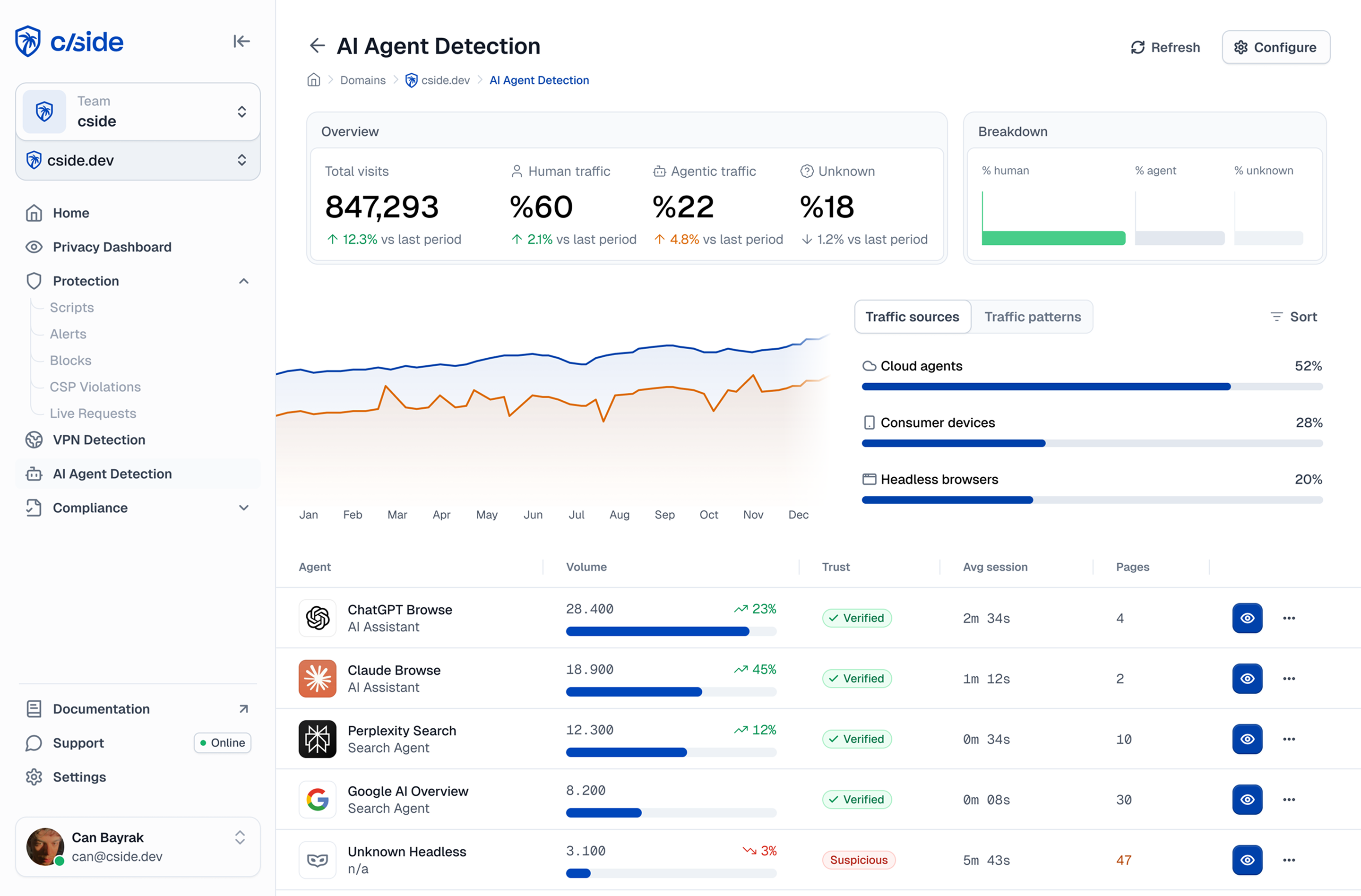
Quick answer: AI agent detection operates at the browser layer, not the network layer. Instead of inspecting headers, it analyses how a session unfolds inside the page: interaction timing, scroll patterns, fingerprint consistency, UI event sequences, and network request behaviour. It classifies intent, not just identity, and can attribute sessions to known agent platforms or flag them as unknown.
Browser-layer detection: what it actually sees
A browser-layer detection platform instruments the page itself. It observes:
- Interaction patterns: Does the session include scroll events, focus changes, cursor movement, and natural-looking click timing?
- Timing signals: Are form fields completed at machine speed or with human-like pauses?
- Fingerprint consistency: Does the reported browser fingerprint match the actual rendering behaviour of the session?
- Network request analysis: Are outbound requests consistent with what a user-initiated session would produce, or do they reveal programmatic patterns?
- VPN and proxy signals: Is the session routing through infrastructure associated with known LLM platforms or anonymisation services?
These signals are invisible at the network layer. They only become observable once the page has loaded and interaction has begun.
Trust scoring and classification: beyond block or allow
Legacy bot management produces a binary outcome: the session is a bot, or it is not. That binary breaks down when the traffic is an AI agent acting on behalf of a legitimate user. Blocking it indiscriminately damages authorised agentic commerce. Allowing it unchecked exposes the site to scraping, ticket scalping, AI card-testing agents, and checkout fraud.
The answer is intent classification. Rather than asking "is this a bot?", it asks whether the session is acting on behalf of a human, and whether that intent can be trusted.
That framing allows for graduated responses: allow a verified agent through, guide an unknown agent to a sandboxed flow, flag a suspicious session for human review, or block an agent whose behaviour matches known fraud patterns. Rules can be applied per page, so checkout might have tighter guardrails than a product detail page.
Deanonymisation: knowing which agent you are dealing with
Not all AI agents declare themselves. Some announce their identity through user-agent strings or IP ranges that match known LLM infrastructure. Others operate through residential proxies or deliberately strip identifying signals.
Purpose-built agent detection can deanonymise sessions using a combination of IP signatures from LLM platforms (OpenAI, Amazon, Perplexity), timing patterns unique to LLM reasoning cycles, and fingerprint anomalies that appear when a real browser is being driven programmatically. This attribution matters: a verified OpenAI Operator session accessing a product page for legitimate shopping assistance is a different risk profile from an unknown agent systematically extracting price data.
cside's approach in detail
cside is built as a browser-layer AI agent detection and agent trust management platform. It detects named agents (OpenAI Operator, Amazon Buy For Me, Perplexity Shopper) and unknown agents using signals gathered inside the browser. Every session is read against a baseline of 250+ browser, device, and network signals that cside collapses into a persistent device fingerprint, so a session can be tied back to its underlying device even as surface details change. The detection signal set includes:
- IP signatures from LLM platform infrastructure (OpenAI, Amazon, Perplexity), allowing attribution of sessions to specific providers even before behavioural analysis begins
- Timing patterns unique to LLM reasoning cycles: the pauses, decision latencies, and action cadences that distinguish AI-driven sessions from human ones
- Fingerprint anomalies that appear when a real browser is being driven programmatically, where the declared fingerprint does not match the actual rendering behaviour
- Outbound network request anomalies that reveal programmatic session patterns not consistent with user-initiated activity
- VPN and proxy correlation against infrastructure associated with known LLM deployment environments and anonymisation services
- UI interaction analysis across the full interaction surface: scroll depth and velocity, hover events, click patterns, focus changes, and form completion behaviour
Controls include intent classification, deanonymisation of AI sessions, and custom guardrails configurable per page type, so a product detail page can operate under lighter rules than a cart or checkout page. Sessions that cannot be clearly attributed can be escalated to human approval rather than blocked outright. The use case spans both fraud prevention and agentic commerce: the same platform that blocks a malicious agent attempting card testing can verify and pass through a legitimate OpenAI Operator session completing a purchase on behalf of a real user. It is the only platform in this comparison where the detection layer, the browser, is the same layer where agent intent shows up. For a deeper look at the tooling landscape, see our roundup of the best tools for AI agent detection to prevent website fraud.
Platform comparison: bot detection vs AI agent detection
Quick answer: Network-layer platforms (Cloudflare, Akamai, Imperva, AWS WAF) handle classic bot traffic well but have limited native visibility into AI agent behaviour. Vendors including DataDome and HUMAN Security are building dedicated agent trust products on top of their network-layer foundations. cside approaches the problem from the browser layer, which is where AI agent interaction actually occurs.
| Platform | Detection Layer | Detects Classic Bots | Detects AI Agents | Intent Classification | Best For |
|---|---|---|---|---|---|
| cside | Browser | Yes | Yes, natively | Yes, per-page guardrails | AI agent detection, agent trust management, browser-layer fraud prevention |
| DataDome | Network or CDN | Yes | Partial (Agent Trust product) | Limited | Broad bot protection with agent trust extension |
| HUMAN Security | Network | Yes | Partial (AgenticTrust) | Limited | Enterprise bot management with emerging agent coverage |
| Imperva | WAF or Network | Yes | Limited | No | WAF-integrated bot protection for regulated industries |
| Akamai | CDN or Network | Yes | Limited | No | CDN-integrated bot and abuse protection at scale |
| AWS WAF Bot Control | Network | Yes | Partial (AI Activity Dashboard, 650+ agents tracked) | No | AWS-native teams needing bot visibility within existing infrastructure |
| Cloudflare | Network | Yes | Limited | No | Network-layer bot management for Cloudflare customers |
A pattern stands out across these vendors. Legacy network-layer platforms are capable against classic bots but are extending their coverage to AI agents incrementally, mainly through additional product modules rather than a fundamental architectural change. The underlying detection layer remains the network.
AWS WAF Bot Control launched an AI Activity Dashboard in February 2026 that tracks more than 650 distinct agent types, showing demand from security teams for visibility even where behavioural classification remains limited at the network layer.
Platforms that started from the browser are structurally better positioned to classify intent, because browser behaviour, not HTTP headers, is where intent actually shows up.
What is a bot score?
A bot score is a single number, usually 0 to 100, that expresses how likely a request came from automation rather than a human. Bot detection platforms compute it from signals like IP reputation, request headers, TLS fingerprint, and behavioral patterns, then let you act on a threshold: allow, challenge, or block. A bot score is a useful summary, but it has two limits. It collapses a lot of nuance into one number, and a raw score does not tell you whether the automation is a benign crawler, a consumer AI agent, or a malicious bot. That is why browser-layer detection pairs the score with classification and intent, so you can enforce different policies for different kinds of automation rather than blocking on a threshold alone.
Which platforms are investing in agent trust management?
Quick answer: Forrester renamed its coverage category to "Bot and Agent Trust Management Software" in Q4 2025, marking formal recognition that AI agents require a distinct trust model. A small number of platforms are building dedicated agent trust products. Most are extending legacy tools incrementally. The structural difference is detection layer: browser-layer detection observes the behaviour that expresses intent.
The Forrester category shift
Forrester renamed the category in Q4 2025 to reflect a change in the threat landscape: the traffic that security teams need to manage is no longer only bots. It now includes autonomous agents acting on behalf of human users, which requires a trust model rather than a simple allow or block rule.
The question of trust is different from the question of authenticity. A bot is not human. An AI agent may be acting on behalf of a real human user and doing exactly what that user asked it to do. The security question has three parts:
- Is the delegation chain trusted: did a real human authorise this agent to act on their behalf?
- What is the agent's intent on this specific page?
- What guardrails apply at that point in the session?
Those three questions cannot be answered at the network layer. They require visibility into what the agent is actually doing inside the browser.
Platforms building dedicated agent trust products
Three platforms have moved furthest towards dedicated agent trust functionality.
cside positions agent trust management as its core product, not an extension. The browser-layer approach gives it native access to the interaction signals that express intent. Custom guardrails can be configured per page type, and sessions can be classified, guided, or escalated rather than simply blocked. See how cside compares directly with DataDome, HUMAN Security, Cloudflare, Imperva, and Akamai.
DataDome Agent Trust extends DataDome's existing network-layer bot management with agent-specific detection modules. DataDome classifies agents into four categories: AI Crawler, AI Assistant, Agentic Browser, and Autonomous Agent. Every session receives a dynamic trust score based on identity strength, reputation, and behavioural intent. DataDome's Galileo research team monitors agent behaviour patterns and identity verification challenges across the traffic it processes. DataDome operates at the network and CDN layer.
HUMAN Security AgenticTrust is HUMAN's dedicated product for AI agent management, built on SATORI threat intelligence. HUMAN AgenticTrust provides cryptographic agent verification using digital signatures, backed by SATORI threat intelligence for cross-vertical threat actor correlation and session-level visibility across the customer journey. It operates primarily from the network layer with agent-specific additions.
Platforms adapting legacy tools
Imperva, Akamai, Cloudflare, and AWS WAF Bot Control remain primarily network-layer platforms. Each has some level of agent identification, either through user-agent matching, known IP ranges, or classification rules. What they lack natively is visibility into in-browser interaction patterns, which limits their ability to classify intent beyond "this traffic came from a known LLM IP range."
Imperva combines a network-layer WAF with bot management that classifies bad bot traffic by category. The limitation is that Imperva has no browser-layer visibility, so AI agents using clean residential or cloud IPs bypass its classification entirely.
Akamai pairs its enterprise CDN with Bot Manager, applying behavioural scoring, device fingerprinting, and ML-based challenges through Kona Site Defender integration. The limitation is that its detection depends on known bot signatures and device fingerprints; LLM-backed agents running inside real browser environments with clean IPs are not reliably caught.
That distinction matters as McKinsey projects $3 to $5 trillion in global revenue from agentic commerce by 2030. If that projection is accurate, AI agents will become a significant share of legitimate commercial traffic. Security teams will need to distinguish authorised agent sessions from malicious ones, not block all of them indiscriminately.
Forrester renamed its bot management coverage category to "Bot and Agent Trust Management Software" in Q4 2025, reflecting how much the threat model has outpaced legacy network-layer tooling. Agent trust management exists to close that operational gap.