TL;DR: AI agent detection POC methodology for CISOs
- Renamed, not re-architected: Most bot vendors added 'agent' to their product names in 2025 without changing detection architecture. Forrester renamed the category Bot and Agent Trust Management Software in Q4 2025 for that reason. Network-layer tools miss the agents that matter, cside engineers bypassed them in 81 of 100 tests.
- The real POC: The real POC runs OpenAI Operator, Amazon Buy For Me, and Perplexity Shopper against your staging environment, plus a stealth headless Chromium. Gartner predicts 80% of product searches will be conducted through agentic AI by 2030 with 20% of purchases completed by agents, and McKinsey projects $3-5 trillion in agentic commerce revenue.
- The decision: If your risk is content scraping or credential stuffing, prioritize browser-layer JavaScript SDK deployment. If you already run DataDome, HUMAN, Imperva, Akamai, or AWS WAF at the edge, add cside at the browser layer. Reject any vendor that will not share false positive data under NDA.
Short on time? See cside's AI-agent detection. It covers everything below in one deployment.
AI agent detection is now a distinct buying decision. Until recently it sat inside bot management evaluations, treated as an extension of the same problem. It is not. AI agents operate differently, require different detection architecture, and present both a fraud risk and a commercial opportunity that classic bot tools were never built to handle.
The market has recognised this. As of early 2025, 63% of websites were already seeing traffic arrive via AI chatbot interfaces, according to Ahrefs research. Gartner predicts that 80% of product searches will be conducted through agentic AI by 2030, with 20% of online purchases completed by AI agents. Most established bot vendors have responded by adding "agent" to their product names. That does not mean the underlying detection capability has changed. Forrester renamed its bot management coverage category to "Bot and Agent Trust Management Software" in Q4 2025, a direct reflection of the gap that still exists between detection tooling and the agent traffic it now needs to classify.
This guide is a five-step framework for security leaders and CISOs evaluating solutions now and needing to cut through the marketing noise.
Why AI agent detection is a distinct security decision from bot management
Quick answer: AI agents use real browsers, adapt to page content, carry LLM-driven decision logic, and can initiate high-value actions like purchases or account changes. Classic bot management detects simple automated HTTP traffic. It was not designed for this threat model, and the detection gap is demonstrably large.
The Forrester category shift
Forrester's reclassification in Q4 2025 was not just terminology. It reflected a structural change in what organisations need to govern. Bot management has historically focused on blocking automated requests at the network perimeter. Agent trust management requires governing intent, identity, and action across an entire session.
The distinction has real procurement consequences. A vendor evaluated against the old category criteria, typically request-level throughput and IP reputation accuracy, will score well on metrics that are largely irrelevant to AI agent detection.
Why AI agents require a different threat model
Classic bots send HTTP requests directly. They are caught by rate limiting, IP reputation, request fingerprinting, and user-agent checks. AI agents are different in almost every respect:
- They operate inside real or headless browsers with full JavaScript execution.
- They adapt based on page content, navigation paths, and CAPTCHA challenges.
- They use residential proxy networks to rotate IP addresses continuously.
- Their browser fingerprints are designed to match legitimate user environments.
- Their timing and interaction patterns are increasingly calibrated to resemble human behaviour.
Network-layer detection covers the majority of established bot management products. It has a structural blind spot for the most capable AI agents, the same autonomous browsers that create distinct privacy and compliance risks for website operators when they bypass cookie consent and complete transactions on a user's behalf.
Step 1: Define what AI agent activity you need to govern
Quick answer: Before approaching any vendor, map your specific threat surface. The governance question for a shopping site is different from the governance question for a SaaS login page or a financial application. AI agent risk is not uniform and your requirements should not be either.
AI agent threat scenarios to assess before buying
Work through these scenarios against your own environment:
- Content scraping. Agents consuming product data, pricing, or proprietary content at scale, often via browser sessions that bypass crawl-rate detection.
- Card testing. Agents submitting small-value payment attempts to validate stolen card credentials against your checkout flow.
- Account creation at scale. Agents generating synthetic accounts to exploit referral bonuses, loyalty programmes, or free trial thresholds.
- Agentic purchases. Legitimate shopping agents like OpenAI Operator or Amazon Buy For Me completing real transactions on behalf of users.
- Credential stuffing. Agents testing breached credential lists against login forms with human-like timing and device rotation.
- Inventory manipulation. Agents locking high-demand inventory to exploit resale markets or force competitors into stockouts.
- Data exfiltration. Agents navigating authenticated sessions to extract structured data from areas not intended for automated access.
Commercial agents vs malicious agents: different use cases, different policies
Not all agent traffic is adversarial. 36% of US consumers are already interested in using AI agents to handle transactions in specific categories (Forrester), and Visa and Mastercard launched agentic payment infrastructure in 2025 to support legitimate AI-driven commerce.
Your solution needs to handle both ends of that spectrum. A tool that can only block agents will increasingly harm conversion as agentic commerce grows. McKinsey projects $3-5 trillion in global revenue from agentic commerce by 2030. The right requirement is detection, classification, and policy, not detection and block alone.
Step 2: Evaluate detection architecture, the most important decision
Quick answer: Detection architecture determines what signals a vendor can actually see. Network-layer tools read IP addresses and headers. Browser-layer tools read what is happening inside the session. Most AI agents are designed to pass network checks. Browser-layer detection is the only reliable way to catch them.
Network-layer vs browser-layer detection
The majority of established bot management vendors operate at the CDN or WAF layer. They intercept requests before they reach your application and apply pattern matching, IP reputation scoring, and behavioural heuristics based on request metadata.
This works for bots that send raw HTTP requests. It does not work for AI agents that use real Chromium or Firefox instances, execute JavaScript against the DOM, navigate multi-step flows over extended sessions, and arrive through residential proxy IPs with no negative reputation history.
Architecture comparison
| Architecture | What you see | What you miss | Right for |
|---|---|---|---|
| Network layer (CDN/WAF) | IP, ASN, headers, request rate, user-agent string | Browser behaviour, DOM interaction, fingerprint anomalies, session-level intent | Simple bots, high-volume scrapers using known IPs |
| Browser layer | Interaction timing, UI signals, fingerprint mismatches, JS execution patterns, session-level behaviour | Raw network traffic that does not reach the browser | AI agents using real browsers, stealth headless tools, residential proxy users |
| Combined | Full stack | Very little, when properly integrated | Organisations with the highest-risk web applications |
Why browser-layer is essential for web application security
According to cside first-party research, cside engineers bypassed traditional bot detection in 81 out of 100 controlled test scenarios. The failure mode is consistent: the agent passes all network checks because it presents a clean IP, a valid user-agent string, and a plausible request structure. The network-layer tool sees nothing anomalous.
The same agent, observed at the browser layer, reveals timing inconsistencies, fingerprint mismatches, or interaction patterns that do not match any known human or legitimate-agent profile. Browser-layer tools catch what network tools miss by design.
Step 3: Assess agent classification and intent scoring capabilities
Quick answer: Detection is necessary but not sufficient. The tool must classify what kind of agent it has found, score its intent, and support differentiated policy responses. A tool that can only return "agent detected" forces a binary choice: generate false positives or miss real threats.
Beyond block and allow: classification depth matters
The agents hitting your web application are not homogeneous. OpenAI Operator executing a legitimate purchase on behalf of a paying customer is categorically different from an unknown headless browser systematically testing your card vault. Treating both identically is an operational error with real commercial consequences.
Questions to ask any vendor:
- Can you identify named commercial agents by name, not just by category?
- Can you distinguish an unknown agent from a known legitimate agent?
- Can you score intent within a session, not just at first contact?
- Can you differentiate an agent browsing product pages from one that has started submitting payment forms?
Named agent identification
Look for vendors that maintain a live index of known agents, including:
- OpenAI Operator
- Amazon Buy For Me
- Perplexity Shopper
- Googlebot and major crawlers
- Other LLM platform agents
Known-agent identification matters because policy differentiation depends on it. A vendor whose detection output is "automated traffic detected" gives you nothing to act on. A vendor that tells you "this is OpenAI Operator browsing product pages with normal timing" gives you enough to route it through a controlled path rather than blocking it outright.
Trust scoring and policy granularity
The policy model should support more than allow and block. Look for:
- Guide actions that redirect agent sessions to controlled paths, rate-limited experiences, or alternative content
- Escalation to human approval for high-value transactions in ambiguous classification zones
- Per-page rule sets so product pages, cart pages, and checkout pages carry different thresholds
- Session continuity so a policy decision made on page one persists through the session
Step 4: Check for integration, deployment, and operational fit
Quick answer: The best detection architecture is useless if it takes six months to deploy or introduces latency that damages user experience. Evaluate deployment model, false positive rate, and reporting quality as hard requirements, not secondary considerations.
Deployment model
Vendors take different integration approaches. The right choice depends on your stack and tolerance for deployment complexity.
| Deployment model | What it involves | Latency risk | Agent visibility |
|---|---|---|---|
| CDN / reverse proxy | Route traffic through vendor infrastructure | Low for CDN-native, higher for proxy | Network layer only |
| WAF agent | Add a processing layer in front of application | Medium | Network layer only |
| JavaScript SDK / tag | Inject a script into your page | Very low | Browser layer |
| Browser extension or managed browser | Vendor-controlled browser environment | N/A | Full browser layer |
For web applications where browser-layer signals matter most, a JavaScript SDK or equivalent browser-side integration is the architecture to prioritize.
False positive rate and legitimate user impact
False positive rate is the most operationally significant metric for any detection system deployed on a customer-facing web application. A false positive on a checkout page is a lost transaction, not a security win.
Request false positive data from any vendor, and ask specifically about:
- False positives on known commercial agents (shopping assistants)
- False positives on mobile browsers with non-standard fingerprints
- False positives on VPN users who are not evading detection
Any vendor unwilling to provide this data under NDA during a proof of concept should be treated with caution.
Reporting and visibility into agent traffic
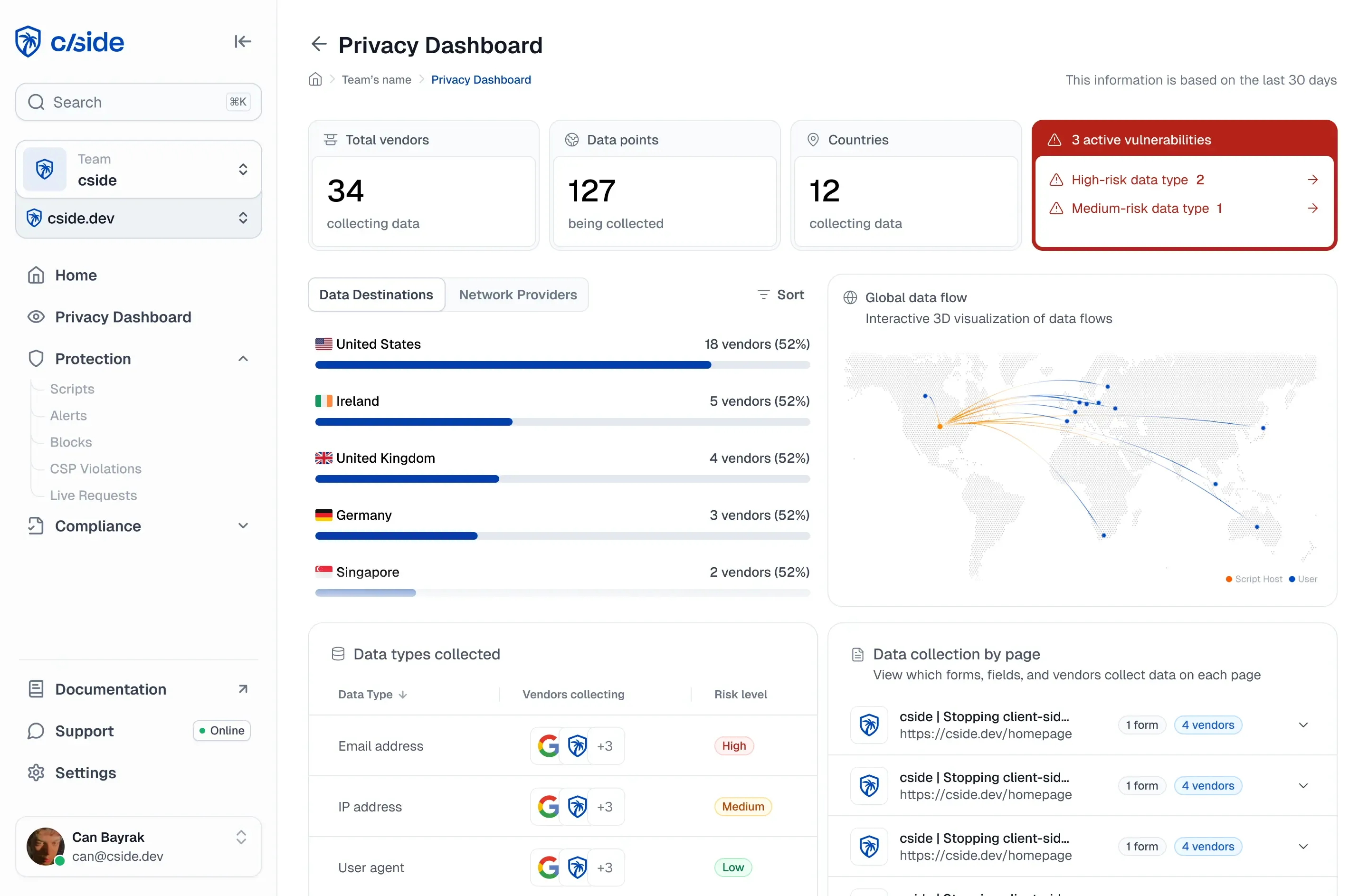
Most organisations lack clear visibility into the agent traffic they are already receiving. Before a detection tool can protect you, it needs to show you what is there.
Minimum visibility requirements for your evaluation:
- Session-level agent logs with classification labels
- Named agent breakdown over time
- Per-page traffic distribution for agent sessions
- Trend data showing whether agent traffic is growing, changing in composition, or targeting new parts of your application
Step 5: Stress test before you commit
Quick answer: The only meaningful evaluation of an AI agent detection vendor is a live proof of concept using real AI agents against your actual environment. Synthetic benchmarks and vendor-provided test traffic are insufficient. Run real tools, measure real detection rates, and treat the cside research benchmark of 81 bypasses out of 100 as the baseline for what an inadequate solution looks like.
How to run a proof of concept
A rigorous POC for AI agent detection should:
- Use real AI agents. Run OpenAI Operator, Amazon Buy For Me, or Perplexity Shopper against your staging environment. Use known testing tools as a baseline.
- Include unknown agents. Use a headless Chromium instance with stealth plugins against the same environment. The vendor should flag it as unknown even without a signature match.
- Test across multiple pages. Product pages, login forms, cart flows, and checkout should each be tested separately with agent traffic.
- Measure false positives. Send real user sessions alongside the agent traffic and count misclassifications on both sides.
- Evaluate the policy response. Do not just test detection. Test what the system actually does with a detected agent session.
The benchmark: 81 out of 100 bypass attempts
According to cside's own research, cside engineers bypassed traditional bot detection in 81 out of 100 controlled test scenarios. Use this as your baseline. If a vendor cannot substantially outperform this threshold against the tools you run in your POC, their architectural claims do not hold up in practice.
What a good vendor should demonstrate
A vendor with genuine AI agent detection capability should:
- Correctly classify at least the named commercial agents within minutes of first contact
- Flag unknown headless browser agents on behavioural signals, not just signatures
- Produce a session-level record with enough detail to reconstruct what the agent did and why it was classified as it was
- Show zero false positives against normal user sessions in a controlled test
Key vendors to evaluate
Quick answer: cside is the only browser-native platform purpose-built for AI agent detection. DataDome and HUMAN Security lead the network-layer category with dedicated agent products. Imperva, Akamai, and AWS WAF Bot Control offer broad bot management with varying degrees of AI agent-specific capability.
cside
The only browser-layer AI agent detection and agent trust management platform. cside detects agents at the session level through interaction patterns, timing signals, UI behaviour, fingerprint anomalies, and network requests made from within the browser. That read draws on a baseline of 250+ browser, device, and network signals per session, enough to bind each session to the device behind it and maintain a persistent fingerprint. It identifies named agents including OpenAI Operator, Amazon Buy For Me, and Perplexity Shopper, and supports allow, block, and guide policy actions with per-page granularity.
Best for: security and digital product teams that need to govern both fraudulent and legitimate AI agent traffic at the browser level.
See the AI agent detection product
DataDome Agent Trust
Network and CDN-layer agent detection built on DataDome's existing bot protection infrastructure. DataDome's Agent Trust product classifies agents into four categories, generates a dynamic 100-point trust score per session, and includes Web Bot Auth and Know Your Agent (KYA) cryptographic verification. Agent Trust is included in all Bot Protect plans. In May 2026, DataDome launched Priority Protect, a virtual waiting room product for high-demand events such as ticket drops, flash sales, and limited inventory releases.
Best for: organisations already using DataDome for bot management who want agent classification without switching vendors.
HUMAN Security AgenticTrust
Network-layer agent and machine-to-machine traffic classification backed by HUMAN's SATORI threat intelligence platform. HUMAN AgenticTrust provides cryptographic digital signature verification and session-level visibility from product discovery to checkout, underpinned by SATORI threat intelligence.
Best for: enterprise teams with HUMAN already in their security stack looking to extend AI agent coverage.
Imperva Advanced Bot Protection
WAF and network-layer bot management with a broad signature database and behaviour-based anomaly detection. One of the most established products in the category.
Best for: security teams running Imperva WAF who want consolidated bot and application protection. AI agent-specific classification is limited compared to purpose-built agent detection vendors.
Akamai Bot and Abuse Protection
CDN-native bot protection with Known-bot Allowance (KYA tokens) for managing trusted automated traffic. Akamai's network scale provides strong IP reputation signal.
Best for: organisations already on Akamai's CDN who want bot protection integrated into their existing edge infrastructure.
AWS WAF Bot Control
Signature-based bot classification with an AI Activity Dashboard launched in February 2026, covering over 650 known bots and agents. Native to AWS infrastructure and CloudFront.
Best for: AWS-native organisations that want agent visibility integrated with their cloud infrastructure. Detection is signature-based; unknown or disguised agents will not appear.