
TL;DR: agentic AI cookie consent bypass
- Edge controls stay blind: Your CDN bot rules never see agentic browsers. ChatGPT Agent, Comet, and Computer Use render full Chromium sessions with valid fingerprints and clean residential IPs, so your edge logs them as normal humans and your GDPR paper trail evaporates.
- Payment pages in scope: PCI DSS 6.4.3 and 11.6.1 apply the moment an agent hits a payment page. Every unauthorized script executes in that session, and cside reads the runtime from inside the browser to flag automation artifacts your WAF cannot see.
- Act this week: If EU visitors reach your site, audit pre-consent tracking this week and map each event to a lawful basis. If you take card data, confirm with your QSA that script authorization covers agent-initiated sessions on the payment page.
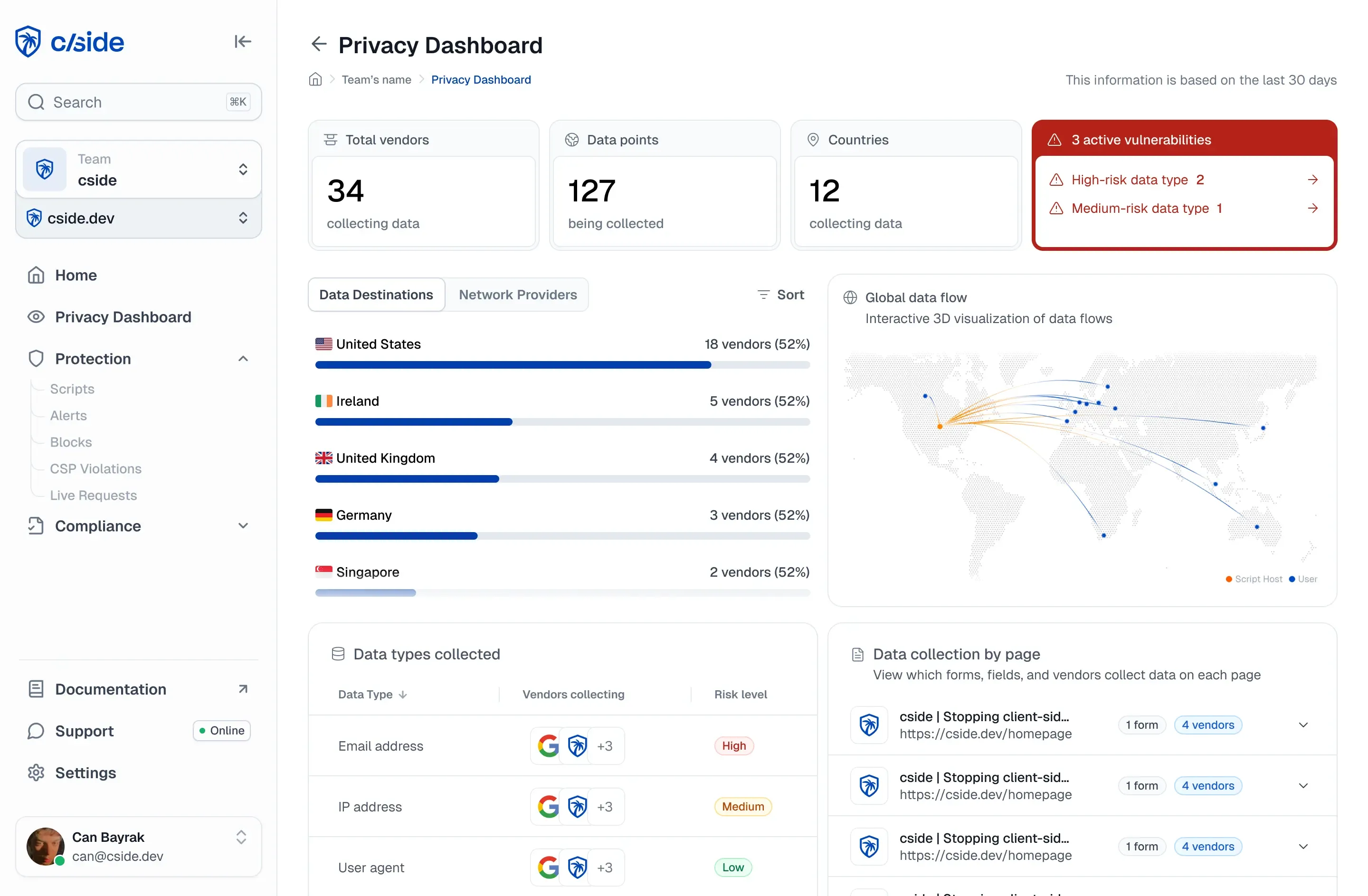
Short on time? See cside Privacy Watch. It covers everything below in one deployment.
Agentic AI security is the set of security and privacy practices required to manage autonomous AI browsers (tools like ChatGPT Agent, Perplexity Comet, and Anthropic's Computer Use) that access websites on behalf of users. Unlike traditional bots, these agents render full Chromium sessions, interact with page elements, and execute every script on the page, bypassing the cookie consent mechanics that govern GDPR lawful basis and evading the CDN-level bot controls that catch request-only scrapers.
What matters for website operators is what an agentic browser actually does once it is inside the rendered session, not what it claims to be. Server-side and CDN-layer controls have no visibility there.
What makes agentic AI browsers different
Traditional bots operate by sending HTTP requests without executing JavaScript. That makes them detectable: they are missing JavaScript execution signals, produce unrealistic browser fingerprints, and often use datacenter IPs that appear on threat lists.
Agentic AI browsers work differently. They open a real Chromium instance, execute every script on your page, generate plausible fingerprints, and interact with DOM elements the way a human would. To your server logs, your CDN, and your analytics platform, an agentic browser session looks like a normal human visit.
That creates specific problems for security and privacy teams:
- Consent is not captured. The agent encounters your cookie banner but does not make an informed choice, dismissing or ignoring it and leaving no documented consent signal.
- Third-party scripts execute in full. Every marketing pixel, analytics tag, and third-party tracker on your page loads and fires during an agent session, without consent gating having functioned correctly.
- Standard bot detection is blind. Controls that key off user-agent strings, IP reputation, or missing JavaScript execution do not flag agentic browsers, because those signals are present and valid.
The cookie consent gap
When a human visits your website, the interaction with a cookie consent banner produces a signal: accept, reject, or configure. The downstream processing is gated on that choice. Most consent management platforms (CMPs) enforce this by delaying tag loading until a choice is recorded.
When an agentic browser loads the same page, it typically dismisses the banner programmatically or ignores it entirely. No meaningful consent signal is recorded, but the page (and all its scripts) continues to load.
The downstream effect: analytics events fire, marketing pixels load, form data flows to CRMs, and cross-border data transfers occur. Under GDPR Article 6, every one of those processing activities requires a documented lawful basis. When the agent bypasses the consent mechanism, that documentation is absent.
This is not an edge case. Any business operating in the EU or serving EU residents that deploys AI agents to browse supplier websites, competitor sites, or partner portals is triggering this gap on those sites as a matter of routine. And any business whose website is browsed by consumer AI agents (shopping agents, research agents, personal assistant browsers) is on the receiving end of the same gap.
| Processing event triggered by an agent session | Consent documented? |
|---|---|
| Cookie banner interaction | No: agent does not make a real choice |
| Analytics event (GA4, PostHog) | No: fires without consent signal |
| Marketing pixel load (Meta, LinkedIn) | No: CMP gating did not function |
| Cross-border data transfer | No: tracker loads without a transfer basis |
| CRM form fill triggered by agent | No meaningful consent trail |
Security risks beyond privacy compliance
Compliance is the most clearly documented risk, but agentic AI access creates security exposure that intersects with your third-party script control environment.
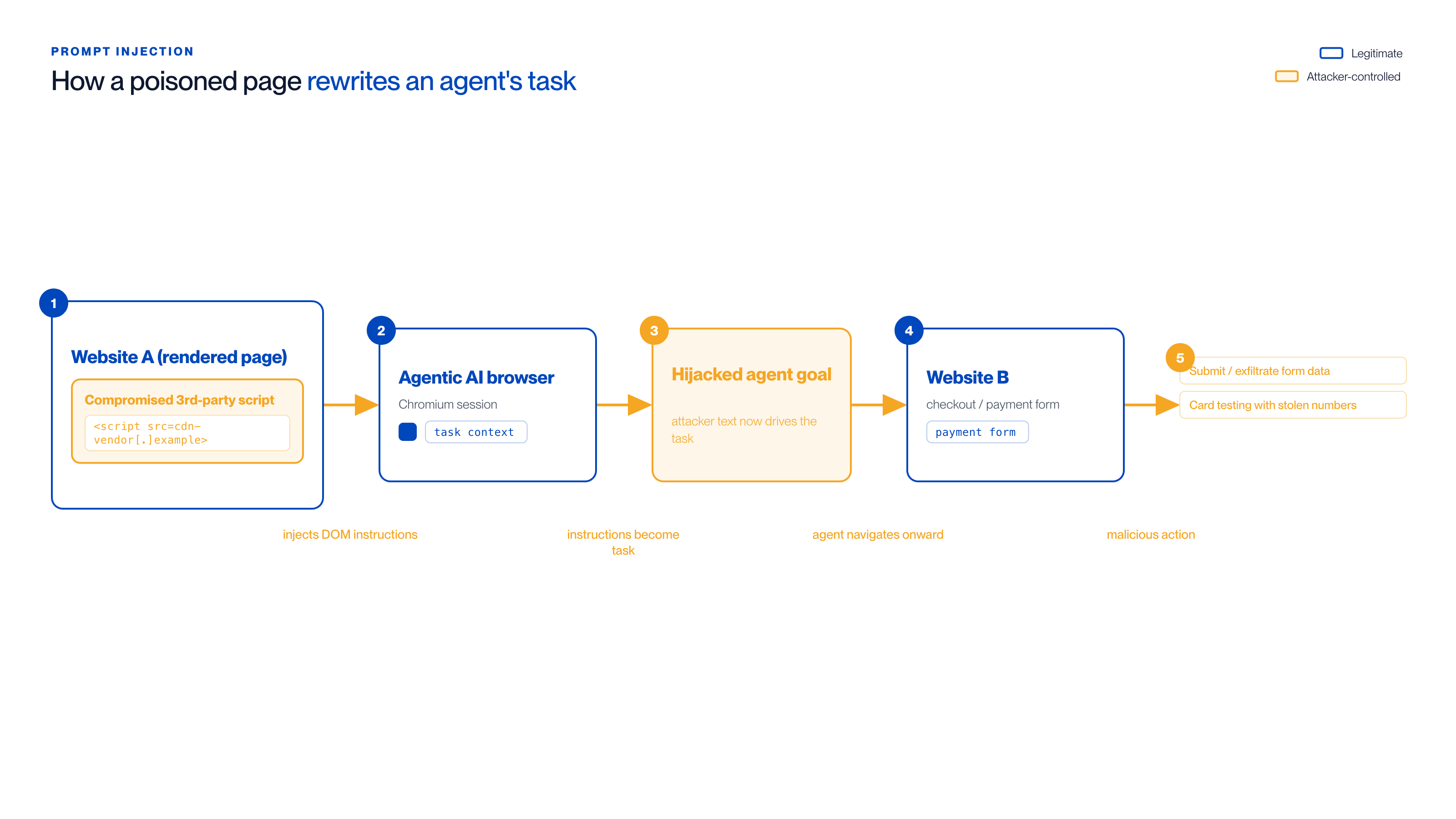
Prompt-injection chain, step by step:
- A compromised (or agent-targeting) third-party script on Website A injects instructions into the rendered DOM.
- The agentic browser reads those injected instructions as legitimate task context.
- The agent's goal is silently rewritten.
- The agent carries the hijacked instructions to the next site it visits (e.g. a checkout / payment form).
- Outcome: it submits or exfiltrates loaded form data, or tests stolen card numbers from a genuine-looking residential session that payment-fraud controls pass through.
Prompt injection via compromised third-party scripts. A third-party script that has been compromised (or that has been written to detect and target AI agent sessions) can inject instructions into the page that redirect an agent's behavior. An agent visiting an attacker-controlled page can be told to carry out actions on other websites it visits afterward: submitting forms, exfiltrating data it has loaded, or modifying its task instructions. This is an active attack pattern. See: how compromised third-party scripts can prompt-inject AI agents.
Card testing from consumer agent sessions. An agent completing a legitimate purchase on behalf of a user passes through your checkout flow with real browser signals and a real residential IP. If the agent's session has been redirected via prompt injection, it can be used to test stolen card numbers in your checkout form. The card test originates from a genuine-looking session that payment fraud controls pass through.
Inventory lock and price extraction. Consumer agents acting in good faith still create operational risk when they run at machine speed. Add-to-cart agents can lock inventory, real-time pricing agents can enumerate your catalog faster than any human, and bulk research agents can extract structured data that is not intended for machine consumption. The intent is not hostile, but the effect is real.
PCI DSS 4.0.1 and agentic sessions on payment pages
PCI DSS 4.0.1 clauses 6.4.3 and 11.6.1 introduced script-level requirements that apply to all payment page sessions, including agent-initiated ones.
Clause 6.4.3 requires that each script on a payment page be authorized, have a documented purpose, and have its integrity maintained. An agentic browser executing a payment task loads every script on your payment page. If a vendor CDN script loads there that is not in your allowlist, your 6.4.3 obligation is triggered regardless of whether the session was human or agent-initiated.
Clause 11.6.1 requires an active change-and-tamper detection mechanism on payment page contents and HTTP headers. A prompt-injected agent session that triggers a script modifying payment page elements (a formjacking pattern) falls within the same detection scope.
The practical implication: if your PCI DSS 4.0.1 controls are implemented correctly for human sessions, they cover agent sessions too. The real gap is identifying which sessions are agent-initiated, so you can audit and monitor them separately. For a detailed breakdown of these requirements, see how to comply with PCI DSS 6.4.3 and 11.6.1.
How detection works at the browser layer
Detecting agentic browsers requires a control that runs inside the rendered page session. Network-perimeter and CDN controls do not have visibility there. Key detection signals are:
Automation artifacts. Agentic browsers run on top of automation frameworks (Playwright, Puppeteer, Selenium) that leave traces in the JavaScript environment: navigator.webdriver set to true, Chrome DevTools Protocol properties in the DOM (the cdc_ prefix pattern), and stripped accessibility node structures that automation frameworks remove by default.
Fingerprint inconsistency. Real browsers on real devices produce coherent WebGL renderer strings, Canvas fingerprints, and AudioContext outputs that match a specific GPU and OS combination. Agentic browsers running in cloud environments or emulated hardware produce fingerprints that do not tell a consistent device story across signals.
Behavioral cadence. A session that navigates pages, loads a form, fills it, and submits within seconds is moving at machine speed. This behavioral signal is observable in the event stream from inside the page and is not visible in request headers.
Session graph pattern. A human browsing your site follows an exploratory pattern: pauses, backtracks, skims. An agent working through a defined task executes a sequence that maps to the task graph: ordered, purposeful, with no dead-end navigations.
cside reads these signals from inside the browser session, classifies the traffic by intent class, and makes the classification available via API so your policy enforcement layer can act on it. For a deeper look at individual signal mechanics, see the guide to detecting AI agent traffic on your website.
What website operators should do
1. Instrument the browser layer. Server-side controls cannot see what happens inside a Chromium session. A runtime agent running in the rendered page is the minimum viable baseline for agentic AI visibility.
2. Audit your consent mechanics for pre-consent data collection. Identify which tracking events, scripts, and data flows trigger before any consent interaction on a fresh session. That is your exposure window when an agentic browser bypasses the banner.
3. Map each pre-consent processing event to a lawful basis. Legitimate interest may cover some processing. For the events where it does not, you have an undocumented compliance gap that applies not just to agentic sessions but to any visitor who closes the browser before interacting with the banner.
4. Confirm PCI scope applies to agent-initiated sessions. Verify with your QSA that script authorization (6.4.3) and tamper detection (11.6.1) are session-agnostic. Most implementations are, but agentic sessions can reveal script execution paths that human sessions do not trigger if the agent navigates different page states.
5. Classify rather than block. Many agentic sessions represent legitimate consumer activity. A blanket block removes real revenue from real customers using AI assistants. Classify by intent (allow, monitor, challenge, rate-limit, or route to agent-specific content) rather than treating all automation as hostile. For the classification framework, see how to choose an AI agent detection solution.
For a vendor comparison, see the best tools for AI agent detection.