
TL;DR: iGaming four-vector fraud detection for AI agents, wallet ATO, multi-accounting, and deposit skimming
- The gap: Email verification and phone OTP are not iGaming fraud gates in 2026. AI agents like OpenAI Operator and Playwright can complete every verification step, and residential proxies make IP blocklists background noise.
- What cside sees: cside runs four detection layers through one script tag, combining them into a real-time verdict that flags AI-agent and automated activity, links multi-accounting via device fingerprint across incognito, VPN, and cleared cookies, and hashes every deposit-page script for PCI DSS 6.4.3 and 11.6.1.
- The decision: If your loss centre is bonus abuse, block AI-agent sessions on bonus-claim pages before the welcome bonus pays out. If it is wallet ATO, trigger step-up authentication when a known account logs in from an unrecognized device fingerprint, before the withdrawal fires.
Short on time? See cside's account-takeover detection. It covers everything below in one deployment.
iGaming fraud detection in 2026 has to cover four attack vectors at once: AI-agent bonus abuse, account takeover on player wallets, multi-accounting across VPN exit nodes, and deposit-page script skimming. Three of the four run through real browsers at human speed, and the fourth hides in JavaScript that executes after the page loads, so network-layer rules and IP blocklists miss most of it. Detection that works reads browser-layer signals on every session and monitors the scripts on every payment page.
Bonus abuse via AI agents and multi-accounting
Bonus abuse is not new to iGaming. What changed in 2025 and 2026 is the tooling.
AI agents, including OpenAI Operator and browser-automation frameworks such as Playwright and Puppeteer running with stealth configurations, can now drive a registration flow end to end. They fill form fields, clear basic CAPTCHA challenges built for humans, and reach the bonus claim step without tripping velocity rules, because they move at a believable human pace. One operator can run dozens of these sessions at once, claiming a welcome bonus on each account before withdrawing the balance.
The cost lands straight on promotional margin. An operator offering a £50 welcome bonus loses that £50 on every automated account, multiplied by the volume the attacker sustains, and it repeats across each promotional cycle.
Multi-accounting makes it worse. The same person opens many accounts with different email addresses and routes each session through a residential VPN exit node to change the apparent IP. Detection that leans on IP matching or email deduplication cannot link those accounts.
Device fingerprinting links them regardless. Even when IP and email rotate, the underlying hardware, canvas rendering output, GPU fingerprint, and audio-context signature stay constant. A fingerprint recorded at registration ties every account created from that device back to one actor, no matter how many email addresses or VPN servers sit in between.
ATO on player wallets
Player accounts that hold a wallet balance are among the most targeted assets in iGaming. A compromised account with a balance is liquid on contact: the attacker stakes and cashes out, or withdraws, inside a single session.
The credential-stuffing campaigns behind this are increasingly run by AI agents. Stolen credential lists get tested against login endpoints at human-plausible speed, slipping past rate limits and checks that look for bot signatures in user-agent strings or request cadence. Credentials that succeed are used within minutes of the run flagging them as valid.
Javelin Strategy & Research put US account takeover losses at $13.5 billion in 2025, up from roughly $11.4 billion the year before, across about six million victims. For iGaming operators the exposed surface is wide, because players reuse passwords across platforms and a breach in any unrelated sector produces a usable list for account takeover. The Verizon 2026 DBIR found that 39% of breaches involve stolen credentials.
Browser-layer detection at the login step flags the attack before the session authenticates. A known account signing in from an unrecognized device fingerprint, with mechanical session cadence and a canvas output consistent with headless rendering, produces a high-confidence signal that can trigger step-up authentication or hold the session for review.
Deposit-page script skimming
The third vector does not touch player behavior at all. It targets the deposit page.
Deposit pages carry payment forms, and those forms usually sit next to third-party scripts: analytics tags, A/B-testing tools, chat widgets, and ad-attribution pixels. If any one of them is compromised, through a supply-chain attack on a CDN or a tampered npm package, it can be rewritten to read payment card data as it is typed into the form.
That is a formjacking attack, and it is silent. The form still submits. The transaction completes. The player sees no error. But a copy of the card number, expiry, and CVV has already gone to an attacker-controlled endpoint.
PCI DSS 6.4.3 and 11.6.1, both mandatory since 31 March 2025, require operators to monitor every script loaded on a payment page and to detect any unauthorized change. Meeting that takes continuous monitoring that hashes scripts per session and alerts on changes, not a point-in-time scan.
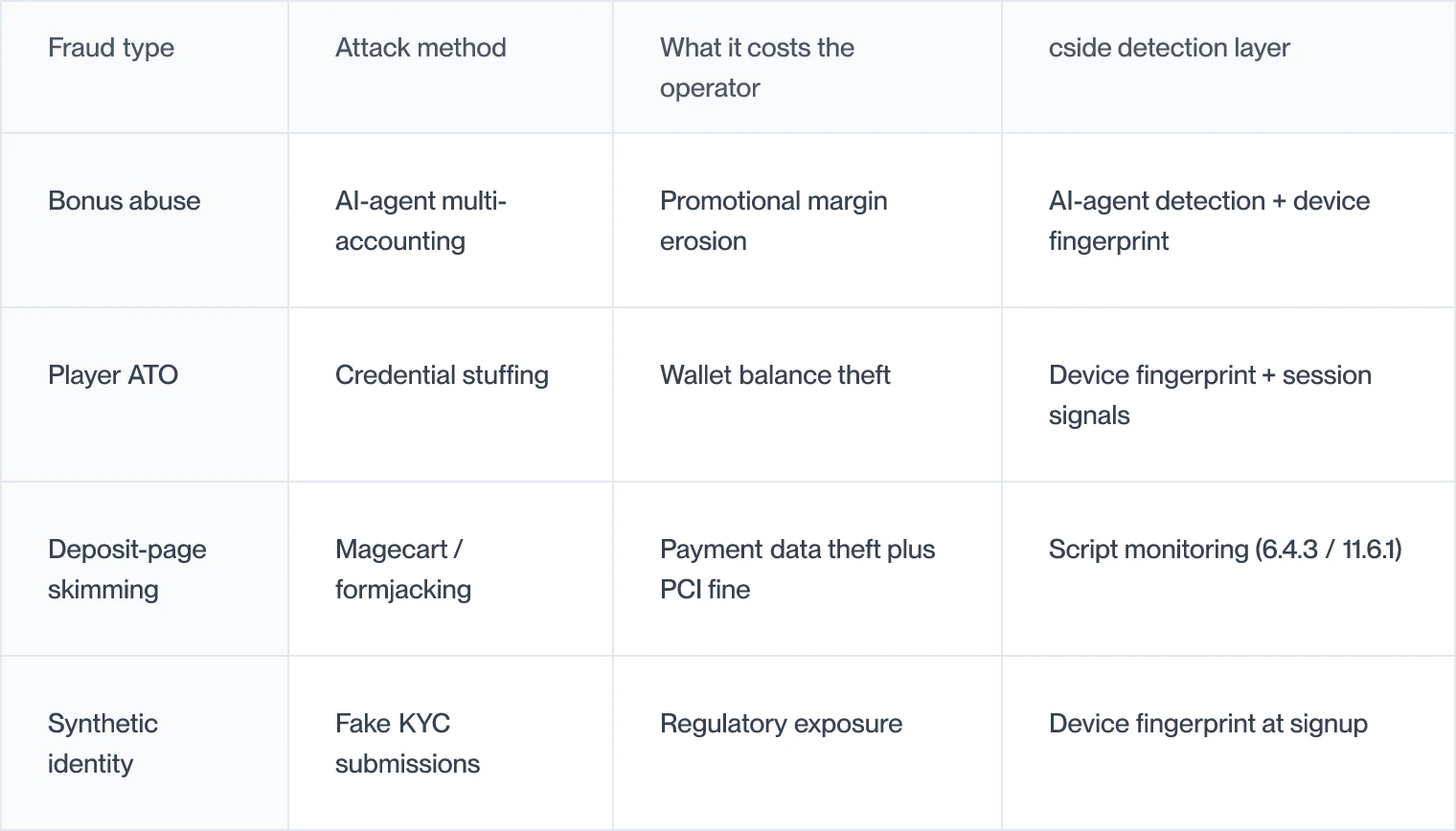
The four vectors and the signal that catches each one:
| Fraud type | Attack method | What it costs the operator | cside detection layer |
|---|---|---|---|
| Bonus abuse | AI-agent multi-accounting | Promotional margin erosion | AI-agent detection + device fingerprint |
| Player ATO | Credential stuffing | Wallet balance theft | Device fingerprint + session signals |
| Deposit-page skimming | Magecart / formjacking | Payment data theft plus PCI fine | Script monitoring (6.4.3 / 11.6.1) |
| Synthetic identity | Fake KYC submissions | Regulatory exposure | Device fingerprint at signup |
cside for iGaming: four-layer coverage
cside delivers all four detection layers through a single script tag. There is no server-side SDK to integrate and no separate vendor for each fraud type.
The layers run together on every session. AI-agent detection identifies automated sessions from canvas-fingerprint entropy, session cadence, cursor geometry, and navigator-property consistency, and it names known automation such as OpenAI Operator, Claude for Chrome, Playwright, Puppeteer, and Selenium. Device fingerprinting links sessions and accounts to specific devices across cookie clearing, incognito mode, and VPN routing. Session signals capture the behavioral anomalies that mark credential stuffing or an account compromise in progress. Script monitoring hashes every third-party script on the deposit page and alerts within seconds of any unauthorized change. In total, cside combines 250+ signals per session into a real-time verdict that flags AI-agent and automated sessions.
Per-page controls set the response by page type. Bonus-claim pages can block AI-agent sessions outright. Login pages can trigger step-up authentication for an unrecognized device fingerprint. Deposit pages get continuous script-integrity monitoring with no player-facing friction. The free tier covers 1,000 API calls a month with no credit card, and paid plans start at $99 a month.
PCI DSS on iGaming deposit pages
Any iGaming operator taking card payments on a deposit page is in scope for PCI DSS v4.0. Requirements 6.4.3 and 11.6.1 have been mandatory since 31 March 2025, and they apply to every script on a payment page, including third-party analytics, chat, and attribution tags.
6.4.3 requires that each script on a payment page is authorized, carries a documented business justification, and has its integrity actively managed. 11.6.1 requires a change-detection mechanism that alerts on any modification to the HTTP headers or content of a payment page.
cside PCI Shield covers both requirements. The PCI Security Standards Council expects ongoing monitoring rather than a point-in-time assessment, so cside checks every session, hashes every script on every load, and produces QSA-ready PCI DSS reports on demand.
Further reading
- PCI DSS compliance checklist: how Requirements 6.4.3 and 11.6.1 apply to your deposit pages.
- AI agent detection: how cside identifies automated and AI-agent sessions.
- Account takeover: stopping wallet ATO at the login step.
- Multi-accounting detection: linking accounts across VPNs and email rotation.