
TL;DR: concurrent session enforcement
- The blind spot: Concurrent session limits flag simultaneous logins. They miss the actual pattern: time-staggered sharing where the sharer and the credential owner never log in at the same time.
- The real signal: Device fingerprint history over a 14-day window separates one person on multiple devices from two people sharing one credential, using hardware signals that survive VPNs and cookie clearing.
- Enforcement: High-confidence classifications route to graduated enforcement (contact, restriction, block). Borderline cases route to human review, not automated action.
Short on time? See cside's frictionless account sharing detection. It covers everything below in one deployment.
Account sharing is the most tolerated form of first-party misuse on subscription platforms. Most product and fraud teams know it is happening. Most do not have the evidence to act on it confidently at scale. The detection is not the hard part. Concurrent session counting, device count signals, and geographic anomalies can all flag accounts that are probably being shared. The hard part is the gap between flagging and acting: what evidence do you have that the flag is correct, how do you enforce without generating false positives that frustrate legitimate users, and what happens when an account holder disputes the enforcement action?
Concurrent session limits address the most obvious case: two simultaneous logins from different IP addresses on the same account. They do not distinguish between a single user on a laptop and a phone and two different people sharing credentials. They do not tell you which device belongs to the account holder and which belongs to the unauthorised user. They do not produce evidence that supports a terms-of-service enforcement action or defends a subsequent chargeback if the account holder disputes the restriction.
This post explains what concurrent session counting catches and where it stops being sufficient, what device fingerprinting adds to the picture, and how browser-layer evidence turns account sharing detection from a flag into an enforceable finding.
What account sharing actually is and what it is not
Quick answer: Account sharing means a single paid account accessed by multiple real people who have not paid for individual access. It is distinct from single-user multi-device use, which is legitimate, and from multi-accounting, where one person controls multiple accounts. The detection challenge is that all three generate similar session signals. Distinguishing account sharing from legitimate multi-device use requires device-level evidence, not just session counts.
Three patterns generate overlapping signals at the session level, and confusing them produces both false positives and false negatives.
The first is single-user multi-device use, which is entirely legitimate. A user who works on a laptop during the day and reads on their phone in the evening generates concurrent or near-concurrent sessions from two different devices and potentially two different IP addresses. If they travel, those sessions appear from different cities. This pattern looks like account sharing on any signal that relies purely on IP diversity or session concurrency.
The second is genuine account sharing: two or more real people accessing the same account under shared credentials. The account holder shares their username and password with a family member, a colleague, or a friend. Each person uses their own device, from their own location, in their own browser. The sessions are genuinely distinct at the device level and the network level. The devices have different fingerprints. The sessions occur in different geographic contexts. The usage patterns reflect two different people's behaviour, not one person on two devices.
The third is credential theft: an attacker who has obtained the account holder's credentials and is accessing the account concurrently with or alternately from the legitimate account holder. The signals at the session level are similar to account sharing, but the risk implication is very different: credential theft is an account takeover vector, not a terms-of-service violation.
Concurrent session limits treat all three patterns identically: they fire when the threshold is exceeded, regardless of why. Enforcement based solely on concurrent session signals produces false positives against legitimate multi-device users, fails to distinguish account sharing from credential theft, and provides no evidence to support the enforcement action if the account holder disputes it.
Related: the upstream version of this problem is fake new account creation, where the abuse happens at signup before any session history exists. cside Signup Shield turns each registration into a real-time trust verdict to stop fake accounts, trial abuse, and multi-accounting before they reach the account base this post is about protecting.
Where concurrent session detection stops being enough
Quick answer: Session limits work against account sharing that is simultaneous, high-volume, and makes no attempt to stay within the limit. Modern credential sharing is rarely that simple. Staggered usage across the same account never triggers a simultaneous session limit. Geographic sharing between household members looks identical to distributed single-user access. Any enforcement based purely on concurrency generates too many false positives to be operationally manageable at scale.
The mechanism of a concurrent session limit is straightforward: if more than N sessions are active on the same account at the same time, the oldest session is terminated or a new login is blocked. This works when all users of the shared account are active simultaneously and when no effort is made to avoid the limit.
In practice, account sharing is rarely this unsophisticated. Two people sharing a subscription often do not use it at the same time. A household shares a SaaS platform between two team members who work different hours, or a streaming subscription used alternately by different people in different rooms. Sessions are sequential, not concurrent. No simultaneous session limit ever fires.
Geographic distribution creates a false positive problem. A single user who works from an office, uses the same account from home in the evening, and occasionally travels generates sessions from multiple cities. This pattern triggers geographic anomaly signals but is entirely legitimate. An enforcement action based on geo-diversity signals alone would affect a large population of entirely genuine users whose only distinguishing characteristic is that they use their account in more than one place.
Time-staggered sharing is particularly difficult for any detection mechanism that relies on session overlap. If two people sharing an account never log in at the same time, there is no concurrent session to detect. The only evidence that the account is being shared is the device fingerprint history: two distinct device profiles appearing in the account's session history, each showing consistent solo usage patterns but never overlapping.
False positive risk is the operational barrier that prevents most platforms from acting aggressively on account sharing signals. Terminating a session or restricting an account affects real customers. Every enforcement action based on a false positive generates support tickets, social complaints, and potential churn. Without evidence that the signal is correct, aggressive enforcement is not operationally viable.
What device fingerprinting adds to account sharing detection
Quick answer: Device fingerprinting expands the signal from session count to device identity. An account accessed by two distinct device fingerprints that do not fit the single-user multi-device pattern (different hardware classes, different browser configurations, different geographic contexts that do not correlate with the account holder's primary location) is a much stronger account sharing signal than concurrent sessions alone. Fingerprinting also builds a historical device record for each account, making new-device access from an unexpected context detectable over time.
A device fingerprint captures the hardware and software characteristics of the browser and device in a session: screen resolution, GPU renderer, font set, canvas rendering behaviour, audio context characteristics, browser plugin configuration, and dozens of other attributes. These characteristics are more stable and more distinctive than an IP address and more informative than a session count. Because cside assembles the identifier from a baseline of 250+ browser, device, and network signals, the resulting persistent device identifier survives cookie clearing, private browsing, and VPN swaps, so a shared credential keeps resolving to the same device even when the network address changes, and that persistence is what exposes account sharing.
For account sharing detection, the key output is a device profile history per account: which distinct device configurations have accessed this account, in what locations, at what times, and with what usage patterns. A single user with a laptop and a phone has two devices, but those devices tend to be used in related contexts (the same home network, the same travel itinerary) and the usage patterns across the two devices reflect a single person's behaviour.
Two real people sharing an account produce a device history with two distinct profiles that have independent geographic contexts, independent usage timing, and independent interaction patterns. The home network of one user is not the home network of the other. The times when each is active do not correlate the way they would for a single person's multi-device use. The content or features accessed by each reflects two different people's preferences and workflows.
This distinction is not visible in session count data. It is visible in device fingerprint history when that history is maintained and analysed across a sufficient time window. An account with two distinct device profiles, each showing consistent independent usage that does not correlate, is a much higher-confidence account sharing signal than two sessions at the same time.
In cside's account-level device analysis, the pattern that most reliably distinguishes single-user multi-device access from genuine credential sharing is the geographic independence of device profiles over time. A single user's devices tend to share the same home network, the same travel itinerary, and correlated session timing. Two people sharing an account generate device profiles with genuinely independent location histories and non-overlapping active periods that become clearly distinguishable after a 14-day observation window.
Anti-detect browser use is a countermeasure some sophisticated account sharers employ to avoid device fingerprint detection: sharing credentials alongside instructions to use a specific browser profile or VPN. cside's browser-layer monitoring detects the anti-detect browser itself, which is itself an anomalous signal in a consumer subscription context. A user running an anti-detect browser to access a SaaS platform or media subscription is not a normal usage pattern.
More on cside's device fingerprinting and account-level session analysis.
What browser-layer evidence enables for enforcement
Quick answer: Detection identifies accounts that are probably shared. Enforcement requires evidence that can justify a terms-of-service action, withstand a customer dispute, and where relevant defend against a chargeback claim filed after enforcement. Browser-layer evidence provides a structured record of the device profiles that have accessed an account, their session histories, and the signals that distinguish shared access from legitimate multi-device use.
The gap between detection and enforcement is the largest operational barrier most teams face on account sharing. Flagging an account as probably shared is a low-cost operation. Contacting the account holder, restricting access, or converting the account to a paid multi-user plan requires confidence that the signal is correct. Acting on a false positive means taking an enforcement action against a paying customer who did nothing wrong.
Browser-layer evidence changes the confidence calculation. Instead of a rule that fired based on a concurrent session threshold or a geo-diversity count, the fraud or product team has a structured record: this account has been accessed by two distinct device fingerprints over the past 30 days, device A appears consistently from location X with usage patterns consistent with user type A, and device B appears consistently from location Y with usage patterns consistent with user type B, and the two never appear active in overlapping windows. That record supports an enforcement action with a degree of confidence that a session count does not.
Graduated enforcement is the operationally recommended approach when evidence quality improves. The first step is contact: a notification to the account holder that the account appears to be accessed from multiple distinct devices and environments, with an invitation to review account access or to upgrade to a multi-user plan. Many account sharers convert at this step without any enforcement action being required. The contact itself is evidence that the platform is aware and monitoring.
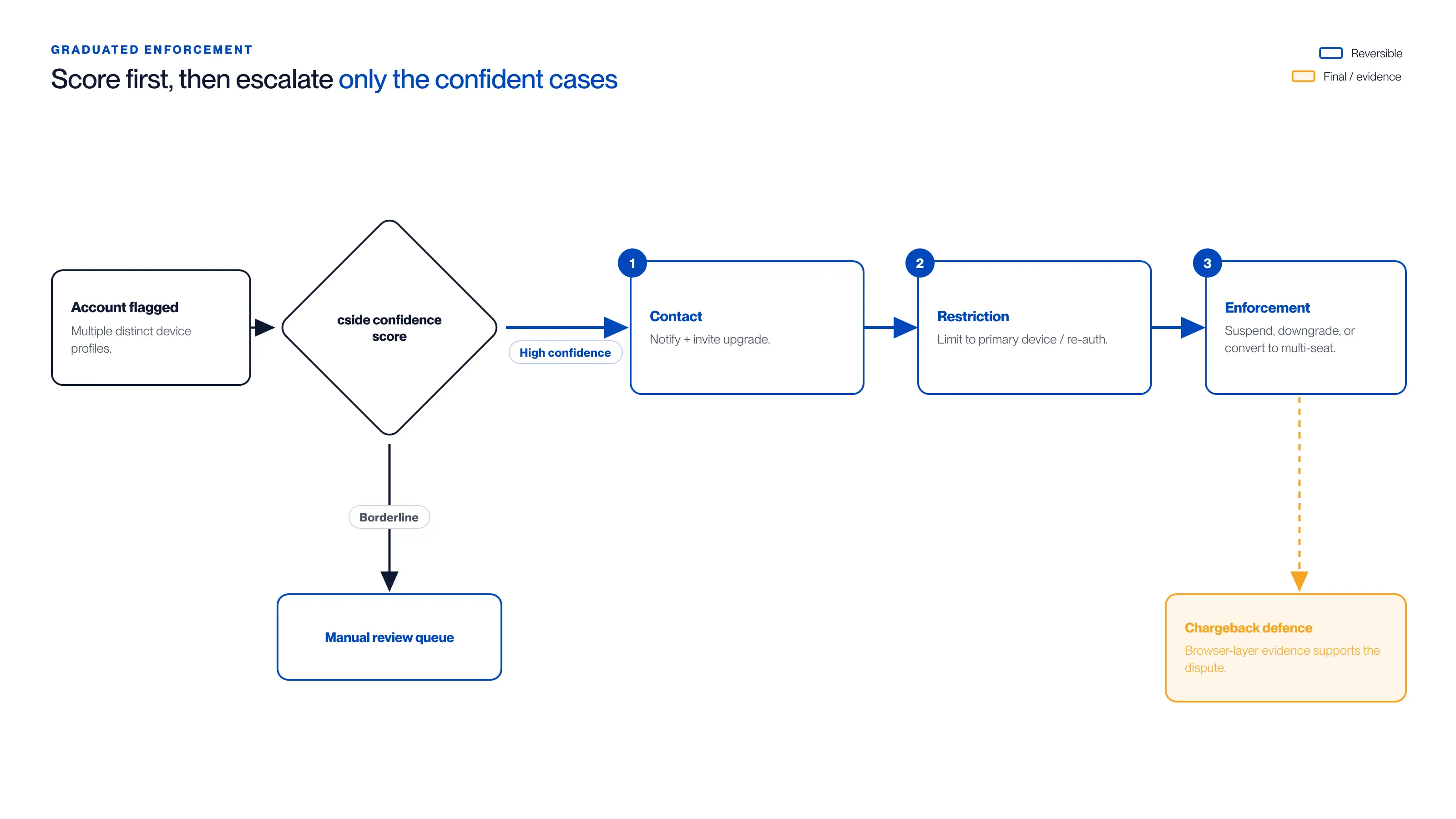
A flagged account (multiple distinct device profiles) passes to a cside confidence score. High-confidence cases escalate through three steps; borderline cases route to a manual review queue instead of automated action.
| Stage | Action | Reversible? |
|---|---|---|
| Account flagged | Multiple distinct device profiles detected | - |
| Confidence score (borderline) | Route to manual review queue | - |
| 1. Contact | Notify + invite upgrade | Reversible |
| 2. Restriction | Limit to primary device / re-auth | Reversible |
| 3. Enforcement | Suspend, downgrade, or convert to multi-seat | Final / evidence |
Browser-layer evidence collected at the enforcement step supports chargeback defence if the holder disputes the charge.
The second step is restriction: limiting access to the primary device or requiring re-authentication when a secondary device profile appears. This is still reversible if the account holder demonstrates that the secondary device is legitimately theirs.
The third step is enforcement: account suspension, plan downgrade, or mandatory conversion to a multi-seat arrangement. At this stage, the account holder may dispute the action with their card issuer if they feel the restriction was unjustified. Browser-layer session evidence supports the enforcement decision: the record shows device profile diversity and independent usage patterns that establish account sharing as the most probable explanation.
The chargeback defence connection matters in high-value subscription markets. A subscriber who is restricted after detected account sharing may dispute the subscription charges for the preceding period. Browser-layer session evidence that demonstrates device diversity and independent usage patterns can be submitted as part of the dispute response, documenting why the restriction was taken and establishing that the subscription was being used by more than one person.
What this means for SaaS and media platforms
Quick answer: SaaS and media platforms have the highest financial exposure to account sharing: a shared SaaS seat is a lost seat sale; a shared subscription is a lost subscription. cside's account sharing detection identifies accounts accessed by multiple distinct device profiles, provides session-level evidence to support enforcement, and routes borderline cases to review rather than automated action. The output integrates with existing subscription management and terms-of-service enforcement workflows.
The revenue impact of account sharing is most direct in per-seat SaaS and subscription media. A shared SaaS seat means the platform is providing the value of two seats for the price of one. Over a contract period, that is a missed upsell opportunity on every shared seat in the customer base. For media platforms, the dynamics demonstrated by major streaming services over the past several years illustrate both the scale of the problem and the revenue recovery available when sharing is addressed with appropriate evidence and enforcement strategy.
The conversion angle matters as much as the enforcement angle. Many account sharers, when contacted with clear evidence that the platform has detected multi-device access and invited to upgrade to a multi-user plan, will convert rather than dispute. The conversion is revenue; the dispute is cost. Evidence-based contact that presents the device access record (here is what we see, here is what the multi-user option costs, here is how to upgrade) converts a higher proportion of detected sharers than a blunt enforcement action.
Threshold calibration is important because not all multi-device access is account sharing. A personal subscription with two devices is probably a single user. The same subscription with five distinct device profiles across four different geographic contexts over 30 days is probably shared. The device count and geographic diversity thresholds that distinguish these cases are platform-specific, and cside's confidence score output allows teams to set thresholds that match their product's expected single-user device footprint.
Integration with existing subscription and billing systems is designed to be lightweight. cside's account sharing signals feed into the risk signal the fraud team already acts on. For SaaS teams using existing customer success or billing tooling to manage plan enforcement, the device profile record is an input to that existing workflow, not a separate system. cside is SOC 2 certified. Full documentation is at trust.cside.com.