
TL;DR: block DeepSeekBot on data sovereignty grounds
- The data sovereignty risk: The default posture is that any declared crawler that respects robots.txt is safe to allow. DeepSeek's compliance track record is less thoroughly documented than GPTBot's or ClaudeBot's in independent reporting, which changes the risk calculation for regulated data.
- Two-layer enforcement: DeepSeekBot uses a declared user-agent in the
DeepSeekfamily and DeepSeek publishes IP ranges; aDisallow: /in robots.txt combined with a quarterly IP-range review at the firewall gives you enforcement that does not rely on the crawler self-policing. - The decision: If you run in a regulated industry, hold sensitive IP, or have an explicit policy on data transfer to Chinese jurisdiction, block DeepSeekBot at both layers before its next crawl. If you have no such policy, robots.txt alone is a proportionate response.
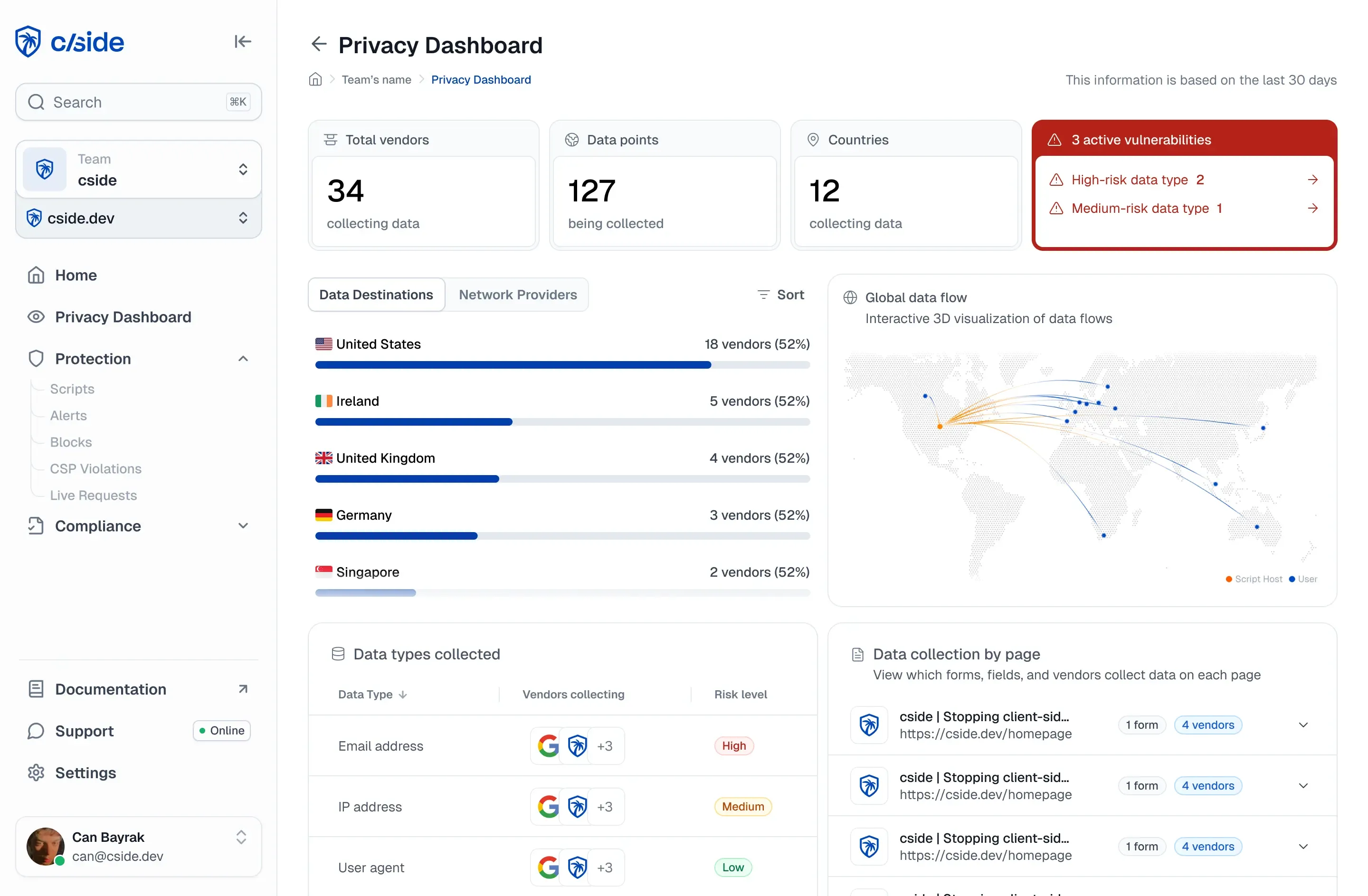
Short on time? See cside's AI-agent detection. It covers everything below in one deployment.
DeepSeekBot is the web crawler operated by DeepSeek, the Chinese AI company that gained widespread attention in early 2025 with models that matched or exceeded GPT-4 performance at a fraction of the training cost. The crawler collects web content for training and improving DeepSeek's AI models.
For many site owners, blocking DeepSeekBot is a data sovereignty decision as much as a technical one. The same robots.txt approach that works for GPTBot and ClaudeBot applies here, with some additional considerations.
What is DeepSeekBot?
Quick answer: DeepSeekBot is a web crawler operated by DeepSeek, a Chinese AI research company. It collects publicly available web content to train DeepSeek's language models. It identifies itself with a declared user-agent string and is an HTTP crawler that does not execute JavaScript or interact with web application interfaces.
DeepSeek's crawler uses user-agent identifiers in the DeepSeek family. Like other declared AI training crawlers, it makes HTTP GET requests, reads text content, and is designed to respect robots.txt directives.
DeepSeek operates under Chinese law and data regulations, which creates a different risk profile from crawlers operated by US-based companies. Content collected by DeepSeekBot may be subject to data access requirements that apply to Chinese tech companies under Chinese jurisdiction. This is relevant context for organisations with regulatory obligations, sensitive intellectual property, or data governance policies that consider data origin.
How to block DeepSeekBot with robots.txt
Quick answer: Add
DeepSeekBotto yourrobots.txtwith aDisallow: /directive. If DeepSeek's crawler respectsrobots.txt(which it is designed to do) this blocks all collection from your site. Use path-level rules for more granular control.
To block DeepSeekBot from your entire site:
User-agent: DeepSeekBot
Disallow: /
If you want to allow indexing on some content while protecting sensitive areas:
User-agent: DeepSeekBot
Disallow: /account/
Disallow: /checkout/
Disallow: /api/
Allow: /blog/
Unlike GPTBot and ClaudeBot, which have well-documented compliance records, DeepSeekBot's robots.txt compliance history is less thoroughly documented in public reporting. If enforcement reliability matters, consider supplementing robots.txt with IP-level blocking. The same gap applies to other lesser-documented training crawlers, such as ByteDance's Bytespider and Common Crawl's CCBot.
Data sovereignty considerations
Quick answer: DeepSeek is incorporated in China and operates under Chinese law. Content collected by its crawler may be subject to data access requirements that apply to Chinese technology companies. For organisations in regulated industries or with explicit data governance policies, this distinction carries compliance weight beyond what it would for a US-based crawler.
This is not a claim that DeepSeek actively misuses data. It is a statement about jurisdiction and the legal framework under which collected data exists. Organisations that maintain policies restricting data transfer to certain jurisdictions, or that have IP concerns about AI training data origin, have legitimate technical and legal reasons to block DeepSeekBot specifically rather than as part of a blanket AI crawler policy.
Security teams in financial services, healthcare, government contractors, and technology companies with proprietary IP have been among the earliest to add DeepSeekBot to their crawler blocklists for exactly this reason.
IP-level blocking for DeepSeekBot
Quick answer: DeepSeek publishes its crawler's IP ranges in its documentation. Adding these ranges to your firewall or CDN provides enforcement that does not depend on
robots.txtcompliance. Given the lower compliance certainty compared to US-based crawlers, IP blocking is the more reliable approach for organisations with strict requirements.
To implement IP-level blocking:
- Locate DeepSeek's current published IP ranges from their official documentation
- Add these ranges to your firewall, CDN, or reverse proxy deny list
- Set a review cycle for updates, as IP ranges expand with crawl infrastructure growth
As with all crawler IP lists, this requires ongoing maintenance. A quarterly review cycle is sufficient for most organisations.
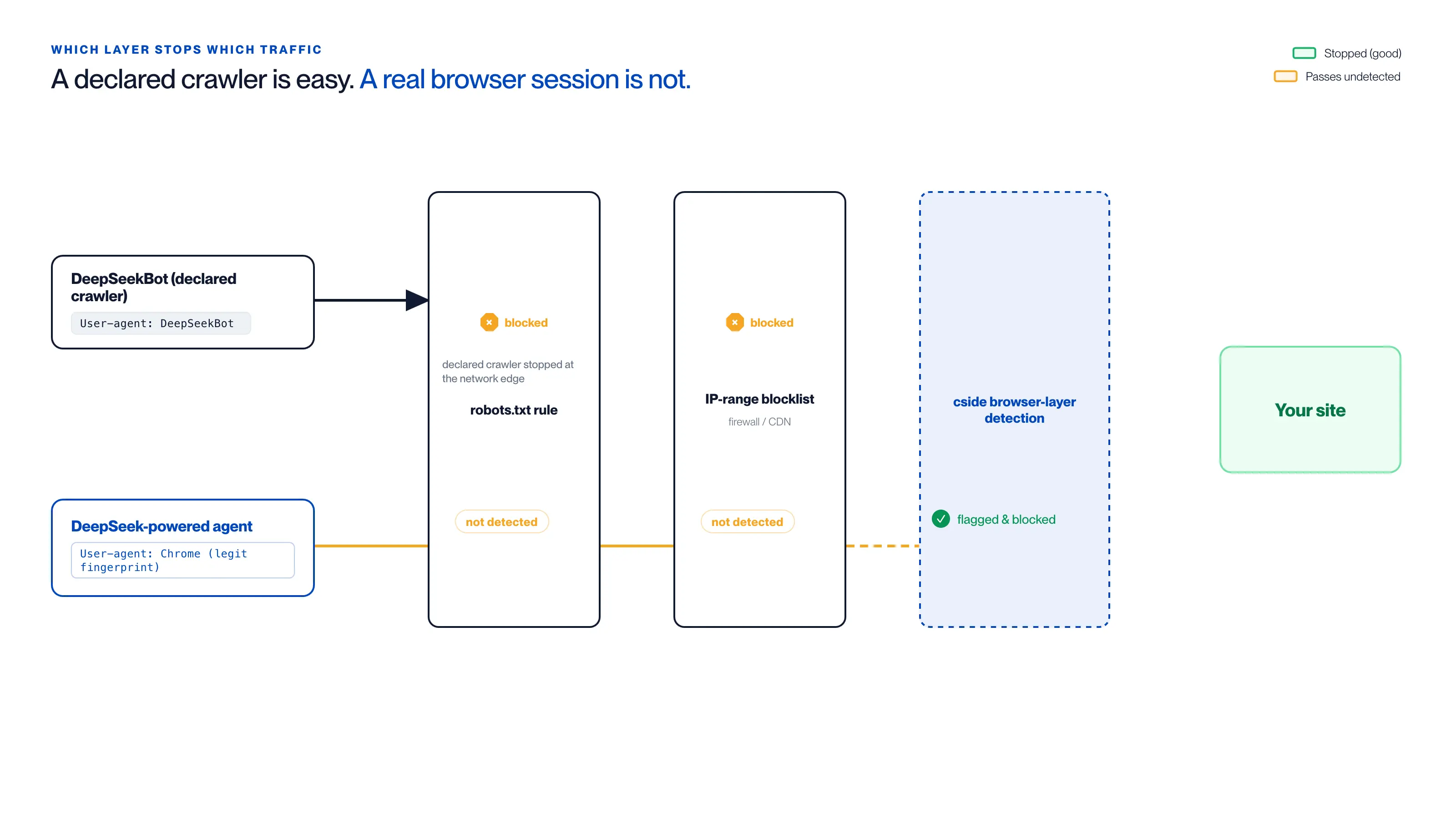
| Enforcement layer | Stops declared DeepSeekBot crawler | Stops DeepSeek-powered agent in a real browser session |
|---|---|---|
robots.txt rule | Yes (if respected) | No |
| IP-range blocklist (firewall / CDN) | Yes | No |
| cside browser-layer behavioural detection | Yes | Yes |
An agent that opens a headless Chromium session presents a legitimate Chrome user-agent and a data-centre IP, so neither robots.txt nor an IP blocklist applies, only browser-layer behavioural detection sees it.
DeepSeekBot vs. DeepSeek-powered agents
Quick answer: Blocking DeepSeekBot addresses DeepSeek's training data pipeline. If DeepSeek builds or enables agentic AI products that browse the web on users' behalf, those sessions would not be DeepSeekBot and would not be affected by your
robots.txtrules.
DeepSeek's public product focus has been on language model capabilities rather than agentic browsing tools, but this is an evolving space. The structural gap applies here as it does to OpenAI and Anthropic: the declared crawler and any future interactive agents are separate systems.
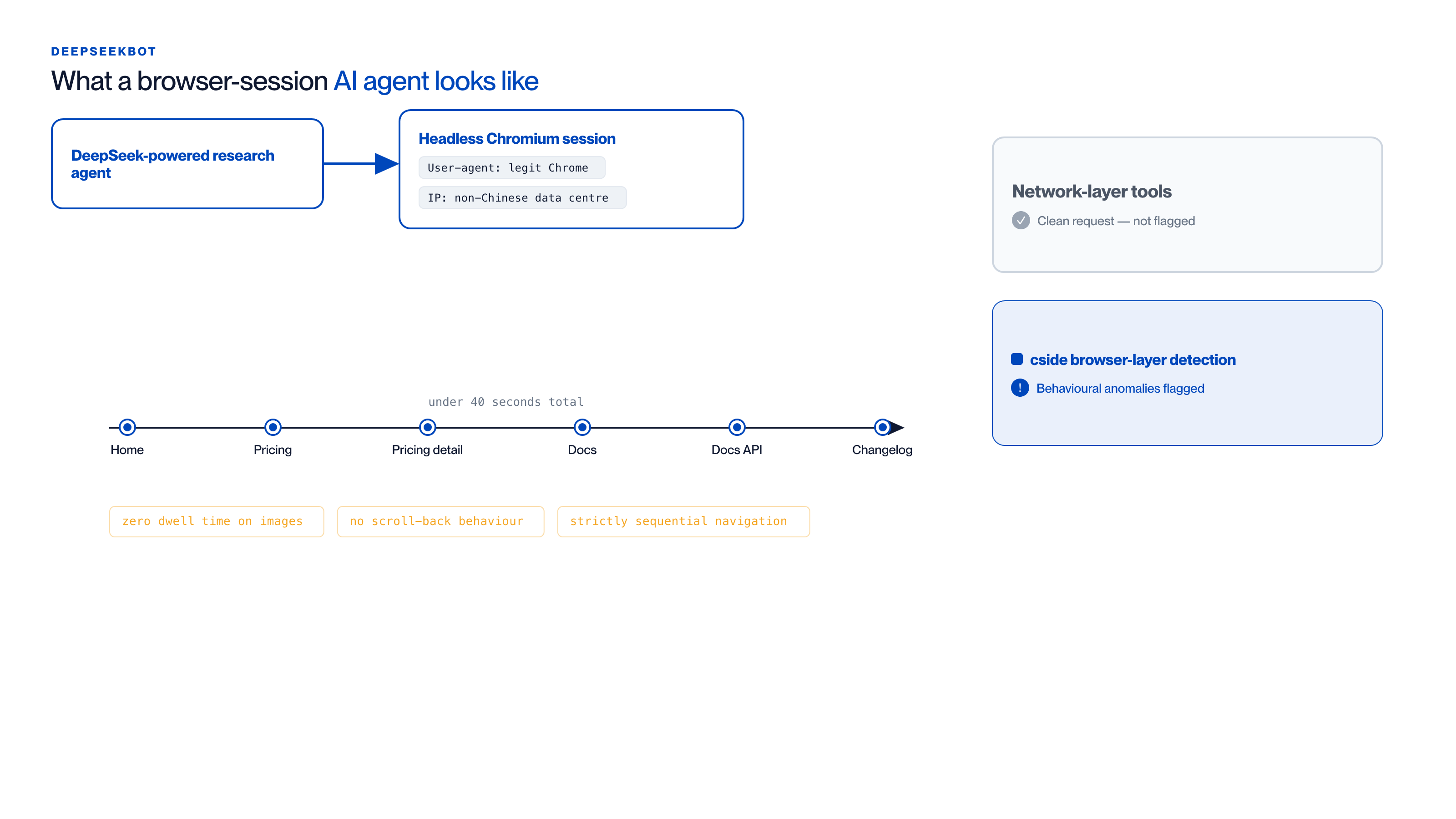
A DeepSeek-powered research agent's session leaves a browser-layer fingerprint that network tools miss. It runs as headless Chromium presenting a legitimate Chrome user-agent, from a data-centre IP in a non-Chinese jurisdiction, so no IP or user-agent filter triggers. It audits 6 pages (Home, Pricing, Pricing detail, Docs, Docs API, Changelog) in under 40 seconds, with zero dwell time on images, no scroll-back, and strictly sequential navigation. Network-layer tools see a clean request and stop there; in cside's controlled testing, traditional tools missed AI agents in real browser sessions in 81 of 100 scenarios.
Organisations that want comprehensive protection against all DeepSeek-related automated access to their sites should monitor DeepSeek's product announcements for agentic products, particularly any browser-use or computer-use capabilities that would create undeclared browser sessions. Browser-layer detection covers those scenarios; robots.txt does not.
Browser-layer detection: beyond the declared crawler
Quick answer: Blocking DeepSeekBot addresses DeepSeek's declared training crawler. It does not address DeepSeek-powered agents or applications that browse your site in real browser sessions on behalf of users. Those sessions require browser-layer behavioural detection, not
robots.txtrules.
DeepSeek's public product roadmap has focused on language model capability rather than agentic browsing tools, but the category is evolving. Any DeepSeek-powered tool that uses real browser automation would present as a standard browser session with no connection to DeepSeekBot's declared user-agent. Your robots.txt block would be irrelevant to that traffic. The same blind spot affects content protection more broadly, which is why blocking AI content scrapers increasingly depends on behaviour rather than self-declaration.
To understand what that gap looks like in practice: imagine a DeepSeek-powered research agent tasked with compiling competitor intelligence on a SaaS vendor. It opens a headless Chromium session, navigates the site's pricing and documentation pages in sequence, and extracts structured data. The session presents a legitimate Chrome fingerprint sourced from a data centre in a non-Chinese jurisdiction, so neither the IP origin nor the user-agent triggers any filter. The agent completes a full audit of six pages in under 40 seconds, with zero dwell time on images and no scroll-back behaviour. Those interaction anomalies are only visible at the browser layer. In cside's controlled testing, traditional tools missed AI agents operating inside real browser sessions in 81 out of 100 scenarios, precisely because network-layer tools see a clean request and stop there.
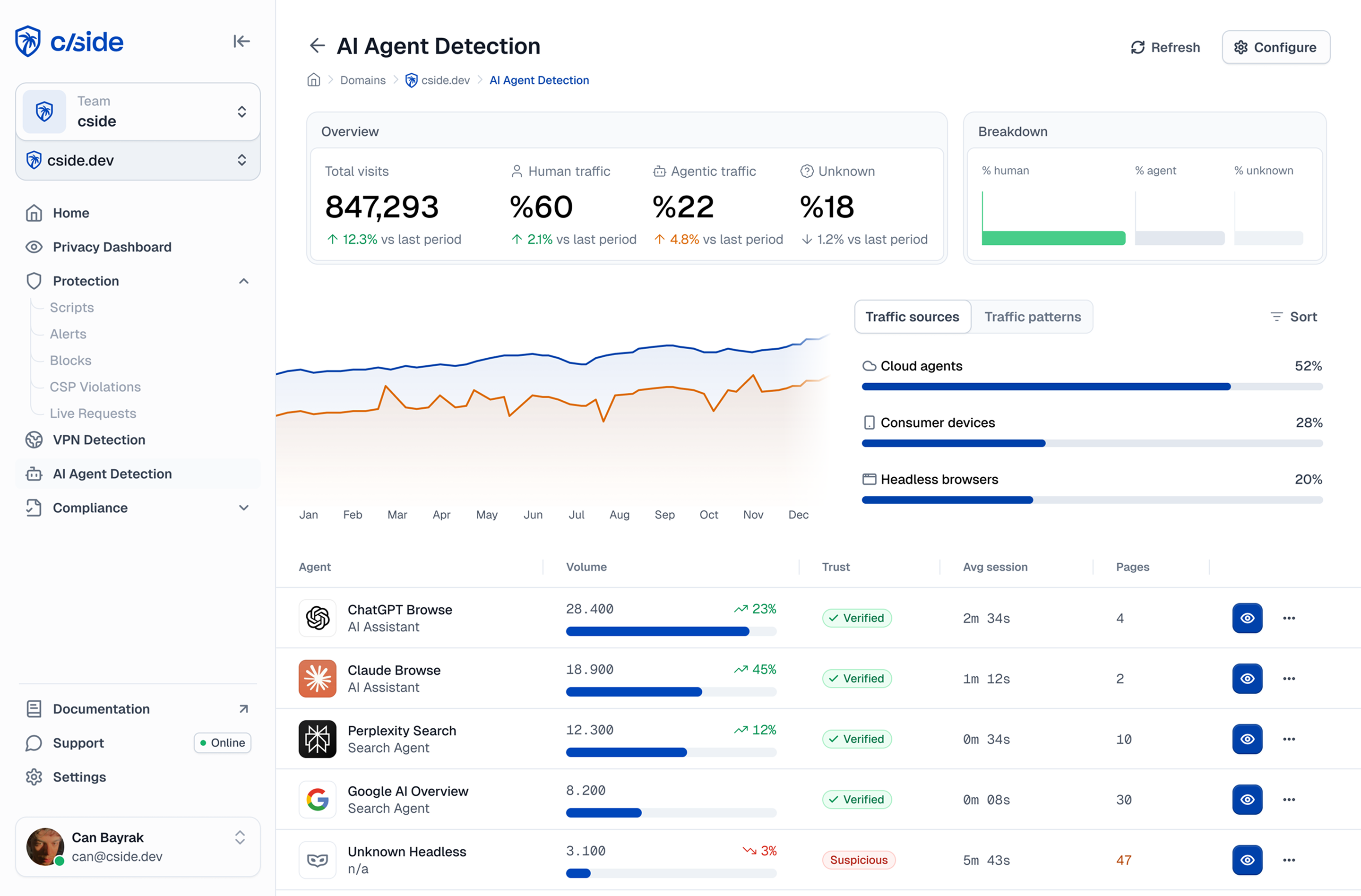
More broadly, the data sovereignty concern that makes DeepSeekBot worth blocking applies equally to any AI-powered session accessing your site from infrastructure in jurisdictions with different data governance frameworks. cside's browser-layer monitoring surfaces named and unnamed agents by behavioural signal rather than self-declaration, including sessions that present no identifying information at all.