
TL;DR: block Bytespider after the 2023 robots.txt non-compliance reports
- The 2023 trust problem: A
Disallow: Bytespiderline looks like a solved problem until you remember 2023. Public security reporting documented Bytespider crawling pages that had explicit robots.txt disallow directives, which sets a different trust baseline than GPTBot or ClaudeBot. - IP-level enforcement: ByteDance publishes Bytespider IP ranges in its crawler documentation, so a firewall or CDN deny list catches the crawler regardless of whether it reads your robots.txt, and a quarterly review keeps the list current as ranges expand.
- The decision: If you are a government contractor, financial services firm, healthcare organisation, or hold competitive IP, treat Bytespider as an IP-block target with robots.txt as the secondary signal. If your data governance policy is silent on Chinese jurisdiction, the robots.txt line alone may be enough.
Short on time? See cside's AI-agent detection. It covers everything below in one deployment.
Bytespider is the web crawler operated by Bytedance, the parent company of TikTok. It collects web content for AI training across Bytedance's product portfolio. Unlike most major AI training crawlers, Bytespider attracted significant public attention in 2023 when reports emerged that it was ignoring robots.txt directives on a number of sites. That compliance history makes it a higher-priority blocking target than most other declared AI crawlers, including ones like the crawler behind ClaudeBot that carry stronger compliance reputations.
What is Bytespider?
Quick answer: Bytespider is Bytedance's AI training crawler. It is used to collect web content for training AI models that power products across Bytedance's portfolio, including TikTok. It uses a declared user-agent string but drew public scrutiny for reportedly bypassing
robots.txtrestrictions on some sites in 2023.
Bytespider uses a user-agent string in the Bytespider family, with references to Bytedance's crawler documentation. Like other AI training crawlers, it is an HTTP-based tool that makes GET requests, reads page content, and does not execute JavaScript in a real browser context.
The key difference between Bytespider and crawlers like GPTBot or ClaudeBot is the compliance history. Reports from security researchers and site owners in 2023 documented instances of Bytespider ignoring robots.txt disallow rules. Bytedance has since updated its crawler practices, but the incident established a different baseline of trust compared to US-based AI crawlers with stronger compliance reputations.
How to block Bytespider with robots.txt
Quick answer: Add Bytespider to your
robots.txt. Given its past compliance issues, treatrobots.txtas a starting point rather than a complete solution. Supplement it with IP-level blocking for sites where crawler access needs hard enforcement.
To block Bytespider from your entire site:
User-agent: Bytespider
Disallow: /
Given the documented compliance history, this alone may not be sufficient if Bytespider resumes the crawling behaviour seen in 2023. IP-level blocking provides the enforcement layer that robots.txt cannot guarantee. The same logic applies to any well-behaved declared crawler you add alongside it, such as the Common Crawl bot CCBot.
IP-level blocking for Bytespider
Quick answer: Bytedance publishes Bytespider's IP ranges in its crawler documentation. Denying these ranges at your firewall or CDN provides enforcement independent of
robots.txtcompliance. For organisations with data governance or competitive concerns about Bytedance access, IP blocking is the more reliable approach.
IP-level blocking steps:
- Locate Bytedance's current published IP ranges for Bytespider from their official documentation
- Add these to your firewall, CDN edge rules, or reverse proxy configuration
- Set a review cycle, quarterly is sufficient for most organisations
The IP blocking approach catches Bytespider regardless of whether it reads your robots.txt, which addresses the core concern raised by the 2023 compliance reports.
Data sovereignty concerns
Quick answer: Bytedance is a Chinese company operating under Chinese law. Content collected by Bytespider may be subject to the same data access framework that applies to other Chinese technology companies operating under Chinese jurisdiction. For regulated industries or organisations with explicit geopolitical data policies, this carries specific compliance relevance.
The concern here mirrors the reasoning behind blocking DeepSeekBot. It is not a claim of specific data misuse: it is a statement about jurisdictional exposure. Organisations that have explicit policies about data transfer to certain jurisdictions, or that handle content subject to regulatory requirements, have documented reasons to treat Bytedance-operated crawlers differently from crawlers operated by US-based companies.
Government contractors, financial services firms, healthcare organisations, and technology companies with competitive IP concerns have been active in adding Bytespider to their crawler blocklists on this basis.
Competitive intelligence risk
Quick answer: Beyond training data, Bytespider's crawl of retail, media, and tech sites creates competitive intelligence risk for Bytedance's product roadmap. TikTok Shop and Bytedance's e-commerce ambitions make detailed product catalogue and pricing data from competitors commercially valuable.
This is the second-order concern that makes Bytespider different from purely research-oriented AI crawlers. Bytedance operates TikTok Shop and has significant e-commerce infrastructure ambitions. A crawler that systematically collects product pricing, inventory, and catalogue data from retail sites serves both training and competitive intelligence purposes simultaneously.
For retailers, media companies, and any site with proprietary product or content data, this dual-use nature of Bytespider's collection is worth factoring into the blocking decision.
Browser-layer detection: what robots.txt leaves uncovered
Quick answer: Blocking Bytespider addresses Bytedance's declared training crawler. The 2023 compliance controversy shows that even declared crawlers can operate outside their stated parameters. Undeclared Bytedance-adjacent agents operating in real browser sessions are entirely invisible to header-based and rule-based detection tools.
Bytespider's compliance history makes browser-layer monitoring especially relevant for organisations blocking it. If the declared crawler bypassed robots.txt in the past, any future undeclared agent browsing your site in a real browser session leaves nothing to inspect at the network layer. The gap is architectural, not something you can configure away, and it is the same gap that lets undeclared AI content scrapers slip past rule-based controls.
cside observes the behavioural signals inside browser sessions that distinguish automated sessions from human visitors: interaction timing, fingerprint consistency, navigation patterns, and JavaScript execution characteristics. In cside's controlled testing, traditional tools missed AI agents operating inside real browser sessions in 81 out of 100 scenarios.
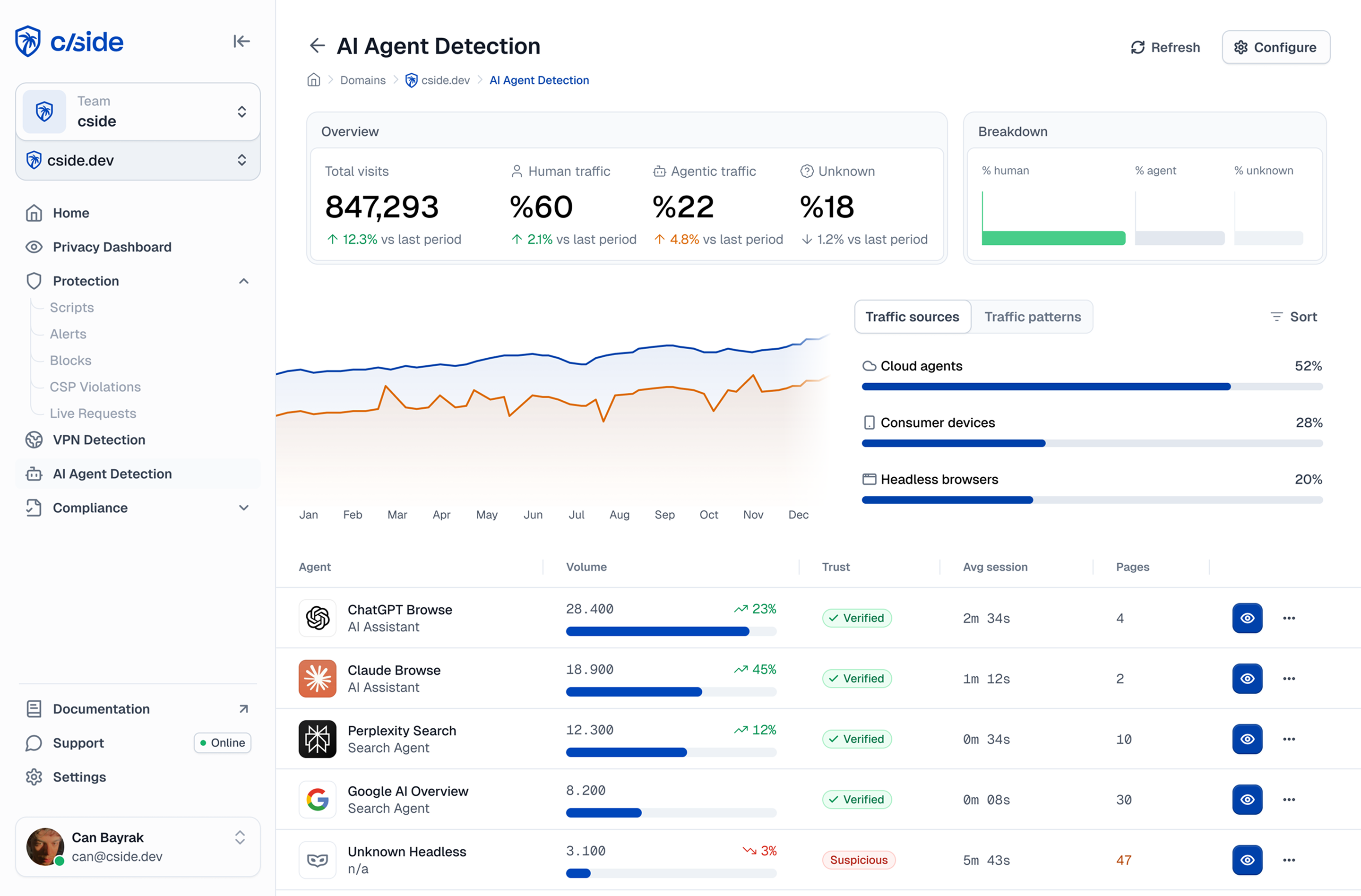
Consider what a Bytedance-adjacent undeclared agent looks like at the browser layer. A session opens a retail category page in a full browser, renders JavaScript, and begins extracting product pricing and inventory data. The IP is clean, the user-agent is a current Chrome build, and the session presents a valid TLS fingerprint. Nothing at the network layer triggers an alert.
What cside observes is different: the agent opens each product detail page in a fixed sequence matching the category listing order, hover events over product images are absent, and the time between page loads is stable to within tens of milliseconds across dozens of requests. No human browsing session produces that combination of signals. cside classifies the session as automated and surfaces it for review before meaningful data has been extracted. For organisations that have added Bytespider to their robots.txt and IP blocklist, browser-layer monitoring closes the gap those controls leave open.