
TL;DR: account sharing detection without false positives
- False positives: Device count thresholds and IP-change alerts trigger constantly on legitimate users. Households with five devices are not sharing. A traveler on hotel Wi-Fi is not a sharer.
- The real signal: The signal is geographic independence of device histories over 14 days, not device count. Two devices with zero shared network context and independent location trajectories is sharing. Five devices that all touch the same home network is a household.
- The confidence score: High-confidence sharing gets an upgrade prompt. Low-confidence goes to review. High-confidence single-user gets left alone. The confidence score is the enforcement contract.
Short on time? See cside's frictionless account sharing detection. It covers everything below in one deployment.
The most common objection to implementing account sharing detection is operational, not commercial: what if the detection flags legitimate users? A subscriber who travels for work, a family with a teenager away at university, a remote employee who uses the product on a laptop and a mobile, any of these legitimate single-subscriber patterns can look like sharing to a detection system that acts on simple signals.
This objection is reasonable. The wrong detection approach does create friction for legitimate users, generates support tickets, damages subscriber relationships, and ultimately costs more in churn than it recovers in enforced upgrades. The real question is whether the detection approach is designed to avoid false positives in the first place.
The Merchant Risk Council's 2026 Global eCommerce Payments and Fraud Report found that 64% of merchants report a meaningful increase in first-party misuse. Platforms that respond to this by deploying imprecise detection methods create a new problem alongside the one they were trying to solve. This post explains how passive device fingerprint analysis and a 14-day observation window address the false positive objection at the design level.
Why simple account sharing detection creates false positives
Quick answer: Simple detection approaches (concurrent session limits, device count thresholds, and IP-change alerts) act on signals that legitimate users generate constantly. A subscriber with two devices can trigger a device count threshold. A subscriber who travels can trigger an IP-change alert. A household where two family members use the product simultaneously can trigger a concurrent session limit. These false positives are common patterns for active, legitimate subscribers, not isolated edge cases.
Concurrent session limits are the most widely deployed account sharing control on subscription platforms. They are also the most prolific source of false positives. A household where two family members watch content simultaneously is the intended subscriber use case for many streaming platforms. A device count threshold that flags any account with more than two devices will flag professionals who carry a work laptop, a personal laptop, and a smartphone. An IP-change alert that flags login from an unusual location will flag the subscriber who works remotely one day per week.
The Verizon 2026 Data Breach Investigations Report found that credential-based attacks are present in 39% of all breaches across the full attack chain. Some of those attacks involve account takeover attempts that generate device and location signals similar to legitimate out-of-home access. The false positive problem in account sharing detection is compounded by the need to distinguish sharing from single-user access, and from account takeover attempts, which carry different enforcement implications.
In cside's account sharing detection across SaaS and streaming platforms, the false positive rate on passive device fingerprint analysis is materially lower than concurrent session limits because device fingerprint history accumulates evidence over time rather than acting on a single-session signal. The distinction between observation and action is fundamental to the false positive problem.
What passive detection means in practice
Quick answer: Passive detection means that account sharing analysis runs continuously in the background, accumulating device fingerprint data over time, without triggering any user-facing action on the basis of any single session. A new device accessing an account for the first time is not flagged. A device accessing from an unusual location is not flagged. Only when the accumulated pattern over a defined observation window produces a high-confidence sharing classification does any action occur.
Passive detection is the design principle that separates low-false-positive sharing detection from high-false-positive session controls. The difference is in when the system acts, not in what signals it collects.
A concurrent session limit acts on a single event: two logins are active simultaneously. That event is sufficient to trigger the limit, regardless of whether the two logins belong to a household, a legitimate remote worker, or a genuine sharer. The action is immediate and based on a single data point.
cside's device fingerprint analysis collects signals continuously and passively, but acts only when the accumulated pattern over a 14-day window meets a confidence threshold. Each device is resolved to a persistent identifier drawn from a baseline of 250+ browser, device, and network signals, one that outlasts cookie clearing, incognito windows, and VPN swaps, so a shared account keeps mapping to the same underlying device rather than a resettable cookie, which is how the sharing is detected. A new device accessing an account does not trigger any action. A device from an unusual location does not trigger any action. These signals accumulate into a picture, and the picture is evaluated for sharing indicators only after it is complete enough to produce a reliable classification.
The user-facing experience of passive detection is no friction at all during the observation window. The subscriber and, if sharing is occurring, the non-paying user both continue to access the product normally while the device fingerprint history is being built. The first user-facing event is the upgrade prompt or enforcement action, which occurs only after the system has high confidence in the sharing classification.
How the 14-day observation window resolves the multi-device legitimate use case
Quick answer: The 14-day window is long enough to distinguish a single user's device pattern from a credential sharing arrangement. A user who travels generates a geographic trajectory that shows one person moving between locations. Two people sharing generate independent geographic histories that show two people each anchored in their own location. Over 14 days, these patterns diverge clearly. A device count threshold acting on day one cannot make this distinction.
The multi-device legitimate use case is the most important false positive scenario for product teams to understand. A subscriber with a work laptop, a home laptop, and a smartphone has three devices. If detection acts on device count alone, this subscriber is flagged immediately. If detection uses geographic independence over 14 days, this subscriber is not flagged, because all three devices follow the same person's geographic trajectory.
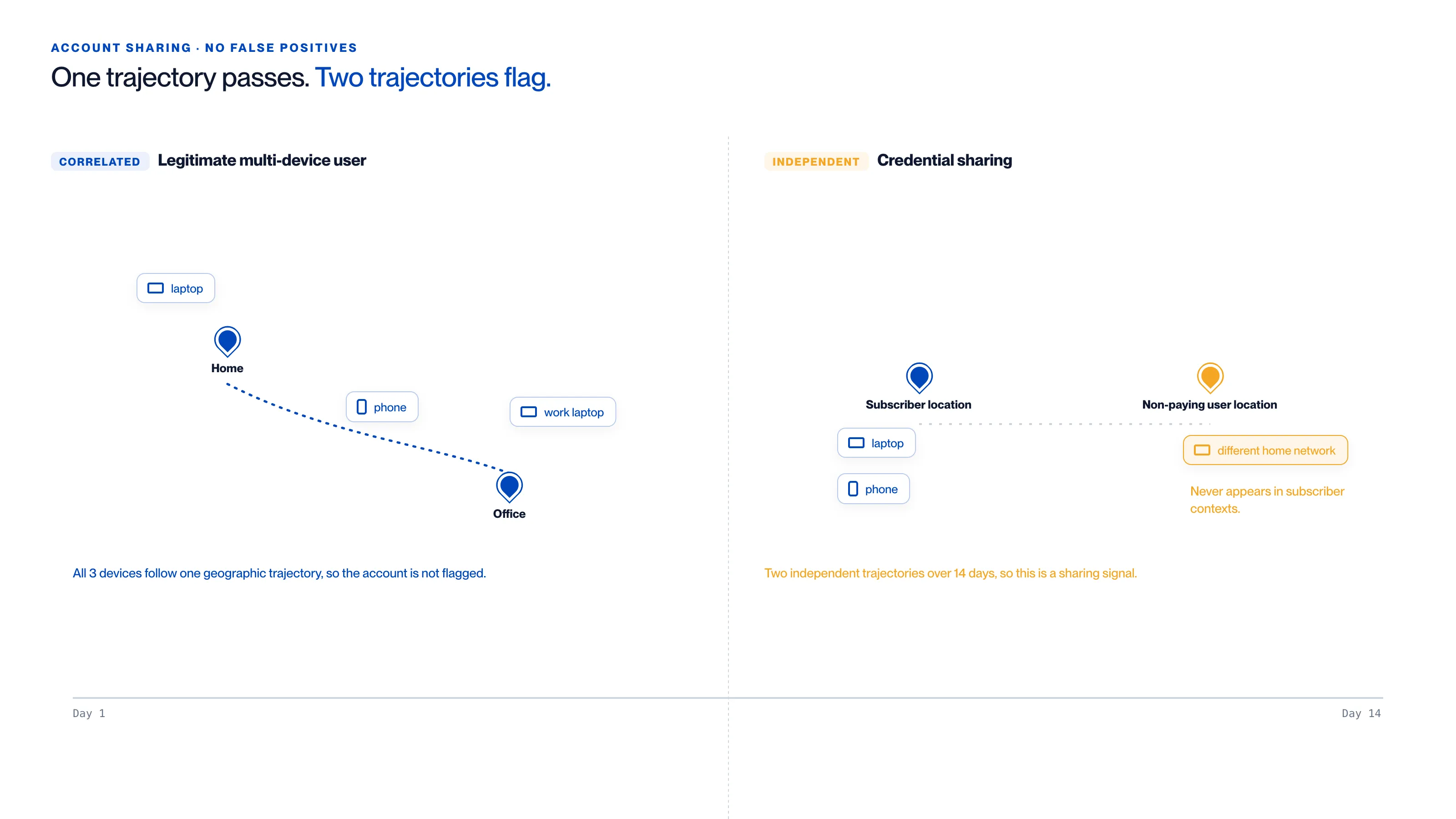
Over the 14-day window the two cases diverge:
- Legitimate multi-device user (correlated): the laptop, phone, and work laptop all appear across the same primary geographic contexts (home and office) because they travel with one person. A user with many devices but one geographic trajectory is not flagged.
- Credential sharing (independent): the non-paying user's devices are anchored in a geographic context the subscriber's devices never enter, on a different home network. Two independent trajectories over 14 days are flagged as a sharing signal.
- Travel case: a new location appears inside the existing device's travel history, not as a new device with no history on the account, so it does not trigger a sharing classification.
The geographic trajectory signal is what the 14-day window enables. A subscriber who commutes between home and office has two primary geographic contexts. Their three devices all appear in both contexts over time, because they travel with the subscriber. The devices are correlated, not independent.
A credential sharer's non-paying user has devices that appear in a geographic context that the subscriber's devices never appear in. Over 14 days, this independence accumulates as a clear signal. The non-paying user's devices are consistently anchored in a different location, with a different home network signature, and they never appear in the subscriber's primary geographic contexts.
The travel case (a subscriber who travels to a new location) is handled correctly because the subscriber's primary device travels with them. The new location appears in the travel history of the subscriber's existing device, not as a new independent device with no history on the account. This distinction is visible in the fingerprint history and does not trigger a sharing classification.
Confidence scoring and review queues
Quick answer: cside's sharing classification outputs a confidence score, not a binary verdict. High-confidence classifications trigger automated actions: upgrade prompts or enforcement restrictions. Low-confidence classifications route to a manual review queue where the fraud team can evaluate the specific case before any action is taken. This means that edge cases (the subscriber with an unusual device pattern that doesn't fit the standard single-user or sharing templates) are reviewed by a person rather than acted on automatically.
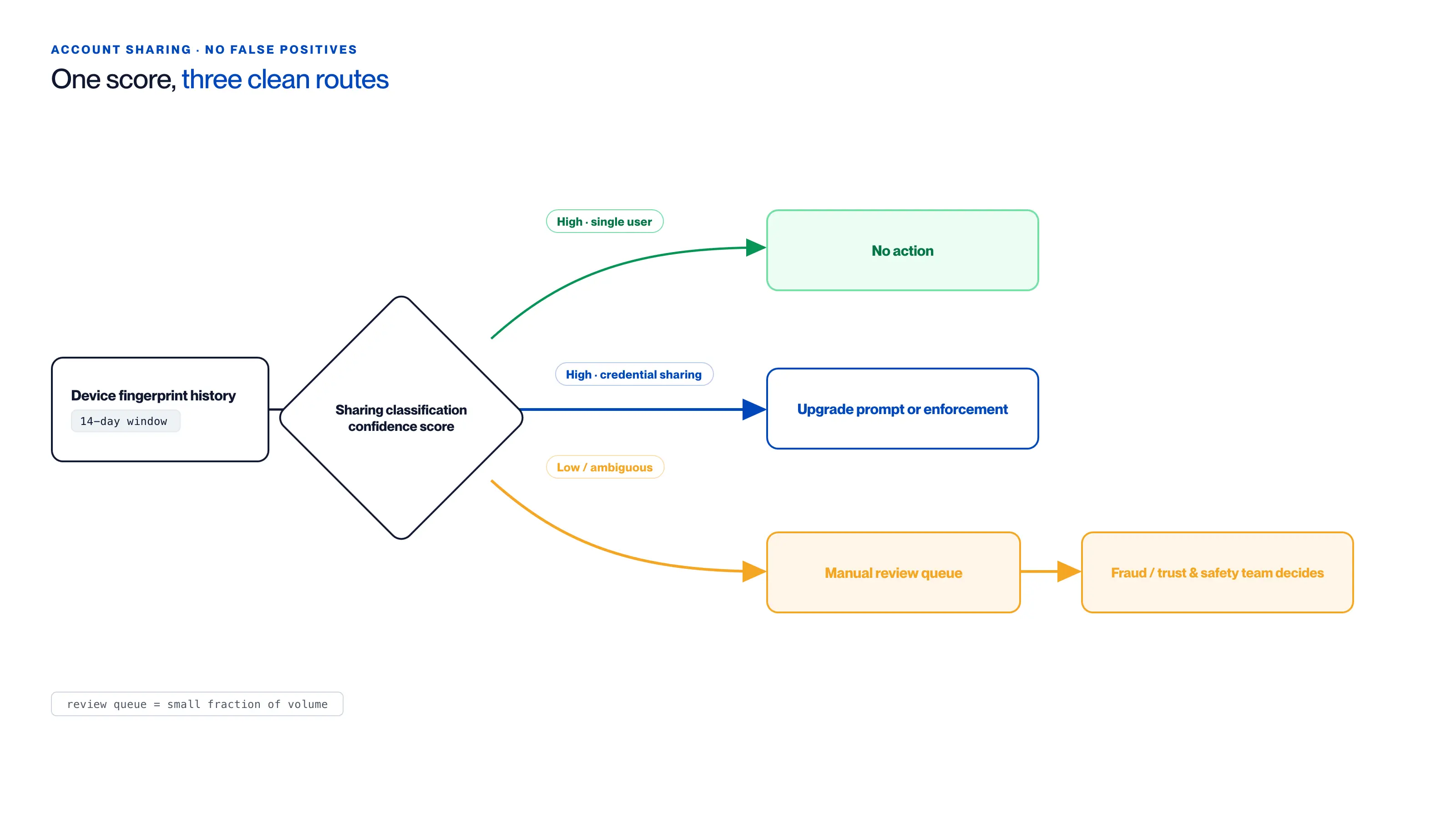
A 14-day device fingerprint history feeds one confidence score, which routes each account by classification:
| Classification | Confidence | Action |
|---|---|---|
| Single user / multi-device | High | No action |
| Credential sharing | High | Upgrade prompt or enforcement |
| Ambiguous | Low | Manual review queue (fraud / trust and safety team decides) |
Only the ambiguous middle cohort reaches a human; the review queue is a small fraction of volume, and the high-confidence majority is resolved automatically.
The confidence score is the mechanism that converts a detection signal into an action with an appropriate false positive rate. A system that acts on every signal with equal confidence will have high false positive rates. A system that acts only on high-confidence signals and routes uncertainty to review will have materially lower false positive rates, at the cost of a review queue that the fraud team manages.
For most platforms, the review queue is a small fraction of the total detection volume. The majority of accounts either clearly fit the single-user multi-device pattern (high confidence, no action) or clearly fit the credential sharing pattern (high confidence, upgrade prompt or enforcement). The ambiguous middle cohort routes to review and is resolved by a human.
This is the right trade-off for platforms where false positive cost is high. A streaming platform that flags a loyal subscriber as a potential sharer, and triggers an enforcement wall that interrupts their viewing, has damaged a subscriber relationship that was worth more in lifetime value than any enforcement action could recover. A review queue means that the cases most likely to produce that outcome are handled with human judgment rather than automated action.
What this means for product and trust teams
Quick answer: The false positive objection to account sharing detection is a legitimate operational concern that can be addressed at the design level. The design principles that resolve it are: passive accumulation (no action on single sessions), temporal pattern analysis (14-day window), geographic independence as the primary signal (not device count or IP address), and confidence-scored output (human review for ambiguous cases). cside's account sharing detection implements all four principles.
Product teams evaluating account sharing detection need to ask how the detection handles their specific legitimate use cases. For a professional services SaaS platform whose users carry multiple work devices, the device count question is central. A streaming platform with a family subscription model needs a clear answer on household detection instead. Any platform with a globally distributed user base has to resolve the travel and remote work question above all.
cside's 14-day device fingerprint history addresses all three questions through geographic independence rather than device count. The number of devices is an input to the analysis, not the primary classifier. The geographic relationships between those devices over time is the classifier. This means that a user with many devices but a single geographic trajectory is not flagged, and a user with two devices but two independent geographic trajectories is.
The operational integration question for product teams is whether detection output connects to the upgrade prompt and enforcement workflow with the right confidence gate. A high-confidence sharing signal should trigger an upgrade prompt; a low-confidence signal should route to review; a high-confidence single-user signal should produce no action. cside's integration supports this routing natively.
Related: the upstream version of this problem is fake account creation, where the abuse happens before there is an account to share. cside Signup Shield turns each registration into a real-time trust verdict so you can stop fake new accounts, trial and promo abuse, and multi-accounting at signup.
cside is SOC 2 certified. The full security posture and privacy architecture documentation is available at trust.cside.com.