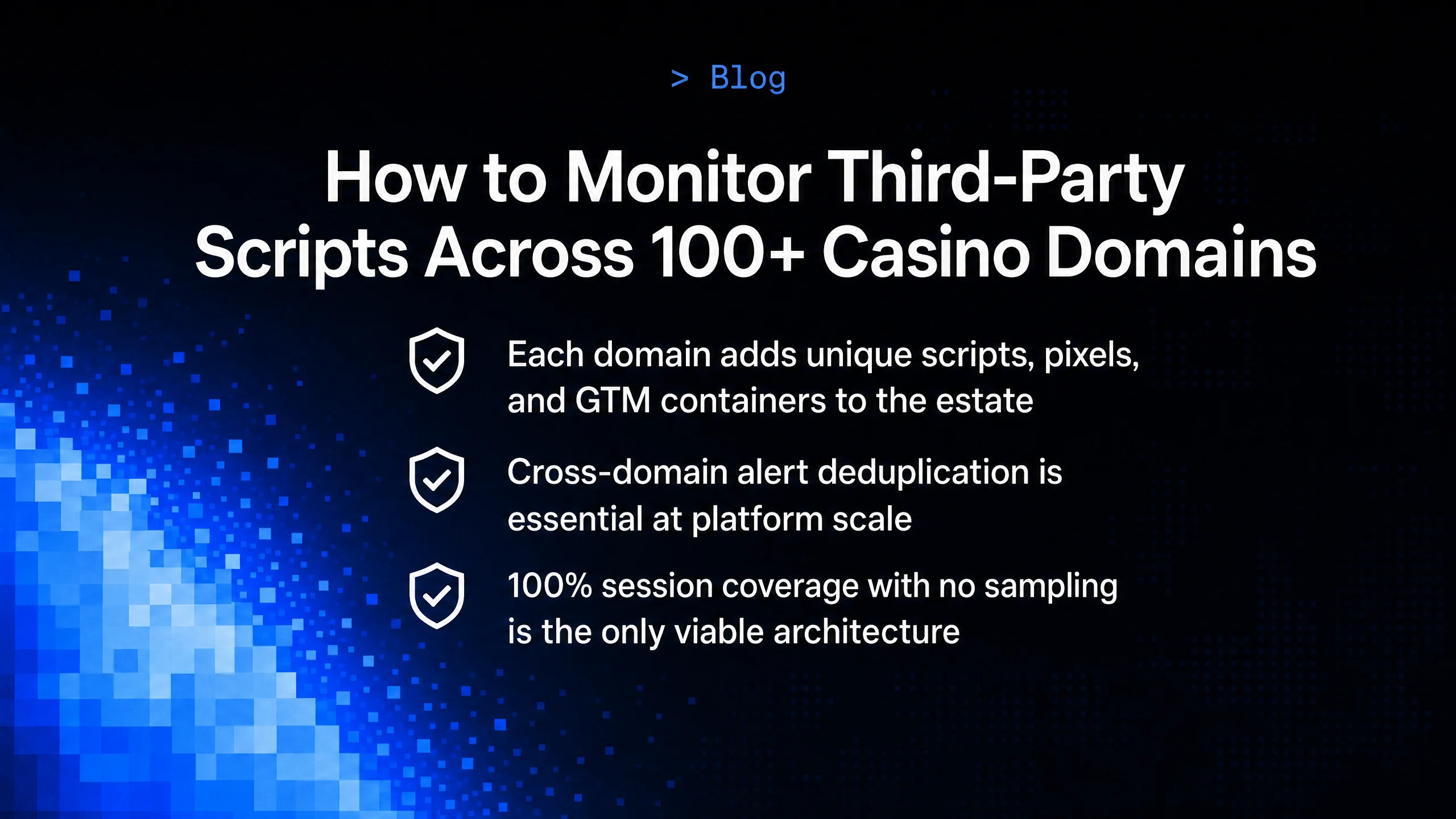
TL;DR: multi-brand casino runtime script visibility across 100-plus domains with cross-domain alert deduplication
- One incident, not 150: One compromised CDN library across 150 casino domains is a platform-wide incident, not 150 separate ones: Polyfill.js hit 490,000 sites in June 2024 through exactly this pattern.
- What the first scan found: The first browser-layer scan on an 80-domain white-label surfaced 94 executing scripts on the primary domain alone, 53 of which the engineering team could not account for.
- One tag, every domain: cside deploys as one head tag across every domain, deduplicates cross-domain alerts into single rollups, and does not charge per domain, so security teams stop rationing coverage.
Short on time? See cside's in-browser Magecart and skimmer blocking. It covers everything below in one deployment.
In my work with multi-brand iGaming operators, managing third-party scripts across a single gambling website is hard enough. Managing them across 100 or more branded casino domains is a different category of problem entirely. In Q1 2025 alone, cside detected more than 300,000 attack signals across monitored sites, and a disproportionate share originated from third-party scripts that nobody had explicitly authorised. For multi-brand operators, the risk compounds with every domain added to the estate, every affiliate partner onboarded, and every market-specific tag deployed by a regional marketing team acting independently.
Why domain count creates exponential script risk
Quick Answer: Each additional casino domain in a multi-brand estate introduces its own set of third-party scripts, affiliate pixels, and GTM containers. A single compromised library shared across the platform can trigger a supply chain breach across every brand simultaneously. Operators managing 100-plus domains face exponential exposure, not linear risk.
A single-brand operator manages one GTM container, one set of affiliate pixels, one analytics stack. A multi-brand operator managing 100 domains routinely runs dozens of GTM containers, hundreds of affiliate tracking pixels, and multiple analytics stacks, often with different configurations per market. The surface area is not 100 times larger in terms of scripts per domain; it is larger in terms of unique script combinations, shared dependencies, and the probability that at least one script across the estate is compromised at any given moment.
The June 2024 Polyfill.js supply chain attack illustrates the mechanism precisely. A widely used CDN-hosted JavaScript library was modified after its domain changed ownership, instantly affecting more than 490,000 websites with malicious redirect code. For an operator running 150 casino domains all loading the same CDN-hosted library, that single event becomes a platform-wide incident.
ENISA's Threat Landscape for Supply Chain Attacks identifies third-party script injection as one of the primary vectors for targeting organisations indirectly through their software supply chains. iGaming platforms are a high-value target precisely because they process payment data and hold player accounts across multiple regulated markets simultaneously.
Consider what a typical 100-domain estate actually looks like in practice:
- 3 to 5 GTM containers, some shared across brand groups, some per-brand
- 20 to 50 affiliate network pixels, with different partners per market
- Regional analytics tools added by local marketing teams
- A/B testing scripts that embed deeply into the page and can call external endpoints
- Customer support chat widgets, each connecting to a third-party API
Any one of these can be the entry point for a supply chain compromise.
How script sprawl happens on multi-brand platforms
Quick Answer: Script sprawl on multi-brand gambling platforms is driven by per-brand marketing autonomy, affiliate partner diversity across markets, and geo-specific regulatory requirements for consent and tracking. The result is a third-party script estate that grows faster than any central security team can audit manually.
The mechanics of script sprawl are structural, not accidental. Multi-brand operators typically grant regional marketing teams the ability to add tags via GTM without requiring a security review for each addition. This is a reasonable operational choice: requiring security sign-off on every marketing pixel would slow campaign launches unacceptably.
The consequence is that scripts accumulate. A brand operating in the UK, Germany, and Sweden may have three different consent management platforms, two different affiliate tracking solutions, and a market-specific analytics tool. Multiply this across 20 brands and the estate becomes effectively unauditable by manual means.
Three structural drivers make this worse in iGaming specifically:
- Affiliate partner diversity: Different affiliate networks operate in different jurisdictions. Each partner brings its own tracking pixel or postback script, often loaded client-side.
- Regulatory variation: Some markets require specific cookie consent tools or data residency constraints that force market-specific tag architectures.
- Mirror domain infrastructure: Operators frequently run mirror domains as resilience or geo-routing infrastructure. Scripts deployed on the primary domain often propagate to mirrors automatically, but the reverse is not always true, creating inventory gaps.
The result is a script estate that no single person in the organisation has a complete picture of. Security teams inherit the risk of every tag ever added.
What multi-domain monitoring actually requires
Quick Answer: Effective script monitoring across 100-plus casino domains requires cross-domain alert deduplication, a centralised inventory view, per-vendor tracking across all domains, and the ability to triage alerts without navigating hundreds of separate dashboards. Sampling-based or proxy-based monitoring architectures cannot provide this at scale.
Standard approaches to script monitoring break down at scale. Manual auditing is impossible. Proxy-based monitoring tools observe scripts from outside the browser and miss execution-level behaviour. Session sampling tools that cover less than 10 percent of traffic will routinely miss low-frequency attacks that target specific user segments.
What operators running large domain estates actually need from a monitoring solution:
- Cross-domain alert deduplication: If the same malicious script fires on 80 of 100 domains, the security team should receive one alert with a domain breakdown, not 80 separate alerts requiring individual triage.
- Per-domain script inventory: A complete list of every script executing on every domain, updated in real time, not from a weekly crawl.
- Vendor ID tracking by domain and across domains: The ability to set an alert when a specific GTM container ID, pixel vendor, or tracker appears on a domain where it was not previously authorised, or disappears from a domain where it was expected.
- Centralised triage without dashboard navigation overhead: Security analysts should be able to assess platform-wide script health from a single view, drilling into specific domains only when needed.
- Unlimited domain coverage in the pricing model: Any monitoring solution that charges per domain creates a perverse incentive to monitor fewer domains. Platform-scale operators need pricing that reflects platform-scale deployment.
Monitoring that covers only a sample of sessions will miss the attack patterns most relevant to large platforms: geo-targeted injections that only fire in specific countries, redirect attacks that activate only for users arriving from specific affiliate links, and time-limited injections that run for hours before being removed.
How cside handles multi-domain deployments
Quick Answer: cside deploys via a single script tag that can be applied uniformly across all domains in a multi-brand estate. It instruments 100% of real user sessions in the browser itself, with no sampling and no proxying. A centralised dashboard surfaces cross-domain inventory, per-domain views, and configurable alerts per vendor or tracker ID.
cside's architecture is designed for this deployment pattern. Deployment requires one lightweight script tag in the <head> that initialises before any third-party script executes, giving cside visibility from the very first script the player's browser loads. That single tag propagates coverage to every domain on the estate without changes to the platform's existing architecture or stack. Most operators complete initial deployment and see their first complete script inventory in under a day. There is no per-domain configuration overhead, and no requirement to maintain separate monitoring accounts for different brand groups.
The instrumentation runs inside the browser on real user sessions, not on a crawled or simulated version of the page. This matters for iGaming because many injected scripts are conditional: they fire only for specific user types, only on specific pages, or only during specific sessions flagged by the injecting party. Proxy-based monitoring and periodic crawl-based auditing will not see these injections.
The dashboard is structured for multi-domain operators. Security and engineering teams can:
- View a consolidated script inventory across the entire domain estate
- Filter by domain, brand group, or script vendor
- Configure alerts to fire when a specific vendor ID appears on any domain where it was not previously seen
- Receive cross-domain alert rollups rather than per-domain noise
For operators running complex infrastructure across multiple Cloudflare accounts or with mirror domain architectures, cside's tagging model means the monitoring layer is independent of the underlying infrastructure configuration. Script coverage does not require changes to DNS, CDN routing, or Cloudflare zone structure.
A practical guide to getting started at scale
Quick Answer: The practical starting point for multi-domain script monitoring is establishing a baseline inventory, prioritising payment-adjacent pages and session flows for immediate alerting, and configuring vendor-specific alerts for known affiliate partners before expanding to anomaly-based detection.
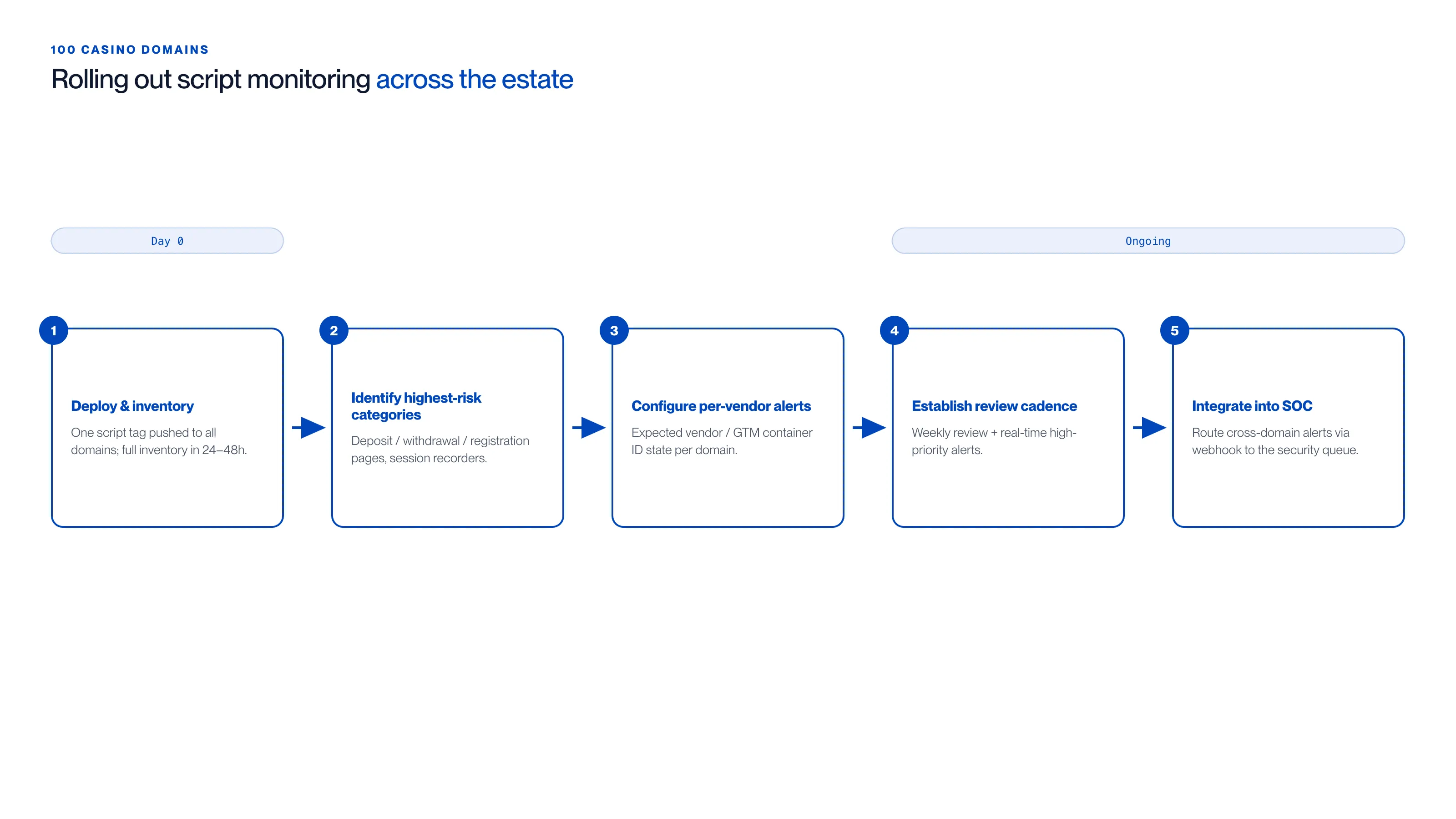
| Phase | Step | Action | Key output |
|---|---|---|---|
| Day 0 | 1. Deploy & inventory | Push one script tag to all domains in a single template change | Full inventory of every executing script in 24-48h |
| Day 0 | 2. Identify highest-risk categories | Flag deposit / withdrawal / registration pages and session recorders | Ranked shortlist of the scripts that matter most |
| Ongoing | 3. Configure per-vendor alerts | Set the expected vendor / GTM container ID state per domain | Alert when an ID appears where it was not authorised |
| Ongoing | 4. Establish review cadence | Weekly review plus real-time high-priority alerts | Sustained coverage as the estate changes |
| Ongoing | 5. Integrate into SOC | Route cross-domain alerts via webhook to the security queue | Alerts triaged in existing tooling, not the dashboard alone |
Operators deploying script monitoring across a large domain estate for the first time typically have no reliable baseline inventory to start from. The monitoring tool itself will generate that inventory as the first output. Here is a practical deployment sequence:
Step 1: Deploy and inventory
Deploy the cside script tag across all domains in a single template push. Because the tag initialises before any third-party script executes, it captures the full load sequence from the first session. Within the first 24 to 48 hours, the dashboard will surface a complete inventory of every executing script, including inline scripts, dynamically injected scripts, and scripts loaded by other scripts. Every event in that inventory is logged with timestamp, session context, and destination mapping, forming the foundation of a PCI audit report and forensic investigation record. This baseline is often the first time the security team has seen the full estate.
Step 2: Identify the highest-risk script categories first
Not all scripts carry equal risk. Prioritise alerting on:
- Scripts executing on deposit, withdrawal, and account registration pages
- Session recording tools with access to form fields
- Scripts making network requests to third-party endpoints not in your approved vendor list
- Any script not present in the GTM container configuration (indicating dynamic injection)
Step 3: Configure per-vendor alerts
Use the vendor ID tracking feature to set expected states per domain. An affiliate pixel that should appear on 30 domains but not on the remaining 70 should trigger an alert if it appears outside its approved set. A GTM container ID that appears on a domain where it was not previously present is a high-priority signal.
Step 4: Establish a review cadence
Cross-domain script inventories change faster than most security teams expect. A weekly review of new script appearances, combined with real-time alerting for high-priority signals, is the minimum cadence for a 100-plus domain estate.
Step 5: Integrate alerts into your security workflow
cside alert outputs can feed into existing security operations tooling via webhook or integration. For platform-scale operators, routing cross-domain alerts to a centralised security operations queue is more efficient than managing them in the monitoring dashboard alone.
The goal is not perfect script control on day one. It is visibility first, then systematic risk reduction based on what the inventory actually reveals.
Summary
Multi-domain monitoring is a different problem from single-domain monitoring at larger scale, and it needs a different architecture: cross-domain alert deduplication, per-vendor tracking across the full estate, 100% session coverage with no sampling gaps, and a pricing model that does not create incentives to monitor fewer domains. The two conditions that make large-estate monitoring viable are a single deployment mechanism that propagates uniformly across all domains, and a centralised view that lets security teams assess platform-wide risk without navigating individual domain dashboards. For operators managing 100 or more casino domains, the practical goal is to reach a state where a script appearing on a domain for the first time triggers an alert within minutes of the first session, regardless of which domain in the portfolio it appears on. cside's client-side security capability is built for exactly this estate-wide deployment pattern.
What the first inventory reveals
When we ran the initial cside monitoring session for a white-label gambling platform operating more than 80 branded casino domains, the security team's starting assumption was that they had a manageable script estate. The platform used a shared GTM container across its main brand group, and the head of engineering had a list of around 30 third-party scripts he expected to find. The first 24 hours of browser-layer monitoring surfaced 94 distinct executing scripts across the primary domain alone. Of those, the engineering team could immediately account for 41. The remaining 53 required investigation.
Within the first week, the team identified three affiliate tracking scripts that were sending session data to endpoints outside the platform's documented vendor list. Two of those scripts had been introduced during a campaign launch six months earlier and had never been formally reviewed. One was sending data to a domain registered three weeks prior, which the security team flagged for escalation. The outcome: the platform disabled two scripts immediately, initiated a GDPR processor assessment for a third, and implemented a change control requirement for all future GTM additions across the domain portfolio. The process started with what the monitoring surfaced, not with a manual audit of code they already knew about.