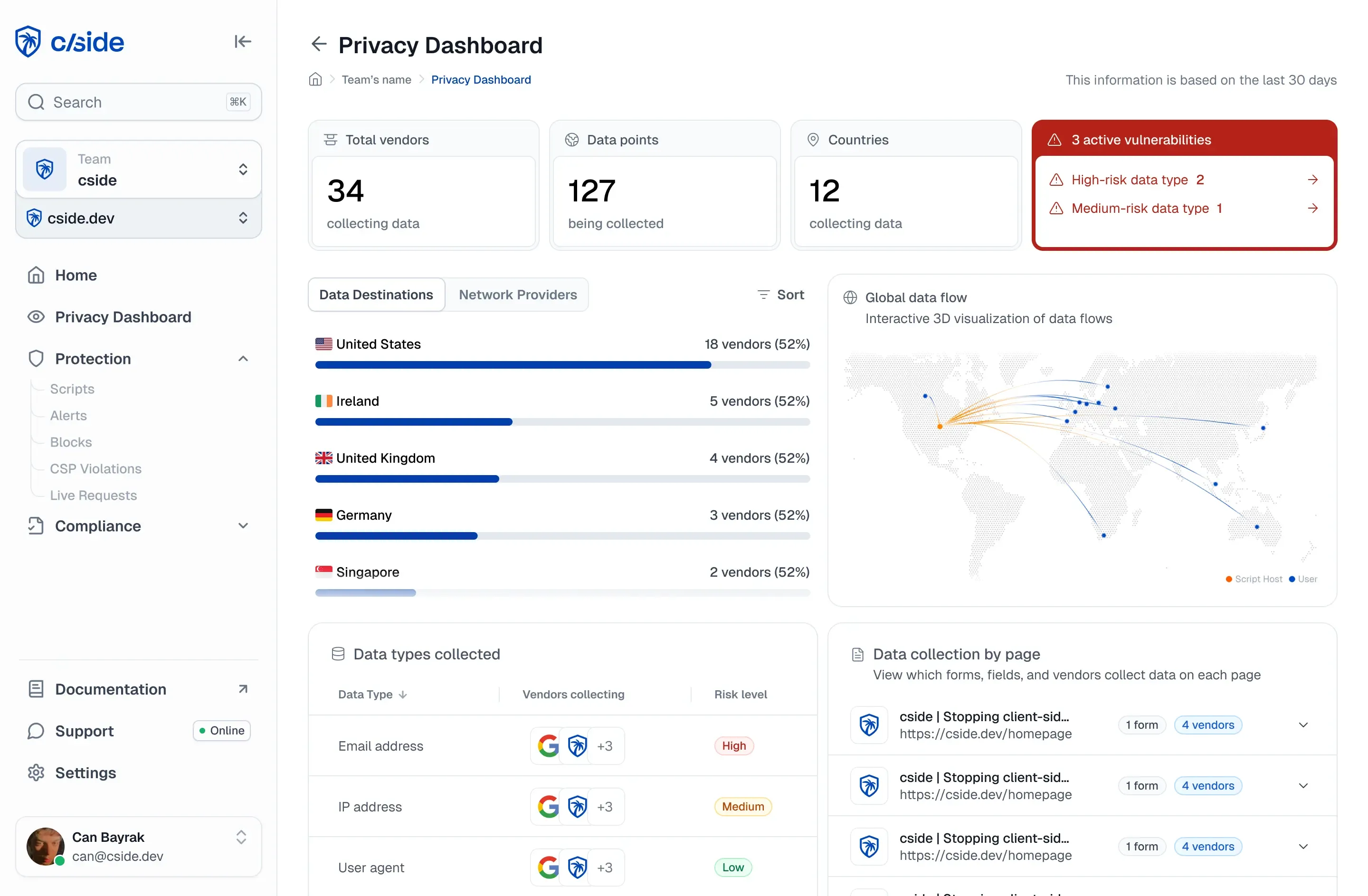

TL;DR: fintech client-side monitoring platform comparison for PCI DSS 4.0.1 and GDPR
- Sampling blind spot: Generic client-side monitoring is not built for fintech. Sampling 10% or 20% of sessions is a structural blind spot when a Magecart injection targets one browser, one checkout flow, or one geography.
- cside coverage: cside PCI Shield is QSA-validated by VikingCloud, covers 100% of real user sessions with no sampling, and surfaced 300,000+ previously unseen client-side attack signals in Q1 2025 alone from cside product data.
- Match to priority: If your priority is PCI DSS 4.0.1 audit readiness, demand QSA-validated evidence. If GDPR field-level script control is the priority, demand form-field-touch visibility. If both apply, only a platform that satisfies both is fit for purpose.
Short on time? See cside PCI Shield. It covers everything below in one deployment.
Client-side monitoring for fintech is the continuous observation and analysis of JavaScript execution, third-party script behaviour, and browser-layer data access within financial web applications. It covers what happens in the user's browser after the page loads: which scripts run, which form fields they touch, what data leaves the session, and whether any script behaviour changes between deployments. For fintech platforms, this is not a general hygiene practice. The combination of live payment data, regulated personal financial information, and strict compliance obligations makes the browser layer a high-value target and a heavily audited surface.
The fintech threat profile is specific. PCI DSS v4.0.1 requirements 6.4.3 and 11.6.1, mandatory since 31 March 2025, require financial platforms to authorise and inventory every script on payment pages and detect unauthorised changes to HTTP headers. GDPR Article 83(5) exposes platforms to fines up to EUR 20 million or 4% of global annual turnover when third-party scripts process personal data without a lawful basis. Supply-chain risk compounds this exposure. The June 2024 Polyfill.js compromise served malicious JavaScript to visitors of more than 490,000 websites through a single compromised CDN domain. Each of those sites had explicitly authorised the script origin, meaning standard CSP and hash monitoring would not have caught it. Fintech platforms that rely on third-party scripts for payment flows, KYC integrations, and analytics face this supply-chain vector directly. General client-side security tools are not designed around these requirements. Fintech security teams need platforms built for them. For the broader picture across both verticals, see our guide to client-side security for ecommerce and fintech platforms.
What is client-side monitoring for fintech? Client-side monitoring for fintech is the real-time inspection of browser-layer JavaScript activity on financial web applications, covering third-party script behaviour, form field access, data exfiltration signals, and compliance with PCI DSS and GDPR controls. It gives fintech security and compliance teams continuous visibility into what runs in the user's browser, what data those scripts can reach, and whether any unauthorised behaviour has occurred during a live session.
What fintech client-side monitoring requires
Quick answer: Fintech platforms need client-side monitoring that covers PCI DSS 6.4.3 script authorisation and 11.6.1 header integrity monitoring, GDPR-signal visibility at the script level, complete session coverage without sampling gaps, QSA-validated audit evidence, and deobfuscated payload archival for incident response. Generic monitoring tools meet some of these requirements but rarely all of them.
PCI DSS 6.4.3 and 11.6.1 compliance readiness
Requirements 6.4.3 and 11.6.1 are not optional for any entity storing, processing, or transmitting cardholder data. Requirement 6.4.3 mandates a full inventory of payment-page scripts with authorisation records for each. Requirement 11.6.1 requires a mechanism to detect unauthorised changes to HTTP response headers and the contents of payment pages. A monitoring platform needs to produce evidence that satisfies a QSA, not just internal dashboards.
GDPR script-level visibility
Under GDPR, the question is not only whether a cookie banner is present. The question is whether every script that executes on a user session has a documented lawful basis for any personal data it accesses. A platform that shows script names but not which form fields each script touches cannot answer that question. Fintech platforms operating in the EU need field-level visibility, not just domain-level script lists.
Full session coverage, no sampling
Sampling is a standard performance compromise in general analytics tools, but it is operationally incompatible with compliance monitoring. A Magecart injection or data exfiltration event can affect a specific session type, a specific browser, or a specific checkout flow. A platform that monitors 10% or 20% of sessions has structural blind spots. Fintech deployments need 100% session coverage.
Deobfuscated payload archival
When a skimmer or supply-chain compromise is discovered, the incident response process requires forensic evidence: what the malicious script was doing, what data it accessed, and when the behaviour changed. Platforms that only alert on anomalies without preserving deobfuscated payload content leave security teams without the evidence needed for regulatory reporting or legal proceedings.
QSA-validated audit evidence
The output of a monitoring platform must translate directly into QSA-acceptable documentation. Dashboards that require manual interpretation, exports that lack the required fields, or evidence packages that a QSA has never reviewed create friction and audit risk. Fintech teams need platforms where the compliance evidence is pre-validated by a recognised assessor.
The platforms
1. cside
Best for: Fintech and regulated financial platforms that need QSA-validated PCI DSS compliance evidence, full session coverage, and GDPR form-field visibility.
cside is a browser-layer script monitoring and client-side security platform built specifically for high-compliance environments. Its PCI Shield dashboard is QSA-validated by VikingCloud, producing audit-ready documentation for PCI DSS requirements 6.4.3 and 11.6.1 without requiring manual interpretation or spreadsheet exports. The platform covers 100% of real user sessions, which means no sampling gaps and no blind spots in live production traffic.
For GDPR compliance, cside provides session-level visibility into which scripts access which form fields. That field-touch mapping is the signal compliance teams need to demonstrate that third-party scripts are operating within their documented lawful basis. cside detected more than 300,000 previously unseen client-side attack signals in Q1 2025 (cside product data), which reflects the breadth of the threat surface the platform monitors across the customer base.
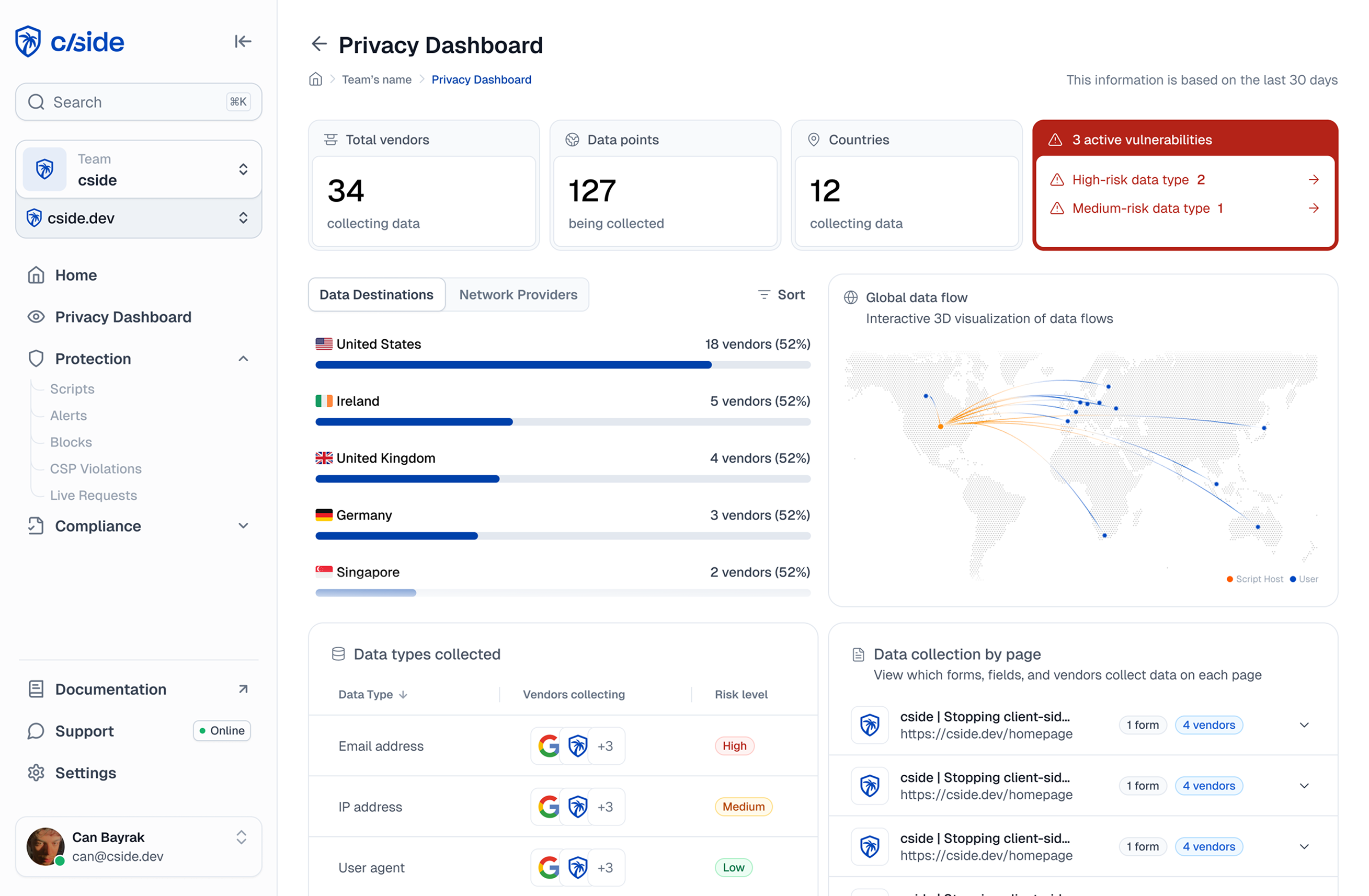
Deobfuscated payload archival means that when an incident occurs, the forensic record is already there. Self-service onboarding and transparent pricing make it practical for fintech security teams who need fast deployment without a long procurement cycle. For fintech teams who want more detail on the PCI DSS compliance use case or GDPR script visibility, both pages walk through the specific controls.
2. Reflectiz
Best for: Teams that serve the same static, unconditional content to every visitor and want a periodic external scanner for script inventory and scheduled review.
Reflectiz is a periodic remote scanner. A cloud crawler visits your pages on a schedule and reports on the scripts it sees at scan time, so its coverage is bounded by what the crawler happens to receive during each visit rather than what runs in a real user's browser. A point-in-time scanner like this sees even less than a sampled in-page agent, because it runs in no real user session at all, only what loads during its scheduled crawl. Because that crawler runs from a known cloud IP range with a predictable user agent, an attacker who fingerprints it can serve a clean script to the scanner while real shoppers receive the malicious version inside the actual DOM. A cloud crawler is not equivalent to a script running in the DOM of a real user session, and that is the structural limit of a scanner-only model.
For fintech, the gap matters most against conditional attacks that vary the payload by IP, geography, device, login state, or checkout step, exactly the sessions most likely to be targeted on a payment page. A scheduled scan can create a false sense of coverage while a targeted skimmer stays invisible to it. On independent assurance, cside's review of Reflectiz's public materials found no equivalent SOC 2 Type II certification or PCI DSS SAQ D published, and Reflectiz's PCI reporting is self-described, so a QSA may still ask for independent validation. Reflectiz also publishes no public status page, no uptime SLA, and no public pricing, which adds friction for procurement and availability verification.
3. Source Defense
Best for: Enterprise merchants that want client-side script controls built around behavioural isolation and sandboxing.
Source Defense offers two methods. "Detect" is a crawler that mimics a user visiting the page and fetches the third-party scripts that load, which carries the same crawler limitation as any scheduled scan: it captures only one context, and attackers can serve a clean script when the request comes from a cloud provider. "Protect" is a JavaScript agent that builds a client-side sandbox to isolate third-party scripts, so the model aims to enforce rather than only observe.
The tradeoffs are architectural. Agent-based detection is trigger-based, so anything that does not trip a trigger is treated as safe, and the triggers live in the browser where a bad actor can study them, like playing minesweeper with the bombs exposed. Because the agent runs in the same browser environment as the attacker, a malicious script that is already running can override core functions such as fetch and intercept the alert before it leaves the browser, so a detection can fire while the signal never arrives. The sandbox can add up to 100ms of latency, and per-script permission policies need ongoing configuration as your integrations change. Most important for fintech forensics: Source Defense cannot show you the script contents, which makes deep incident analysis and QSA-grade evidence harder. Source Defense maintains a public changelog but no status page or uptime SLA, and publishes no public pricing or free tier.
4. Jscrambler
Best for: Development teams that also need JavaScript obfuscation and code protection alongside webpage integrity monitoring.
Jscrambler began in JavaScript obfuscation and runtime code protection and added webpage integrity monitoring later. Its "code locks" restrict where and when first-party code can run, and its runtime protections aim to detect tampering and debugging, but those detections are self-contained and run in the browser, which is an ideal sandbox for an attacker to develop a bypass. The monitoring layer relies on periodic scanning and does not preserve raw payloads. Because Jscrambler does not track script contents at all, it cannot show you the script that ran, and bad actors often sample their attacks, so the malicious code can be impossible to recover afterward.
For fintech compliance, that forensic gap is the key limitation: webpage integrity monitoring without archived, deobfuscated payloads gives a QSA behavioural observations rather than the actual attack code. Jscrambler's AI features rely on the APIs of large third-party AI companies and are opt-in, whereas cside runs open-source LLMs on infrastructure it controls. Jscrambler integrates with Jira but not Linear, and publishes no public pricing or free tier; its status page is password-gated with no public uptime history. In the independent 2026 Globee Cybersecurity Awards for Client-Side Security, Jscrambler received Silver and cside received Gold (Best of Category). The platform makes most sense for teams that want obfuscation and monitoring together rather than compliance teams evaluating monitoring in isolation.
5. Feroot
Best for: Teams looking for a JavaScript-agent behavioural monitor with an allow-list script model.
Feroot was founded in 2017 and combines two products. "PageGuard" deploys permissions and an allow-list where you pre-approve which scripts may run, and overwrites core JavaScript to constrain behaviour. The weakness of an allow-list is that it checks the source of a script, not the code that is actually served, so it would not have caught the 2024 Polyfill attack, where a trusted domain changed ownership and quietly began serving malicious code from an already-approved origin. "Inspector" deploys synthetic honeypot users to simulate real behaviour, which is effectively a scanner/crawler running periodic checks, an approach similar to Reflectiz, and one that can be avoided by serving malicious scripts only to residential IPs.
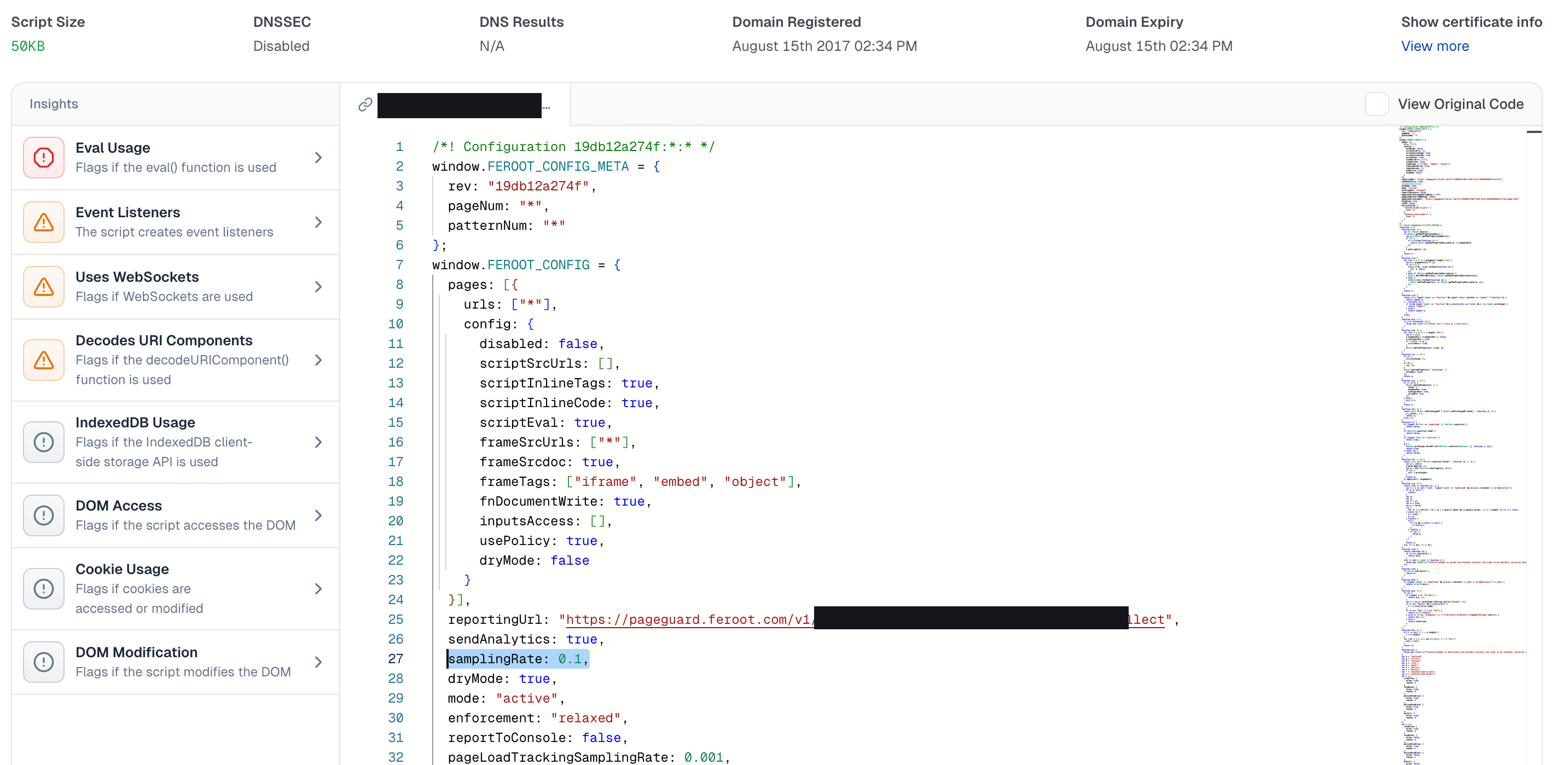
Because Feroot's agents flag behavioural anomalies after scripts have loaded and executed, and sample a fraction of sessions rather than observing all of them, a payload served only to one geography, one device class, or logged-in users can sit in the unsampled majority indefinitely. Feroot's own PageGuard configuration sets samplingRate: 0.1, roughly 10% of real user sessions, so about 90% run unmonitored. A crawler on its own also cannot satisfy PCI DSS, which requires a mechanism to prevent unauthorised scripts. Forensic depth and payload archival are more limited than platforms designed for security incident response, so fintech teams that need archived attack evidence for a QSA should weigh that gap.
Platform comparison
| Platform | Detection approach | Real-user session coverage | Deobfuscated payload archival | PCI DSS 6.4.3 + 11.6.1 evidence | Public pricing / free tier |
|---|---|---|---|---|---|
| cside | Script Method + Scan Method, server-side analysis | 100% of real user sessions, no sampling | Yes, immutable archive | QSA-validated by VikingCloud | Yes, public pricing and free tier |
| Reflectiz | Periodic remote scanner (cloud crawler) | Scan-time only, no real-user DOM visibility | Not documented | Self-described, no published independent validation | No public pricing |
| Source Defense | Crawler (Detect) + JS-agent sandbox (Protect) | Bounded by what the agent enforces or the crawler sees | No, cannot show script contents | Detection logs, no forensic payload | No public pricing or free tier |
| Jscrambler | Trap-based detection + periodic scanning | Periodic scanning | No, does not track script contents | Behavioural monitoring, no archived payloads | No public pricing or free tier |
| Feroot | JS agents (PageGuard) + synthetic-user crawler (Inspector) | Samples a fraction of sessions | Limited | Allow-list/crawler; a crawler alone cannot meet PCI DSS | Not documented in this comparison |
How to choose for fintech
Quick answer: Turn your most urgent compliance driver into hard requirements, then keep only the platforms that meet all of them. For a fintech browser layer, the criteria that separate audit-ready monitoring from partial coverage are: QSA-validated PCI DSS 6.4.3 and 11.6.1 evidence, 100% real-user session coverage with no sampling, server-side payload analysis that attackers cannot fingerprint or disable, deobfuscated payload archival for forensics, CDN-agnostic deployment with no lock-in, and transparent public pricing with a free tier to prove it before you commit.
Use the comparison table above against these criteria. Do not accept a platform that meets most of them, because in fintech the gaps are exactly where a targeted skimmer or an audit finding lands.
If your primary concern is PCI DSS 4.0.1 audit readiness: Require evidence that a named QSA has actually validated for requirements 6.4.3 and 11.6.1, not just a dashboard that maps to PCI controls, and require 100% session coverage so no payment session falls outside a sample. Independent assessor validation is what survives a live QSA review; self-described reporting is not the same thing.
If your primary concern is GDPR-compliant third-party script governance: Require form-field-touch visibility, a record of which scripts read which form fields during real user sessions, not just which scripts load. A domain-level script inventory cannot demonstrate a lawful basis for the personal data a script actually accesses.
If your primary concern is incident response and forensic evidence: Require archived, deobfuscated payloads and session-level behavioural records. An alert without the preserved script leaves the incident response team reconstructing an attack from incomplete signals, and a platform that never captures script contents cannot produce the attack code a regulator or QSA will ask for.
If your primary concern is resistance to evasion and conditional attacks: Require detection that runs where attackers cannot see or disable it, server-side rather than inside the browser, and coverage of every real session rather than a scheduled crawl. Browser-only agents and cloud-IP scanners can be fingerprinted and served a clean payload while a real shopper is skimmed.
Evaluation checklist for fintech security teams
Quick answer: Before committing to a fintech client-side monitoring platform, verify five things in a proof-of-concept: QSA-accepted evidence format, 100% session coverage (not sampled), form-field-touch visibility for GDPR, deobfuscated payload retention, and GDPR data flow export capability. A platform that passes all five is genuinely ready for a fintech compliance audit.
Before committing to a platform, verify these five capabilities in a proof-of-concept or demo:
- QSA evidence validation. Ask the vendor whether their PCI DSS compliance evidence has been reviewed and accepted by a named QSA assessor. Dashboards that map to PCI controls are not the same as pre-validated evidence packages.
- Session sampling policy. Confirm whether the platform monitors 100% of sessions or operates on a sample. Request documentation of the session coverage methodology.
- Form-field-touch visibility. Ask the vendor to demonstrate which form fields each third-party script reads during a live session, not just which scripts are present.
- Deobfuscated payload retention. Ask whether the platform retains readable script payloads for incidents and for how long. Alert metadata alone is insufficient for regulatory notification.
- GDPR data flow mapping. Ask whether the platform can generate a GDPR-compliant record of which scripts accessed which data fields, and whether that record is exportable for regulatory submissions.
Try cside before you buy. cside has a free plan, so you can sign up, deploy, and explore the platform yourself, with no sales calls or procurement process. And our support team is one message away whenever you need a hand.