
TL;DR: CTEM client-side coverage
- CTEM misses the browser: CTEM programs are pitched as continuous, but most of them cover server-side infrastructure and CVEs on a monthly rhythm while the JavaScript executing in user browsers is treated like static code that never changes between vendor releases.
- Continuous script discovery: cside continuously discovers every script running on a web property, flags when a script accesses sensitive DOM elements or ships data to a new endpoint, and generates the alerts and evidence Mobilization teams need without manual investigation.
- In scope or a finding? PCI DSS 4.0.1 Requirements 6.4.3 and 11.6.1 have been mandatory since 31 March 2025, so the question is whether your CTEM program treats client-side JavaScript as in-scope or as an exposure line item that the assessor will find for you.
Short on time? See cside's in-browser Magecart and skimmer blocking. It covers everything below in one deployment.
Continuous Threat Exposure Management (CTEM) is a security framework for managing risk as an ongoing program instead of a periodic audit. Gartner introduced the term to describe a repeating cycle that discovers exposures, ranks them by real exploitability, and validates that fixes actually close the attack path.
The premise is straightforward. Your attack surface changes every day. New vendors get onboarded, new scripts land on your web properties, and new vulnerabilities get published, so a quarterly or annual assessment is already out of date by the time the report is written. CTEM programs run continuously, prioritize exposures by how exploitable they are in your actual environment, and track remediation through to verified closure.
The five stages of CTEM
CTEM programs are built around five stages that repeat as a continuous cycle rather than a linear project.
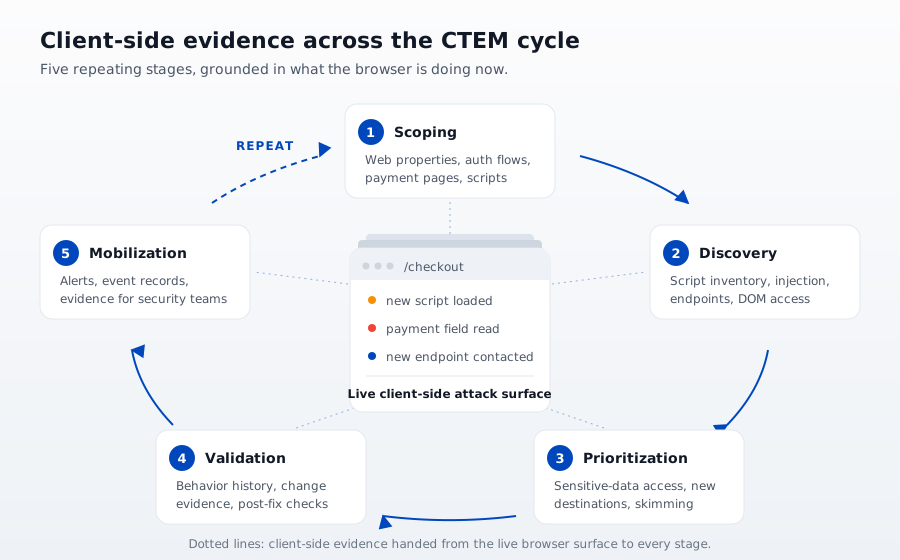
| Stage | CTEM task | Client-side evidence |
|---|---|---|
| Scoping | Define the assets and attack surfaces for the current cycle | Web properties, authentication flows, payment pages, and third-party scripts |
| Discovery | Identify the exposures inside the defined scope | Complete script inventory, dynamic injection, endpoints, and DOM access |
| Prioritization | Rank exposures by exploitability and business impact | Sensitive data access, new destinations, and skimming patterns |
| Validation | Test the exposure and confirm remediation | Live behavior history, change evidence, and verification after the fix |
| Mobilization | Assign owners and track each finding to closure | Alerts, event records, and evidence for security and application teams |
Stage 1: Scoping
The program defines which assets and attack surfaces are in scope for the current cycle. Scoping is not permanent. It expands as the program matures. Early CTEM programs usually scope to the most business-critical assets first: production web applications, authentication flows, and payment infrastructure. Later cycles pull in internal systems, third-party integrations, and the supply chain. Scoping answers a plain question: what are we protecting, and what threat are we defending against?
Stage 2: Discovery
Discovery identifies every exposure inside the defined scope, and it goes well beyond known CVEs and installed vulnerabilities. In a CTEM context, discovery covers which third-party components are present, which scripts execute in a web application, which services are reachable from outside, which identities can touch sensitive resources, and where data crosses system boundaries. It surfaces the attack surface as it exists right now, including exposures the security team did not know were there.
Stage 3: Prioritization
Not every exposure can be fixed at once. Prioritization ranks them by real risk, the combination of severity, exploitability in the current environment, and business impact if exploited. CTEM deliberately deprioritizes theoretical vulnerabilities that are not reachable or exploitable in practice, and elevates the ones threat actors are actively targeting. This is the stage that separates CTEM from raw vulnerability scanning. The output is a ranked list of what to fix first, not a flat list of every finding.
Stage 4: Validation
Validation tests whether the identified exposures are actually exploitable and whether existing controls hold up. It uses penetration testing, red team exercises, and breach and attack simulation to confirm that a prioritized exposure is real risk. Validation also confirms that remediation closed the exposure, meaning the attack path no longer works, not just that a patch was applied. It answers a blunt question: does our defense actually work?
Stage 5: Mobilization
Mobilization turns validated findings into remediation actions across the teams that own the affected systems. Security teams rarely own the assets they defend. Application teams, infrastructure teams, and third-party vendors all have a part to play. Mobilization translates findings into concrete work items for those teams and tracks each one through to verified completion.
Why client-side JavaScript is a CTEM blind spot
Most CTEM programs scan server-side infrastructure, known CVEs, and network-level exposures well. The client-side layer, the JavaScript that runs in a user's browser when they interact with your web application, is consistently underrepresented.
A few characteristics make the client-side attack surface hard to cover with traditional CTEM tooling.
It changes without notice. Third-party scripts (analytics tools, chat widgets, tag managers, CDN-loaded libraries) update their content whenever the vendor decides to. A script assessed as safe last month may have been modified since, compromised by an attacker, or given new behavior. That constant change is invisible to point-in-time assessments.
Authorized scripts can be weaponized. Magecart attacks make the point clearly. The risk is not limited to unauthorized scripts. Authorized scripts that change what they do are the harder problem. A payment page that loads an approved analytics script is exposed if that script is compromised and starts reading card fields. The script was in scope. Its behavior was not being monitored.
CVE scanners do not catch it. CVE-based scanners look for known software vulnerabilities. They do not detect behavioral changes in JavaScript, new third-party script additions, or client-side data exfiltration paths.
Regulators now require it. PCI DSS 4.0.1 Requirements 6.4.3 and 11.6.1, mandatory since 31 March 2025, require payment page script inventory, authorization controls, and runtime change detection. Those requirements exist precisely because the client-side attack surface was not being managed.
How cside fits into CTEM programs
cside covers the client-side exposure layer that most CTEM programs never reach. Mapped to the CTEM stages:
- Discovery: cside continuously discovers every script executing on a web property, including scripts added through tag managers, CDN dependencies, and dynamically injected code, which gives you the complete inventory the Discovery stage needs.
- Prioritization: cside's behavior monitoring flags when scripts access sensitive DOM elements, send data to external endpoints, or match patterns tied to skimming attacks, the signals that separate exploitable client-side exposures from theoretical ones.
- Validation: cside produces real-time evidence of script behavior changes, confirming whether an exposure is active and what data it is touching.
- Mobilization: cside generates the alerts, event logs, and evidence documentation that let security and application teams act on client-side findings without manual investigation.
For payment pages specifically, this is also how cside satisfies PCI DSS 6.4.3 and 11.6.1 in a single deployment: a continuous script inventory with authorization controls plus automated tamper detection.