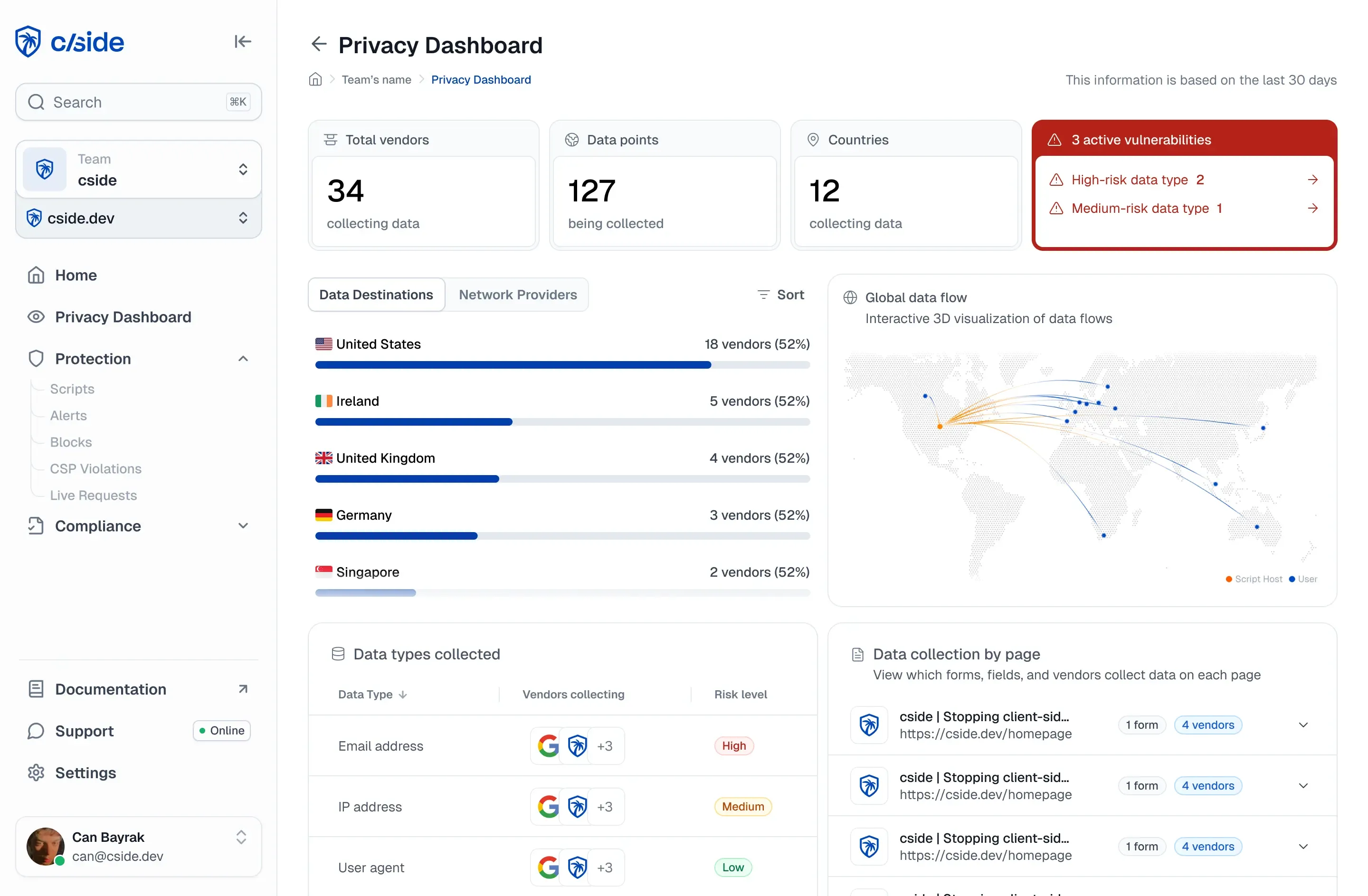

TL;DR: full-purchase-journey client-side security for ecommerce and fintech payment pages
- Checkout-only misses the funnel: Instrumenting only the checkout page is the current biggest gap in ecommerce client-side security. Modern skimmers hit cart and product pages first, where the funnel begins and where sampled monitors never look.
- The strongest posture: The strongest posture monitors 100% of real user sessions with no sampling, analyzes every script server-side where an attacker cannot fingerprint or disable the detection, tracks changes across URL, hash, behavioral, execution-path, and destination categories, and archives deobfuscated payloads for forensics.
- Require QSA-validated evidence: For PCI DSS 4.0.1, require evidence for requirements 6.4.3 and 11.6.1 that a QSA has validated rather than self-described reporting. If your primary risk is active Magecart and you need to reconstruct incidents, require deobfuscated payload archival over dashboard-only alerts. If you carry PCI plus GDPR plus HIPAA in one team, require evidence exports that match all three, not just one.
Short on time? See cside's in-browser Magecart and skimmer blocking. It covers everything below in one deployment.
Client-side security for eCommerce and fintech is the discipline of monitoring and protecting JavaScript that executes in a user's browser during a purchase or financial transaction, covering third-party scripts, payment form inputs, session data, and behavioural signals that server-side tools cannot observe. It addresses a distinct attack surface: the browser environment where payment card data, PII, and financial credentials are entered, before they reach any server the merchant controls.
eCommerce and fintech sites share a threat profile that is unlike most other web application environments. The combination of high-value payment data, a large third-party script estate, real-time transactions, and strict regulatory obligations creates a client-side attack surface that general-purpose security tools are not built to address.
Magecart-style skimming remains the dominant threat. Attackers compromise vendor scripts or inject code through supply-chain attacks, then silently read payment card data from browser form fields before it is submitted. Modern skimmer payloads use anti-analyst evasion techniques and multi-channel exfiltration paths to extend dwell time and avoid detection by periodic scanning tools. The sophistication of these attacks has outpaced perimeter defences.
The consequences are documented. The Information Commissioner's Office enforcement action against British Airways established that approximately 500,000 customers were affected over 15 days in 2018 by a browser-layer script attack: card data captured before it reached the payment processor, invisible to BA's server infrastructure. On the compliance side, PCI DSS 4.0.1 requirements 6.4.3 and 11.6.1 have been mandatory since 31 March 2025. They introduce script inventory, authorisation governance, and runtime change detection as explicit controls on payment pages. For fintech organisations subject to GDPR, the intersection of behavioural tracking scripts with PII and financial data creates additional compliance obligations that most standard client-side monitoring tools do not address.
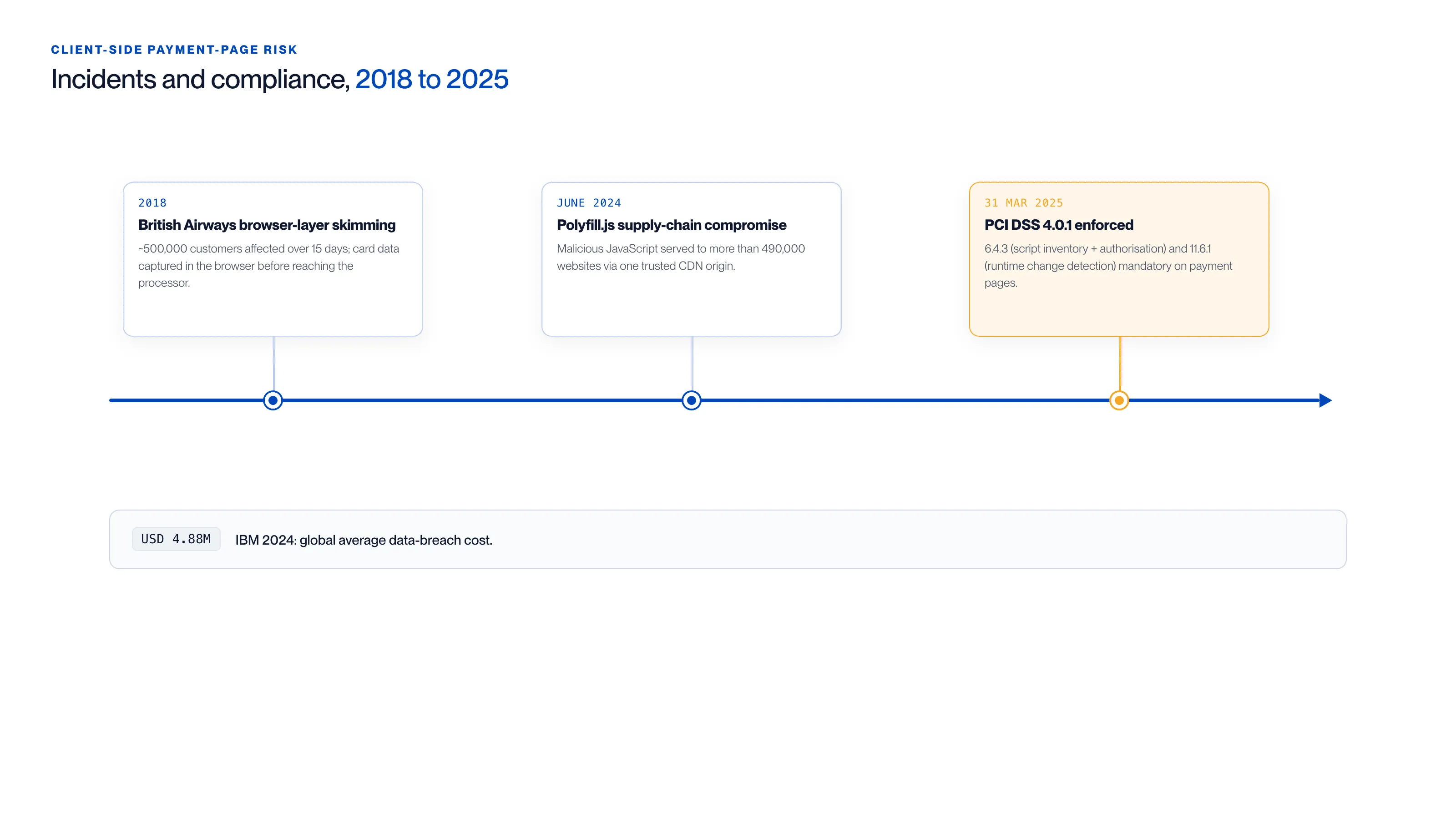
| Date | Event | Impact |
|---|---|---|
| 2018 | British Airways browser-layer skimming attack | ~500,000 customers affected over 15 days; card data captured in the browser before reaching the payment processor |
| June 2024 | Polyfill[.]js supply-chain compromise | Malicious JavaScript served to more than 490,000 websites through a single trusted CDN origin |
| 2025-03-31 | PCI DSS 4.0.1 enforced | Requirements 6.4.3 (script inventory + authorisation) and 11.6.1 (runtime change detection) became mandatory on payment pages |
This review covers five platforms evaluated against the specific requirements of eCommerce and fintech security teams: Magecart and skimming detection, PCI DSS 4.0.1 compliance, and session data protection across the full purchase journey.
The eCommerce/fintech client-side security requirement, in brief: Detect skimmer activity across the full session (not just the checkout page). Satisfy PCI DSS 6.4.3 and 11.6.1 with QSA-ready evidence. Monitor all sessions, not a sample. Archive enough evidence to reconstruct a specific incident if card data is compromised.
What eCommerce and Fintech Security Teams Actually Need
Quick answer: eCommerce and fintech client-side security has five specific requirements that distinguish it from general web application security: full-purchase-journey coverage (cart and product pages, not only checkout), 100% session observation, PCI DSS compliance evidence, supply-chain compromise detection, and IR-grade evidence archival for post-incident card data reconstruction.
Full-purchase-journey coverage. The most common misconception about Magecart is that it targets the checkout page. Modern skimmers target product and cart pages where the purchase funnel begins, collecting data before users reach the payment form. A monitoring platform that instruments only the checkout page misses the current attack surface.
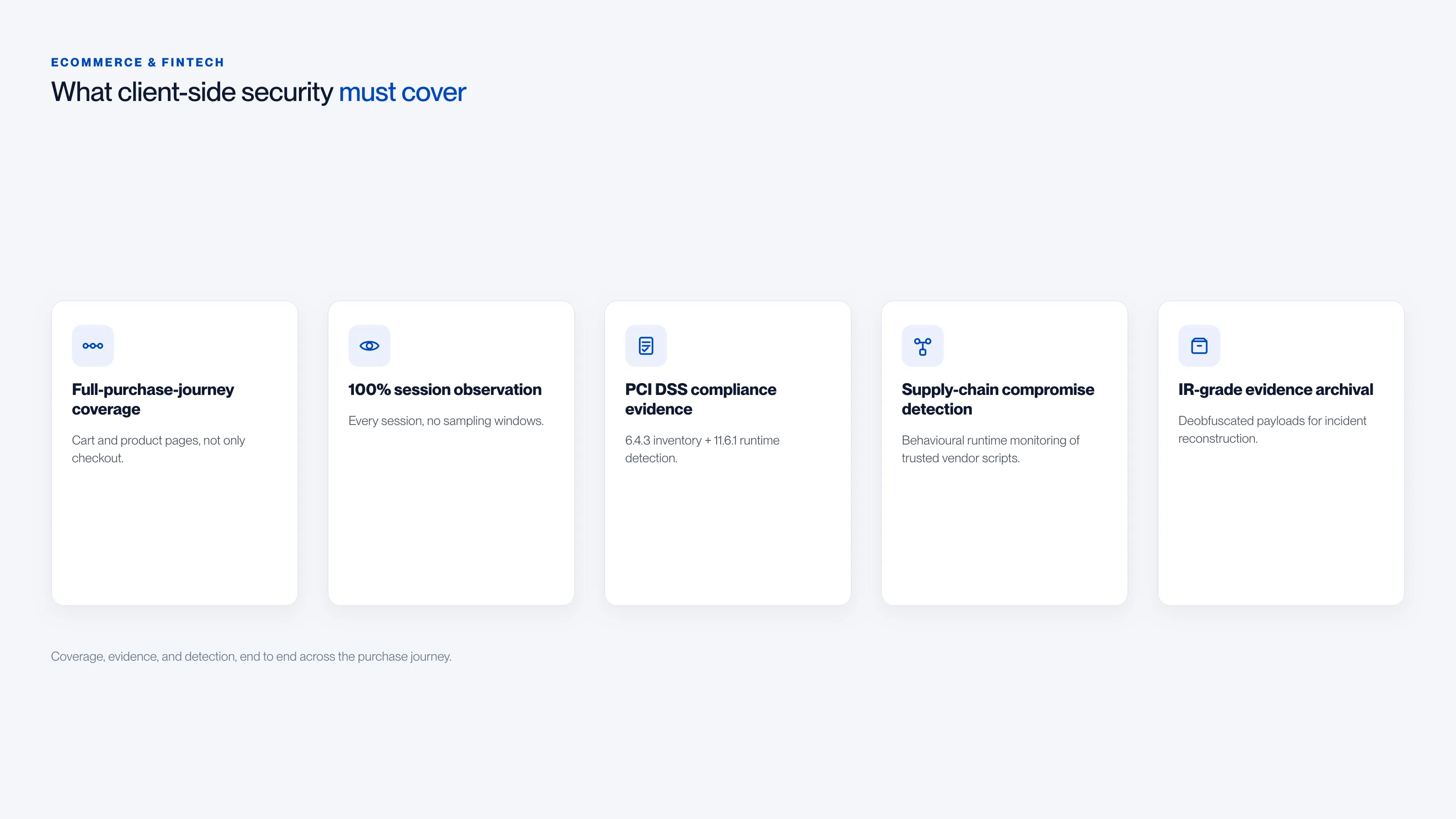
| Requirement | What it means |
|---|---|
| Full-purchase-journey coverage | Instrument cart and product pages, not only checkout |
| 100% session observation | Cover every session, no sampling windows for time- or geo-targeted skimmers |
| PCI DSS compliance evidence | Produce 6.4.3 (inventory + authorisation) and 11.6.1 (runtime detection) evidence in QSA-validated form |
| Supply-chain compromise detection | Detect new behaviour inserted into trusted vendor scripts via behavioural runtime monitoring |
| IR-grade evidence archival | Archive deobfuscated script payloads so a card-data incident can be reconstructed |
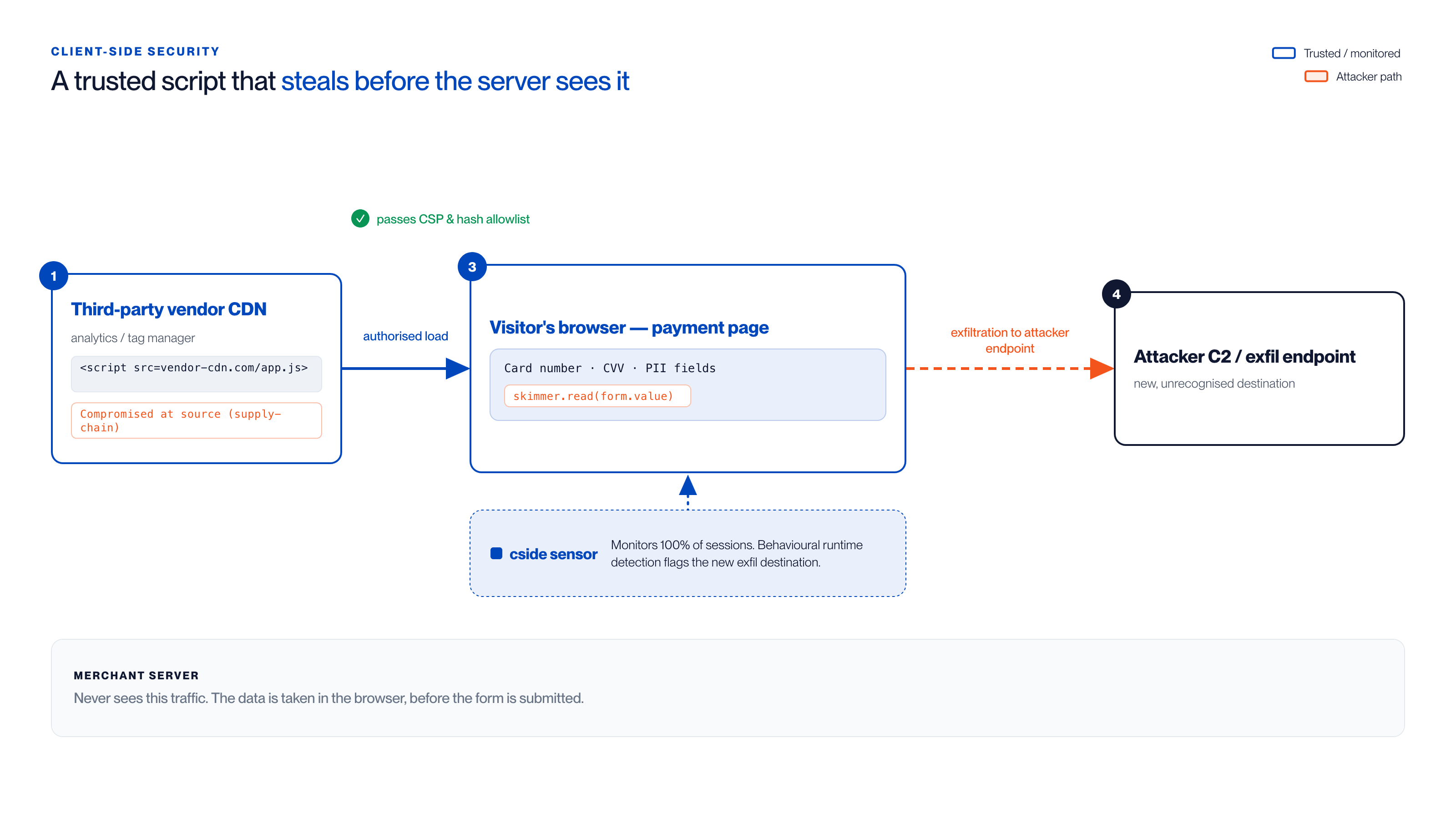
How a supply-chain skimmer reaches card data (and why the server never sees it):
- A legitimate vendor script (analytics, tag manager, live chat) is compromised at the CDN source.
- The merchant has already authorised that domain, so CSP and hash-allowlist controls pass it through.
- The skimmer runs inside the visitor's browser and reads card number, CVV, and PII directly from the payment form fields.
- It exfiltrates the values to an attacker-controlled endpoint before submission, so the merchant's server-side infrastructure never observes the theft.
- Only behavioural runtime monitoring of every session detects the new exfiltration behaviour, because the malicious code arrives through a trusted, authorised channel.
100% session observation. Sampling-based monitoring creates attack windows. Geo-targeted, time-limited, or session-fingerprint-aware attacks are specifically designed to evade sampled monitoring. The detection model must cover every session.
PCI DSS compliance evidence. Requirements 6.4.3 (inventory and authorisation) and 11.6.1 (runtime detection) generate specific evidence that QSAs will check. Platforms that produce evidence in a QSA-validated format reduce assessment friction.
Supply-chain compromise detection. The attack vector is increasingly the vendor, not the merchant's own code. The June 2024 Polyfill[.]js compromise served malicious JavaScript to visitors of more than 490,000 websites through a single trusted CDN origin: the merchant sites had authorised the domain, so CSP and hash monitoring would not have caught it. Only behavioural runtime monitoring detects this pattern. A script monitoring platform that only detects changes to known-malicious content misses supply-chain compromises that insert new behaviour into legitimate vendor scripts.
IR-grade evidence archival. When card data is compromised, the forensics team will ask what was running in the browser at the time of the incident. Platforms that archive deobfuscated script payloads alongside change events answer that question; platforms that log only alerts and metadata do not.
The Platforms
cside
Best for: eCommerce merchants and fintech platforms that need full-session monitoring with no sampling, server-side payload analysis, QSA-ready PCI evidence, and forensic-grade payload archival in a single platform.
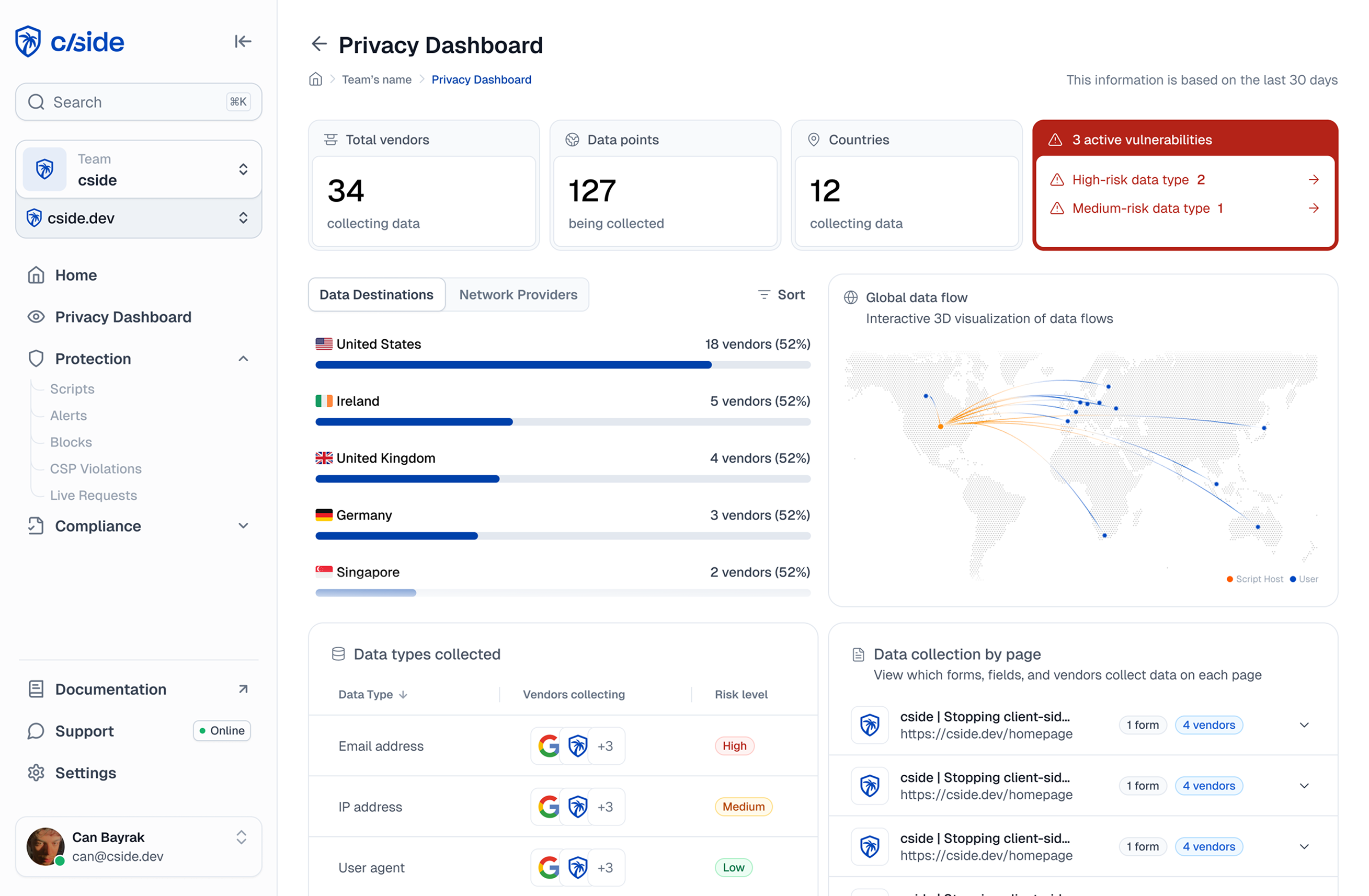
cside runs in 100% of real user sessions with no sampling and downloads every script to its own infrastructure for server-side analysis, where an attacker cannot see or interact with the detection. Its engine learns what scripts are supposed to do and flags deviations, so protection is automatic without manual rule writing. When a malicious change is detected, cside preserves the actual payload, the full script code, in an immutable archive, giving incident-response teams and QSA auditors the exact attack code rather than behavioural alerts alone.
cside offers two deployment options: the Script Method (add one script tag, deploys in seconds; it monitors behaviour client-side and analyses scripts server-side) and the Scan Method (threat-intelligence-powered scanning for sites where a script cannot be added). The PCI Shield covers PCI DSS 4.0.1 requirements 6.4.3 and 11.6.1, and cside has been reviewed and approved by VikingCloud (QSA) for both. cside also publishes SOC 2 Type II certification and PCI DSS SAQ D through its Trust Center, a public status page, and a 99.9% uptime SLA. Pricing is public and there is a free tier, so it is accessible without a services engagement.
For fintech teams carrying obligations beyond PCI, cside checks the box for multiple compliance frameworks, including PCI DSS, HIPAA, GDPR, and CPRA, and integrates natively with Linear and Jira so security findings flow into existing ticketing workflows.
Source Defense
Best for: enterprise merchants that want to contain what a compromised third-party script can reach on the payment page through in-browser sandboxing.
Source Defense specialises in client-side website security (founded 2014) and offers two methods. "Source Defense Detect" is a crawler that mimics a visitor and fetches the third-party scripts that load; because a crawler is only one specific combination of location, device, and time, and can be fingerprinted as cloud infrastructure and served a clean script, it does not capture the precise payload a real visitor receives. "Source Defense Protect" is a JavaScript agent that builds a client-side sandbox to isolate third-party scripts and restrict what they can access on the page.
The agent model has known limits by design. It is trigger-based, so anything that does not trigger is treated as good; it can add up to 100ms of latency; and its per-script permission model needs ongoing configuration as new scripts and dependencies change. Because the agent runs in the same browser environment as the attacker, a malicious script that is already running can intercept or redirect the alert before it leaves the browser. Source Defense provides behavioural alerts when sandbox boundaries are crossed but cannot show you the script contents, which makes forensic reconstruction hard. It targets enterprise merchants, with no public pricing and no free tier, and maintains a public changelog but no status page or uptime SLA.
Reflectiz
Best for: teams that want periodic, remote inventory and review of third-party scripts without deploying anything on the page.
Reflectiz is a periodic remote scanner: a cloud crawler visits your pages on a schedule, so coverage is limited to what it happens to see at scan time. Because the scan runs from a known cloud IP range with a predictable user agent, an attacker who fingerprints the scanner can serve it a clean page while real shoppers receive malicious code inside the actual DOM, the conditional-attack blind spot that affects any scanner-only model. Reflectiz has no real-user browser visibility. A point-in-time scanner like Reflectiz sees even less than a sampled in-page agent, because it runs in no real user session at all, only what loads during its scheduled crawl.
On assurance, as of the May 20, 2026 review of public materials, Reflectiz did not publish SOC 2 Type II certification, PCI DSS SAQ D, or equivalent QSA approval; its PCI evidence is self-described and may still need independent validation, and it publishes no public status page or uptime SLA. Reflectiz scores 4.7/5 on G2 (31 reviews); recurring themes in its own G2 "what do you dislike" responses include rudimentary reporting, a cluttered interface, false positives on popular payment and tracking providers, and the added cost of required training.
Jscrambler
Best for: development teams that own significant first-party JavaScript and want obfuscation and anti-tampering alongside webpage-integrity monitoring.
Jscrambler started in JavaScript obfuscation and added webpage integrity later. Its core protects first-party code through obfuscation, runtime protection, and anti-tampering, with "code locks" that restrict where and when code can run (a specific domain or time window). For third-party script monitoring it uses trap-based detection, injecting decoy objects and monitoring code into the page and waiting for malicious scripts to interact with them. Because those detections run in the browser, a sophisticated attacker can find and avoid the decoys or block the callback endpoints, and traps that never fire produce no signal, so the model does not know what it did not catch.
The monitoring layer relies on periodic scanning and does not track or preserve raw script contents at all, which makes forensic reconstruction difficult. Jscrambler's AI functionality is limited and opt-in, relying on the APIs of large third-party AI companies. There is no public pricing and no free tier; its status page at status.jscrambler.com is password-gated, with no publicly accessible uptime history and no published uptime SLA. Jscrambler integrates with Jira but not Linear. In the 2026 Globee Cybersecurity Awards Client-Side Security category, Jscrambler received the Silver award (cside received Gold).
Feroot Security
Best for: merchants evaluating a JavaScript-agent behavioural monitor with allow-list policies for payment pages.
Feroot (founded 2017) splits its offering into two products. PageGuard deploys permissions and policies and overwrites core JavaScript, using an allow-list where you pre-approve which scripts may run on which pages. Because an allow-list only checks the source of a script, not the code that is actually served, it has no visibility into a trusted domain that changes behaviour: PageGuard would not have caught the 2024 Polyfill[.]js attack, where a domain changed ownership and the served code changed. Inspector deploys synthetic "honeypot" users to simulate real behaviour; this is effectively a scanner or crawler doing periodic checks, which attackers can evade by serving malicious scripts only to residential IP addresses based on user agent and other parameters. A crawler on its own cannot meet PCI DSS, which requires a mechanism to prevent unauthorised scripts.
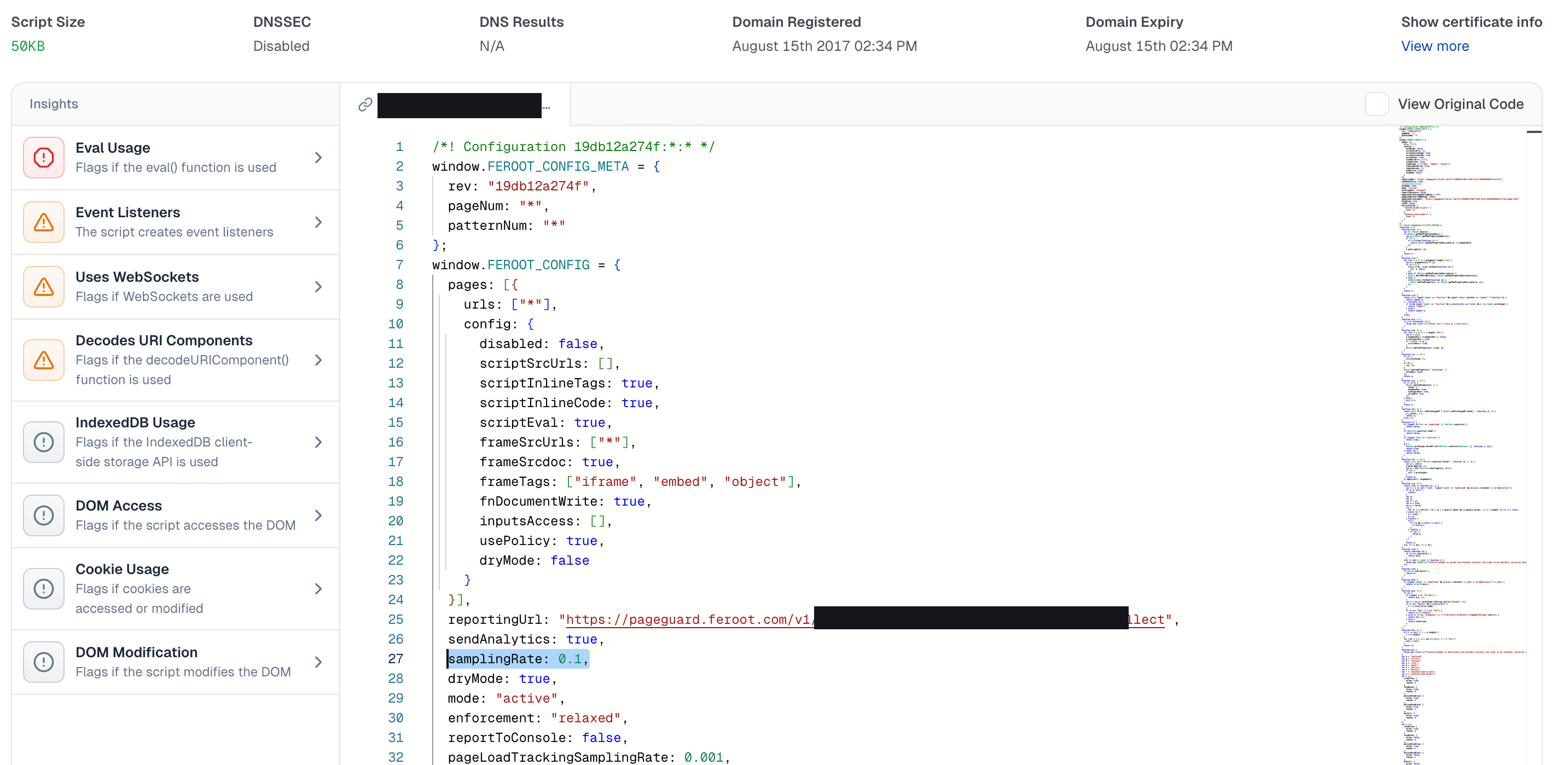
Feroot's agents flag behavioural anomalies after scripts have loaded and sample a fraction of sessions rather than observing all of them, so a payload served only to one geo, one device class, or logged-in users can sit in the unsampled majority. Feroot's own PageGuard configuration sets samplingRate: 0.1, roughly 10% of real user sessions, so about 90% run unmonitored. They provide behavioural logs rather than archived payloads. Feroot scores 4.6/5 on G2 and 2.3/5 on Google Maps.
Comparison at a Glance
| Platform | 100% real-user sessions (no sampling) | Server-side script analysis | PCI 6.4.3 + 11.6.1 evidence | Supply-chain / evasion resistance | Forensic payload archival |
|---|---|---|---|---|---|
| cside | Yes | Yes | Yes (QSA-validated) | Yes | Yes (deobfuscated) |
| Source Defense | Agent + crawler | No (in-browser sandbox) | Not documented in this comparison | Containment (sandbox) | No (no script contents) |
| Reflectiz | No (periodic scanner) | No | Partial (self-described) | Limited (scanner evasion) | No |
| Jscrambler | No (browser traps + scanning) | No | Partial | Limited (bypassable traps) | No (no script contents) |
| Feroot | No (samples sessions) | No | Partial | Limited (allow-list) | No (behavioural logs) |
How to Choose
Quick answer: Do not start from a shortlist of names. Start from the requirements below and eliminate any platform that fails one of them. Compliance documentation and operational detection are both mandatory: a platform that optimises only for evidence output can leave detection gaps, and a platform that optimises only for detection may not produce QSA-acceptable evidence. Use the comparison table above to see which product clears every line.
Score each candidate against this checklist and require every item, not a subset:
- QSA-validated PCI evidence. Insist on PCI DSS 4.0.1 requirement 6.4.3 (script inventory and authorisation) and 11.6.1 (runtime change detection) evidence that a Qualified Security Assessor has independently validated, not self-described reporting. Confirm SOC 2 Type II and PCI DSS SAQ D are published as well.
- 100% real-user session coverage, no sampling. Require observation of every real user session across the full purchase journey (cart and product pages, not only checkout). Reject sampled monitoring and scheduled remote scans, which conditional, geo-, device-, or login-state-targeted skimmers are built to evade.
- Analysis an attacker cannot see or bypass. Prefer server-side payload analysis that runs where an attacker cannot fingerprint, study, or disable it, over in-browser traps, agents, or crawlers that live in the same environment the attacker controls.
- Deobfuscated payload archival for forensics. Require that the actual malicious script code is captured and archived so a card-data incident can be reconstructed. Behavioural alerts and metadata alone will not answer what was taken, from whom, and for how long.
- Supply-chain and evasion resistance. Require behavioural runtime detection of new behaviour inserted into trusted vendor scripts. Source-only allow-lists would not have caught the 2024 Polyfill[.]js compromise.
- Multi-framework evidence. If you carry GDPR or HIPAA alongside PCI, require evidence exports that satisfy all of them, not just one.
- Transparent commercials and independent verifiability. Favour public pricing, a free tier to prove value before signing, a public status page, and a published uptime SLA over opaque enterprise-only procurement.
A platform that clears every line above is fit for eCommerce and fintech payment-page security; one that clears only some is not. For the wider category, see our review of Magecart prevention and client-side security platforms, the client-side security detection layer, and PCI DSS compliance evidence.
Try cside before you buy. cside has a free plan, so you can sign up, deploy, and explore the platform yourself, with no sales calls or procurement process. And our support team is one message away whenever you need a hand.