
TL;DR: device-bound session security
- The gap: MFA gets treated as the finish line for account security, but the moment authentication completes it stops helping, and every stolen session token issued after a valid MFA challenge still works from any device on the internet.
- What cside sees: cside device-bound sessions generate a hardware-derived fingerprint from GPU rendering, canvas entropy, font metrics, and WebGL output that survives cookie clearing, incognito mode, and VPNs because it recalculates from the device rather than sitting in cookie storage.
- The decision: If your account takeover posture stops at MFA, decide this quarter whether an XSS bug or man-in-the-browser tool that lifts a valid session token is a risk you are willing to underwrite in full.
Short on time? See cside's account-takeover detection. It covers everything below in one deployment.
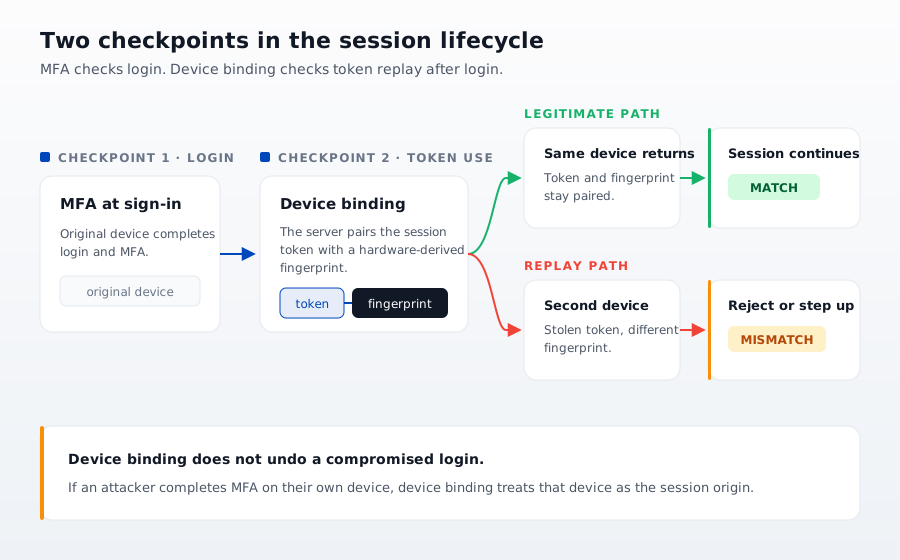
A device-bound session is an authenticated session tied to the specific device that created it. If the session token is later presented from a different device, the fingerprint mismatch is caught and the session is rejected or sent to a step-up challenge. That closes a gap most authentication leaves open: the window after login, when a valid token can be stolen and replayed from somewhere else.
| Scenario | What MFA does | What device binding does |
|---|---|---|
| Stolen credentials before login | Challenges the attacker for a second factor | Waits until a session exists to bind |
| Attacker completes MFA on their device | Allows the login because the challenge was satisfied | Binds the new session to the attacker's device, so it does not undo the compromised login |
| Valid session token is stolen after MFA | Runs no new login challenge | Detects a fingerprint mismatch when the token is replayed from another device |
| Valid request comes from the original device | Has already completed its login check | Matches the stored fingerprint and lets the session continue |
The post-authentication gap that device binding closes
MFA protects the login event. It confirms that the person submitting credentials also controls a second factor at that moment. Once authentication completes and a session token is issued, MFA has done its job. The token itself is a bearer credential, so any party that holds it can present it to the server and get an authenticated response.
Session tokens get stolen through several routes: cross-site scripting that reads cookies, man-in-the-browser proxies that capture tokens as they are set, stolen device storage, and social engineering that tricks users into exposing them. In each case the attacker ends up with a valid token that was issued after a legitimate MFA challenge. The challenge is already in the past. The stolen token still works.
Device-bound sessions close that gap. Even when an attacker holds a valid token, using it from a different device produces a fingerprint mismatch the server can detect. The session is only trusted when it comes from the device that created it.
How device binding works technically
The session is bound at the moment of authentication. When a user logs in, the device fingerprint for that session (derived from browser and hardware signals) is recorded alongside the session token in the server's session store.
On every later request that presents the token, the server compares the current fingerprint against the one recorded at login. If they match, the request proceeds. If they do not, the session is invalidated or a step-up challenge fires.
The fingerprint used for binding has to be stable and hardware-derived. Cookie-based identifiers are not suitable, because they can be copied alongside the session token. An attacker who steals a session cookie can also steal any cookie-based device ID sitting in the same store. A browser-layer fingerprint derived from GPU rendering, canvas entropy, font metrics, and WebGL output cannot be pulled from cookie storage, because it is not stored there. It is recalculated from the hardware on each session.
cside device-bound sessions generates a hardware-derived fingerprint at session creation and returns it alongside the session token through its API. That fingerprint is derived from a baseline of 250+ browser, device, and network signals read per session, binding the session to the specific device behind it. Your server records the fingerprint with the session. On each protected request, cside's lightweight script recalculates the fingerprint for the current session, and your application compares it against the stored value. cside does not replace your session token. It gives you a device signal strong enough to tell whether the token is being replayed somewhere it should not be.
What device binding protects against
Session hijacking after XSS. A cross-site scripting flaw that lets an attacker read session cookies does not hand over a usable session when that session is device-bound. Replaying the stolen token from the attacker's machine produces a fingerprint mismatch.
Man-in-the-browser session capture. Browser malware that intercepts an authenticated session captures the token but not the device signal, because the signal is calculated from the victim's hardware. The stolen token does not match the attacker's fingerprint.
Credential sharing after authentication. When a legitimate user hands their session token to a colleague (common in enterprise tools where adding a seat needs admin action), the shared session shows a device mismatch. This is the account sharing problem applied at the session layer rather than the login layer.
Impossible travel. A session created in London and then presented from a device with network characteristics from a different geography, inside a time window too short for physical travel, is detectable through the fingerprint change combined with network signals.
How device-bound sessions and MFA fit together
Device binding protects the session after authentication. MFA protects the login event during authentication. They cover different points in the session lifecycle, and a complete account takeover posture needs both.
An attacker who beats MFA through a SIM swap or push-notification fatigue and authenticates successfully receives a session token on their own device. Device binding on that session does not help, because the attacker's device is the session origin. MFA is the control that matters at that stage.
An attacker who watches a legitimate user complete MFA and then steals the session token through XSS is stopped by device binding, because their fingerprint does not match the session origin. MFA already completed and offers nothing at this point.
Put the two together and the coverage is clear. MFA stops attackers at login who lack valid credentials or cannot satisfy the second factor. Device binding stops attackers after login who obtained a valid session some other way.