
Blog
Blog

VikingCloud approves cside for PCI DSS requirement 6.4.3 and 11.6.1

cside has partnered with VikingCloud to perform a deep technical assessment of the security solutions we offer under the enterprise plan, within the scope of PCI compliance. With proper implementation, our products meet requirements 6.4.3 and 11.6.1.

Apr 24, 2025 • Updated Jul 20, 2026 • 2 min read
cside-vikingcloud-partnership-cover-image
Table of Contents

TL;DR: VikingCloud QSA validation for PCI DSS 4.0.1 script control

  • Marketing vs assessment: Most PCI vendors publish a whitepaper they wrote themselves and call it validation. That is marketing, not assessment. A real QSA sign-off comes from a firm that audits your solution against the standard and puts its name on the finding.
  • VikingCloud's finding: VikingCloud, the largest global PCI compliance and security firm and Mastercard partner, ran a deep technical assessment of the cside enterprise platform. Their conclusion: the cside runtime script observability and agentless solution detected script changes via hashed values and blocking configurations, and demonstrated capability to meet PCI DSS 6.4.3 and 11.6.1 when deployed correctly.
  • What to ask vendors: If you are shortlisting client-side PCI tools, ask each vendor for a QSA firm's signed technical evaluation, not a self-published whitepaper. If VikingCloud's finding on cside is what you need, the detailed report is on the cside trust portal.

Short on time? See cside PCI Shield. It covers everything below in one deployment.

VikingCloud (formerly Sysnet) is the largest global PCI compliance and security firm. VikingCloud has partnerships with Mastercard and is the Qualified Security Assessor to some of the largest multinationals worldwide.

cside has partnered with VikingCloud to perform a deep technical assessment of our enterprise security solution and the scope of PCI compliance. With proper implementation, our product meets requirements 6.4.3 and 11.6.1.

VikingCloud: "During its analysis, VikingCloud confirmed that the cside Proxy and agentless solution detected the changes of the website scripts, using hashed values and/or "Blocking" configurations for specific website scripts, and demonstrated the capability to meet PCI DSS requirements 6.4.3 and 11.6.1. The technical evaluation and testing supported the finding that the solution meets the above requirements when deployed correctly. VikingCloud concluded that the solution offers protection against unauthorized script execution and prevents unauthorized changes to web-facing applications. The integration of cside platform may enable organizations to fulfill specific PCI DSS requirements and add an additional security layer for web applications."

Related reading: our PCI DSS 6.4.3 and 11.6.1 compliance guide · PCI DSS 6.4.3 and 11.6.1 solution comparison
Download the detailed report on our trust portal.

Simon Wijckmans
Founder & CEO

Founder and CEO of cside. Previously a product manager on Cloudflare Page Shield (now Cloudflare Client-Side Security). Co-chair of the W3C Anti-Fraud Community Group and a Forbes 30 Under 30 honoree. Building accessible security against client-side attacks, web security is not an enterprise-only problem.

FAQ

Frequently Asked Questions

They are the two PCI DSS v4.0.1 requirements that govern payment-page scripts. Requirement 6.4.3 says every script on a payment page must be authorized, inventoried, and integrity-assured, so only approved scripts run. Requirement 11.6.1 requires a change-and-tamper detection mechanism that alerts on unauthorized modifications to the payment page and its HTTP headers. Together they close the client-side gap that skimming and Magecart attacks exploit in the browser.

A QSA, or Qualified Security Assessor, is a firm accredited by the PCI Security Standards Council to audit solutions against the standard. QSA validation matters because most client-side vendors publish a whitepaper they wrote themselves and call it proof. An independent QSA firm instead tests the product and puts its name on the finding. VikingCloud, a global QSA and Mastercard partner, ran that kind of assessment on cside for requirements 6.4.3 and 11.6.1.

Start by confirming the tool covers both halves of the requirements: a live script inventory with authorization and integrity assurance for 6.4.3, and tamper detection with alerting for 11.6.1. Then weigh deployment effort, whether it can block and not only alert, and how it proves compliance. Prioritize vendors with an independent QSA firm's signed evaluation over a self-published whitepaper, since an assessor's finding is what an auditor will actually trust.

Ask for a QSA firm's signed technical evaluation naming their product, not a whitepaper they wrote about themselves. Ask how they detect script changes; cside compares hashed script values in real browser sessions. Ask whether they can block unauthorized scripts or only alert, how they build and maintain the script inventory for 6.4.3, and what deployment requires. cside installs as one first-party script or an agentless scan, with no DNS change and without routing your site traffic.

A self-published whitepaper is marketing the vendor wrote about its own product, so it carries no independent accountability. A QSA-signed evaluation comes from an accredited assessor that tested the solution against the standard and attached its name to the conclusion. For cside, VikingCloud ran a deep technical assessment and found the platform demonstrated capability to meet 6.4.3 and 11.6.1 when deployed correctly. That is the document an auditor will actually weigh.

Both meet the requirements, and the right choice depends on how much you want to touch the page. cside offers a Script Method, one first-party script tag added to the page, and a Scan Method that is agentless. The Script Method gives continuous, real-session coverage of scripts as they execute; the agentless scan suits teams that cannot add a tag. VikingCloud validated cside using hashed values and blocking configurations across this approach for 6.4.3 and 11.6.1.

No. Maintaining the authorized-script inventory that 6.4.3 requires is part of what cside does, so you do not need a standalone inventory product alongside it. cside discovers the scripts running on your payment pages, records them, flags unauthorized changes through hashed value comparison, and can block scripts you have not approved. That covers both the inventory-and-authorization side of 6.4.3 and the change detection 11.6.1 asks for, in one deployment.

cside computes hashed values for each script on your payment pages and watches for any change to those hashes in real browser sessions, so a modified or newly injected script is flagged the moment its payload differs from the approved version. It fetches and analyses third-party scripts on its side before they execute, and can be set to block unauthorized ones. VikingCloud confirmed this hash-based detection during its technical assessment of the platform.

cside can do both. It alerts on script changes for the tamper-detection duty in 11.6.1, and it also supports blocking configurations that stop unauthorized scripts from executing, which is what 6.4.3 expects for authorization control. VikingCloud specifically noted that cside detected script changes using hashed values and blocking configurations, and concluded the solution offers protection against unauthorized script execution when deployed correctly.

VikingCloud ran a deep technical assessment of the cside enterprise platform and tested whether it detected changes to website scripts. It confirmed that cside detected those changes using hashed values and blocking configurations, and demonstrated the capability to meet PCI DSS 6.4.3 and 11.6.1 when deployed correctly. VikingCloud concluded the solution protects against unauthorized script execution and prevents unauthorized changes to web-facing applications. The full report is on the cside trust portal.

You add cside as a single first-party script tag to your pages, or use the agentless Scan Method if you cannot place a tag. There is no DNS change and cside does not route your site traffic. Once live, it inventories the scripts on your payment pages, compares hashed values to catch unauthorized changes, and can block scripts you have not approved. Deploying correctly is the condition VikingCloud attached to its finding, so follow the enterprise setup guidance.

cside uses a usage-based model rather than a flat license, so cost scales with your traffic; there is a free plan to start, and PCI-scoped script control sits in the enterprise offering VikingCloud assessed. Because pricing depends on your page volume and which method you deploy, the accurate number comes from talking to the cside team. cside PCI Shield packages the 6.4.3 and 11.6.1 coverage in one deployment.

Monitor and Secure Your Third-Party Scripts

Gain full visibility and control over every script delivered to your users to enhance site security and performance.

Start free, or try Business with a 14-day trial.

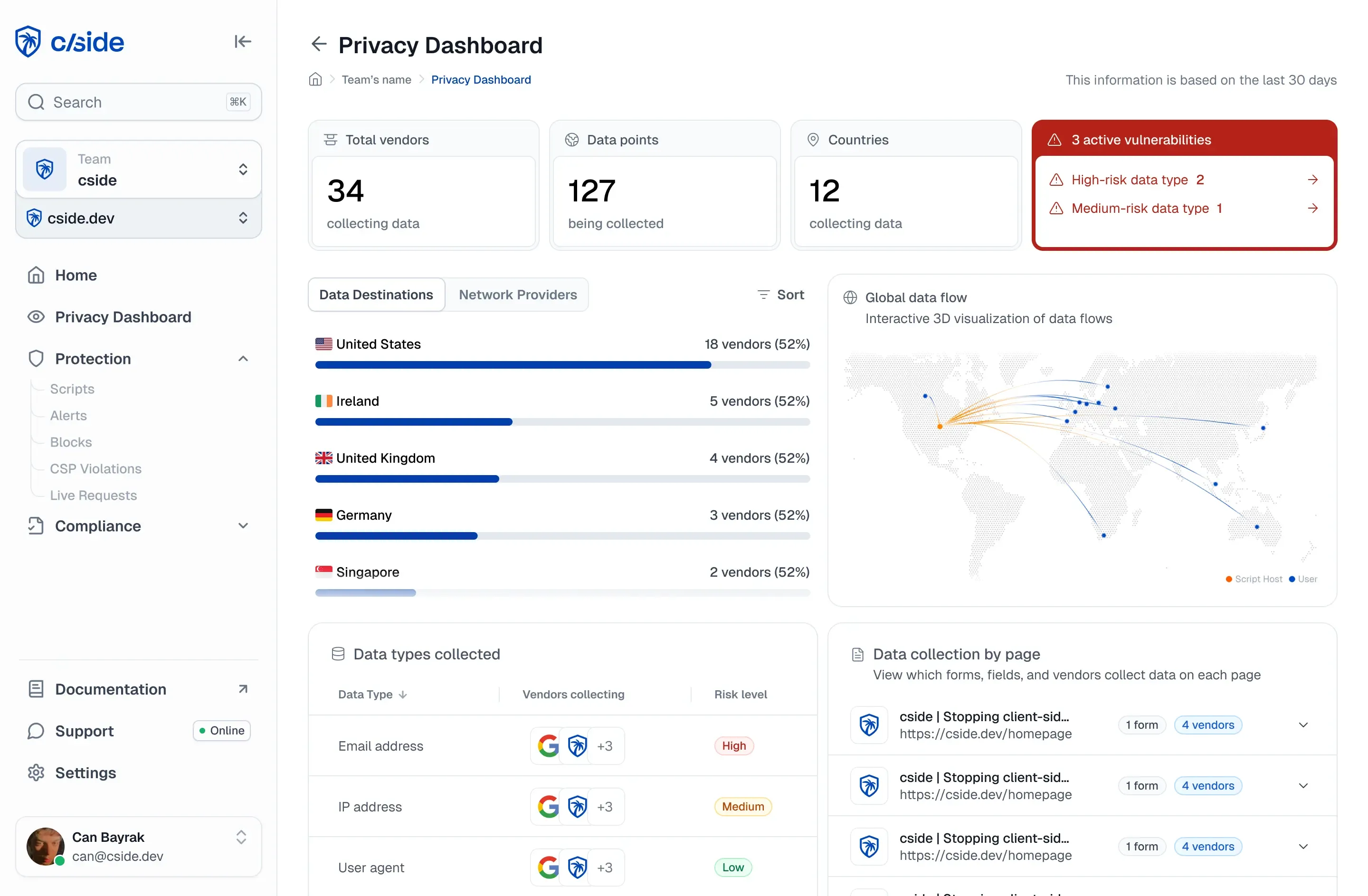
cside dashboard interface showing script monitoring and security analytics
Related Articles
Book a demo

Want to walk through this with an engineer?

Thirty minutes, on your own site. Not a slide deck.

Book a personalized demo to see:

How to achieve PCI DSS requirement 6.4.3 & 11.6.1 compliance in 1 day
Why third-party scripts are a security risk for you and your visitors
Monitoring privacy and consent leakage (GDPR, CCPA) across every third party
Stopping signup abuse, account sharing, and chargeback fraud with device intelligence
Detecting and controlling AI agents and bots hitting your site in real time

Rather just send a question?

Finding open slots…

Real humans only. We'd know.

Having trouble booking? Open scheduler in a new tab

What are you trying to solve?

Tell us in a line and we'll come back with something useful, not a generic pitch.

We usually help with:

Seeing which third-party scripts run on your site
PCI DSS 6.4.3 and 11.6.1 evidence
Bots, AI agents and account takeover

Prefer to just book a time? Pick a slot instead