PCI DSS requirements 6.4.3 and 11.6.1, mandatory since March 31, 2025, require payment page script inventory, justification, integrity verification, and weekly tamper detection. Five purpose-built tools are compared here: cside (from $99/mo, public pricing), Feroot, Cloudflare Client-Side Security, Reflectiz, and DomDog. Only cside combines real-user session monitoring, server-side payload blocking, and independent QSA validation by VikingCloud. Scanner-only and CSP-only approaches leave gaps auditors and attackers can exploit.
TL;DR: PCI DSS 6.4.3 and 11.6.1 compliance tools comparison
- The mandate: PCI DSS requirements 6.4.3 and 11.6.1 became mandatory on March 31, 2025. You need to inventory every script on your payment pages, justify it, verify its integrity, and catch unauthorized changes.
- Three control types: Control mechanisms fall into three buckets: CSP + SRI (free, limited), scanner-only (easiest setup, no blocking ability), and JavaScript agent-based (real-time, adds a script). The strongest tools combine all three approaches and add server-side payload analysis on top.
- What this guide compares: This guide compares the leading purpose-built tools on features, pricing, and reviews, and closes with a buyer's checklist so you can judge each one against the criteria that actually matter. Public pricing runs as low as $99 a month; several vendors are custom-quoted or undisclosed.
- Beware "free" tools: Watch out for "free" compliance tools. They often fill requirements partially or generate evidence that auditors will not accept.
Short on time? See cside PCI Shield. It covers everything below in one deployment.
Comparison Table: PCI DSS 6.4.3 & 11.6.1 Solutions
There are dozens of vendors with PCI DSS 6.4.3 and 11.6.1 compliance capabilities. We filtered this list to five with purpose-built client-side security features, rather than general WAFs or endpoint tools where 6.4.3 & 11.6.1 compliance are used as a sales add-on.
| Vendor | Solution type | Fully covers 6.4.3 & 11.6.1 | Real-time blocking | Independent QSA validation | Pricing |
|---|---|---|---|---|---|
| cside | Multi-layer: JavaScript agent (Script Method) + server-side AI payload analysis + scanner (Scan Method) | Yes | Yes, before scripts reach the browser | Yes, VikingCloud validated (6.4.3 & 11.6.1) | Public, from $99/mo, unlimited domains |
| Feroot | JavaScript agent (browser-side) + synthetic-user scanner | Yes | Detection + alerts (post-execution) | Not documented in this comparison | Not documented in this comparison |
| Cloudflare Client-Side Security (prev. Page Shield) | Network-layer CSP reporting + static AI code analysis (Advanced tier) | On the paid Advanced tier | Via CSP content security rules (Advanced tier) | QSA applicability guide only, not QSA-validated | Free base tier; Advanced is a paid add-on |
| Reflectiz | Remote scanner (agentless) | Yes* | No (detection only) | No independent QSA validation | Custom-quoted, no public pricing |
| DomDog | CSP reporting + JavaScript agent | Yes* | No (CSP allowlist by source, no payload blocking) | No SOC 2 or PCI certification found | Public, from $999/yr |
*Scanner-only and CSP-only tools may not satisfy the blocking mechanisms referenced in PCI SSC guidance, and neither analyzes the exact payload a real user receives. Discuss with your QSA.
How to Choose a PCI DSS 6.4.3 & 11.6.1 Solution
The tools above look similar on a checklist and behave very differently in an audit and under a real attack. Instead of starting from a product name, start from the requirements and score each option against a fixed set of criteria. A tool worth buying should meet all of the following, not just some:
- Independent QSA validation of 6.4.3 and 11.6.1. An outside QSA firm has technically assessed the product against both requirements, not just a self-published applicability guide or "QSA-ready" marketing claim.
- 100% of real user sessions, no sampling. Coverage of every session, not a small percentage of traffic, so rare or targeted skimmers can't hide in the unobserved majority.
- Server-side payload analysis that can't be fingerprinted. The analysis happens on infrastructure attackers can't detect from the browser, so they can't serve a clean copy to a known scanner or fetcher.
- Analysis of the exact script the user received, at any size. The tool inspects what actually executed in the visitor's browser, including large bundled scripts, not a separately fetched copy or a size-capped sample.
- Raw payload archival for forensics. The actual attack code and full version history are preserved as evidence, not just a score or an alert. Retention is tiered by plan.
- Real-time blocking before scripts execute. Malicious code is stopped before it runs, rather than flagged after data may already have been exfiltrated.
- In-product inventory and justification workflow for 6.4.3. A real workspace to inventory, approve, and justify every script, not a CSV export you reconcile by hand.
- No CDN, WAF, or hosting lock-in. Works on any stack, so client-side coverage doesn't require migrating your edge.
- Transparent, public pricing and a free CSP reporting tier. You can budget before procurement and get baseline CSP visibility at no cost.
- Independent operational assurance. SOC 2 Type II, a public status page, and a published uptime SLA you can verify yourself.
Run the comparison table above against this list. Score each tool on how many criteria it fully meets, and the strongest fit becomes obvious on its own, no vendor pitch required.
Why PCI DSS 6.4.3 & 11.6.1 Compliance Matters
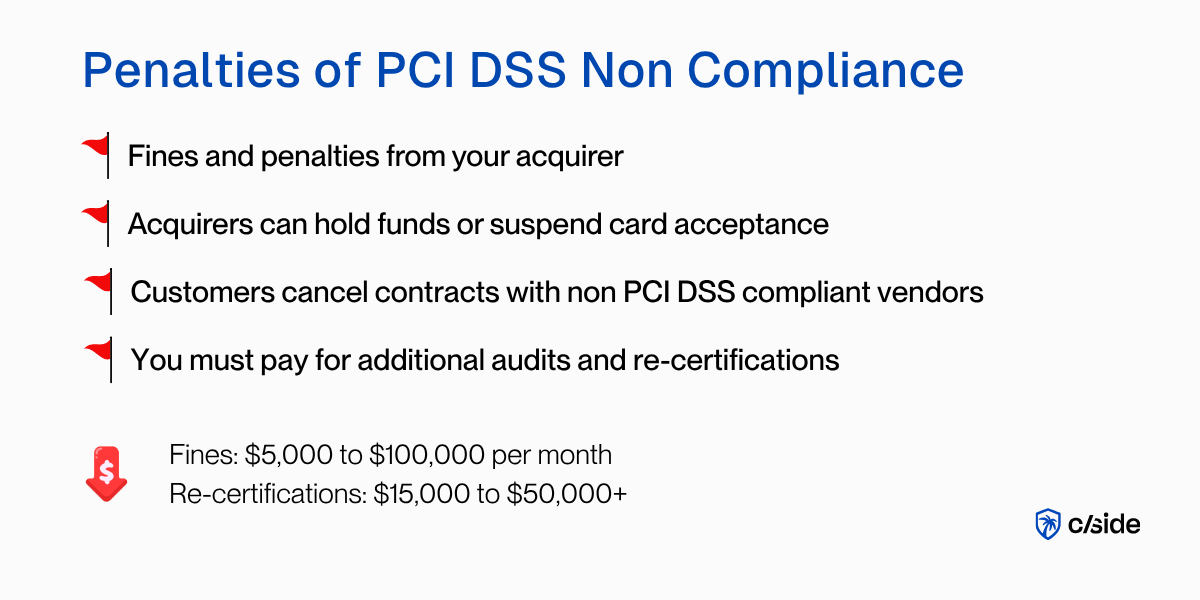
What is PCI DSS 6.4.3 & 11.6.1 Compliance
PCI DSS Requirement 6.4.3 covers payment page script management:
- Maintain an inventory of every script running on your payment pages
- Document a business or technical justification for why each script is needed
- Verify the integrity of each script
- Detect and alert on unauthorized script changes
What PCI DSS 6.4.3 Protects You Against: Attackers injecting malicious scripts into your payment pages to steal credit card data.
PCI DSS Requirement 11.6.1 covers change and tamper detection:
- Deploy a mechanism that alerts personnel to unauthorized modifications to HTTP headers and payment page contents as received by the consumer's browser
- This mechanism must run at least once every seven days, or more frequently based on your risk analysis under Requirement 12.3.1
These requirements go hand in hand. Vendor solutions typically solve both of them in one tool.
Both of these requirements became mandatory on March 31, 2025, under PCI DSS v4.0.1.
If you're looking for a step-by-step walkthrough of how to meet these requirements, we wrote a detailed guide on how to comply with PCI DSS 6.4.3.
Who Needs PCI DSS 6.4.3 & 11.6.1 Compliance
Any organization that processes, stores, or transmits cardholder data and has payment pages. This includes e-commerce merchants, SaaS platforms with billing flows, subscription services, higher education institutions processing tuition and fee payments, and payment service providers.
A note on SAQ A: The PCI SSC removed requirements 6.4.3 and 11.6.1 from SAQ A in January 2025 for merchants who fully outsource payment processing via iframes. But they added a new eligibility criterion: you must confirm that your site is "not susceptible to script-based attacks." That's arguably harder to prove without tooling than the original requirements were.
If you build payment software rather than operate a payment page, PCI SSF applies instead of PCI DSS.
Buy vs. DIY - An Expert's Perspective

"Out of hundreds of clients our company has worked with, I've only seen one successfully build PCI DSS 6.4.3 and 11.6.1 compliance in-house. When a team builds a solution in-house we need to verify every single mechanism. When we're auditing a client using a proven vendor solution, we're mostly making sure they have it configured properly."
- Marc Jackson, QSA & Compliance Advisor, MegaplanIT
Why DIY fails: it requires ongoing specialized engineering to cover edge cases like dynamic scripts, session-specific loading, and geo-targeted content. You need to generate audit-ready documentation that your QSA will accept. And you need to maintain at least a weekly monitoring cadence under 11.6.1. The real cost of DIY is the maintenance, month after month. Our PCI 6.4.3 compliance guide breaks down each requirement so you can see what's involved.
PCI DSS 6.4.3 & 11.6.1 Compliance in Less Than a Day
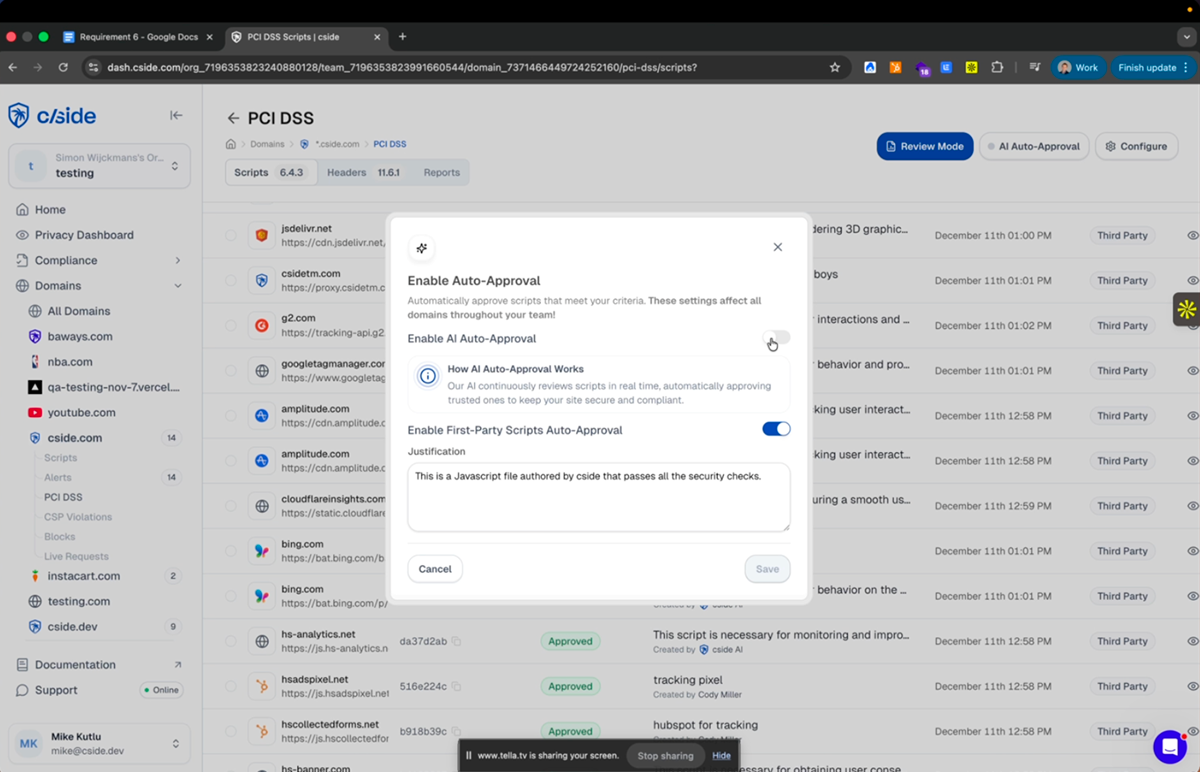
In this video, we walk through a platform that automates PCI DSS 6.4.3 and 11.6.1 compliance. Showing you examples of auditor approved script inventories and reports.
Watch VideoFor free and paid PCI DSS 6.4.3 compliance paths and what to expect from each implementation approach, see free vs paid PCI DSS 6.4.3 and 11.6.1 compliance options.
Comparison of Solutions for PCI DSS 6.4.3 & 11.6.1 (Features, Reviews)
1. cside
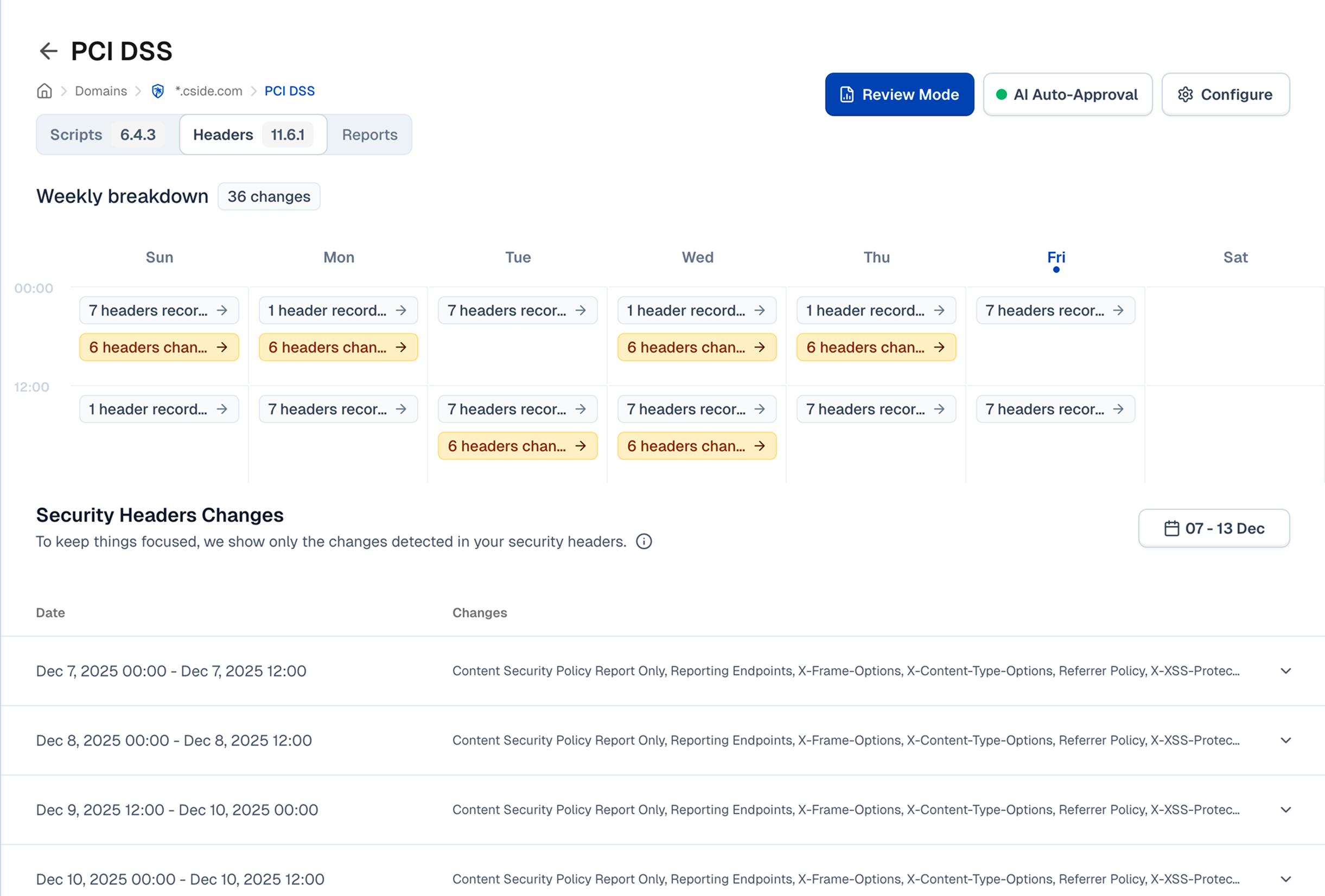
cside is a client-side security platform that combines multiple layers of protection: a JavaScript agent (Script Method) that runs in real user sessions, a scanner (Scan Method) for pages where a script tag isn't possible, and server-side AI payload analysis. It's the only vendor in this comparison with publicly listed pricing and a self-serve deployment model. PCI Shield was built specifically for PCI DSS requirements 6.4.3 & 11.6.1.
Tool type: Multi-layer (JavaScript agent + server-side AI payload analysis + scanner)
Features for PCI DSS 6.4.3 & 11.6.1:
- Full coverage for PCI DSS 6.4.3 & 11.6.1
- Runs in 100% of real user sessions with no sampling; every script is downloaded to cside's own infrastructure for real-time, server-side analysis
- Enforces blocks at runtime in the browser, alongside CSP. Detection is layered: the in-page engine reports from real user sessions, so a script served only to certain visitors is still recorded, and the payload analysis runs off the page, out of reach of anything executing in the browser
- Automated script inventory with real-time discovery across all payment pages
- AI-generated script justifications and summaries that can be reviewed or overwritten
- Continuous integrity monitoring with tamper detection and alerting
- Archives the raw payload of every script version served, so auditors and incident responders get the actual attack code and a full timeline
- Analyzes the full payload regardless of script size, and includes a free CSP reporting endpoint on every plan
- Vendor-neutral: works on any CDN, WAF, or hosting with no lock-in
- Audit-ready PCI reports: script inventories, authorization logs, weekly monitoring evidence
Pricing:
- Starts at $99/month
- Based on pageview volume to protected pages (payment pages)
- Transparent pricing on the pricing page
- All plans include unlimited domains
Reviews:
- 5/5 on Google Maps
- Consistently 5-star reviews on G2
- Named a top performer in the Client-Side Security category on SourceForge
“ The detection capabilities we got with cside were unlike anything we saw in other products we tested in the past. We would definitely recommend the product for PCI and more.
Mark D, CEO
Verified review from G2
“ A simple PCI DSS solution backed by outstanding support.
Frédéric Boyer, Director of Engineering, Amilia
Verified review from G2
Implementation: Self-serve. Add a script tag to your website. Typical setup takes less than a day. Guided onboarding and staging setup available upon request.
Pros:
- Only vendor in this comparison with transparent, published pricing
- VikingCloud QSA validation for PCI DSS 6.4.3 and 11.6.1
- Unlimited domains on all plans
- Multi-org dashboard for agencies and whitelabel vendors
- cside itself is an independently audited SAQ-D company
Best fit:
- Higher education institutions (existing customers include University of Ottawa, University of Waterloo)
- Fortune 500 online vendors with large-scale, multi-brand operations
- Payment services providers managing compliance across merchant portfolios
- Agencies, MSPs, and organizations that want to whitelabel their compliance offering, with free unlimited domains and views on a multi-org platform built specifically for handling multi-brand deployments
2. Feroot
Feroot is a browser-side JavaScript agent focused on payment page security. Its offering splits into two products, PageGuard and Inspector.
Tool type: JavaScript agent (browser-side) + synthetic-user scanner
How it works and features for PCI DSS 6.4.3 & 11.6.1:
- PageGuard deploys permissions and an allow-list where you pre-approve which scripts may run on which pages, and overwrites core JavaScript to protect the page.
- Because the allow-list checks only the source of a script and not the code it serves, a trusted source that turns malicious slips through. PageGuard would not have caught the biggest client-side attack of 2024, the Polyfill attack, where a trusted domain changed hands and began serving malicious code.
- Inspector deploys synthetic "honeypot" users that simulate real behavior to spot malicious scripts, effectively a scanner/crawler running periodic checks. A crawler can be evaded by serving malicious scripts only to residential IPs.
- Monitoring samples only a fraction of real user sessions rather than observing all of them, so the unsampled majority, including attacks that target specific geographies, device classes, or logged-in users, goes unobserved; and its agents run in the browser, where sophisticated attackers can detect, analyze, and potentially disable them.
- Provides behavioral alerts and monitoring logs, but does not archive the exact malicious payload for forensic evidence.
Pricing:
- Not documented in this comparison
Related reading: our PCI DSS 6.4.3 and 11.6.1 compliance guide · how to comply with PCI DSS 6.4.3
Reviews:
| Platform | Rating |
|---|---|
| G2 | 4.6/5 |
| Google Maps | 2.3/5 |
| SourceForge | No reviews |
Implementation: Deployment embeds a JS tag on payment pages.
Where cside goes further: cside downloads and analyzes every script server-side, in real time, across 100% of real user sessions with no sampling, and enforces blocks at runtime in the browser, alongside CSP, instead of only alerting after the fact. That analysis runs on cside's own infrastructure rather than on the page, and every payload is archived as forensic-grade QSA evidence, not just a behavioral log.
3. Cloudflare Client-Side Security (previously Cloudflare Page Shield)
Cloudflare Client-Side Security (previously known as Page Shield) started as a dedicated client-side security product and has since been folded into Cloudflare's broader application security platform. In 2026 Cloudflare rebranded Page Shield to Client-Side Security: domain-based threat intelligence became free on the base tier, the paid add-on became Client-Side Security Advanced (opened to self-serve customers rather than Enterprise-only), and "Page Shield policies" were renamed "content security rules."
Tool type: Network-layer CSP reporting + static AI code analysis (Advanced tier)
How it works and features for PCI DSS 6.4.3 & 11.6.1:
- Detection hinges on a report-only CSP header added to only a small sample of responses, in practice on the order of 1% of traffic. Nothing happens until one of those sampled reports comes back; only then does Cloudflare download the script out-of-band. That roughly 1% sampling is even less coverage than a sampled in-page agent, so rare or targeted payloads that land between samples are never seen.
- On the Advanced tier, ML/LLM analysis inspects the actual JavaScript code, not just the source domain, but the classifier only runs on scripts up to 300 KB.
- The out-of-band fetch comes from Cloudflare's own IP ranges with different headers than a real visitor, so the copy it scores is frequently not the payload a real user received, and often it can't fetch the script at all.
- Resource history is short-lived: Cloudflare deletes information about a reported resource after 30 days without a new report.
- Enforcement leans on CSP content security rules (capped at 5, gated to Advanced), which trust the origin, not the content of each script.
- Requires routing your domain through Cloudflare.
Pricing:
- A free Client-Side Security base tier (script monitoring + domain threat intelligence) exists but does NOT include the monitoring, alerting, or reporting needed for actual 6.4.3/11.6.1 compliance
- Client-Side Security Advanced is a paid add-on
Reviews:
- Not documented in this comparison
Implementation: Self-serve for existing Cloudflare customers. If you're not already routing traffic through Cloudflare, adoption means onboarding to Cloudflare's platform first, a significant infrastructure change just to add PCI script monitoring.
On QSA validation: Cloudflare publishes a QSA applicability guide and tells customers to export the scripts report and write the business and technical justifications themselves. That is not the same as an independently QSA-validated PCI dashboard; the day-to-day workflow is a generic monitoring UI, not a PCI-mapped one.
Where cside goes further: cside analyzes the exact script that executed in real user sessions, 100% of them with no sampling, regardless of script size, and keeps a full payload archive rather than a sampled, 30-day memory. It ships a PCI-specific dashboard independently validated by QSA firm VikingCloud with one-click and AI-assisted justification, and runs on any CDN with no lock-in.
4. Reflectiz
Reflectiz is a fully agentless, scanner-based solution that monitors payment pages by crawling them from external cloud IPs on a schedule. No code is deployed on your site.
Tool type: Remote scanner (agentless)
How it works and features for PCI DSS 6.4.3 & 11.6.1:
- Remote script inventory and baseline monitoring, and a PCI DSS compliance dashboard.
- Because a scanner is a browser running from a known cloud IP range with a predictable user agent, attackers can fingerprint it and serve clean JavaScript to the scanner while serving malicious code to real users based on IP, geography, device, login state, or time window.
- A point-in-time scanner sees even less than a sampled agent, because it runs in no real user session at all, only whatever happens to load during its scheduled crawl.
- Detection only, after the fact; any browser-side blocking control still has to run inside the application.
- As of the May 20, 2026 review of public materials, Reflectiz does not publish SOC 2 Type II certification, PCI DSS SAQ D, or independent QSA approval, and publishes no public status page or uptime SLA.
Pricing:
- Custom-quoted, no public pricing
- No public dollar amounts
- Requires sales engagement for pricing
Reviews:
| Platform | Rating |
|---|---|
| G2 | 4.7/5 (31 reviews) |
| SourceForge | 0 native reviews (tooltip aggregates 33 third-party ratings) |
| Gartner Peer Insights | 0 reviews |
Recurring dislikes in Reflectiz's own G2 reviews include rudimentary reporting, a cluttered interface, false positives on common payment and tracking providers, and the added cost of required training.
Implementation: Fast, zero-deployment setup, no code on your site. Monitoring runs from Reflectiz's external infrastructure.
Where cside goes further: cside also offers scanning (Scan Method) but doesn't make it the whole model. Its Script Method observes script behavior in the actual DOM of real user sessions, so a bad actor can't serve it a clean page the way they can a scheduled crawler. cside also publishes SOC 2 Type II, PCI DSS SAQ D, VikingCloud QSA validation, a public status page, and a 99.9% uptime SLA.
5. DomDog
DomDog is a client-side security tool tailor-made for PCI DSS 4.0.1 requirements 6.4.3 and 11.6.1. Its founders have a long track record in client-side security, and unusually for this space, its product details and pricing are fully public and easy to find.
Tool type: CSP reporting + JavaScript agent
How it works and features for PCI DSS 6.4.3 & 11.6.1:
- Setup requires a single script added to your site's header tag (similar to cside's script tag).
- It collects data, shows the scripts in a dashboard, and asks you to review them, which is fine for PCI but limited from a security standpoint.
- As a JavaScript "agent," it operates within the JavaScript layer and can't monitor code outside it. Because it doesn't sit in the delivery flow, it can't detect a stored XSS script that turns malicious. It scans which data scripts collect and lets you black- or whitelist scripts per site or page.
- Its secondary approach is a Content Security Policy (CSP), which trusts pre-approved script sources but not their content, so a source that stays the same while its content changes (as in the 2024 Polyfill attack) slips through.
- It does not analyze payloads or archive attack code.
Pricing:
- Public and easy to find
- Starts at $999/year (similar to cside)
Reviews:
- No independent review-platform ratings are cited in cside's comparison materials
- No SOC 2 or PCI DSS certification could be found
Implementation: Self-serve, a single header script.
Where cside goes further: DomDog is built to check the PCI DSS 4.0.1 box; cside is built to stop client-side attacks, with compliance following from real security. cside performs payload analysis on its own infrastructure, downloading scripts server-side to identify malicious intent at the code level, including targeted attacks that only activate for certain geos, time windows, or device types, and enforces blocks at runtime in the browser. It keeps immutable payload archives with full version history, and extends beyond PCI DSS to HIPAA, GDPR, and CPRA, ground DomDog doesn't cover.
Types of PCI DSS 6.4.3 & 11.6.1 Solutions
If you're evaluating tools for PCI DSS 6.4.3 and 11.6.1, the first thing you'll notice is that not all of them work the same way. The approach a tool takes determines what gaps it leaves, and those gaps are exactly what your QSA is going to ask about during your audit.
CSP + SRI
Content Security Policy (CSP) is a list of allowed domains from which script sources a browser may execute. Subresource Integrity (SRI) validates script content using a cryptographic hash; if the script changes, the hash breaks and the browser blocks it. Both are free to implement with no vendor needed.
CSP only controls where scripts come from, not what they do. A 'trusted' script that is compromised will pass right through CSP. Trusted third party scripts are one of the main entry points of client-side attacks (such as the recent AppsFlyer attack).
SRI breaks on any dynamic script (analytics, A/B testing, tracking pixels) because legitimate updates invalidate the hash. Neither generates audit evidence or detects HTTP header tampering.
Many organizations consider CSP + SRI because it is mentioned as a control mechanism in PCI SSC documentation. Unfortunately, this is misleading: very few large environments are able to truly maintain compliance with these controls. For a detailed look at what 6.4.3 actually requires and why CSP alone falls short, see our step-by-step compliance guide.
Scanner-Only Solutions
Scanner-based tools periodically crawl your payment pages from external cloud IPs, inventory scripts, check HTTP headers, and compare against baselines to detect changes. No code is deployed on your site. Setup is fast with zero deployment friction.
The limitation: scanners can't block attacks in real-time; they detect after the fact. Scans from external IPs miss scripts that only load for specific user sessions, geographies, or post-interaction triggers. Sophisticated attackers can serve clean pages to known scanner IPs while targeting real users.
While scanner only solutions require minimal effort to implement and may get you past the audit, academic research published on ISACA shows that they have a massive gap when it comes to security. You might tick the checkbox for auditors while leaving your users exposed. PCI DSS v4.0.1 Requirement 11.6.1 specifies that the detection mechanism must observe changes "as received by the consumer browser" — language the PCI SSC added precisely because scanners operating from static cloud IPs can be served clean payloads by attackers who detect the crawl.
JavaScript Agent-Based Solutions
Agent-based tools embed a monitoring JavaScript tag directly on your payment pages. The tag runs in the user's browser alongside your other scripts, observing DOM changes, network calls, and script loading in real time.
The strength: agent-based monitoring captures what actually happens in the end-user's browser, making it strong for both 6.4.3 (real-time script inventory) and 11.6.1 (continuous change detection).
Mature solutions, like cside, combine multiple layers: JavaScript agents, scanning, and AI-powered analysis. The goal is to cover the gaps that any single approach leaves open.
AI Features That Streamline PCI DSS Compliance
These features are not required for PCI DSS compliance. But they dramatically reduce the operational burden of maintaining compliance day-to-day.
An example from our own deployment: We use cside to handle the third-party script management for our own website (cside.com). We run over 50 scripts. Without AI assistance, the manual effort of justifying, understanding, and categorizing each one would be enormous. It saved us roughly 30 hours on our initial setup, and saves us an hour or two every time we go through a review process or set up new scripts.
- AI-written script justifications. PCI DSS 6.4.3 requires a justification for every script on your payment pages. AI generates a starting point you can review or overwrite. No more writing 100 justifications from scratch.
- AI script summaries. Tells you what a script actually does in plain language, so you're not waiting days for someone to explain what an analytics tag or open-source library is for.
- AI threat detection. Catches vulnerabilities like outdated libraries with known exploits, the kind of risk a human reviewer would miss during a routine inventory review.
- AI script categorization. Automatically groups scripts into logical categories (analytics, marketing, payment processing, functionality) so you're reviewing 8-10 categories instead of 100 individual scripts.
Ask the Vendors You're Assessing About Their AI Capabilities
This isn't something most teams think about when evaluating a PCI DSS 6.4.3 & 11.6.1 tool. Compliance is the priority, but a streamlined workflow will save you from headaches down the road. Mature vendors will have AI features built into their platform to reduce manual effort. If your vendor doesn't, it's worth looking at who does.
What PCI DSS 6.4.3 Protects You Against
- E-skimming and Magecart attacks: malicious JavaScript injected into payment pages to steal cardholder data in real time.
- Supply chain attacks: compromised third-party scripts that you trusted. The Polyfill.js hijack in 2024 affected over 490,000 websites (Censys independently counted 384,773 hosts still referencing the domain in July 2024) when attackers took over a widely-used CDN domain.
- Unauthorized script injection: a marketing team adds a tracking tag without security review, or a developer includes an open-source library with a known vulnerability. Both create attack surfaces that 6.4.3 is designed to catch.
What PCI DSS 11.6.1 Protects You Against
- HTTP header tampering: attackers modifying security headers to weaken CSP protections or disable integrity checks
- Silent script changes: a legitimate third-party script gets updated with a malicious payload, and no alert fires because no one is watching for changes
- Session hijacking via injected scripts: attackers inserting scripts that capture session tokens or redirect payment data
Beware of "Free Tools"
The search for a free PCI DSS 6.4.3 compliance tool is understandable. But what most vendors call "free" falls short of what your QSA will actually accept as evidence.
Cloudflare Client-Side Security (previously Page Shield) has a free tier, but it doesn't include the script monitoring, alerting, or compliance reporting needed for 6.4.3 and 11.6.1. CSP + SRI is free to implement, but requires significant engineering effort to maintain and doesn't fully satisfy the requirements on its own. Some vendors offer free PCI DSS dashboards that give you visibility but no protection and no audit evidence.
The question isn't "is there a free tool?" It's "will your QSA accept what this tool produces as evidence?"
If a tool can't generate audit-ready documentation (script inventories with justifications, authorization logs, weekly monitoring reports), it's a monitoring dashboard, not a compliance solution.
What Was Added in PCI DSS v4.0.1 Surrounding Client-Side Security
For a deeper look at what PCI DSS v4.0.1 changed for client-side security, including the clarifications around iframe scope, script justification language, and HTTP header monitoring, this video covers the key additions.
PCI DSS 6.4.3 & 11.6.1 Compliance with cside
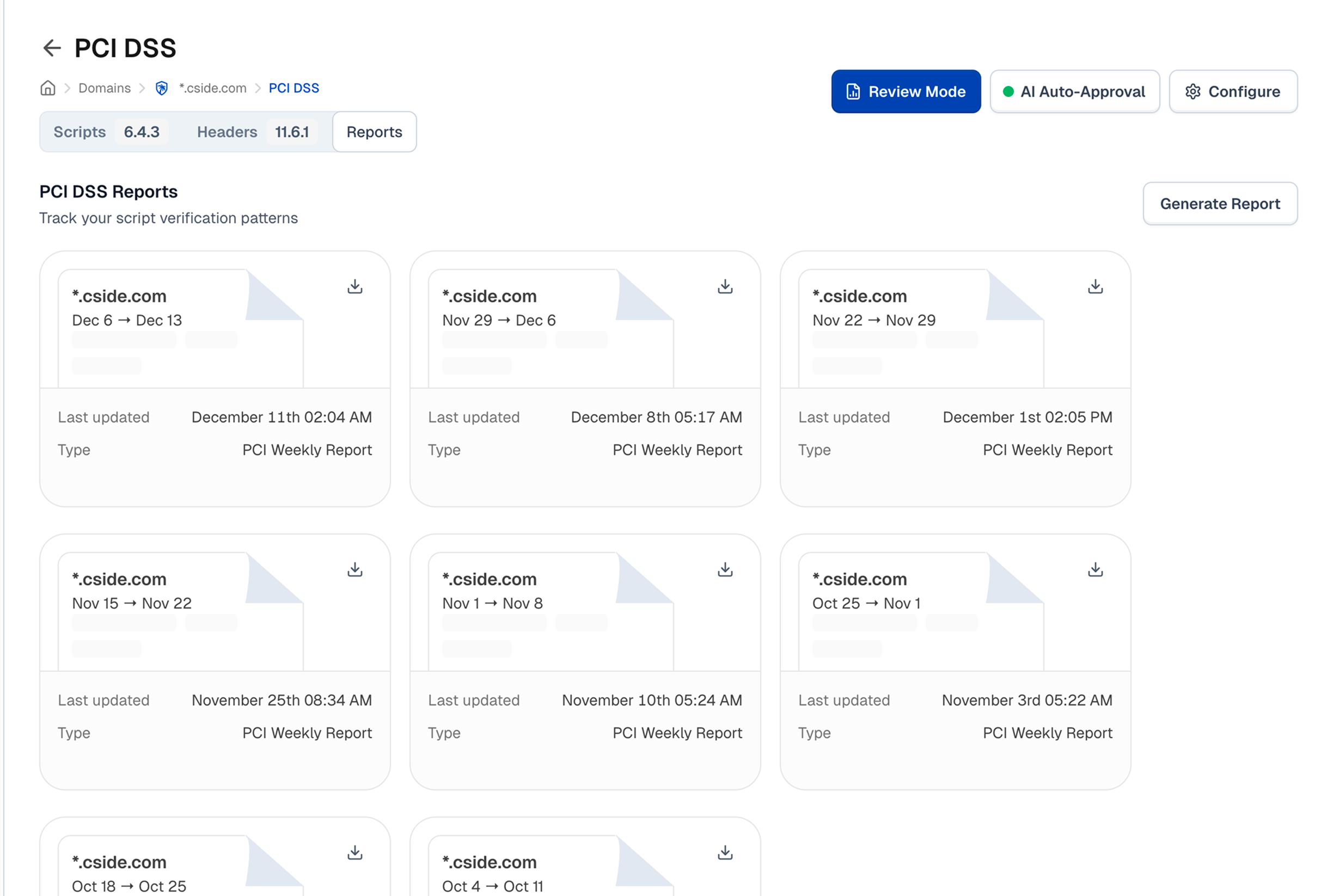
cside's PCI Shield has helped organizations across e-commerce, higher education, payment services, and Fortune 500 retailers pass PCI DSS audits. We're not just a vendor. cside is itself an independently audited SAQ-D company. We use our own platform to manage compliance on cside.com.
cside has undergone an independent QSA assessment. VikingCloud conducted a multi-week technical evaluation confirming that cside meets PCI DSS 6.4.3 and 11.6.1 requirements when deployed correctly.
For agencies, MSPs, and whitelabel vendors managing multiple client websites, cside's multi-org platform provides a single dashboard across all client environments, with per-client isolation, consolidated billing, and unlimited domains on every plan.
Try cside before you buy. cside has a free plan, so you can sign up, deploy, and explore the platform yourself, with no sales calls or procurement process. And our support team is one message away whenever you need a hand.