
What is ATO? ATO, account takeover, is the unauthorized access to a legitimate user's online account by a third party. The attacker uses stolen credentials, phishing, or session hijacking to gain control, then monetizes it through financial theft, data extraction, or loyalty-point fraud. ATO affects every industry handling user accounts, from banking and retail to travel and SaaS platforms.
TL;DR: what is account takeover
- What it is: An attacker gets into a legitimate account and monetizes it: draining balance, changing shipping, arbitraging loyalty points, gift-card scams.
- Three common paths in: credential stuffing, phishing kits with Evilginx MFA bypass, and SIM swap to beat SMS OTP.
- Detect at each stage: velocity and device intelligence at login, session anomaly in-app, device fingerprint at checkout.
Short on time? See cside's account-takeover detection. It covers everything below in one deployment.
What is ATO (account takeover)?
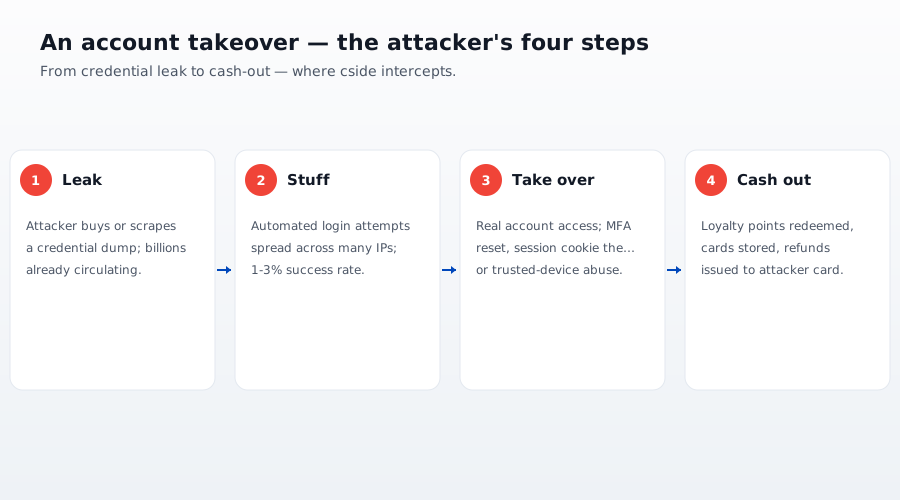
Account takeover is unauthorized access to a legitimate user's account by an attacker who is not the account's rightful owner. The attacker did not sign up under a false identity (that would be new-account fraud). The account belongs to a real person. The attacker gained the credentials or session to control it.
Once in, the attacker can:
- Complete transactions using the payment methods on file
- Extract stored value: loyalty points, gift card balances, credits
- Read or steal data: personal information, communications, financial history
- Change account settings to lock the real user out
- Use the account as a launching point for further attacks
What Are the Main Account Takeover Attack Paths?
ATO does not usually start with breaking the authentication system. It starts with obtaining credentials through easier channels.
Credential stuffing: attackers take username/password pairs from public data breaches and test them against many sites, betting that users reuse passwords. This is the highest-volume ATO vector because breach data is cheap and abundant. See our detailed guide on credential stuffing detection and prevention.
Phishing: attackers trick users into entering credentials on a fake site. Modern phishing kits target MFA codes and session cookies, not just passwords.
Session hijacking: attackers steal active session cookies from the user's browser and impersonate them without needing credentials. See our post on cookie theft, session hijacking, and pass-the-cookie attacks.
MFA bypass: SIM-swap attacks, prompt bombing, MFA fatigue, and adversary-in-the-middle attacks defeat the second factor.
Social engineering of support staff: attackers call or message the support team pretending to be the user, using leaked personal details to answer verification questions.
How ATO is different from other fraud
ATO looks different from account creation fraud (fake signup) and card testing fraud in what an attacker does with the account:
| Fraud type | Account starts | Attacker uses account to |
|---|---|---|
| Account takeover | Legitimate user | Extract value from an existing account |
| Account creation abuse | Fake identity | Abuse promotions, laundering, or spam |
| Card testing / carding | Guest checkout | Test stolen card numbers |
| Friendly fraud | Legitimate user | Dispute their own valid transactions |
The controls differ per category. See our account sharing vs account takeover comparison for the specific distinction between ATO and account sharing, which are often confused.
How Do You Detect Account Takeover?
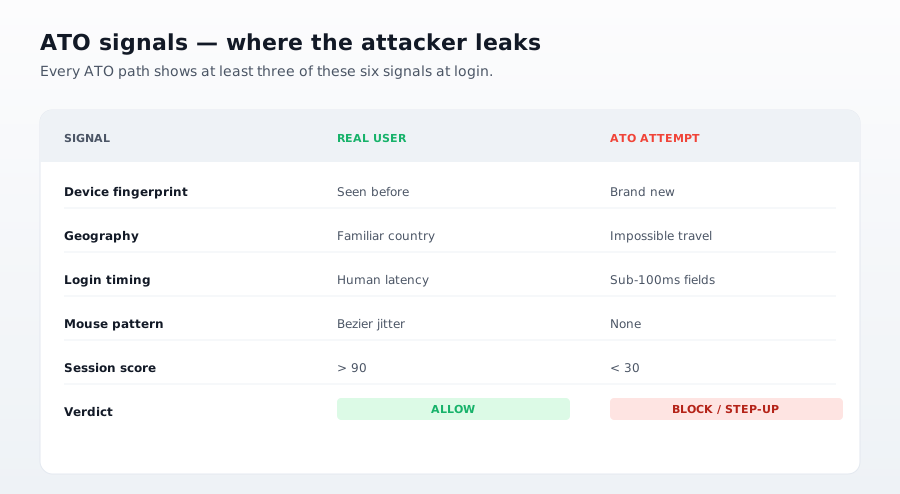
Effective ATO detection combines signals from three layers:
Authentication layer
- Failed-login velocity per user, IP, or device
- Successful login from a new geography
- Login timing outside the account's normal pattern
- MFA challenge success rate below the account's historical baseline
Browser and device layer
- Device fingerprint that does not match the account's historical devices
- Impossible travel: login from a location incompatible with the last known location
- Behavioral patterns during the session (typing rhythm, cursor motion) that do not match historical baselines
- Session characteristics consistent with automation or scripted access
Business action layer
- Password change immediately after login
- MFA reset or method change
- Address of record change
- Payment method addition
- Large or unusual transaction
The strongest detection systems combine all three. Network signals alone miss too much because attackers rotate IPs cheaply. Business action signals alone catch the abuse too late.
Impossible travel detection
Impossible travel is one of the strongest single ATO signals: two authenticated sessions on the same account from geographic locations that could not be reached in the elapsed time. A user logged in from London at 09:00 UTC and Kuala Lumpur at 10:30 UTC is impossible unless they teleport.
The detection needs care, since VPNs, cloud desktops, and mobile networks can produce false positives. See our what is impossible travel detection guide for the specific implementation.
AI agents and ATO
AI agents can be used to conduct ATO at scale. An agent driving a real browser can attempt credential stuffing more convincingly than a scripted bot, complete MFA prompts if the user has been socially engineered, and execute post-login abuse before the user notices. See how AI agents break account security for the emerging attack patterns.
Prevention playbook
The controls that actually reduce ATO risk:
- Rate-limit authentication: cap failed logins per IP, per device, per account
- MFA everywhere it can be enforced: with resistance to MFA bombing and SIM swap
- Device fingerprinting: bind sessions to devices and flag mismatches
- Behavioral scoring: detect the automation signature during login and post-login actions
- Session integrity: device-bound session credentials where supported
- Impossible travel monitoring: detect geographic implausibility
- Post-login action controls: extra verification for high-risk actions like password change, MFA reset, and large transactions
- Credential breach monitoring: check user passwords against known breach corpora at login
For the deeper playbook see the browser-layer detection guide and the top ATO prevention solutions selection guide.
Where cside fits
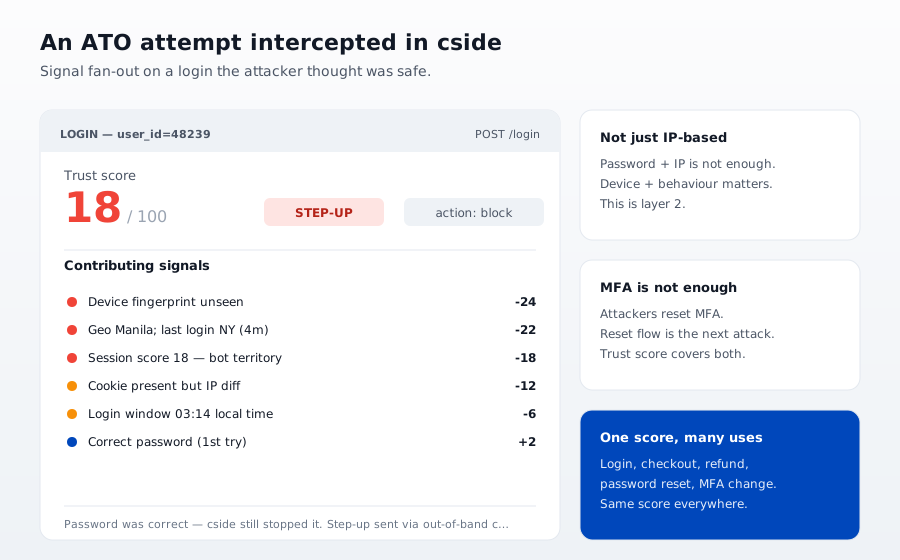
cside produces the device fingerprint and behavioral scoring that ATO detection depends on. Every login session gets scored against the account's historical device set and behavioral baseline. That device set is a persistent device ID built from a baseline of 250+ browser, device, and network signals, so a session from an unrecognized device is caught even when the credentials are valid. Impossible travel, device mismatch, and automation signatures fire in real time so business logic can enforce step-up authentication, block the session, or flag it for review.
The same signals feed the broader fraud stack. The fingerprint that catches an ATO attempt today is the same fingerprint that provides chargeback evidence tomorrow.