
TL;DR: AI-agent driven account takeover
- The gap: MFA raises the bar at the password step, but AI agents target what comes after: they replay stolen session cookies and OAuth tokens to skip authentication entirely, or walk through the recovery flow to rebind the account to attacker-controlled email and phone.
- The evidence: cside 2026 research reports installs of playwright-stealth grew on the order of 10x across 2025. That is the toolkit driving real Chromium instances at human speed, past IP reputation, headless checks, and rate limits that stop scripted bots.
- The decision: If your ATO signal fires only at login, an agent that replays a valid token or resets the factor via a fresh-device recovery event slips past clean. Instrument recovery and post-auth with the same browser-level scrutiny as login, or the side door stays open.
Short on time? See cside's account-takeover detection. It covers everything below in one deployment.
AI agents break account security by automating the parts of takeover that used to need a human. They drive real browsers, so they replay stolen credentials, reuse hijacked sessions and tokens, and walk through account-recovery flows the way a person would. That defeats controls built for blunt, request-level bots. To catch bot-driven account takeover (ATO), you have to read the browser session itself, not just the IP and the request rate.
This post covers the three stages where AI agents actually break in: automated credential replay, session and token reuse, and recovery-flow abuse. For each, it names the browser and device signals that expose the agent, and where cside supplies them.
How is AI-agent ATO different from a normal bot?
A legacy stuffing bot is a script. It posts username and password pairs to your login endpoint, fast, from a handful of IPs, with no real browser behind it. Rate limits, IP reputation, and a headless check stop most of it.
An AI agent works differently. It runs an actual browser through automation frameworks like Playwright or Puppeteer, often wrapped in a stealth kit that patches the obvious tells. It renders your page, reasons about what it sees, fills forms, and changes course when a challenge appears. That lets it finish flows a script cannot: clicking a reset link in a victim's inbox, re-submitting an intercepted one-time code, or completing a checkout after a step-up prompt.
The tooling got cheaper and easier. cside's 2026 web security research reports that installs of playwright-stealth, one of many stealth-browser kits, grew on the order of 10x across 2025, a measure of how fast browser-driven automation became standard attacker equipment. cside 2026 research
The three stages where AI agents break in
| Stage | What the agent does | Signal that exposes it |
|---|---|---|
| Credential replay | Drives a real browser to submit breached pairs and pass challenges | Automation flags, fingerprint drift, residential-proxy egress |
| Session / token reuse | Replays a stolen cookie or OAuth token to skip the login entirely | Environment mismatch vs. the session's origin device |
| Recovery abuse | Walks the reset/change-of-factor flow to seize the account for good | New device on a recovery event, agent behavior mid-flow |
Stage 1: automated credential replay
This is credential stuffing with a browser in front of it. Instead of raw requests, the agent logs in through the rendered page so the traffic looks human. It rotates browser fingerprints across attempts to avoid being grouped, distributes egress across residential proxy pools to beat IP limits, and solves or outsources CAPTCHAs.
The browser environment still gives the agent away. Automation frameworks expose navigator.webdriver and other patched properties that contradict the claimed browser. Stealth kits try to hide these, but the patches themselves are detectable: a property that has been redefined, a Chrome DevTools Protocol (CDP) Runtime artifact, a headless rendering quirk, or a fingerprint that shifts between requests in one session. Those inconsistencies are invisible in a network packet and obvious in the browser environment.
Stage 2: session and token reuse
More capable agents skip your login. If they steal a session cookie or OAuth/bearer token, through a phished session, malware, or a skimming script on your own page, they replay it and inherit an authenticated session without ever facing the password or MFA prompt. This is the AI-agent token reuse pattern.
A correct token says nothing about whether the same user holds it. The browser environment does. A replayed session usually surfaces a different fingerprint, a different device, and a different network path than the one that originally authenticated. When the token is valid but the environment around it does not match the session's origin device, that mismatch is the tell. This is also why a compromised third-party script on your login or checkout page is so dangerous: it can lift the token before your server ever sees a malformed request.
Stage 3: recovery-flow abuse
Recovery is the soft target, because it is designed to let a legitimate user back in after they have lost their factor. An agent abuses exactly that. It triggers a password reset, intercepts or social-engineers the reset link, and re-binds the account to attacker-controlled email, phone, or passkey, turning a temporary intrusion into permanent ownership.
This stage rarely shows the velocity spikes that flag stuffing. The volume is low and deliberate. The signal that matters is context: a recovery or change-of-factor event arriving from a brand-new device and browser environment, executed with the timing and navigation pattern of automation rather than a confused human. Instrument recovery with the same browser-level scrutiny as login, or you protect the front door and leave the side door open.
What browser and device signals expose bot-driven ATO?
Network signals describe where traffic came from. Browser signals describe who is actually operating the session. For AI-agent ATO, the second set is where the evidence lives.
- Automation and stealth tells:
navigator.webdriver, redefined or patched browser properties, CDP Runtime leaks, and headless rendering quirks that contradict the claimed browser. - Fingerprint drift: a device or browser fingerprint that changes between requests inside one session, the rotation pattern agents use to dodge grouping.
- Environment-vs-token mismatch: a valid session or token presented from a device, fingerprint, or network path that does not match the session's origin.
- Residential-proxy behavior: egress that looks residential but behaves like infrastructure, used to launder automated traffic past IP reputation.
- Stage-aware context: a new device on a recovery event, or automation behavior surfacing specifically at reset, change-of-factor, or checkout.
No single row convicts. The decision comes from the stack: a stealth-browser tell plus fingerprint drift plus a recovery event from a new device almost never describes a real user. Capturing these signals, and the device and real IP behind them, is also what gives a fraud team a defensible audit trail when an attack adapts mid-session.
How cside fits
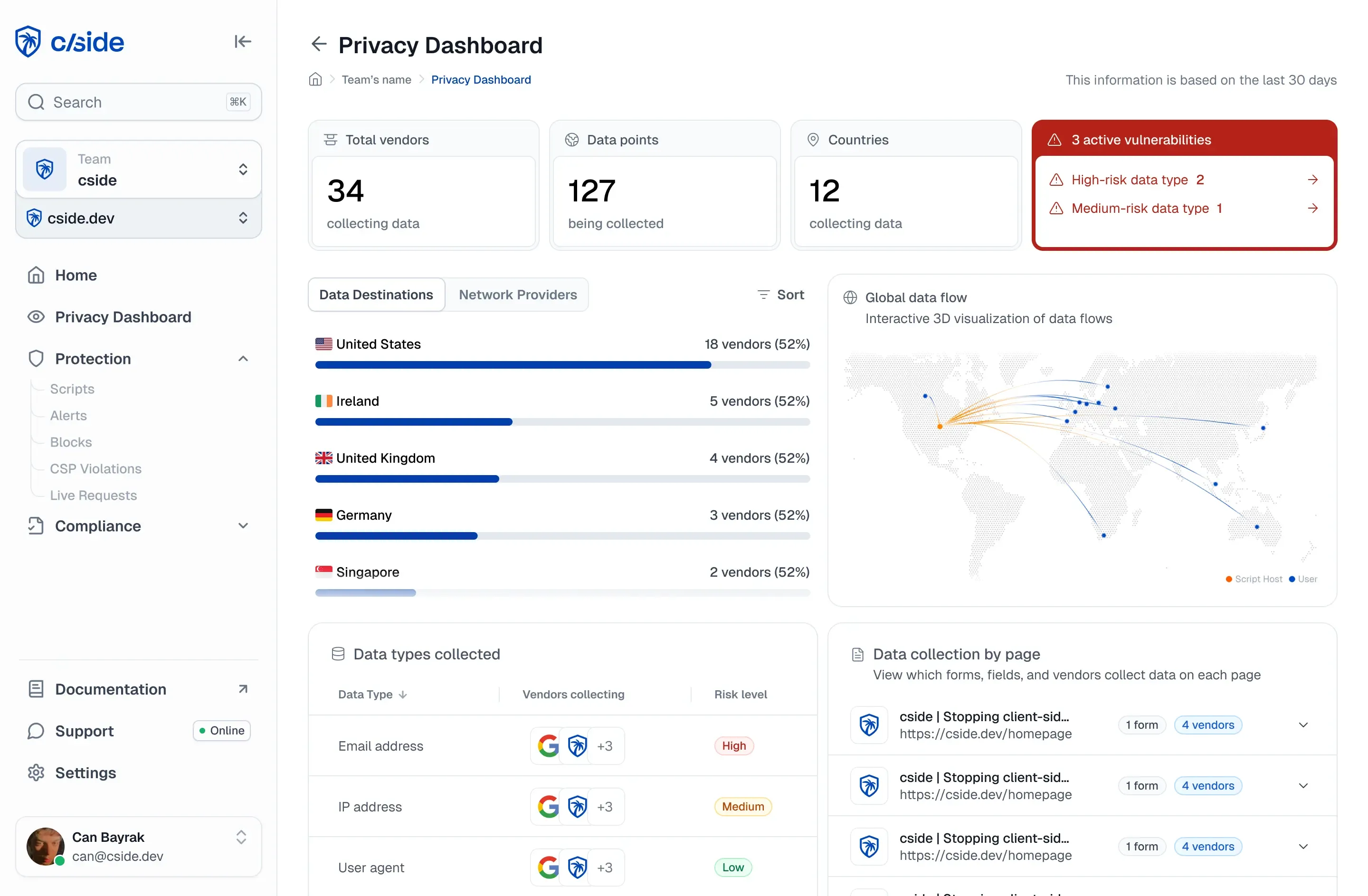
cside is a client-side security platform that operates in the browser layer, where AI agents actually run. It combines AI-agent detection with device and browser fingerprinting and VPN/proxy behavioral analysis to surface the signals above, then delivers them as raw signals via API so developer-led teams plug them into their own login, session, and recovery risk logic. That fingerprinting reads a baseline of 250+ browser, device, and network signals per session, enough to tie each session to the device behind it and expose a replayed token whose environment no longer matches.
Because the analysis is grounded in the browser, cside catches stealth browsers, token replay, and recovery abuse that network-only tooling does not see. It also gives visibility into third-party scripts on your login and checkout pages, the same surface an attacker uses to lift a session token before your server sees a single bad request.
Further reading on cside
- Detect account takeover before it happens: browser and device signals
- Credential stuffing: how to detect and stop it
- What is client-side security
- Best tools to detect AI agents on your website
- cside Signup Shield for the upstream problem: stopping fake new accounts at signup before they ever reach login
- cside AI Agent Detection