
TL;DR: detect Anthropic Computer Use by cursor arcs and typing cadence
- The WAF sees nothing: Everyone expects Claude's Computer Use to look like a scraper, so they point their WAF at it and see nothing. The agent drives a full real browser that executes JavaScript, receives cookies, honors CSP, and produces network traffic indistinguishable from a human session.
- The six-pattern signature: The signature lives in six patterns showing up together: scripted cursor arcs from click target to click target, uniform inter-keystroke delays with no natural pauses or corrections, fast error-free task completion, deterministic DOM-order form filling, absent exploratory browsing, and a stable device fingerprint across sessions. Two or three sustained is a strong classification.
- The decision: If you run checkout, account creation, or content behind a gate, treat Computer Use traffic as high-risk by default because agent-driven ATO, account creation abuse, and card testing are already happening in the wild. If your only concern is content scraping, the crawler-focused controls do not cover this.
Short on time? See cside's AI-agent detection. It covers everything below in one deployment.
Anthropic's Claude has a capability called Computer Use that lets the model control a real computer by moving a cursor, clicking buttons, typing into forms, and completing tasks the way a human would. It is part of the same wave of agentic AI as OpenAI Operator and Amazon Buy For Me. If you run a site with a checkout, an account creation flow, or content behind any kind of gate, Computer Use traffic is already reaching you or will be soon.
Why Computer Use is harder to detect than a scraper
Traditional bot detection assumes the automation calls your endpoints directly or uses a headless browser. Both of those produce network-layer signals that firewalls and WAFs can catch. Computer Use is different: it drives a real full browser session (Chrome, Firefox, whatever) that executes JavaScript, receives cookies, honors CSP, and interacts with the DOM the way a human would.
From the network perspective, a Computer Use session looks identical to a human. The difference lives in how the browser is being used, not in what requests it produces.
The behavioral signature
Every distinguishing signal is in the browser session. Six patterns show up together and separate Computer Use from a real human:
- Cursor paths: the agent moves in scripted arcs from click target to click target. Humans produce noisy, jittery, non-optimal paths.
- Typing rhythm: uniform inter-keystroke delays with no natural pauses, corrections, or micro-hesitations
- Task completion speed: fast and error-free from page load to form submission
- Form field order: deterministic, following the DOM order or a scripted plan rather than the tab order a human would use
- No exploratory browsing: the session goes straight to the target task without the wandering that characterizes real visits
- Stable device fingerprint across sessions: an agent-driven session often reuses the same environment even when the underlying user changes
A single signal is not enough. Two or three together sustained across a session is a strong classification.
How this fits with other agent detection
If you have already worked through detection for OpenAI Operator, ClaudeBot, Perplexity Shopper, or the Perplexity crawler, the mental model here is similar. Computer Use sits in the same category as Operator, an agent that drives a real browser rather than a headless scraper.
The difference from a crawler like ClaudeBot is intent. Crawlers index content. Computer Use completes transactions. That means the risk surface is checkout abuse, account creation abuse, and workflow manipulation rather than content scraping.
Business decisions before technical decisions
Before rolling out detection, decide the policy:
| Site type | Common policy |
|---|---|
| Content site (ads or subscription) | Detect and serve paywall or block, treat as scraper |
| Ecommerce with defined AI-agent policy | Allow with terms, require agent identification, price accordingly |
| Ecommerce without a policy | Detect and either block or flag for review, since the agent may be legitimate or fraud |
| Account creation, signup flows | Block by default until the agent proves it is authorized |
| Financial services, payments | Block by default; agent-driven ATO and card testing are documented threats |
The technical detection is the same across all of these. What changes is what you do when the classifier fires.
What cside does with the signal
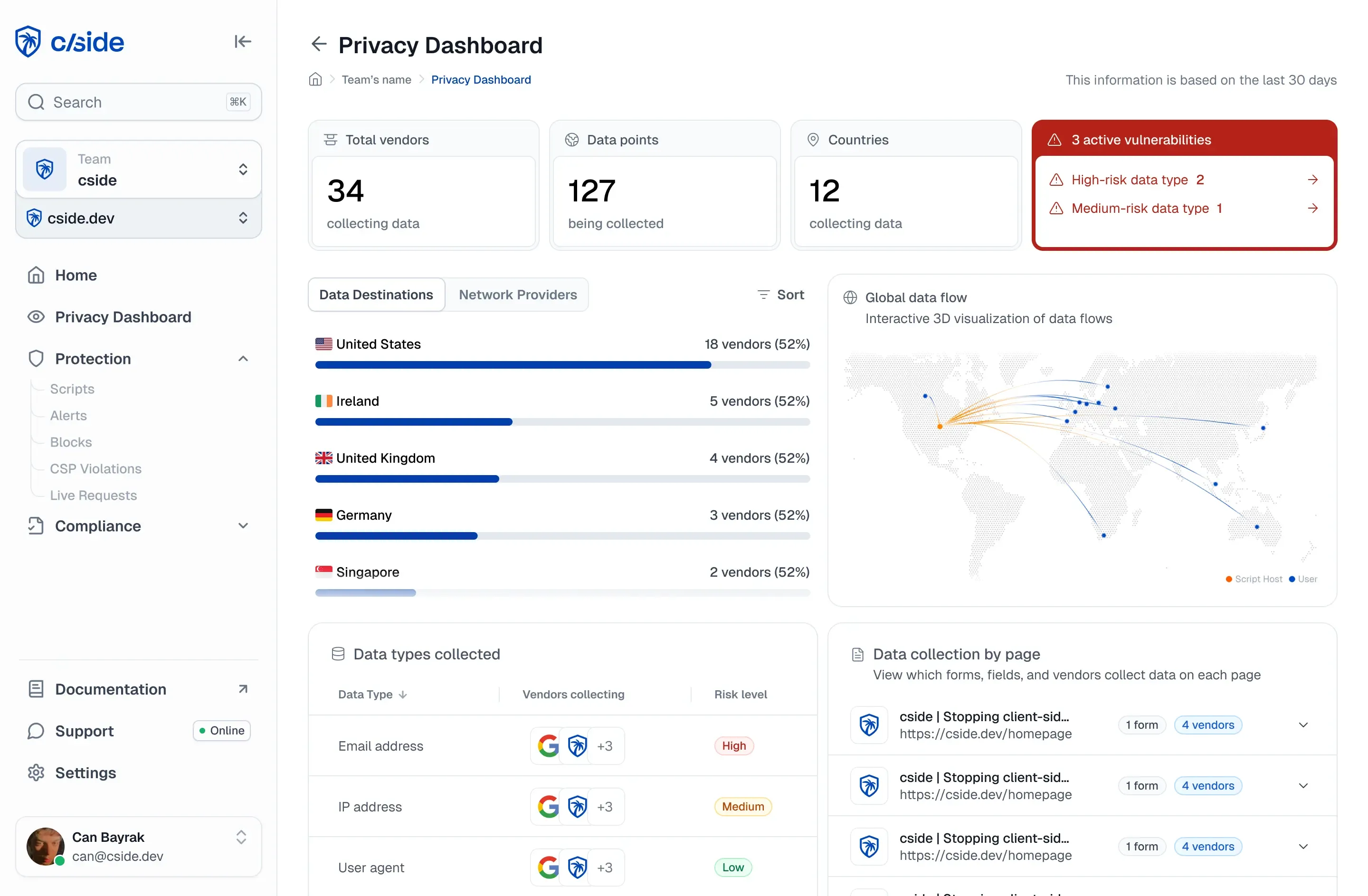
cside runs at the browser layer on every session and produces the device fingerprint, behavioral scoring, and script activity that separates Computer Use from a human user. When a session profile matches an agent (scripted cursor motion, uniform typing, deterministic form order), cside flags it in real time so you can enforce whatever policy fits the surface.
For the broader picture on how agents are used to break existing account security, see how AI agents break account security and our guide on how to choose an AI agent detection solution.
What to check this week
Two questions tell you whether Computer Use traffic is already on your site:
- Do any of your recent sessions show the behavioral signature above (scripted cursor, uniform typing, sub-second form completion) while claiming to be a normal Chrome or Firefox user?
- Are any of those sessions completing high-value actions (checkout, account creation, credential entry)?
If both answers are yes, an agent is already testing your surface. Whether that is a real customer using their agent legitimately or an attacker using an agent to abuse your flows is the next question, and it is one you cannot answer without browser-layer detection.