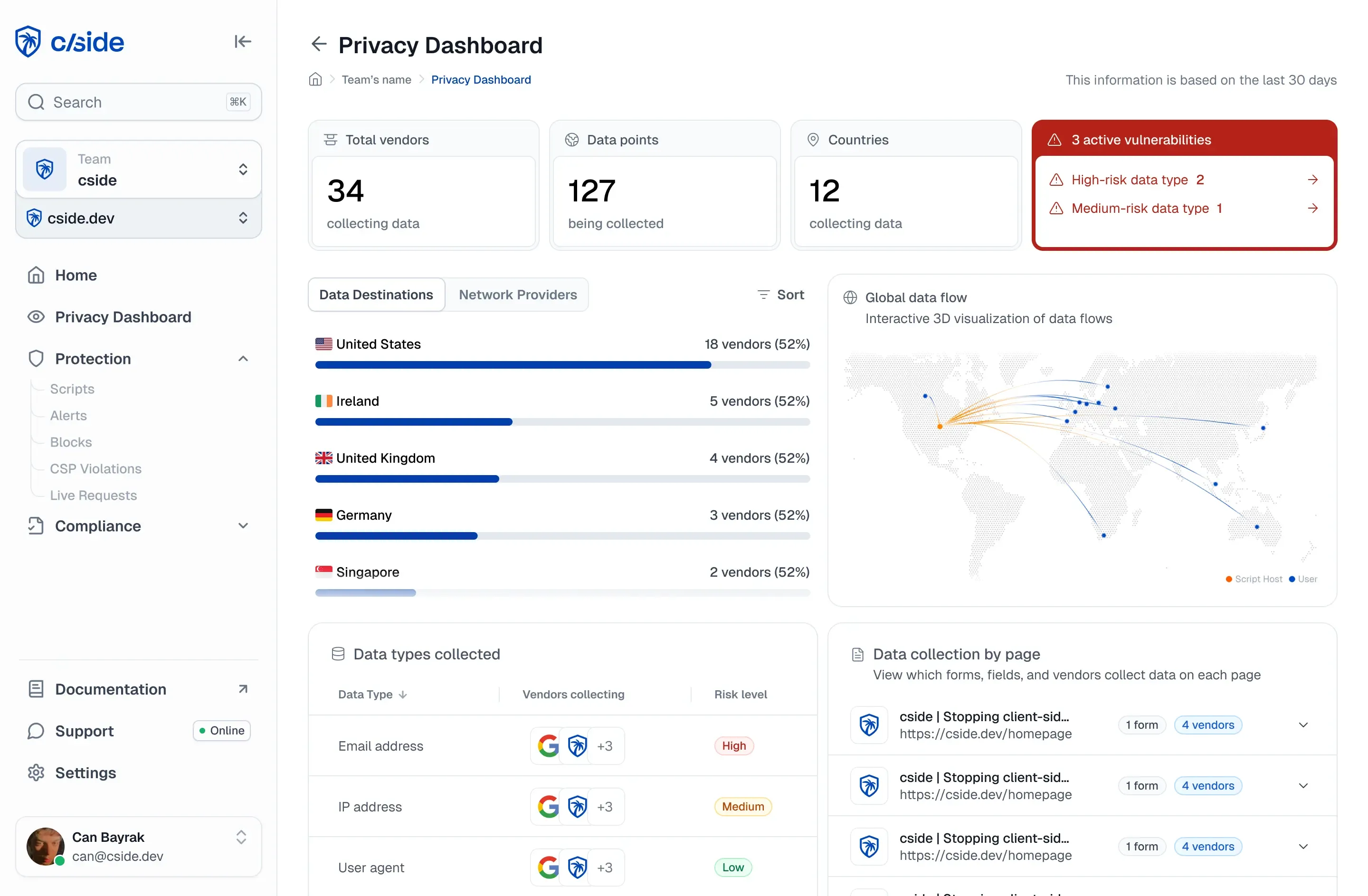
TL;DR: MGA Player Protection Directive browser layer audit evidence
- The unmonitored layer: MGA-licensed operators pour resources into game certification and financial controls while the browser layer sits outside compliance monitoring. That is the layer where players actually interact, and it is the one an MGA auditor will start asking about first.
- The evidence trail: cside detected over 300,000 attack signals across monitored sites in Q1 2025, and the Polyfill.js compromise in June 2024 hit more than 490,000 sites simultaneously. cside instruments 100% of real user sessions, maps each script to its data destinations, and produces the timestamped evidence trail MGA reviews expect.
- Start this quarter: If you hold an MGA licence and cannot produce a third-party script inventory with destinations for a technical review, start there this quarter. If you are a white-label platform provider running multiple brands, deploy one cross-brand instrumentation before the next licence conversation instead of five separate ones.
Short on time? See cside's in-browser Magecart and skimmer blocking. It covers everything below in one deployment.
In working with MGA-licensed operators across Malta and through their white-label networks, the pattern is consistent: compliance resources go into game certification, financial controls, and player protection programme documentation. The browser layer is treated as an IT matter, separate from the regulatory compliance agenda. When a compliance team first receives a complete picture of what is executing in their player sessions, the reaction is usually the same: there are more scripts than they expected, from more vendors than they recognised, sending data to more destinations than they had documented.
The Malta Gaming Authority licences a large share of the European online gambling market, including many of the platforms that power white-label operators across multiple jurisdictions. The MGA's Player Protection Directive and Remote Gaming Regulations set out clear requirements for technical security, player data protection, and auditability, yet the browser layer sits almost entirely outside most operators' compliance monitoring. cside detected over 300,000 attack signals across monitored sites in Q1 2025 (measured as distinct anomalous behaviours per instrumented real-user session across the monitored estate), and the platforms most exposed were those with the largest third-party script footprints: analytics, affiliate tracking, live chat, payment widgets, and bonus management tools loading on every player session. For MGA-licensed operators, the real question now is how quickly they address the browser layer.
MGA Technical Compliance Requirements and What They Mean for the Browser Layer
Quick Answer: MGA Remote Gaming Regulations and the Player Protection Directive require operators to maintain a technically secure and auditable platform. This extends to every layer where player data is handled, including the browser. Third-party scripts loading on player-facing pages are in scope because they execute within the licensed platform environment and can affect player outcomes, data integrity, and game fairness.
The MGA's technical compliance framework is principally focused on game fairness, player fund protection, and system integrity. Compliance teams tend to focus on RNG certification, game testing, and financial controls. The browser layer, where the actual player interaction takes place, is frequently unaudited.
MGA requirements that directly touch the browser layer include:
- Secure technical environment: operators must ensure that no unauthorised modification of their platform can occur; a third-party script that modifies page content or intercepts player input is an unauthorised modification
- Player protection: the MGA Player Protection Directive requires operators to prevent harm to players through any vector within the operator's control
- Data security: player data processed on the licensed platform must be protected in transit and at rest; this includes data captured in the browser before it reaches the server
- Audit trail: operators must be able to evidence their technical controls to MGA auditors, including what is executing on their platform and when
An operator that cannot produce an inventory of third-party scripts running on its platform during an MGA audit is not in a strong compliance position. The MGA expects operators to know their technical environment.
How Third-Party Scripts Create MGA Player Protection Directive Exposure
Quick Answer: The MGA Player Protection Directive requires operators to maintain a secure environment for player transactions. A third-party script that captures payment form data, redirects players at critical moments, or records player sessions without disclosure is a direct violation of player protection obligations. The Polyfill.js supply chain compromise in June 2024 demonstrated that a single upstream vendor compromise can affect over 490,000 sites simultaneously.
| Abuse pattern | What the script does in the browser | Where it sends data | Why network-layer tools miss it |
|---|---|---|---|
| Data exfiltration | Reads registration, payment, and ID fields | Undeclared external server | Request leaves via an already-approved CDN endpoint |
| Redirect attack | Intercepts navigation at deposit / withdrawal / bonus moments | Competitor or fraudulent page | Redirect is triggered by in-browser execution, not an inbound request |
| Undisclosed session recording | Captures full session incl. form interactions | Recording vendor not in privacy policy | No malicious IP or blocked origin to alert on |
| Affiliate fraud | Over-attributes registrations, harvests player data | Affiliate's own infrastructure | Loads through delegated tag manager the operator already trusts |
Most MGA-licensed operators load scripts from dozens of vendors across their player-facing pages. Each vendor relationship is a potential supply chain risk. The Polyfill.js compromise in June 2024, in which a widely-used JavaScript library was taken over and weaponised, affected more than 490,000 websites simultaneously. Operators who had never intentionally installed malicious code found themselves serving it to players.
The categories of third-party script behaviour that create Player Protection Directive exposure include:
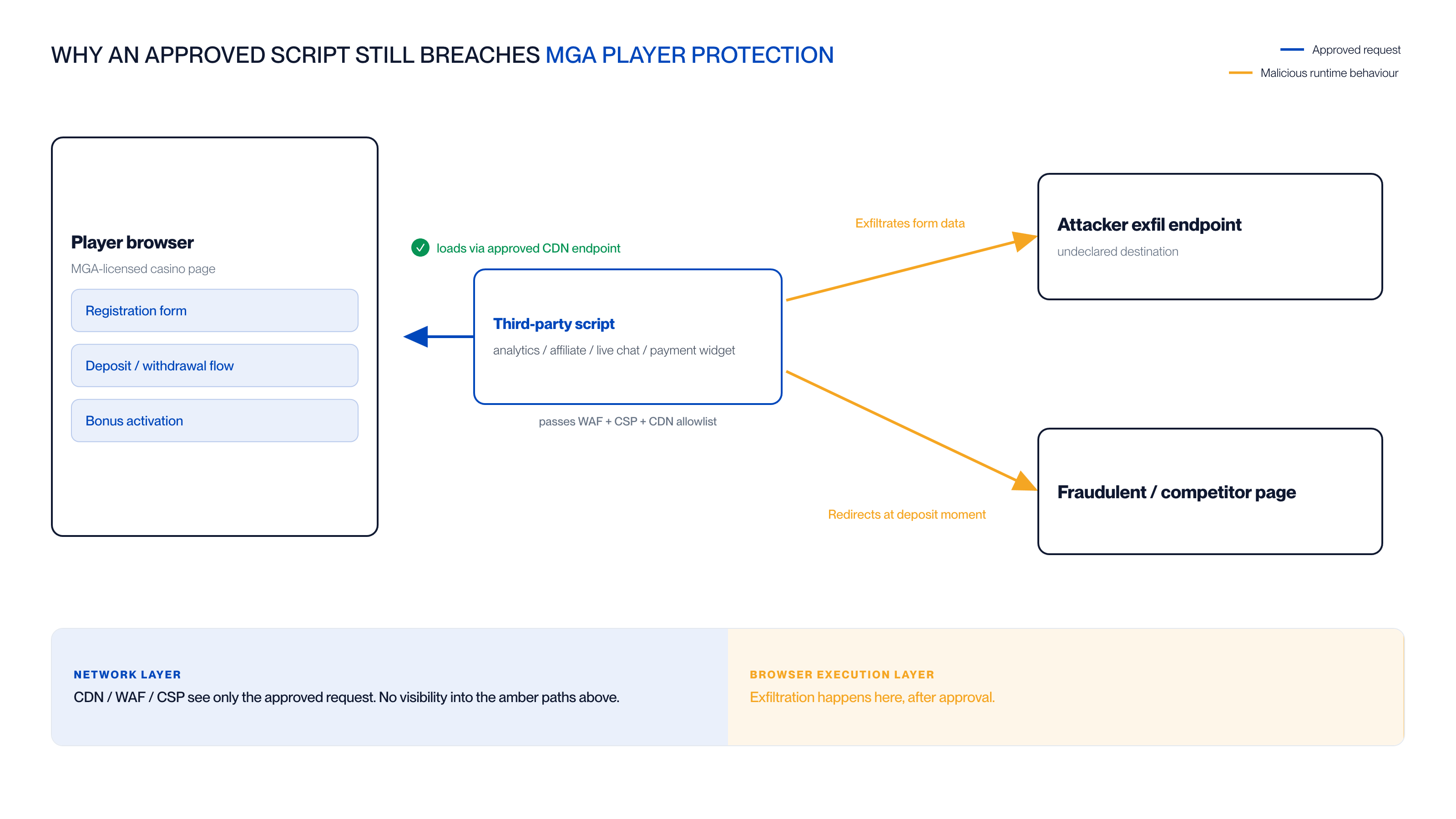
- Data exfiltration: scripts that access and transmit player form data, including registration details, payment information, and identity documents, to external servers the operator does not control
- Redirect attacks: scripts that intercept player navigation at high-value moments (deposit initiation, bonus activation, withdrawal request) and redirect to competitor platforms or fraudulent pages
- Session recording without disclosure: tools that capture full player sessions, including sensitive form interactions, in ways that are not disclosed in privacy policies
- Affiliate fraud: scripts injected by affiliate partners that over-attribute registrations, manipulate bonus triggers, or harvest player data for use in competing acquisition campaigns
The MGA's expectation is that operators prevent these outcomes. Claiming ignorance of what a third-party script is doing is not a recognised defence under the Player Protection Directive framework.
GDPR Overlap: MGA-Licensed Operators Processing EU Player Data
Quick Answer: MGA-licensed operators processing data from EU players are subject to GDPR regardless of where their servers are located. GDPR Article 28 makes operators responsible for any processing of player data by third-party scripts on their platforms. Without a documented processor agreement covering each script's data processing, operators are in breach of GDPR even if the underlying script behaviour is otherwise benign.
Malta is an EU member state, and MGA-licensed operators processing data from EU residents must comply with GDPR. For operators based in Malta or processing EU player data from any jurisdiction, this creates a layered compliance obligation: MGA technical requirements and GDPR data processing rules apply simultaneously.
The GDPR obligations that apply to third-party script behaviour are:
- Article 5: personal data must be processed lawfully, fairly, and transparently; a script exfiltrating player data to an undisclosed third party violates all three principles
- Article 28: any third party processing personal data on behalf of the operator must be covered by a documented Data Processing Agreement; scripts without a DPA in place create a structural GDPR breach
- Article 33: if a script leads to personal data exposure, operators must notify the relevant supervisory authority within 72 hours of becoming aware; the challenge is that most operators are not aware until long after the breach begins
The IBM 2024 Cost of a Data Breach report estimates the global average cost of a data breach at $4.88M. For MGA-licensed operators, this figure compounds with MGA licence review risk, GDPR enforcement action, and reputational damage with payment processors and white-label partners. The ICO's £20M penalty against British Airways for browser-layer data harvesting by third parties is the clearest precedent for what enforcement looks like in practice.
What MGA Auditors Look For and How to Evidence Script Security Controls
Quick Answer: MGA auditors conducting technical compliance reviews expect operators to demonstrate that their platform is secure, that player data is protected, and that they have controls in place to detect and respond to unauthorised activity. Script security controls should be evidenced through a documented inventory, change logs, anomaly detection records, and incident response procedures specific to the browser layer.
Technical audits by the MGA or approved test houses focus primarily on game system integrity and financial controls. However, the scope of a security audit increasingly covers the broader technical environment, including client-side controls. Operators who arrive at an audit without documented browser-layer security measures are exposed.
The evidence that supports a strong audit position includes:
- Script inventory: a maintained list of every first, third, and fourth-party script loading on player-facing pages, including dynamically loaded scripts and those loaded conditionally by tag management systems
- Change detection logs: a record of when scripts changed, what changed, and whether the change was authorised
- Anomaly alerts: documented instances of unusual script behaviour and the operator's response, demonstrating active monitoring rather than passive assumption
- Continuous compliance evidence: timestamped logs of every script execution event, suitable for MGA audit preparation and as the evidentiary basis for PCI audit reports and forensic investigations
- Vendor assessment records: documentation showing that third-party script vendors have been assessed for security posture and that DPAs are in place where required
- Incident response playbook: a documented procedure for responding to script-related security incidents, including escalation paths and regulatory notification thresholds
Most operators currently lack all five. The most common gap is the absence of change detection: operators know which scripts they approved at the time of onboarding but have no mechanism for detecting when those scripts subsequently change their behaviour.
How cside Provides the Runtime Visibility MGA-Licensed Operators Need
Quick Answer: cside instruments 100% of real user sessions in the browser, providing MGA-licensed operators with a complete script inventory, real-time change detection, and anomaly alerts mapped to specific data destinations. It generates the audit-ready evidence trail that MGA compliance reviews require, covering the browser layer that CDN and network-layer tools cannot reach.
The tools most operators currently use for technical security monitoring operate at the network layer: CDN logs, WAF alerts, and Content Security Policy violations. These tools are valuable but structurally incomplete. A script that loads through an approved CDN endpoint and then exfiltrates data to an undisclosed third party will not trigger a network-layer alert. The exfiltration happens inside the browser, after the initial request has been approved.
cside closes this gap by instrumenting the execution layer directly:
- Every first, third, and fourth-party script executing on player-facing pages is identified, including those loaded dynamically and those activated only for specific player segments
- Script behaviour is monitored in real sessions: what data is accessed, what is sent, and to which destinations
- Changes to script behaviour trigger automated alerts, even when the script URL and file hash remain the same
- All activity is logged with timestamps, session context, and destination mapping, creating a continuous evidence trail that satisfies MGA audit preparation requirements, supports PCI audit reports, and forms the basis for forensic investigation when incidents occur
For white-label platform providers operating multiple brands under a single MGA licence, cside provides coverage across all front-end environments from a single integration. This is particularly important for platforms where different brands load different third-party scripts through shared or delegated tag management configurations.
Other browser-layer security tools include network-layer options such as Cloudflare Page Shield, which monitors requests but cannot observe script execution, and code protection tools such as JScrambler, which protects your own code from reverse engineering but does not monitor third-party runtime behaviour. cside is the layer between your existing network controls and the MGA's requirement to know what is executing on your platform.
In one deployment at an MGA-licensed white-label platform provider (operator details anonymised), cside found that three affiliate partner scripts across multiple brand front-ends were sending player session events to destinations outside the operator's documented vendor list. None of these scripts appeared in the network-layer alerts because they were routing through CDN endpoints that were already approved. The operator was able to initiate conversations with the affiliate partners, remove the undeclared tracking, and update their vendor documentation before their next MGA compliance review.
| Tool type | Scope | What it covers | MGA audit evidence value |
|---|---|---|---|
| CDN / WAF | Network perimeter | Inbound requests, known malicious IPs | Low for browser layer |
| Content Security Policy | Script origin domains | Prevents unapproved script sources | Partial: does not cover execution behaviour |
| Consent management platform | Declared tags | Manages consent for listed tools | Low: does not cover undeclared scripts |
| Cloudflare Page Shield | Network requests | Outbound destinations | Partial: cannot observe post-load execution |
| JScrambler | First-party code | Obfuscation of your own JS | None: does not monitor third-party scripts |
| cside runtime monitoring | Browser execution layer | Every script, every session, every destination | High: complete, timestamped audit trail |
What to Do Next
If your organisation holds an MGA licence and you are preparing for a technical compliance review, the starting point is a documented script inventory with evidence of what each script sends and to whom. cside's client-side security solution generates this inventory from real player sessions and flags every undeclared destination automatically. For white-label platform providers managing multiple brands, cside's client-side security capability provides cross-brand coverage from a single integration. The time to build the evidence trail is before the audit, not during it. For a side-by-side comparison of client-side script monitoring approaches, see which platform offers the most comprehensive client-side script monitoring.