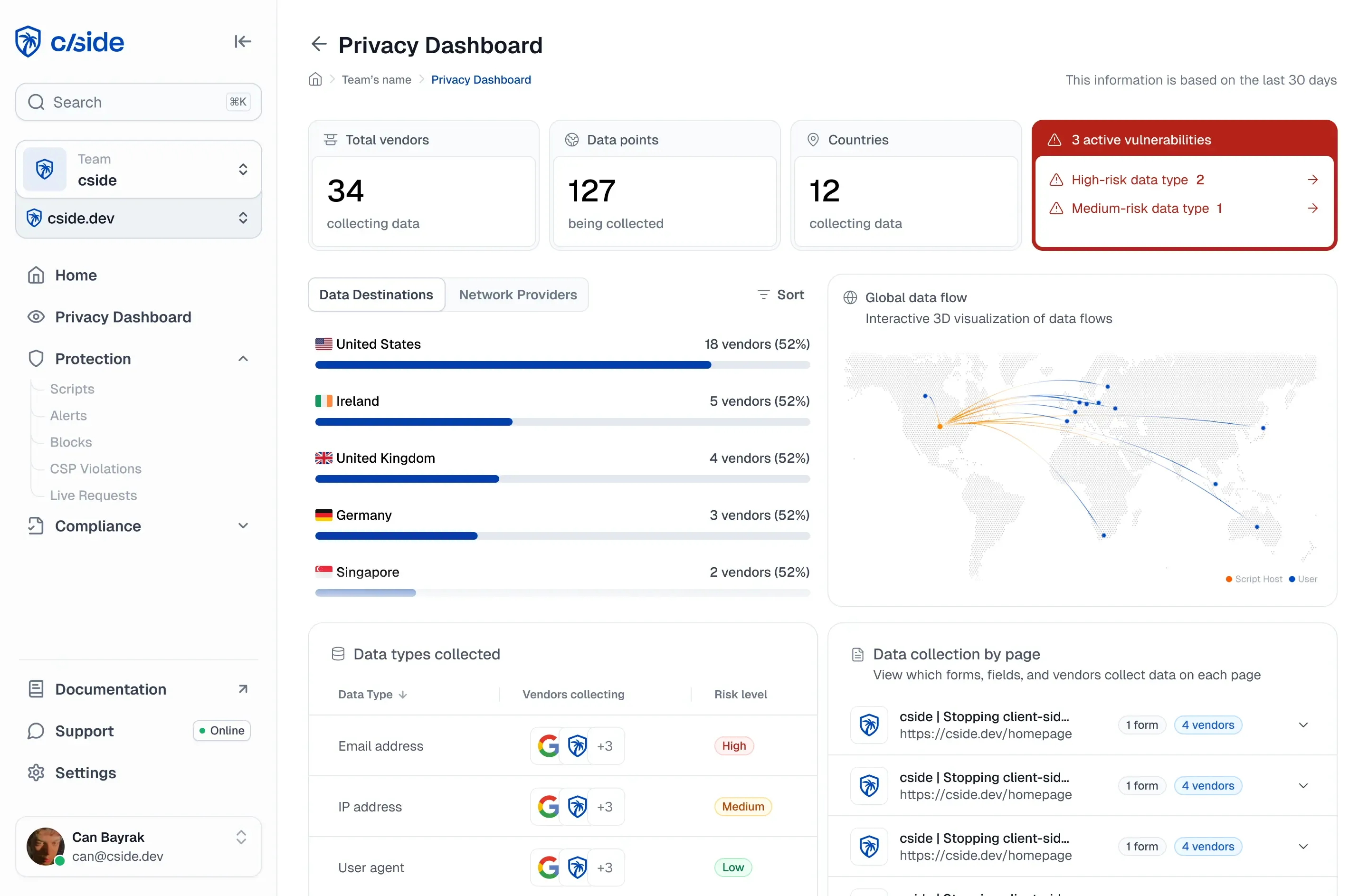

TL;DR: best payment fraud detection software 2026
- Two layers: Payment fraud detection splits between pre-authorization detection (stop the bad checkout before it reaches your PSP) and post-authorization scoring (catch it after the payload arrives). A working stack in 2026 covers both, because VAMP counts declined enumeration attempts toward your dispute ratio.
- The gap: The checkout evidence gap is where most vendors fall down: they score the transaction data but never see the browser environment that generated it. That evidence gap is what loses friendly-fraud disputes even when the transaction was legitimately fraudulent.
- Where cside fits: cside captures browser and device evidence at checkout and ships it into Visa CE 3.0 compelling-evidence format automatically. Pair with a scoring platform (Sift, Kount) or a guarantee vendor (Signifyd, Riskified) for the decisioning layer.
Short on time? See cside's chargeback-evidence tooling. It covers everything below in one deployment.
Payment fraud detection tools split into three buckets: signal layers that catch browser-level fraud pre-authorization (cside), scoring platforms that decide approve-or-block post-authorization (Sift, Kount, Forter), and guarantee models that underwrite the loss (Signifyd, Riskified). Most merchants in 2026 need one from at least two of the three, because no single vendor covers the full window from checkout attempt to chargeback response.
Full disclosure before the ranking: cside is our platform, and it sits at #1. We ranked the other nine as honestly as we would in a pilot call. Signifyd, Sift, and Kount are what most large teams pick as their primary decisioning platform. cside is the browser-layer evidence source that makes both approval decisions and chargeback disputes measurably more accurate.
The 10 best payment fraud detection software platforms in 2026
1. cside: best for checkout evidence and Visa CE 3.0 compelling evidence
Every other vendor on this list evaluates the transaction after your PSP has already received it. cside evaluates the browser session that produced the transaction, before it reaches your PSP. That difference is where the "evidence gap" lives: the reason merchants lose friendly-fraud disputes even on legitimately fraudulent transactions.
At checkout, cside captures device fingerprint (250+ browser signals, stable across incognito + cookie-clear + VPN), AI-agent presence (Playwright, Puppeteer, Selenium, OpenAI Operator, Claude for Chrome), real IP behind a VPN via TLS handshake fingerprinting, cross-account device correlation, and any unauthorized script activity on the payment page. All of that is available as a JSON verdict before the transaction fires, so your scoring platform, rules engine, or PSP consumes it alongside transaction data. The same evidence is auto-formatted into Visa CE 3.0 compelling-evidence for dispute responses.
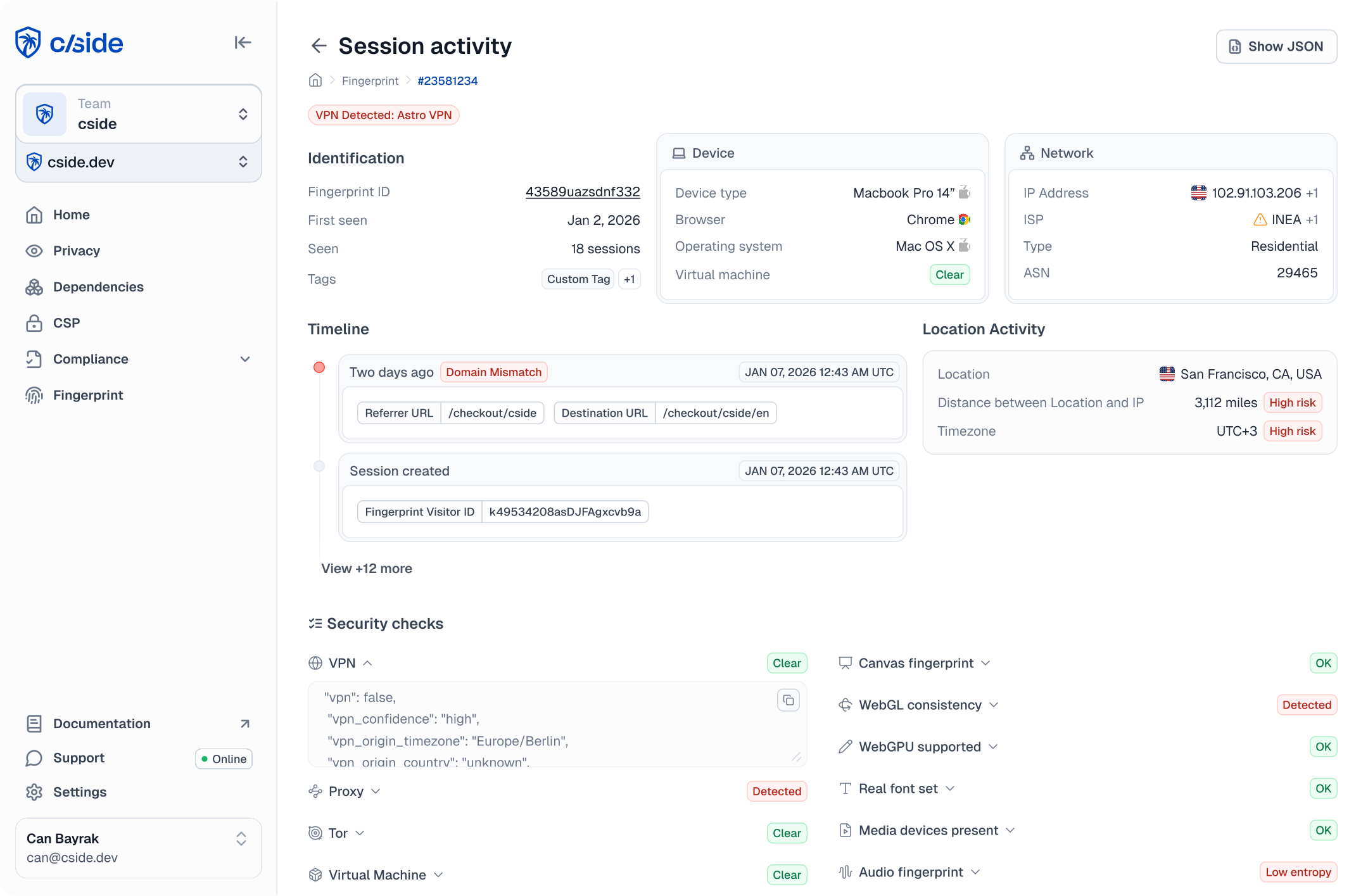
Best for: Any merchant already running a scoring platform (#2-#10) who wants checkout evidence to feed both approval decisions and chargeback dispute responses. Also merchants needing PCI DSS 4.0.1 script-monitoring evidence for their QSA. Watch out for: cside is not a decisioning platform on its own. Pair with a scoring vendor for approve/block calls. See cside chargeback evidence. Pricing: Free tier of 1,000 API calls/month, paid plans from $99/month.
2. Signifyd: chargeback guarantee for DTC merchants
Signifyd's pitch is "approve, we eat the chargeback." Single throat to choke, priced as a percentage of protected orders.
Best for: Mid-market DTC merchants ($50M+ GMV) who want risk transferred, not detected. Watch out for: Guarantee only covers what Signifyd approves. Approval rate is not published: get it in the pilot.
3. Sift: the ML platform default for high-volume teams
Sift is the machine-learning platform most large teams start with. Ingests your transaction history, applies risk models, returns scores. Works well with millions of monthly events to train on.
Best for: Marketplaces, platforms, and brands with 500K+ monthly transactions. Watch out for: Explainability. If the answer is "the model decided," you cannot operate it.
4. Kount (Equifax): legacy bundled default
Kount ships bundled with many PSPs, so a lot of merchants already run it. Solid post-authorization scoring, aging browser-layer coverage.
Best for: Merchants who want "good enough" via their existing PSP. Watch out for: Not the pick against modern AI-agent or bot fraud on its own.
5. Riskified: Signifyd's cross-border twin
Same guarantee model, historically stronger internationally.
Best for: Enterprise merchants doing significant cross-border volume. Watch out for: 24-month contracts.
6. Stripe Radar: the PSP-native option for Stripe merchants
If you are on Stripe, Radar is the fraud tool that ships out of the box. Rules engine, ML scoring, custom rule builder. It works, and it is essentially free for Stripe merchants at low volume (paid tier for advanced features).
Best for: Stripe-native merchants at any GMV. Watch out for: Radar only sees what Stripe sees: pre-authorization browser signals and cross-PSP account correlation are outside its window.
7. Adyen RevenueProtect: the PSP-native option for Adyen merchants
Adyen's equivalent to Radar. Built into the Adyen platform, priced as part of the processing relationship.
Best for: Adyen-native merchants. Watch out for: Same PSP-boundary limits as Radar.
8. Forter: approvals-first enterprise payment fraud
Forter's edge is approval optimization: approve more of your good customers, not block more fraud. Pays off when false declines are the biggest cost line.
Best for: Enterprise retail ($100M+ GMV) where false declines eat more revenue than fraud. Watch out for: Enterprise-only sales and pricing.
9. Sardine: behavioral biometrics for high-risk payment fraud
Sardine grew up in crypto and fintech. Behavioral biometrics on top of device fingerprinting. Strong for high-risk categories.
Best for: Fintech, crypto exchanges, high-risk merchants. Watch out for: Overkill for straightforward ecommerce.
10. ClearSale: payment fraud with manual review layer
ClearSale bundles ML scoring with a human manual-review team for the borderline cases. Approval guarantee available.
Best for: Merchants selling into LATAM or high-fraud verticals who want manual review as part of the service. Watch out for: Manual review adds latency and cost. Get the SLA in writing before signing.
Side-by-side comparison of the 10 vendors
| Vendor | Category | Best fit | Checkout evidence | Visa CE 3.0 support |
|---|---|---|---|---|
| cside | Signal layer | Feeds any vendor below | Yes | Auto-formatted |
| Signifyd | Guarantee | Mid-market DTC | Limited | Partial |
| Sift | ML platform | Marketplaces / platforms | Partial | Partial |
| Kount | Rules + ML | PSP-bundled | Partial | Yes |
| Riskified | Guarantee | Enterprise cross-border | Limited | Partial |
| Stripe Radar | PSP-native | Stripe merchants | Limited | Partial |
| Adyen RevenueProtect | PSP-native | Adyen merchants | Limited | Partial |
| Forter | Approvals-first | Enterprise retail | Partial | Partial |
| Sardine | Behavioral + fintech | Fintech / crypto | Yes | Partial |
| ClearSale | ML + manual review | LATAM / high-risk | Partial | Partial |
How to close the payment fraud evidence gap in 2026
Three moves in order of ROI:
- Capture browser evidence at checkout, before your PSP fires. This is the layer every scoring platform and guarantee vendor is blind to. cside sits here.
- Layer it into your existing scoring or guarantee platform. Do not rip and replace: feed the browser signals into Sift, Kount, Signifyd, or your PSP's native tool as extra features.
- Auto-format the evidence for Visa CE 3.0. When a chargeback fires, the same signals that scored the transaction become the dispute response. Do not let the evidence rot in a log file, get it into the case file automatically.
If your dispute ratio is climbing toward the VAMP 0.9% threshold, order matters. Pre-authorization detection (step 1) is what actually moves the ratio down. Better dispute automation (step 3) only wins back money you already lost.
Best AI payment fraud detection tools
Payment fraud detection is now AI-first: Sift, Kount, Feedzai, Signifyd, and Stripe Radar all score transactions with machine learning. What they share is a blind spot at the browser. cside is the pre-transaction signal layer that fills it, capturing AI-agent detection, device fingerprinting, and behavioral signals on the checkout page before the transaction submits, and exporting device evidence for Visa CE 3.0 disputes. Pair a scoring platform with cside for the most complete AI payment-fraud stack.