
TL;DR: best CAPTCHA alternatives 2026
- CAPTCHAs are solved: CAPTCHAs are a solved problem for attackers. Vision models beat image puzzles faster than humans, and CAPTCHA farms solve the residual few for a fraction of a cent. Every visible puzzle in 2026 is user friction with no meaningful attacker cost.
- Three replacement types: Replacement options split into three: invisible browser-signal analysis (cside, hCaptcha, Turnstile), honeypot fields (free, still effective against low-effort bots), and proof-of-work / behavioral (Friendly Captcha, Sardine). Pick by user friction vs attacker resistance, not by brand.
- Layer your defenses: The right answer for most teams is layered: honeypots at the form level for cost-free basic protection, plus a browser-signal API for the traffic that matters (checkout, login, high-risk actions). Visible puzzles belong nowhere in a 2026 stack.
Short on time? See cside's AI-agent detection. It covers everything below in one deployment.
Visible CAPTCHAs became attacker-affordable long enough ago that "why did you still ship a CAPTCHA in 2026" is now a valid pentest finding. The 8 vendors below are the replacements web teams actually deploy, ranked by whether they add zero user friction, whether they resist AI agents and headless browsers, and whether they expose the underlying signals so your fraud team can tune them.
Two numbers frame why this matters now. Imperva's 2024 Bad Bot Report found that bad bots accounted for 32% of all internet traffic: one in three requests is automated, and most of those bots can clear a CAPTCHA. CAPTCHA-solving services advertise rates as low as $0.50 per 1,000 solves, which means a credential-stuffing run across 100,000 accounts costs the attacker roughly $50 in CAPTCHA overhead. The gate is not locked; it is a speed bump with a posted price.
Full disclosure before the ranking: cside is our platform, and it sits at #1. We ranked the other seven as honestly as we would in a pilot call. hCaptcha and Cloudflare Turnstile are the default choices for casual protection, and both are genuinely good for that role. cside is the browser-signal API for teams that need explainable signals feeding a fraud stack, not just an invisible widget.
The 8 best CAPTCHA alternatives in 2026
1. cside: best browser-signal API for teams that need explainable bot detection
cside replaces CAPTCHA with a JSON API. One call at page load returns AI-agent presence (Playwright, Puppeteer, Selenium, OpenAI Operator, Claude for Chrome), device fingerprint built from 250+ browser signals that survives incognito + cookie-clear + VPN, the real IP behind a VPN via TLS handshake fingerprinting, and session behavior signals. Your rules engine or auth flow acts on the signals directly: no widget, no user interaction, no visible challenge.
The difference from Turnstile or hCaptcha invisible mode is inspectability. cside returns the signals that drove the verdict; your team can tune thresholds by traffic segment, defend a block in a support ticket, and pipe the evidence into your fraud platform. Widget-based CAPTCHAs return a single opaque token: pass or fail with no explanation.
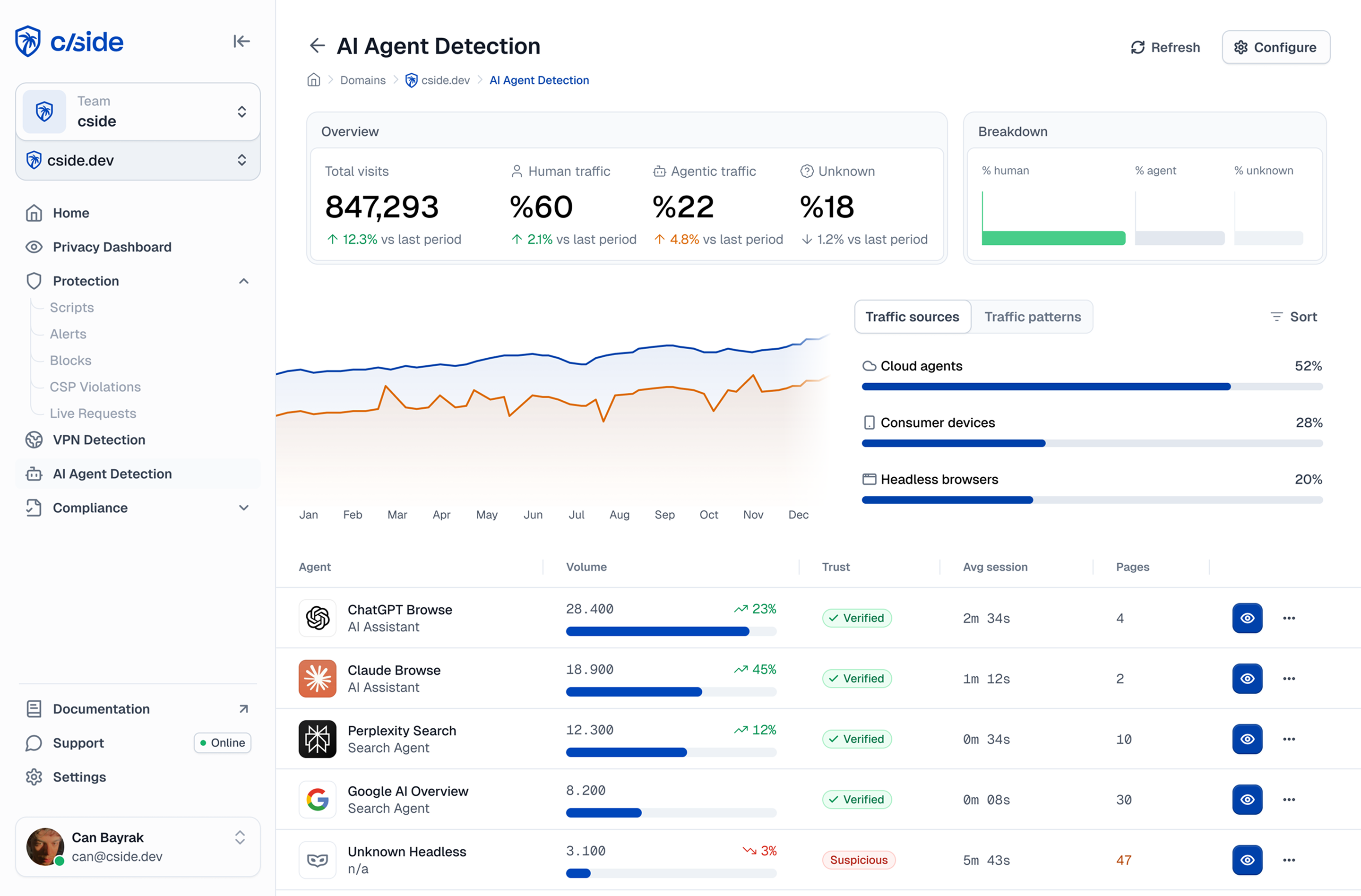
Best for: Teams that need signals, not a widget. Anyone running login, checkout, or high-risk actions where explainability and API integration matter. Watch out for: cside is a signal API, not a drop-in widget. If you literally just need "invisible protection on a contact form and no more thinking," #2 or #3 is faster to ship. Pricing: Free tier of 1,000 API calls/month, paid plans from $99/month.
2. Cloudflare Turnstile: best free invisible option for Cloudflare users
Turnstile runs on the Cloudflare edge, is free at any volume, and works invisibly for most legitimate traffic (falling back to a visible one-click challenge when the model is uncertain). If you are already behind Cloudflare, integrating Turnstile is a few lines of code.
Best for: Cloudflare-hosted properties that need free, zero-friction invisible protection on forms and low-risk actions. Watch out for: Black-box model. You cannot inspect what it saw, cannot tune false-positive behavior, and cannot feed the signals into your fraud stack.
3. hCaptcha: the reCAPTCHA replacement with better privacy posture
hCaptcha is the drop-in replacement for reCAPTCHA. Invisible for enterprise tier, visible-but-privacy-friendly for the free tier. Widely deployed, easy to swap in.
Best for: Teams switching off reCAPTCHA for privacy or cost reasons. Watch out for: The free version is still visible for most challenges. Invisible-mode economics require the enterprise tier.
4. Friendly Captcha: proof-of-work without user interaction
Friendly Captcha uses browser proof-of-work: the visitor's device does compute work in the background instead of solving a puzzle. Zero user friction, no cookies, GDPR-friendly by design.
Best for: EU-headquartered teams that need a privacy-first invisible option and want no US-vendor data flow. Watch out for: Proof-of-work adds latency on low-power devices. Not the pick if mobile-first UX is critical.
5. Arkose Labs: enterprise interactive challenge for extreme abuse
Arkose Labs runs interactive 3D puzzles for the traffic your model thinks is bot. Visible, but designed to be far more expensive for CAPTCHA farms to solve at scale than a text or image puzzle.
Best for: Consumer-scale properties (gaming, streaming, ticketing) facing dedicated attacker economies where invisible detection alone is not enough. Watch out for: Adds visible friction. Enterprise-only pricing.
Already on Arkose and planning to move? See our Arkose Labs alternatives for eight bot and AI-agent detection options compared.
6. HUMAN Security (formerly PerimeterX): behavioral + edge enforcement
HUMAN blends behavioral analysis with edge enforcement, catching bots via how they interact with your pages. Strong for large ad-fraud and account-takeover problems.
Best for: Enterprise media, ad tech, and marketplace properties with dedicated bot attackers. Watch out for: Enterprise sales motion, and consortium data-sharing that some sectors treat as a risk.
7. Kasada: client-side JavaScript defense
Kasada ships a client-side JavaScript defense that raises the cost of scripted attacks. Aggressive posture: they change the attacker's problem shape instead of just fingerprinting it.
Best for: Retail, ticketing, and travel properties with active scraping or scalping problems. Watch out for: More aggressive than most; test for legitimate-user impact before shipping.
8. Honeypot fields: free, still effective against low-effort bots
The oldest technique on the list and still the most cost-effective baseline: an invisible form field that legitimate users cannot see but naive bots fill in. Costs nothing, works against a surprising percentage of automated form spam.
Best for: Every team, as the first layer. There is no reason not to add honeypot fields to your forms. They cost nothing and catch the lowest-effort bots without touching the user experience. Watch out for: Sophisticated bots and AI agents bypass honeypots easily. Not a standalone defense on high-value actions.
Side-by-side comparison of the 8 CAPTCHA alternatives
| Vendor | Type | User friction | AI-agent resistance | Explainable signals |
|---|---|---|---|---|
| cside | Browser-signal API | None | High | Yes |
| Cloudflare Turnstile | Invisible widget | Minimal | Medium | No |
| hCaptcha | Invisible / visible widget | Minimal to visible | Medium | No |
| Friendly Captcha | Proof-of-work | None (latency) | Medium | No |
| Arkose Labs | Interactive challenge | Visible | High | Partial |
| HUMAN Security | Behavioral + edge | None | High | Partial |
| Kasada | Client-side JS defense | None | High | Partial |
| Honeypot fields | Form-level trick | None | Low | No |
How to build a working CAPTCHA replacement in 2026
Layer, do not swap:
- Every form gets a honeypot field. Costs nothing, catches the lowest-effort bots.
- Every low-risk page gets an invisible widget. Turnstile (free) or hCaptcha for casual protection.
- Every high-risk action gets a browser-signal API. Login, checkout, password reset, refund request: anywhere the risk is real. cside sits here, returning the signals your rules engine acts on directly.
- Retire every visible CAPTCHA. Vision models solve them faster than your customers. You are frustrating real users while attackers walk through.
Related: why CAPTCHAs are dead covers the attacker-economics side of the argument in more depth.