
TL;DR: UKGC LCCP third-party script exposure
- The LCCP still applies: The UKGC never says JavaScript, so operators pretend the LCCP does not either. Social Responsibility Code 3.4.1 and Ordinary Code 5.1 do not care what layer the harm happened at. If a script on your domain hurt the player, you own it.
- The fines are real: The typical operator loads 40 to 80 third-party scripts per session, and cside detected over 300,000 attack signals across monitored sites in Q1 2025. The ICO fined British Airways 20 million pounds for the same class of browser-layer failure and UK GDPR Article 33 gives you 72 hours to notify.
- Start with one scan: Run one scan of a live player-facing page this week. Every script your compliance team cannot immediately name is a licence question waiting to happen. That is your starting inventory.
Short on time? See cside's in-browser Magecart and skimmer blocking. It covers everything below in one deployment.
Working with UKGC-licensed operators, the gap we encounter most consistently is not in their responsible gambling policies or their AML controls. It is in the browser layer. Compliance teams spend months preparing for UKGC reviews and ICO inquiries, but almost none of them have a documented answer to the question: what third-party JavaScript is executing on your player-facing pages right now? When we run an initial scan for a new operator, the typical finding is 40 to 80 scripts per session, with a material proportion that the compliance team cannot immediately account for.
The UK Gambling Commission holds licensed operators to a high standard of technical integrity and player protection. What many compliance teams have not yet accounted for is the browser layer: the JavaScript that runs on a player's device after your pages load. cside detected over 300,000 attack signals across monitored sites in Q1 2025 alone. This figure is derived from instrumented real-user sessions across the monitored estate, counting each distinct anomalous behaviour (redirect attempt, data exfiltration, form field access outside declared scope, or shadow pixel fire) as a separate signal. A significant proportion of those signals originated from third-party scripts that operators had either forgotten about or assumed were benign. If a script on your domain is redirecting players, exfiltrating form data, or committing affiliate fraud, the LCCP makes you responsible for it.
What the LCCP actually requires at the browser layer
Quick answer: The UKGC's Licence Conditions and Codes of Practice require operators to maintain a technically secure environment for player interactions. While the LCCP does not name JavaScript supply-chain attacks by name, Social Responsibility Code 3.4.1, Ordinary Code 5.1, and anti-fraud obligations collectively require operators to know what is executing on their platforms and to prevent harm to players from any source.
The LCCP does not read like a cybersecurity specification. That is part of the problem. Compliance teams focus on responsible gambling measures, age verification, and advertising standards, while the technical environment conditions sit in the background, assumed to be covered by IT.
The relevant conditions include:
- Social Responsibility Code 3.4.1: operators must take all reasonable steps to protect customers from harm
- Ordinary Code 5.1: operators must maintain the integrity of their systems and the safety of customer data
- Anti-money laundering and anti-fraud conditions: operators must have controls in place to prevent fraudulent activity on their platforms
- Technical standards for remote gambling systems: platforms must function as players expect them to
Third-party scripts can violate every one of these conditions without a single line of your own code being compromised. A rogue affiliate script injecting a competing operator's overlay, a compromised analytics tag harvesting payment data, or a redirect attack sending players to a different site during deposit are all technical integrity failures under the LCCP. The Commission does not accept "we didn't know it was there" as a defence.
How third-party scripts create LCCP compliance exposure
Quick answer: The average gambling operator loads 40 to 80 third-party scripts per session covering analytics, affiliate tracking, live chat, CDNs, and payment widgets. Each is a potential entry point. When any of these scripts misbehaves, operators face exposure under player protection, technical integrity, and anti-fraud conditions simultaneously, regardless of whether the script was intentionally malicious.
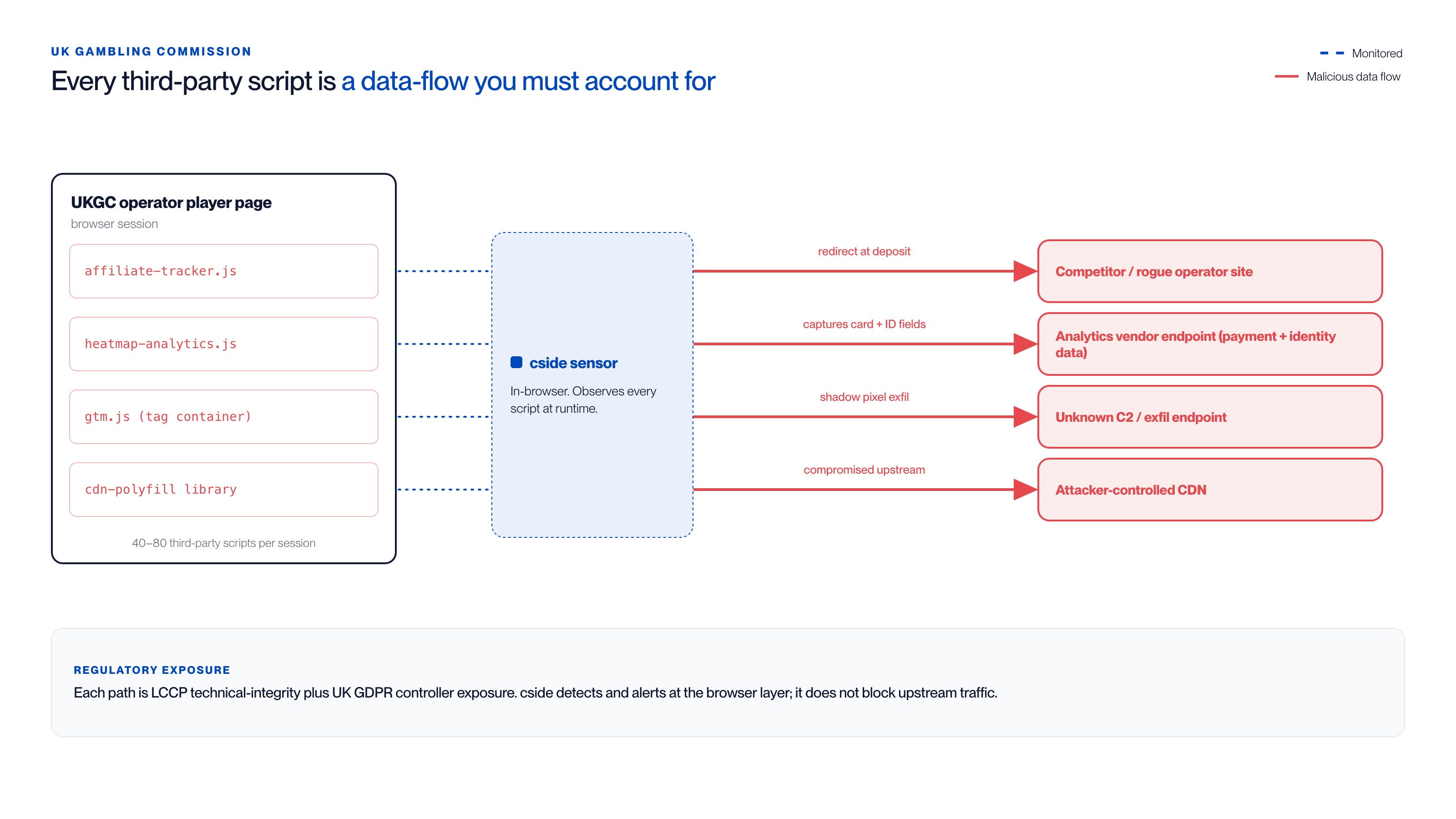
| Script on the page | What it does | Where the data/player goes | LCCP / UK GDPR exposure |
|---|---|---|---|
| Affiliate redirect tag | Redirects players at registration or deposit | Competitor or rogue operator site | Player protection (SR 3.4.1); technical integrity (Ordinary 5.1) |
| Analytics / heatmap tool | Captures form-field input (card, identity docs) | Third-party analytics endpoint | UK GDPR Art 5 & 28; PCI scope |
| Shadow pixel via compromised GTM | Exfiltrates player session data | Unknown C2 / exfil destination | UK GDPR Art 33 (72-hour breach clock) |
| Compromised library (polyfill[.]io-style) | Weaponised upstream, fires for some sessions | Attacker-controlled CDN | Technical integrity; anti-fraud conditions |
Across a typical 40-80 scripts per session, any one of these paths creates exposure because the harm happens on your licensed platform. A browser-layer sensor like cside observes each script at runtime, detects these behaviours, and alerts, it does not block upstream traffic.
The risk is not theoretical. Operators regularly discover scripts on their platforms they cannot account for, either because they were added years ago by a team member who has since left, because a tag management container was misconfigured, or because a legitimate vendor was compromised upstream.
Common third-party script risks on gambling platforms include:
- Affiliate redirect scripts that quietly send players to competitor platforms at the moment of high intent (registration, deposit)
- Analytics or heatmap tools that capture form field input, including payment card data or identity documents
- Shadow pixels injected through compromised GTM containers that exfiltrate player session data to unknown destinations
- Polyfill.js-style supply chain compromises where a widely-used library is taken over and weaponised (the June 2024 Sansec disclosure showed 100,000+ sites affected simultaneously)
Under the LCCP, each of these scenarios creates regulatory exposure because the harm occurs on your licensed platform, within a player interaction you are responsible for. The UKGC does not distinguish between harm caused by your code and harm caused by a third-party script running on your domain.
UK GDPR overlap: operators are responsible for all data processing on their domain
Quick answer: UK GDPR Article 28 makes operators responsible for any third-party processing of player data occurring on their domain. If a script exfiltrates player data to an external server, the operator is the data controller responsible for that transfer, even if they did not install the script. The ICO's £20M penalty against British Airways shows the scale of enforcement risk for inadequate technical data security controls.
The ICO's action against British Airways in 2020 remains the clearest UK precedent for browser-layer data security failures. The ICO issued a £20M penalty after attackers compromised the British Airways website and used injected scripts to harvest customer payment data. The ICO's finding was unambiguous: the organisation was responsible for the data processing occurring on its website, regardless of the attack vector.
For UK-licensed gambling operators, the parallel is direct. Player data processed on your domain falls under UK GDPR, and that includes data processed by third-party scripts without your knowledge.
Key obligations include:
- Article 5: data must be processed lawfully, fairly, and with integrity; operators cannot claim compliance if unknown scripts are processing player data
- Article 28: third parties processing data on your behalf require documented processor agreements; a script running on your site with no contract in place is a structural violation
- Article 33: if a script breach results in personal data exposure, operators have 72 hours to notify the ICO; this clock starts from awareness, and most operators do not even know a breach has occurred until days later
The IBM 2024 Cost of a Data Breach report puts the global average breach cost at $4.88M. For regulated gambling operators, add ICO enforcement, UKGC licence review, and reputational damage with payment processors, and the exposure is substantially higher.
What a compliance-ready script monitoring posture looks like
Quick answer: A compliance-ready posture for UKGC-licensed operators requires a complete, maintained inventory of every script executing on player-facing pages, automated alerting when new or changed scripts appear, evidence of what each script sends and to whom, and audit-ready reporting that can be produced on request during a UKGC review or ICO investigation.
Most operators currently rely on one or more of the following, none of which is sufficient on its own:
- Network-layer monitoring (CDN or WAF logs): catches network requests but cannot see what a script executes after it loads or what data it captures in memory
- Content Security Policy headers: a useful baseline control but requires maintenance and cannot detect exfiltration through allowed endpoints
- Periodic manual audits: a point-in-time snapshot that misses changes introduced between audit cycles
- Consent management platforms (CMPs): manage consent for known tools but do not detect scripts that are injected outside the consent flow
A compliance-ready posture requires runtime visibility: monitoring that instruments actual user sessions in the browser and observes what scripts execute, what data they access, and where they send it. This is the layer that catches affiliate redirect attacks, shadow pixels, and supply chain compromises in real time rather than weeks later.
The operational requirements for UKGC compliance readiness include:
- Full script inventory: every first, third, and fourth-party script on every player-facing page, including dynamically loaded and conditionally loaded scripts
- Change detection: alerting when a script's behaviour changes, even if its URL has not
- Anomalous behaviour detection: scripts accessing payment fields, identity fields, or cookie stores without a documented reason
- Evidence trail: timestamped logs of every script execution event that can be provided to the UKGC or ICO during a review and used as the basis for forensic investigation and PCI audit reports
How cside produces audit-ready evidence for UKGC-licensed operators
Quick answer: cside instruments 100% of real user sessions in the browser, not a sampled subset and not a proxy simulation. It detects every script executing on your player-facing pages, maps data flows to external destinations, and generates the change detection and anomaly alerts that compliance teams need to evidence technical controls during a UKGC licence review or ICO inquiry.
Unlike network-layer tools such as Cloudflare Page Shield, which monitors requests but cannot see what a script executes after it loads, cside operates inside the browser where the actual risk lives. Unlike proxy-based approaches, cside uses real user sessions with no sampling, meaning it catches intermittent attacks and scripts that only activate for certain player segments.
For UKGC-licensed operators, cside provides:
- A continuously updated inventory of every first, third, and fourth-party script on player-facing pages
- Automated alerts when new scripts appear or existing scripts change their behaviour
- Detection of data exfiltration attempts, redirect injections, and affiliate fraud
- Timestamped evidence logs for every script execution event, suitable for PCI audit reports, forensic investigation, and continuous compliance evidence under LCCP technical standards
- Integration with existing incident response and compliance workflows
In one deployment at a mid-size UK-licensed sportsbook (operator details anonymised), cside discovered 14 third-party scripts with active network connections that the compliance team had not listed on their script inventory. Three of those scripts were sending data to destinations the operator could not immediately identify. Within 48 hours of deployment, the operator was able to produce a full inventory, close the undeclared data flows, and initiate DPA documentation with two previously undocumented vendors. That inventory became part of their ICO compliance evidence file.
Compliance teams using cside can respond to a UKGC technical review with a documented record of what has been running on their platform, when it changed, and what action was taken, rather than scrambling to reconstruct the picture after the fact.
| Tool type | What it monitors | What it misses |
|---|---|---|
| WAF / CDN (e.g. Cloudflare Page Shield) | Inbound and outbound network requests | Script execution behaviour after load; data accessed in memory |
| Content Security Policy | Script origin domains | What approved scripts do with data; exfiltration through permitted endpoints |
| Consent management platform | Declared tools within consent flow | Scripts added outside CMP; supply chain compromises; conditional activation |
| Periodic manual audit | Scripts present at audit time | Changes between audit cycles; dynamically loaded scripts |
| cside runtime monitoring | 100% of real session script execution | Designed to close all of the above gaps |
What to do next
If your organisation holds a UKGC licence and you do not currently have a documented script inventory and runtime monitoring capability, the immediate steps are: commission a script inventory of your player-facing pages, assess what each script sends and to whom, identify gaps against your processor agreements, and establish a change detection mechanism so future additions are captured in real time. cside's client-side security solution and supply chain monitoring capability are built specifically for this workflow. If you are preparing for a UKGC licence review or an ICO inquiry and need to evidence technical controls, a runtime monitoring deployment provides the audit trail that static tools cannot.