
TL;DR: ecommerce account sharing
- Household vs sharing: A household with a phone, a laptop, and a tablet on the same home network is not sharing. Two devices with zero shared network context is. Device count thresholds fail this test constantly.
- The household test: The household test is 14 days of device fingerprint history plus geographic and network-context correlation. Subscription memberships leak free delivery. Loyalty tiers leak status benefits. Business account sharing leaks bulk pricing.
- The response: Household devices: no action. Out-of-household subscription sharers: evidence-based upgrade prompt mid-membership. Loyalty sharers: flag during member-exclusive sales. Business account sharing: credential restriction.
Short on time? See cside's frictionless account sharing detection. It covers everything below in one deployment.
Ecommerce account sharing is not a single problem. It takes at least three distinct commercial forms, each with its own detection challenge and its own revenue consequence. A subscription member sharing their free-delivery benefits with a friend outside their household is a different problem from a loyalty programme member sharing member-exclusive pricing with someone who has never earned that status, and both are different again from a business account being shared with buyers who do not qualify for wholesale pricing.
The Merchant Risk Council's 2026 Global eCommerce Payments and Fraud Report found that 64% of merchants report a meaningful increase in first-party misuse. Account sharing is one of the most commercially significant forms of that misuse in ecommerce, because it directly erodes the economics of subscription models, loyalty programmes, and trade pricing structures that retailers have spent years building.
What makes ecommerce account sharing harder to detect than, say, streaming sharing is that ecommerce accounts have always had legitimately complex household use cases. A couple sharing a single account, one of whom does the household shopping, is a perfectly valid account model. A family where both parents order from the same account is expected and desirable. The detection task is identifying the line between legitimate household multi-user access and out-of-household credential sharing, which is a materially different problem from detecting two simultaneous streaming sessions.
This post examines how ecommerce teams can detect each sharing pattern accurately, why the household test is more nuanced for retail than for streaming, and how detected sharers can be converted into paying subscribers rather than simply cut off.
The ecommerce account sharing problem
Quick answer: Ecommerce account sharing manifests in three patterns. Subscription membership sharing involves one paying subscriber's benefits being accessed by people outside their household without additional payment. Loyalty programme sharing involves a member's credentials being used by non-members to access exclusive pricing or early sale access. Business account sharing involves trade or wholesale pricing being accessed by buyers who do not qualify for those terms. Each pattern has a distinct commercial consequence and a distinct detection signature.
Subscription membership sharing is the ecommerce equivalent of the streaming account sharing problem, with an important difference: the value being shared is often tangible and transactional rather than content-based. Free delivery, discounted expedited shipping, early access to products, and platform cashback are all benefits tied to a paid subscription. Each order placed by a non-paying sharer on the subscriber's account consumes those benefits without contributing to the subscription fee that funds them. Over the account's lifetime, this creates a real per-order subsidy cost to the platform.
For platforms where free delivery is subsidised by subscription fees, every non-paying user who places an order under a shared account increases the delivery cost per subscription pound. The subscription model is built on the assumption that the subscription fee covers the margin cost of fulfilling free-delivery orders for that subscriber's household. Out-of-household sharers break that assumption.
Loyalty programme sharing has a different but equally significant consequence. Loyalty programmes create a tiered pricing structure where members who have engaged with the platform, made a qualifying number of purchases, or paid for membership access better prices than non-members. When a member shares their credentials so a non-member can access member prices during a sale, the exclusivity that makes the loyalty tier commercially attractive is directly undermined. If member prices are accessible without membership, the membership's value proposition collapses.
Early sale access is particularly sensitive to this sharing pattern. Exclusive sale windows create demand for loyalty membership because they offer genuine commercial advantage. When credentials are shared for early access, the advantage is accessed by people who have not earned or paid for the status, and the capacity of early access windows is consumed by non-members, reducing the benefit for genuine members.
Business account sharing is the B2B ecommerce variant. Trade accounts, wholesale accounts, and contractor pricing accounts often carry significant per-unit price advantages over public pricing. When a business account holder shares credentials with individuals or organisations that do not qualify for those terms, the result is revenue lost at the margin level rather than the subscription level. For platforms with significant margin compression between public and trade pricing, the per-order impact of non-qualifying business account access can be substantial.
Javelin Strategy and Research's 2026 Identity Fraud Study found that new account fraud increased 31% to 5.4 million victims in 2025. While the majority of that figure relates to fraudulent account creation, the underlying trend of account misuse at scale is consistent with the trajectory of first-party misuse that MRC's data shows across ecommerce merchants.
Related: fraudulent account creation is the upstream version of this problem, where the fake account is created at signup rather than shared after the fact. cside Signup Shield turns each registration into a real-time trust verdict to stop fake new accounts, trial and promo abuse, and multi-accounting before they enter your subscriber base.
What makes ecommerce sharing hard to detect
Quick answer: Ecommerce accounts are structurally multi-user in a way that most other account types are not. A household account where one person does the grocery order, another manages subscription settings, and children browse from their own devices is a single legitimate account generating device diversity that is indistinguishable from out-of-household sharing if the detection logic only counts devices or IP addresses. The detection challenge is distinguishing household device diversity from geographically independent device access.
The ecommerce legitimate-use problem is distinct from the streaming version. In streaming, the default assumption is one primary viewer who may watch on multiple devices. In ecommerce, the default assumption for many platforms is a household account where multiple people may browse, add items to a shared wishlist, or place orders. Detection logic designed for a single-user account model creates false positives at high rates on legitimate ecommerce household accounts.
Consider a typical household shopping account: a partner who does the main weekly grocery order from their smartphone, another who orders from a laptop during the working day, and a teenager who browses and makes occasional purchases from a tablet. This account generates three device fingerprints, three different IP histories (if any of them uses mobile data), and three different browsing time patterns, all from a single legitimate household. Unsophisticated device-count detection would flag this household as a sharing account.
IP address detection has similar limitations. Mobile data networks, VPNs used by one household member, and the growing use of privacy relay services mean that different devices on a legitimate household account may appear to originate from different network contexts. IP matching cannot reliably distinguish a legitimate household with varied connectivity from an out-of-household sharing arrangement.
Behavioural heuristics based on purchase frequency or basket composition are also insufficient on their own. Two legitimate household members may have completely different shopping patterns, category preferences, and visit cadences, producing behavioural diversity that mimics what you would expect from two unrelated people sharing credentials.
The detection method that works for ecommerce is the same one that works for streaming: geographic independence of device fingerprint histories over a multi-week observation window. The key question is not whether there are multiple devices on the account, but whether those devices have ever shared a geographic context, and whether their geographic histories over time are correlated or independent.
How device fingerprint history identifies ecommerce account sharing
Quick answer: cside builds a device fingerprint history over a rolling observation window, tracking where each device appears geographically, what network contexts it has shared with other devices on the account, and how its activity pattern relates to other active devices. For ecommerce accounts, the household signal is the presence or absence of shared network context among the account's active devices. Devices that share a home network signature at any point are likely to be household devices. Devices with fully independent geographic histories and no shared network context are likely to be out-of-household.
Because cside distils a baseline of 250+ browser, device, and network signals into a persistent device identifier that survives cookie clearing, incognito sessions, and VPN swaps, an out-of-household sharer's device keeps resolving to the same fingerprint no matter how they try to reset it, which is what makes the geographic-independence test dependable. In cside's analysis of subscription ecommerce accounts, the most prevalent sharing pattern involves two to three users with geographically independent device histories. These accounts show different home network signatures, different browsing time zones, and consistent usage patterns that reflect two separate people's household routines rather than one person using multiple devices. The shared account's device diversity increases over the account's lifetime as additional friends or family members are added to the sharing arrangement.
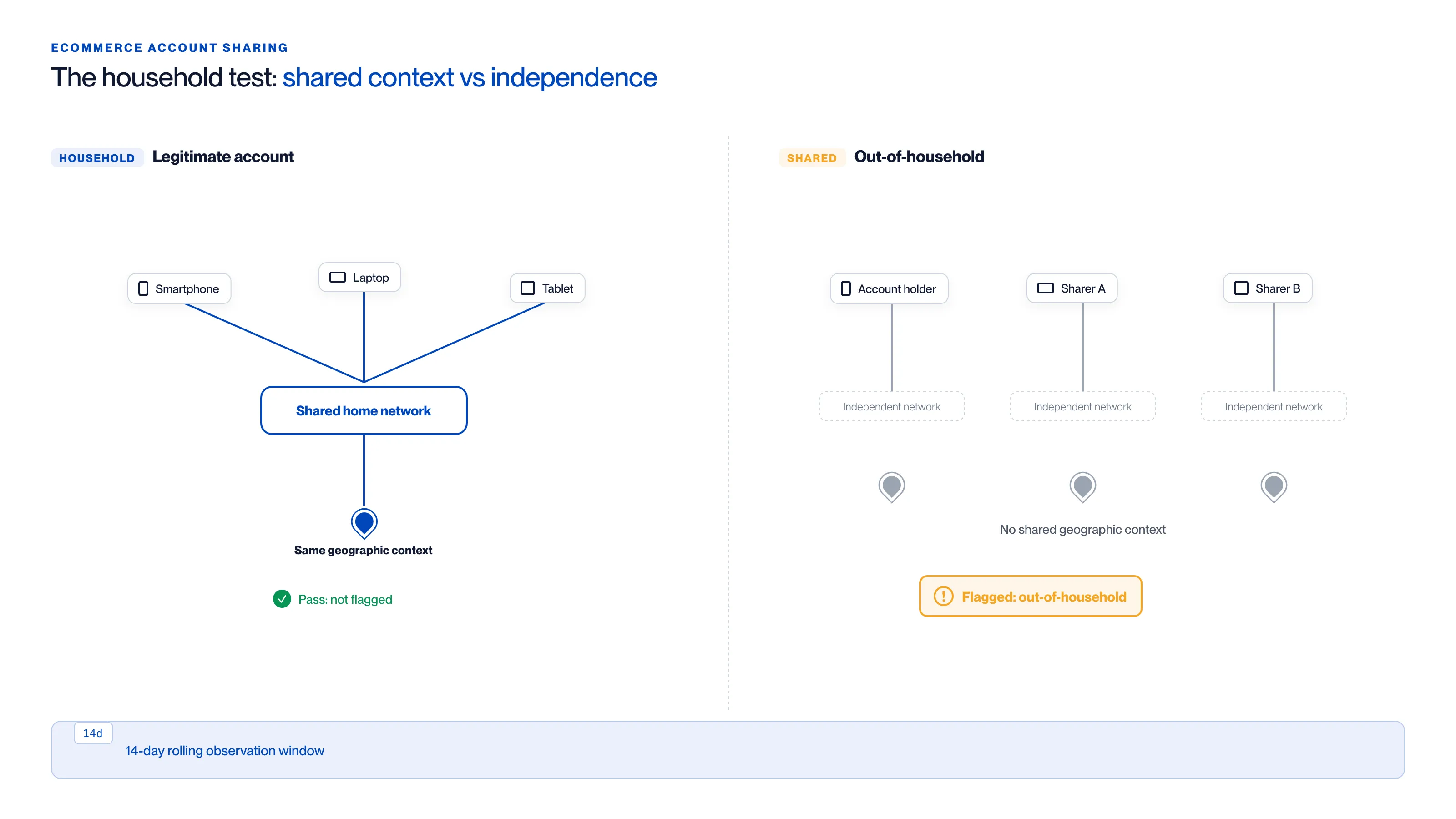
How the household test reads two accounts over a 14-day window:
| Signal | Legitimate household | Out-of-household sharing |
|---|---|---|
| Shared home-network context | Yes, devices meet on one home network | No, each device on an independent network |
| Geographic overlap of device histories | Devices converge to one geographic context | No overlap across the full window |
| Browsing time zones | Single household time zone | Independent time zones |
| Detection outcome | Not flagged | Flagged as out-of-household sharing |
This observation has an important practical consequence for detection timing. In the first week or two of a sharing arrangement, a new device on an account is ambiguous. The account could legitimately have added a new household device, or it could be a sharer in a different location. Over a 14-day observation window, the geographic independence of the device's history becomes clear: a new household device will share geographic context with the account's existing devices within that window, while a non-household sharer's device will consistently appear from a different location with no geographic overlap.
For ecommerce teams with device fingerprinting integrated at the browser layer, this analysis runs passively without any change to the shopping experience. Every session contributes to the device history that makes the household test more accurate over time.
The business account sharing pattern has an additional detection signal. Trade and wholesale accounts tend to have coherent business geography: orders placed from the business's registered address, invoices going to a consistent address, and device histories anchored in a consistent location associated with the business. When a business account is shared with individuals who access it from unrelated residential locations, that geographic incoherence is visible in the device history. A business account with devices appearing from three different residential areas in three different cities, none of which corresponds to the business's registered location, is a strong sharing signal.
For loyalty programme sharing, the most useful signal is the timing correlation between the sharer's device activity and high-value loyalty events. During member-exclusive sale windows, a shared loyalty account will show device activity from geographically independent devices within the same session period, because both the member and the non-member sharer are attempting to access the same early access benefit. This coincidence of geographically independent device access during loyalty events is a reliable signal when it is observed across multiple events.
The account sharing use case page covers cside's broader detection methodology for readers who want to understand the full technical approach.
The conversion opportunity: turning shared access into paid subscriptions
Quick answer: A person who has been using a friend's subscription account for several months and relies on free delivery or member pricing is a qualified buyer who has already demonstrated that they value the service. The conversion rate from an evidence-based upgrade prompt directed at detected sharers is higher than from a cold subscriber acquisition, because the sharer already understands the product's value and has built usage habits around it. The commercial opportunity from sharing detection is not just revenue protection; it is subscriber acquisition at a lower cost per acquisition than outbound marketing.
The conversion framing is essential for ecommerce teams who are concerned about friction and cancellation risk from sharing enforcement. The wrong frame is: "we are catching people who are cheating us and cutting off their access." The right frame is: "we have identified people who already rely on our service and have not yet been offered the right upgrade path."
A subscription membership sharer who has been receiving free delivery on orders for six months has proven their propensity to buy and their reliance on the delivery benefit. They did not start sharing because they are opposed to paying; they started sharing because someone offered them convenient access before the platform did. The upgrade prompt converts them by offering what the sharing arrangement has already shown them they want: their own access, on their own terms.
The prompt design that converts best is specific. A generic "your account is being accessed from outside your household" message is less effective than one that references the actual pattern: "It looks like your orders are placed from a different address than the account holder's primary location. You can get the same free delivery benefit on your own subscription for [price]." The specificity signals that the detection is real, removes ambiguity about whether the user might be able to continue sharing undetected, and frames the upgrade as a continuation of access rather than a punishment.
For loyalty programme sharers, the conversion message has a different angle. The non-member who has been using a member's credentials to access member pricing has experienced the value of the loyalty tier directly. The prompt can reference the specific benefit they accessed: "You accessed member pricing during our last sale. Membership is [price] and includes [list of benefits]. Your next order as a member would earn [points/cashback]." This converts sharers into members while communicating the programme's value concisely.
Business account sharers represent a different conversion case. Non-qualifying buyers who have been accessing trade pricing are unlikely candidates for wholesale account conversion if they genuinely do not qualify. The appropriate action is credential restriction rather than upgrade prompt, combined with outreach about whether a standard account with any applicable professional pricing would suit them.
For ecommerce teams who want to read more about conversion mechanics, the post on how to convert account sharers into paying customers covers prompt design, timing, and sequencing in detail.
What this means for ecommerce revenue and product teams
Quick answer: Ecommerce teams evaluating account sharing detection need a solution that passes the household test with high accuracy and without creating friction in the checkout flow. cside's device fingerprint history analysis runs passively at the browser layer, contributes to a rolling observation window that improves detection accuracy over time, and feeds into subscriber management and enforcement systems without any change to the purchase experience. cside is SOC 2 certified and the full security posture is documented at trust.cside.com.
The household accuracy requirement is non-negotiable for ecommerce. A subscription platform that generates false positives on legitimate household multi-device accounts will see cancellations and complaints from its most engaged household subscribers, which are often the accounts with the highest order frequency and lifetime value. The detection method must be accurate at the household level before any enforcement action is taken.
This accuracy requirement rules out simple approaches: device counts, IP matching, concurrent session detection, and order frequency thresholds all produce unacceptable false positive rates on legitimate ecommerce household accounts. The only approach that reliably distinguishes household device diversity from out-of-household sharing is geographic independence of device fingerprint histories over a meaningful observation window.
For product teams, the integration question is straightforward. cside's device fingerprint analysis connects at the browser layer and does not require changes to the checkout flow, payment processing, or order management systems. The analysis output is available via API to feed into subscriber management, loyalty programme administration, or business account review workflows as appropriate for the platform's architecture.
For revenue and fraud teams, the priority question is usually where to start. The highest-return detection programme for most ecommerce platforms with subscription or loyalty components targets out-of-household subscription membership sharing first, because the combination of delivery cost subsidy and missed subscription revenue makes it the most directly quantifiable impact. Loyalty programme sharing is the second priority, particularly for platforms with upcoming major sale events where early access is a genuine member benefit. Business account sharing is typically addressed as part of a broader trade account audit programme.
The governance case for implementing detection is strengthened by the compliance context. Credential sharing is a terms of service violation on virtually every ecommerce platform with a subscription or loyalty component. Detection and enforcement is commercially justified and contractually supported. The question is not whether enforcement is appropriate; it is whether the detection is accurate enough to enforce fairly, which is the standard cside's device fingerprint history is designed to meet.
cside is SOC 2 certified. The full security posture, audit reports, and compliance documentation are available at trust.cside.com for procurement and security review teams.