
TL;DR: seat licensing
- The invisible leak: Three to seven colleagues on one seat all show up as one user to IP-based detection because they share the office network. The revenue leak is invisible to concurrent session limits.
- The hardware signal: Device fingerprinting reads GPU, audio context, and canvas rendering, so distinct hardware on the same IP is visible. A 14-day observation window converts that into a confidence score for each seat.
- Expansion, not enforcement: High-confidence sharing does not go to security. It goes to the account executive as an expansion signal, then a soft in-product prompt. Named-user enforcement is the last step, not the first.
Short on time? See cside's frictionless account sharing detection. It covers everything below in one deployment.
Seat-based licensing is the revenue model that makes B2B SaaS unit economics work. Each user who derives value from the product should hold a paid seat. When a single credential is shared across three, five, or seven colleagues in the same department, the platform loses the seat revenue from every user who is not paying, and, critically, never gets the usage data that would let the revenue team see how much value the product is delivering to that account.
The B2B sharing problem is structurally different from consumer sharing. Consumers share credentials to save money on a personal subscription. B2B users share credentials because seat procurement is a friction point: getting three additional seats approved by finance takes longer than sharing a login. The sharing is not motivated by cost avoidance; it is motivated by the gap between how fast teams want to use a tool and how fast their procurement process moves. The sharer is not a bad actor. They are a qualified user of the product who should be paying for access.
The Merchant Risk Council's 2026 Global eCommerce Payments and Fraud Report found that 64% of merchants report a meaningful increase in first-party misuse. In B2B SaaS, this manifests primarily as seat licensing abuse: teams with budget for one seat deploying the product across the full team under a single credential. The revenue gap is recoverable (these are motivated users who want the product) but only if the sharing is detectable.
The B2B seat sharing pattern
Quick answer: The most common B2B SaaS sharing pattern is a single paid seat distributed across a department, typically 3-7 users, all of whom access the product from the same organisation's office network. The original seat holder is usually the person who championed the product purchase or manages the team. Their colleagues access the product under the same credential because getting additional seats approved is slower than sharing a login. Every person in this arrangement is a genuine potential customer who is actively using the product.
In cside's monitoring of B2B SaaS platforms with seat-based licensing, the most common enforcement gap is the department-level credential share: one paid seat distributed across 3-7 users within the same organisation, often from the same IP range but with distinct device fingerprints. This pattern has several characteristics that distinguish it from consumer sharing:
Organisational context. All users work for the same company. They know each other, share work objectives, and have legitimate access to the content or workflows the product provides. The sharing is transparent within the team; only the platform is unaware of it.
Business hours usage. Access is concentrated in business hours and follows the organisational calendar. Usage drops significantly on weekends and during public holidays. The temporal pattern matches a team of users working standard hours, not a single user working intensively.
High session depth per device. Each sharing user has a genuine reason to use the product. Unlike consumer sharing, where a non-paying user may access an account occasionally, B2B sharing users tend to be active. They are using the product for work, which means their session depth is comparable to a legitimate paying user's. The product is delivering value to every person sharing the credential.
Same or adjacent IP ranges. All users access the product from the same organisation's office network or from a small number of corporate IP ranges. This is the characteristic that makes IP-based detection ineffective: the access signals are indistinguishable from a single user who works at the same company.
Why IP-based controls fail in B2B environments
Quick answer: IP-based detection flags unusual access based on geographic or network changes. In B2B sharing, there are no unusual access signals at the network level. All users access the product from the same corporate IP range. The network context is identical for every user sharing the credential, because they are all connecting from the same office, the same VPN, or the same corporate infrastructure. IP-based controls produce no signal where the sharing is concentrated within a single organisation.
The failure mode for IP-based B2B sharing detection is structural. IP-based controls are designed to catch account takeover patterns: a login from an IP in a country where the account has never been used, or a rapid shift between distant geographic locations. These signals indicate that the account's credential has been stolen and is being used remotely.
B2B seat sharing generates none of these signals. All users in the sharing arrangement are at the same company. They access the product from the same IP range the paid seat holder uses. A platform that detects "unusual IP" patterns will see nothing unusual, because the IP is consistent and expected.
The Verizon 2026 Data Breach Investigations Report found that credential-based attacks are present in 39% of all breaches across the full attack chain. The IP signals designed to detect those attacks are tuned for external attackers accessing accounts from unfamiliar networks. An internal team sharing a credential from a familiar corporate network bypasses these controls entirely.
Concurrent session limits also fail for B2B sharing at the department level. A team of five users sharing a single credential who access the product at staggered times during the business day generates very few concurrent sessions. If person A checks the product at 9am, person B at 10am, person C at 11am, and person D after lunch, the concurrent session count never exceeds one. The sharing arrangement is undetectable by session concurrency monitoring.
How device fingerprint history catches office sharing
Quick answer: Device fingerprint history catches B2B sharing because each individual user has a distinct device. Even when all devices share the same office IP, they have different GPUs, different audio hardware, different font sets, different operating system configurations, and different browser profiles. A department sharing one credential generates a growing set of distinct device fingerprints on that account. Over a 14-day observation window, this fingerprint diversity is the signature of credential sharing, not of a single user with multiple devices.
cside's device fingerprint analysis builds a picture of which devices are associated with an account over a 14-day observation window. The signals that generate a device fingerprint are hardware and software attributes that are inherent to each individual device:
- GPU renderer: each user's computer has a specific graphics card or integrated GPU that produces a characteristic rendering output. A laptop running an Intel integrated GPU produces a different fingerprint than a workstation with a discrete GPU, even when both are on the same office network.
- Audio context: the device's audio processing hardware produces a characteristic response to a synthetic audio processing test. This signal varies between hardware configurations and is not affected by shared network context.
- Canvas rendering: the combination of GPU, operating system version, and font rendering produces a characteristic canvas output. Two colleagues sitting next to each other with different laptop models produce different canvas fingerprints.
- Font set and rendering: the specific fonts installed on a device, and how the operating system renders them, vary between devices. A Windows device with a standard corporate image produces a different font fingerprint than a macOS device, even within the same organisation.
Device fingerprint history over a 14-day observation window produces accurate sharing detection even when all access originates from the same office IP range, because each user's device has a distinct browser and hardware configuration. Even when a colleague clears cookies, works in incognito, or routes through a VPN, the identifier cside derives from a baseline of 250+ browser, device, and network signals stays attached to the same physical machine, so each additional seat-sharer still resolves to a distinct device rather than blurring into the paid seat holder. A single user accessing the product from three devices generates three fingerprints with a consistent geographic context and usage pattern that shows one person moving between devices. Five colleagues sharing one credential generate five fingerprints with overlapping business-hours usage from the same network, but no consistent single-user geographic trajectory.
The 14-day window is the accumulation period that makes the distinction reliable. In the first day or two, a new device on an account is ambiguous. By day 14, an account with five distinct device fingerprints all active during business hours from the same corporate IP range is classified with high confidence as a shared account.
Enforcement that protects the customer relationship
Quick answer: B2B seat enforcement requires a fundamentally different approach than consumer enforcement. In consumer enforcement, the sharer is typically a personal user with limited commercial relationship to the platform. In B2B enforcement, the sharing account may be the platform's entry point into a large organisation that could become a major customer. The detection goal is not to penalise the sharing. It is to surface the opportunity for a seat expansion conversation that the account executive can lead.
The revenue opportunity in B2B sharing is seat expansion, not punitive enforcement. An account that has five users sharing one credential is a prospective five-seat account that is already using the product and finding value in it. The correct response is to convert the sharing arrangement to a legitimate multi-seat purchase, not to restrict access in a way that damages a potentially high-value customer relationship.
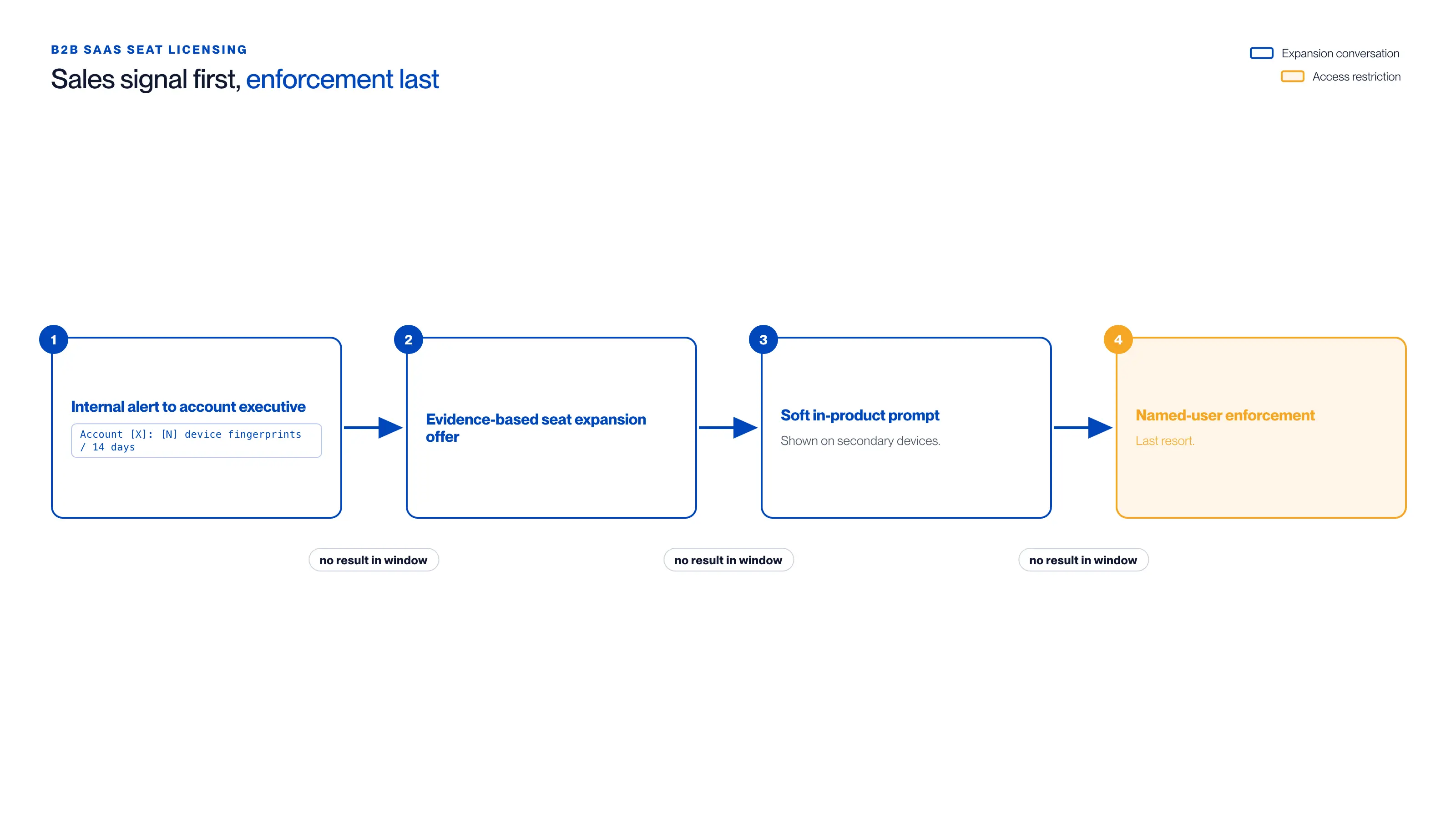
| Stage | Action | Trigger to advance |
|---|---|---|
| 1 | Internal alert to the account executive: "Account [X]: [N] device fingerprints / 14 days, consistent with [N] users sharing one seat." | Sales signal first (expansion, not compliance) |
| 2 | Evidence-based seat expansion offer from the account executive | No result in window |
| 3 | Soft in-product prompt to secondary-device users (path to legitimate access, no immediate block) | No result in window |
| 4 | Named-user enforcement: access restricted to registered devices, secondary users redirected to trial/purchase | Last resort, reached only if earlier stages fail |
The recommended enforcement sequence for B2B platforms:
Stage 1: Internal alert to the account executive. When device fingerprint analysis identifies a sharing pattern on an account, the first action is an internal notification to the account executive responsible for that customer. The signal is: "Account [X] is showing [N] distinct device fingerprints over the past 14 days, consistent with [N] users sharing one seat." The account executive uses this data to open an expansion conversation, not a compliance conversation.
Stage 2: Evidence-based seat expansion offer. The account executive reaches out with a specific, factual expansion offer: "We can see that your team of [N] is actively using the platform. We'd like to move you to an [N]-seat plan that gives each team member their own access." The specificity of the evidence makes this a helpful observation rather than an accusation. The customer cannot dispute the device count; the conversation is about making the existing usage legitimate.
Stage 3: Soft in-product prompt. If the account executive conversation does not produce a seat expansion within a defined window, an in-product prompt can appear for secondary device users: "You're accessing this account from a device that hasn't been linked to your profile. Ask your team lead to add you as a named user, or start your own trial." This prompt does not block access immediately; it creates a path to legitimate access.
Stage 4: Named user enforcement. After the prompt window, access is restricted to the primary credential holder's registered devices, and secondary users are redirected to a trial or purchase flow. This stage is reached only when the earlier expansion conversation has not produced a result, and it is applied knowing that the secondary users are active, qualified users who have been offered a legitimate path.
This sequence treats detected B2B sharing as a sales signal, not a fraud signal. The enforcement goal is to convert the sharing arrangement into paid seats, not to reduce usage.
Related: when those secondary users are redirected to start their own trial, the upstream surface is fake account creation at signup. cside Signup Shield turns each registration into a real-time trust verdict that stops fake new accounts, trial abuse, and multi-accounting before a seat is ever created.
What this means for revenue and product teams
Quick answer: B2B seat sharing is the most commercially recoverable form of account sharing because every sharing user is a qualified buyer who is already using and valuing the product. The revenue recovery calculation is straightforward: the number of detected sharing accounts multiplied by the average number of users per sharing account multiplied by the seat price. cside's device fingerprint analysis provides the sharing account count and the per-account device count within a 14-day observation window, giving revenue teams the data to scope the seat expansion pipeline.
For revenue teams, the business case for B2B seat sharing detection is not primarily a security or abuse prevention case. It is a product-qualified lead case. A user who has been sharing a colleague's credential for two weeks has demonstrated product fit. They know how to use the product. They have incorporated it into their workflow. They are a better expansion prospect than a cold inbound lead. The detection data that identifies them is also the data that qualifies them for an account executive conversation.
The revenue calculation:
- Detected sharing accounts: the number of accounts with two or more distinct device fingerprints consistent with credential sharing over the 14-day window.
- Average sharing size: typically 3-5 users per sharing arrangement in the department sharing pattern, based on cside's monitoring across B2B SaaS platforms.
- Seat expansion rate: the proportion of sharing accounts that convert to expanded seat purchases following the account executive conversation. The base rate for motivated product users receiving a specific, evidence-based expansion conversation is substantially higher than cold upsell conversion rates.
- Seat price: the per-seat monthly or annual cost.
For a platform with 2,000 active accounts, a 15% sharing rate (300 sharing accounts), an average of 4 users per sharing arrangement (1,200 potential new seats), and a 30% seat expansion conversion rate (360 new seats), the annual seat revenue recovery at £80 per seat per month is approximately £3.5 million per year. These are illustrative figures; actual rates depend on the platform's pricing, product category, and customer profile. The detection data makes the calculation precise.
For product teams, the device fingerprint data also provides insight into how teams are actually using the product. An account with five active device fingerprints but one paid seat is a team of five who want more than one person's access to the product. That usage signal informs product development decisions about collaboration features, team plans, and pricing tier design.
cside is SOC 2 certified. The device fingerprint analysis that identifies B2B sharing accounts operates at the browser layer and collects no personally identifiable information. The full security posture is documented at trust.cside.com.