
TL;DR: airline loyalty account sharing
- The wrong signal: A platinum flyer accessing from 12 cities in two months is not suspicious. That is the job description. Geographic diversity alone is the wrong signal.
- The real signal: The real signal is device-to-flight-record mismatch. A redemption from a device that never appears in the account's history, or two devices in impossible-travel positions (Manchester and Singapore within one hour) is the definitive tell.
- Graduated response: Household pooling within terms: no enforcement. Out-of-household sharing: step up, then communicate, then enforce. Commercial account trading: immediate restriction plus investigation.
Short on time? See cside's frictionless account sharing detection. It covers everything below in one deployment.
Airline loyalty programmes sit at an unusual intersection of high-value digital access and high-volume account activity. A gold or platinum tier frequent flyer account carries lounge access, complimentary upgrades, priority boarding, and a points balance worth hundreds or thousands of pounds in redeemable travel. That value makes frequent flyer accounts a persistent target for credential sharing, credential theft, and organised miles fraud, and the detection challenge is harder than it first appears.
The difficulty is one that every loyalty fraud team encounters: a legitimate platinum tier member genuinely does access their account from London, New York, Singapore, and Dubai in the same month. Geographic diversity is the normal usage pattern for the members with the highest account value. A detection model built on location signals alone will either generate constant false positives on your best members or set thresholds so permissive that genuine sharing goes undetected.
The Merchant Risk Council's 2026 Global eCommerce Payments and Fraud Report found that 64% of merchants now report a meaningful increase in first-party misuse. For airline loyalty programmes, that misuse manifests across at least three distinct sharing patterns, each with different revenue impact, different enforcement risk, and different detection requirements. Getting the detection right requires separating what the account holder's device history shows from what their travel record shows, and identifying the cases where those two histories diverge in ways that no single traveller could produce.
Why airline loyalty accounts attract credential sharing
Quick answer: Airline loyalty accounts attract credential sharing because the benefits they carry, including lounge access, upgrades, and redeemable miles balances, have high real-world value that is not intrinsically tied to the account holder's identity at the point of use. A shared credential that unlocks lounge access is worth tangibly more than a shared streaming subscription, and the sharing is harder to detect because the account's normal usage pattern already spans many cities and devices.
The value proposition of a high-tier frequent flyer account is substantial and partially transferable. Lounge access is verified by account credentials, not always by passport match. Upgrade eligibility is tied to the booking reference associated with the loyalty number. A miles balance worth several thousand pounds in flight redemptions can be spent by whoever holds the login, provided the redemption address details can be modified. This creates three distinct sharing patterns that loyalty programme teams encounter:
Family and household sharing. Spouses and household members pool miles under one account to reach redemption thresholds faster. This is often within programme terms, particularly for programmes that offer formal household pooling. Detection must not flag this pattern as abuse, and enforcement against it would damage member relationships without legitimate justification.
Out-of-household credential sharing. The account holder shares credentials with friends, colleagues, or acquaintances so they can access lounge benefits, earn miles on purchases, or benefit from status tier privileges without paying for the tier themselves. The sharer accrues programme benefits, such as lounge visits and upgrade prioritisation, that the programme designed exclusively for paying tier members. This directly reduces the value of the status tier for members who have genuinely earned it, and costs the programme for benefits delivered to non-qualifying users.
Commercial miles trading and account sale. High-balance accounts are sold or credentials shared with third parties who redeem the miles balance for high-value flights or travel products. This operates at scale in some markets and is the highest-risk sharing pattern in terms of financial exposure. A single compromised account with a 200,000-mile balance holds a redeemable value of £2,000 or more in business class flights. The Javelin Strategy and Research 2026 Identity Fraud Study found that new account fraud jumped 31% to 5.4 million victims in 2025, and the organised credential market that enables this includes loyalty account credentials alongside payment credentials. The upstream side of the same problem is fake account creation, where attackers register new accounts at signup to harvest enrolment bonuses or seed credentials for later trading; cside Signup Shield addresses that registration surface.
The Verizon 2026 Data Breach Investigations Report found credential-based attacks present in 39% of all breaches. Airline loyalty accounts appear in that credential market because their value is high and the redemption pathway is relatively straightforward compared to payment fraud.
What legitimate multi-device travel access looks like versus sharing
Quick answer: Legitimate frequent flyer access is geographically diverse but device-consistent. A member travelling from London to New York to Singapore will access their account from their own laptop, their own phone, and occasionally an airport lounge terminal, but the underlying device fingerprints are their devices moving through those locations alongside them. Credential sharing produces device fingerprints that are geographically separated from the account holder's verified travel record, because the sharing user's device is in a city where the account holder has no corresponding flight activity.
The detection challenge for airline loyalty programmes is that the signals that ordinarily indicate suspicious access are precisely the signals that characterise normal high-value membership behaviour. A platinum tier member accessing their account from four continents in a month is not suspicious. It is the expected behaviour of the member archetype the programme most wants to protect and retain.
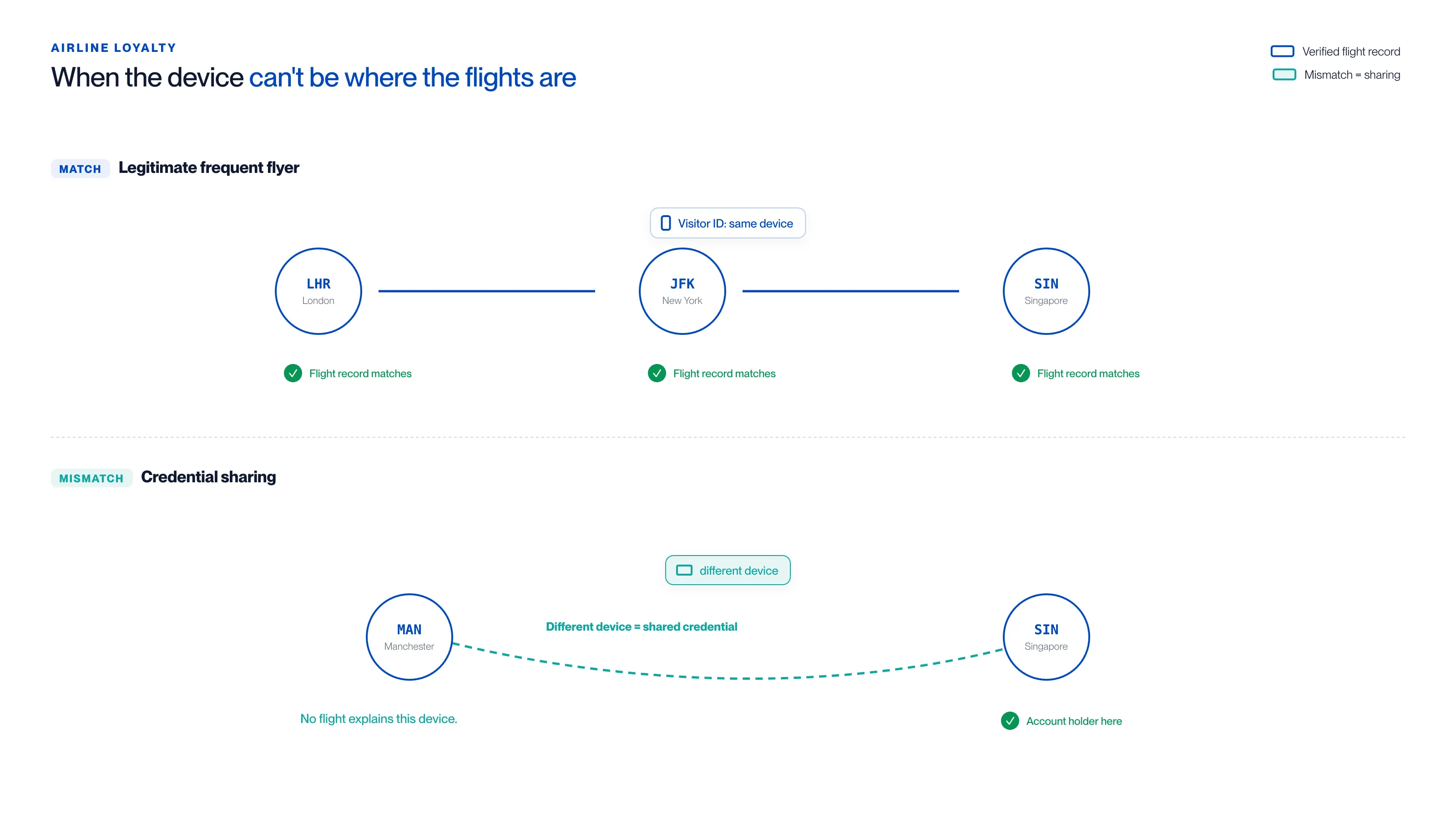
How the two patterns differ:
- Legitimate access (MATCH), the account holder's device fingerprints travel with them: the same personal laptop and phone (same Visitor ID) appear in London (LHR), New York (JFK), and Singapore (SIN), and each location is explained by a matching flight record.
- Credential sharing (MISMATCH), a different device appears in a city the flight record does not explain (the account holder is in Singapore (SIN); a device surfaces in Manchester (MAN) with no flight connecting them), so that device belongs to someone else.
- Definitive signal, two distinct device fingerprints active on one account from locations no single person can occupy at once (for example Manchester and Singapore within a one-hour window) cannot be explained by VPN or proxy routing.
The distinction between legitimate access and sharing comes down to the relationship between device history and travel history, not geographic diversity.
A legitimate member's device fingerprints travel with them. Their personal laptop appears in London when the account shows a Heathrow departure. The same laptop appears in New York when the account shows a JFK arrival. Their phone is on the same trajectory. The geographic diversity of device access is explained by and consistent with the account's verified flight activity. When a new device appears in a city, the account shows a flight to or from that city.
Credential sharing produces a different pattern. The account holder's travel record shows them in Singapore. A device fingerprint appears in Manchester. There is no flight activity in the account that places the account holder in Manchester. The Manchester device is not travelling with the account holder because no travel connects the account holder to Manchester. That device belongs to someone else.
The second pattern to identify is redemption from non-travel devices. High-value redemptions, including business class flight bookings, upgrade requests, and lounge pass allocations, made from devices that have never appeared in the account's verified travel history are a strong indicator of third-party access. A legitimate member redeems miles from the devices they use to manage their travel, which are the same devices that appear in their travel-correlated access history. A third party redeeming a miles balance uses their own device, which has no history in the account.
The third pattern is simultaneous access from geographically separated devices. Two devices active on the same account from locations that no single person can physically occupy at the same time, for instance Manchester and Singapore within a one-hour window, is consistent only with credential sharing. Unlike the corporate VPN scenarios that complicate IP-based detection, two distinct device fingerprints from geographically incompatible locations cannot be explained by routing or proxy behaviour.
How device fingerprint history identifies loyalty account sharing
Quick answer: Device fingerprint history works for loyalty account sharing because it builds a model of which physical devices the account holder actually uses and how those devices move through the world alongside the account holder's verified travel record. A device that appears in the account's fingerprint history without a corresponding travel record explaining its geographic location is almost certainly not the account holder's device, and is almost certainly a shared credential.
In cside's analysis of loyalty programme accounts, the most reliable indicator of credential sharing is a mismatch between the device fingerprint history and the account's verified travel record. A device consistently appearing from a city where the account holder has no corresponding flight activity is almost always a shared credential, because a legitimate traveller accesses their account from wherever they physically are. Their device is with them. If a device appears in a city where the account holder is not, that device is not their device.
The technical architecture for this detection uses device fingerprinting to build a persistent device profile for each login event. The fingerprint captures characteristics of the device and browser environment that persist across sessions and are resistant to cookie clearing or incognito mode. Because that profile is assembled from a baseline of 250+ browser, device, and network signals, the resulting identifier holds steady even when a shared user clears cookies, opens a private window, or switches VPN exit nodes, which is what lets the model tie repeat access back to a single physical device and surface the sharing. Each profile is associated with the account and the login's geographic context.
The detection model cross-references three data sources:
Device fingerprint history. The list of device profiles that have authenticated against this account, each with a geographic context and a timestamp history. A legitimate member's device list is small (personal laptop, personal phone, occasionally a second phone or work device) and the geographic history of each device is consistent with the account holder's travel pattern.
Account travel record. The verified flight activity associated with the loyalty number, including departure and arrival cities, dates, and times. This is first-party data that the airline already holds and can use as the ground truth for where the account holder was physically located on any given date.
Login event stream. Each login or account access event, with device fingerprint, timestamp, and geographic context. The detection model flags events where the device fingerprint does not appear in the account's established device list and the geographic context of the login is not explained by the account's travel record.
The advantage of this approach for airline loyalty programmes over standard account sharing detection is that the travel record provides an unusually strong ground truth that most digital product categories do not have. A SaaS platform can build a device history over time but has no external reference point for where the account holder physically was on a given date. An airline loyalty programme already holds verified proof of where the account holder travelled. That data transforms the device history from a statistical model into a definitive comparison: does this device's location match where the flight record places the account holder? If not, the access requires explanation.
For high-value redemptions specifically, the detection can be applied at the point of redemption rather than purely at login. A business class flight redemption from a device that has never appeared in the account's device history is a high-confidence sharing or compromise signal that warrants step-up authentication before the redemption is confirmed.
Cside's account sharing detection generates a persistent visitor ID for each device profile that remains stable even when cookies are cleared or browsers are updated. That stability is what makes the device history comparison reliable over the multi-month observation windows that loyalty programme abuse detection requires.
For context on the revenue impact of credential sharing across digital products more broadly, the account sharing revenue loss benchmarks post covers the available data.
Enforcement options for loyalty programme teams
Quick answer: Enforcement against loyalty account sharing requires calibrating the response to the sharing pattern. Household sharing that is within programme terms should not be enforced against. Out-of-household credential sharing warrants a progressive response, starting with authentication friction and progressing to programme terms communication. Commercial account sale and organised miles fraud warrants immediate account restriction and potential legal action under programme terms, with law enforcement referral for the largest cases.
The enforcement decision for loyalty programmes is more nuanced than for most digital product categories because the member relationship has significant long-term commercial value. A platinum tier member who has taken 80 long-haul flights in two years has already delivered lifetime revenue and advocacy disproportionate to any single abuse event. Enforcement approaches must protect programme integrity without damaging the highest-value member relationships.
Household sharing within programme terms. If the programme offers a formal household pooling feature, members using a single credential to pool miles across spouses or dependent family members are often not in violation of programme terms. The detection model should distinguish this pattern, typically characterised by devices in the same geographic household that travel together on the same booking references, from out-of-household sharing where the secondary device user has no relationship to the account holder's travel record. Do not enforce against in-terms household behaviour. If your programme does not offer a formal pooling feature, consider whether this is an upgrade or add-on opportunity rather than an enforcement case.
Out-of-household credential sharing. For accounts showing device fingerprints from geographically separate locations that are not explained by the account's travel record, the appropriate first response is step-up authentication at the next login or at the next high-value action. This can be a one-time code sent to the verified contact on the account, a biometric verification prompt, or a security question sequence. The step-up authentication serves two purposes: it verifies whether the account holder controls all active sessions, and it creates an audit record of the response that supports further enforcement if the behaviour continues.
A progressive communication approach works well for the second tier of response. A notification to the account holder's verified contact explaining that the account has been accessed from an unfamiliar device, combined with information about the programme's credential sharing terms, often resolves the behaviour without confrontational enforcement. Many account holders are unaware that sharing credentials violates programme terms, or they shared credentials without intending ongoing access.
Commercial miles trading and account sale. For accounts showing patterns consistent with organised miles fraud, specifically high-value redemptions from devices with no history in the account, multiple simultaneous logins from geographically incompatible devices, or redemption address changes immediately before a high-value booking, the appropriate response is immediate account restriction pending investigation. The account holder should be notified that unusual activity has been detected and that access has been temporarily suspended for their protection. This framing protects the programme's relationship with genuine account holders whose credentials have been compromised while enabling investigation of deliberate fraud.
Programme terms for major frequent flyer programmes typically allow immediate suspension of accounts found to have been involved in miles trading or credential sale, with forfeiture of the miles balance. Legal referral is appropriate for cases involving organised account sale at scale.
What not to enforce. The detection model will surface accounts with device fingerprints from many locations. Do not treat geographic diversity alone as an enforcement signal. An account with logins from 12 cities in two months is not a suspicious account if the device fingerprints are consistent and the locations match the travel record. The enforcement decision should always be grounded in the mismatch between device history and travel history, not in the volume of locations alone.
What this means for loyalty fraud and programme integrity teams
Quick answer: Loyalty fraud teams that add device fingerprint history to their detection stack gain a signal that is uniquely well-suited to the airline environment, because the verified travel record provides a ground truth reference for device location that most industries do not have. The practical workflow is: collect device fingerprints at every login and redemption event, cross-reference against the account's travel record, flag mismatches for review, and apply progressive enforcement responses calibrated to the sharing pattern identified.
Frequent flyer programmes face a detection environment that differs from most digital fraud contexts in one important respect: the programme already holds verified proof of where the account holder was on any given date. That asset, the flight record, transforms device fingerprint analysis from probabilistic inference into direct comparison. A device that appears in a city on a date when the account's flight record places the account holder elsewhere cannot belong to the account holder. The inference is not probabilistic. It is structural.
For loyalty fraud teams building or upgrading their detection stack, the practical implications are as follows.
The detection layer should sit at two points in the account lifecycle: at authentication and at the point of high-value action. Authentication-time detection catches credential sharing at the login event and builds the device history that the comparison model relies on. Action-time detection, applied when a member initiates a redemption above a threshold value or requests a benefit that requires physical presence such as a lounge visit, catches the cases where a shared credential has been used specifically to access programme benefits.
The threshold calibration for flagging should be conservative on geographic diversity and strict on device-travel mismatch. An account with 20 login locations is not suspicious. An account with a login from a location where the travel record places the account holder on a different continent is suspicious regardless of how many other locations appear in the account history.
For programmes that have not yet built a device fingerprint baseline, the initial observation period should run for 30 to 60 days before enforcement actions are triggered. The device history needs to establish a reliable picture of the account holder's legitimate devices before mismatches can be identified with confidence. Retrospective analysis of high-value redemption events against device histories is a useful first step that can identify past abuse without requiring a forward-looking observation period.
Integration with loyalty management platforms is typically handled via API. Cside's device fingerprinting returns a stable visitor ID with each event that can be stored against the account record in the loyalty management system and cross-referenced with the flight record on a scheduled or event-triggered basis. The integration does not require changes to the loyalty management platform's data model because the visitor ID is an additional attribute on the account, not a replacement for existing identifiers.
Programmes that operate under GDPR or equivalent data protection regimes should note that device fingerprinting for fraud prevention purposes is typically a legitimate interest processing activity rather than a consent-dependent one, given that the processing is directly related to protecting the account holder's own loyalty balance from misuse. Legal review of the specific programme's jurisdiction is appropriate before deployment. Cside is SOC 2 certified, and security and compliance documentation is available at trust.cside.com.
The revenue case for detection investment in loyalty programme account sharing is not limited to direct miles fraud. Out-of-household credential sharing that allows non-status members to access lounge facilities or upgrade inventory costs the programme for delivered benefits and reduces the perceived value of status for members who have legitimately earned it. Protecting the integrity of the status tier is a retention argument as well as a fraud prevention argument, because members who believe that status benefits are being diluted by sharing will pursue status with lower intensity or switch to programmes with stronger access controls.