TL;DR: shadow pixel detection gambling sites
- CSP won't save you: Content Security Policy will not save you. connect-src facebook.com is a binary permission, so an authorised pixel and a shadow pixel from the same domain look identical to a CSP, no matter which ad account they feed.
- cside maps every pixel: In Q1 2025, cside detected over 300,000 attack signals across monitored sites with non-first-party pixel firing among the top categories. cside instruments 100% of sessions and maps every pixel ID back to the exact script that loaded it.
- Dual liability at once: If a Facebook, TikTok, or LinkedIn pixel is firing that you did not authorise, both GDPR and the ad platform's policy are triggered at once. Fix one and you still lose the other unless you can attribute pixel IDs to scripts in real time.
Short on time? See cside Privacy Watch. It covers everything below in one deployment.
Licensed gambling operators know they cannot advertise on Facebook, TikTok, or LinkedIn. Platform policies prohibit gambling advertising in most jurisdictions without specific exemptions, and even where exemptions exist, targeting consented adults is tightly regulated. What many operators do not know is that pixels from those same platforms may already be firing on their websites, placed there by affiliate scripts, shadow tag manager containers, or compromised marketing tools, without their knowledge or consent. In Q1 2025, cside detected over 300,000 attack signals across monitored sites, with non-first-party pixel firing consistently among the top categories surfaced. The IBM Cost of a Data Breach 2024 report puts the global average cost of a data breach at $4.88 million, a figure that does not account for the advertising account suspensions and regulatory enforcement actions that shadow pixels specifically can trigger for gambling operators. This is simultaneously a security problem, a GDPR enforcement risk, and an advertising platform compliance risk. In working with licensed gambling operators, I have found that shadow pixels are almost always the compliance exposure nobody planned for, placed by scripts nobody in the security team knew were running.
How Shadow Pixels Reach Gambling Sites
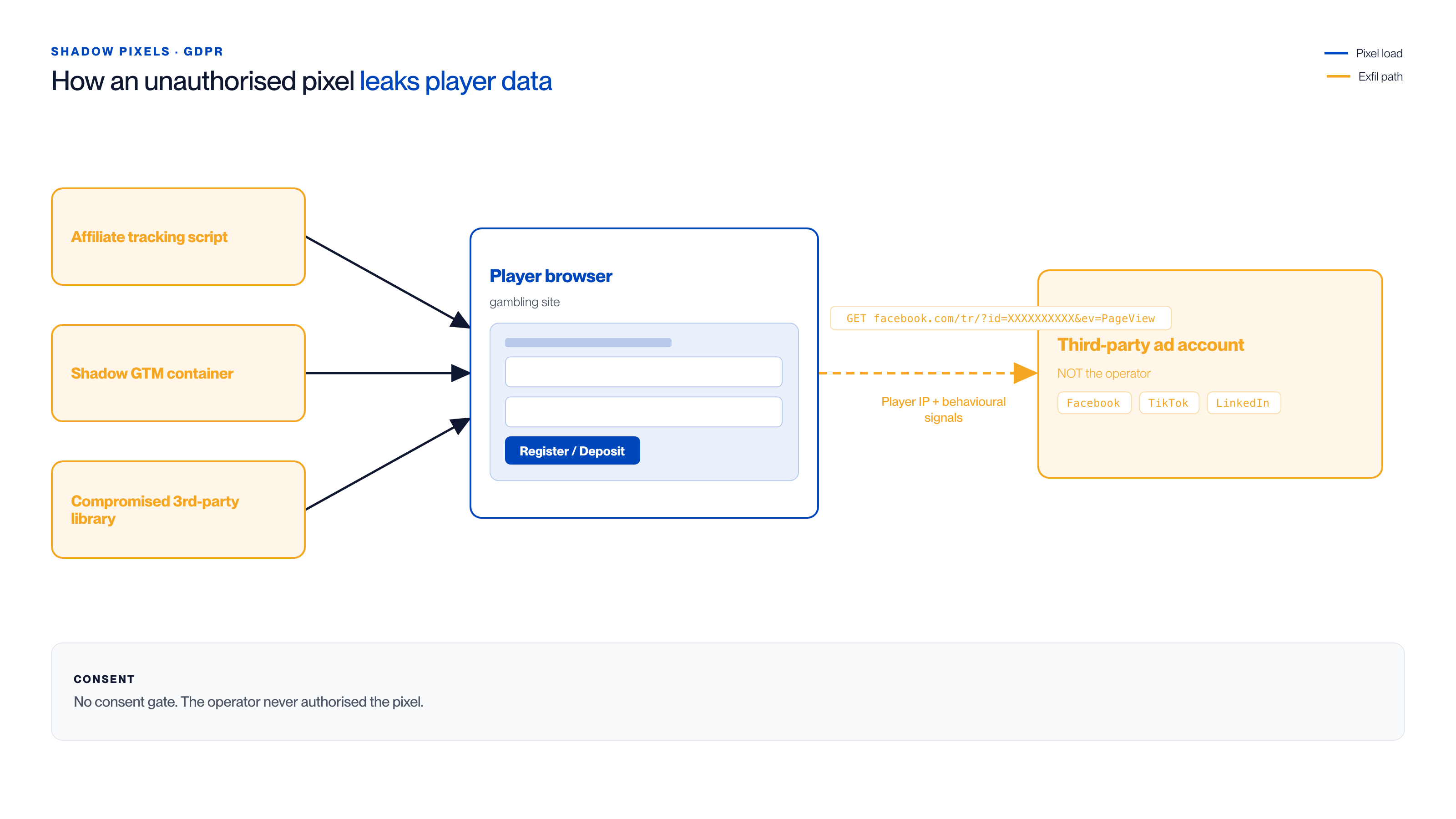
Quick Answer: Shadow pixels arrive on gambling sites through three primary routes: affiliate JavaScript that embeds a pixel as part of its tracking stack, shadow GTM containers added by marketing or agency teams that include social platform pixel tags, and supply chain compromise of third-party libraries that inject pixel code without the operator's knowledge. In every case, the pixel fires on players without their consent being collected for that purpose.
| Route onto the site | Who adds it | What loads in the player browser | Where the data goes |
|---|---|---|---|
| Affiliate tracking script | Marketing / affiliate deal | Social pixel bundled inside the affiliate snippet | Third-party ad account, NOT the operator's |
| Shadow GTM container | Marketing or agency staff | Social platform pixel tag published in the container | Third-party ad account, NOT the operator's |
| Compromised 3rd-party library | Attacker via a supply-chain update | Injected pixel-loading code | Third-party ad account, NOT the operator's |
All three routes converge on the player browser on the gambling site, where the pixel fires with a non-first-party pixel ID. The outbound call (GET facebook.com/tr/?id=XXXXXXXXXX&ev=PageView) sends the player's IP address and behavioural signals to a third-party Facebook, TikTok, or LinkedIn ad account. There is no consent gate, and the operator never authorised the pixel.
Understanding the mechanics is the first step toward addressing the liability. A shadow pixel is not planted by a sophisticated attacker in the way a Magecart skimmer is. More often, it arrives through routine operational processes that have no security oversight.
The three most common routes for iGaming platforms:
-
Affiliate tracking scripts: an affiliate network provides a JavaScript snippet that fires a postback on player registration or deposit. Inside that snippet, either explicitly or through a dependency the affiliate includes, is a Facebook Pixel or TikTok Pixel call. The pixel fires with a non-first-party pixel ID, meaning the data goes to an ad account that is not yours. The player's browser data, including IP address and behavioural signals, is sent to the platform.
-
Shadow GTM containers: as covered in detail separately, an unauthorised GTM container can publish any tag, including social platform pixels. A marketing manager or agency staff member adds a container to one or more casino domains, publishes a TikTok Pixel tag inside it, and the pixel begins firing on all player sessions on those domains. Security is not in the loop.
-
Supply chain compromise: a JavaScript library used for session analytics, chat widgets, or A/B testing is compromised by a third party who adds pixel-loading code to a minor version update. The Sansec Polyfill.js disclosure in June 2024 showed that over 490,000 sites could be simultaneously affected by a single compromised CDN-hosted script. The same vector can deliver pixel payloads.
In all three scenarios, the pixel fires on player devices and sends data to a social advertising platform. The operator did not authorise this. The player did not consent to it for this purpose. And neither the operator nor the player knows it is happening.
Why Shadow Pixels Are Invisible to Network-Layer Tools
Quick Answer: Pixel calls are standard HTTPS requests to domains like facebook.com, tiktok.com, or linkedin.com, all of which are legitimate, widely-trusted destinations that network-layer tools do not flag. The request looks identical whether it originates from an authorised first-party pixel or a shadow pixel installed without consent. Only browser-layer monitoring can distinguish between them by examining which script initiated the request and which pixel ID it carried.
This invisibility is what makes shadow pixels a persistent compliance risk rather than a detectable anomaly. Network logs will show outbound requests to facebook.com/tr/, analytics.tiktok.com, or px.ads.linkedin.com. These are expected, legitimate domains that appear in network traffic from millions of websites. There is no signature to block.
What network tools cannot determine:
- Which script on the page initiated the pixel call
- Whether the pixel ID in the request belongs to the operator or to a third party
- Whether a valid consent signal was collected for this specific data transfer before the pixel fired
- Whether the pixel is firing on all sessions or only on specific user segments
A standard firewall rule or CDN-level inspection sees: GET https://www.facebook.com/tr/?id=XXXXXXXXXX&ev=PageView. It has no mechanism to cross-reference that pixel ID against an approved list, or to check whether the script that made the call was authorised by the site's operator.
Content Security Policy does not help either. CSP allows or blocks domains, not individual pixel IDs or the scripts that load them. connect-src facebook.com is a binary permission. It cannot distinguish between an authorised pixel and a shadow one from the same domain.
The Dual Liability: GDPR and Advertising Platform Policy
Quick Answer: Shadow pixels on gambling sites create two simultaneous legal exposures. Under GDPR Article 5, collecting and transferring player behavioural data to third-party ad networks without a valid lawful basis and appropriate consent is a data protection violation. The British Airways £20M ICO penalty illustrates the enforcement stakes. Separately, the advertising platforms whose pixels are firing can suspend or de-platform the operator's advertising accounts when gambling-related pixel activity is detected on non-compliant domains.
These two liabilities are independent. Resolving one does not resolve the other. And both can materialise from the same unauthorised pixel firing on your site.
The GDPR dimension:
GDPR Article 5 requires that personal data be processed lawfully, fairly, and transparently. When a pixel fires and sends a player's IP address, device identifiers, and behavioural data to a social advertising platform, that is a transfer of personal data. For it to be lawful, the operator needs a valid basis, typically explicit consent collected before the pixel fires. If the pixel was placed without the operator's knowledge, no consent mechanism was configured for it. Every session where the pixel fires is a potential GDPR breach.
The enforcement context is not abstract. The UK Information Commissioner's Office fined British Airways £20 million for failures that allowed third-party scripts to harvest passenger data. While that case involved credential harvesting rather than pixels specifically, the regulatory principle is identical: you are responsible for what JavaScript executes on your domain and what data it sends to third parties. Ignorance of the pixel's existence is not a defence.
The advertising platform policy dimension:
Facebook, TikTok, and LinkedIn prohibit gambling operators from advertising on their platforms in most markets, or require specific restricted-category approval. When a shadow pixel fires on a gambling site, it links the operator's domain to a pixel ID that is associated with an advertising account. If the platform detects gambling-related pixel activity from a non-approved domain, the linked ad account can be suspended. This can have significant consequences if the operator runs legitimate advertising campaigns on that platform for non-gambling products or in approved markets, as the entire account may be at risk.
The dual nature of this liability means compliance teams, DPOs, and marketing operations teams all have a stake in detecting shadow pixels, alongside security and engineering.
| Liability type | Regulatory / enforcement body | Potential consequence |
|---|---|---|
| GDPR data transfer without consent | ICO (UK), national DPAs (EU) | Fines up to 4% of annual global turnover |
| Advertising platform policy breach | Facebook, TikTok, LinkedIn | Ad account suspension or permanent ban |
| Combined exposure | Both simultaneously | Regulatory fine plus loss of advertising capability |
How cside Detects Non-First-Party Pixel IDs Across All Sessions
Quick Answer: cside instruments 100% of real user sessions at the browser layer and identifies every script that fires, every network request those scripts make, and every pixel ID contained in those requests. When a pixel ID is detected that does not match the operator's authorised pixel inventory, cside raises an alert with the full context: which script triggered it, which domain it was sent to, and which pages and user segments were exposed.
cside's approach to pixel detection goes beyond identifying that a request was made to a social platform domain. It surfaces the pixel ID in the request, maps it to the script that fired it, and identifies the container or tag manager context that loaded that script.
For a multi-brand gambling platform, this means:
- A unified pixel ID inventory across all domains: cside shows every distinct pixel ID observed firing, per domain, updated in real time
- First-party versus third-party classification: authorised pixel IDs are enrolled in the platform's script inventory; any pixel ID not on the approved list triggers an alert
- Script attribution: for each shadow pixel event, cside identifies the exact script that made the call, whether it was an affiliate JS snippet, a tag inside a GTM container, or a modified third-party library
- Consent timing validation: cside can surface whether a pixel fired before or after a consent interaction, which is directly relevant to demonstrating GDPR compliance or identifying violations
- 100% session coverage: because cside monitors every session rather than sampling, it captures geo-targeted or segment-targeted pixel deployment that sampled monitoring would statistically miss
Proxy-based monitoring approaches intercept traffic at the network layer before it reaches the browser. This surfaces some pixel activity but cannot observe the full JavaScript execution context: specifically, which script loaded the pixel, in which container, and under what trigger conditions. Network proxy approaches also have inherent sampling limitations on high-traffic platforms.
Beyond detection, cside provides per-vendor permission control. An analytics or attribution pixel vendor can be assigned a permission profile that blocks its access to the Payment Request API, cookie writes, or localStorage, enforced at the browser layer. This means that even if a pixel vendor's code is later compromised, a hijacked pixel script cannot access payment fields or session data because the permission profile prevents it regardless of what the script attempts to do.
In our monitoring of licensed gambling operators, unauthorised pixel firing is one of the most common compliance exposures we surface on first deployment. Operators are typically unaware that pixels are firing because the pixel domain (facebook.com, analytics.tiktok.com) appears in network logs as a routine, expected destination. Without browser-layer attribution tying the request back to a specific script and container, there is no mechanism to determine whether the pixel ID belongs to the operator or to a third party.
What a first monitoring session finds on a gambling platform
When we ran the first cside monitoring session on a major European multi-brand online gambling platform earlier this year, the compliance team's immediate concern was GDPR. What the browser-layer inventory surfaced on day one was more specific than they expected. Across the initial monitored brand domain, cside identified multiple social platform pixels firing on live player pages, carrying pixel IDs that did not belong to the operator. The pixels had arrived through affiliate JavaScript snippets embedded during campaign setup. The marketing team had added the affiliate tags in good faith as part of legitimate deals. No one had audited what else the affiliate scripts contained.
The pixels were firing on every session, with no consent gate, sending player IP addresses and behavioural signals to external ad accounts. The compliance team had no prior visibility into this because the pixel domains (facebook.com, analytics.tiktok.com) appeared in their network logs as routine, expected destinations. There was no alert and no mechanism to cross-reference the pixel IDs against an approved list. Within 24 hours of monitoring beginning, the platform had a full inventory of every pixel ID firing across the test domain, including which scripts were delivering them, which pages they were active on, and how long they appeared to have been running. The DPO initiated an Article 33 assessment the same day.
Remediation Workflow: From Detection to Resolution
Quick Answer: When cside surfaces an unauthorised pixel, the remediation workflow has four stages: immediate containment (block the script or container delivering the pixel), impact assessment (determine which domains, date ranges, and user segments were exposed), regulatory notification assessment (evaluate whether a breach report is required under GDPR Article 33), and process improvement (update your script governance process to prevent reoccurrence).
Because shadow pixels may constitute a personal data breach under GDPR, remediation is a compliance exercise as much as a technical one, and the two need to run in parallel.
-
Containment: Identify the script or GTM container delivering the unauthorised pixel and remove it from the affected domains. cside's execution attribution tells you exactly which asset to target, eliminating the guesswork of a manual audit.
-
Impact scoping: Determine the date range during which the pixel was firing, which domains were affected, and approximately how many sessions were exposed. This data is required for any regulatory notification and for the internal incident record.
-
Regulatory assessment: Under GDPR Article 33, a personal data breach must be reported to the relevant supervisory authority within 72 hours if it is likely to result in a risk to individuals' rights and freedoms. Transferring player behavioural data to a social advertising platform without consent may meet this threshold. Your DPO needs to make this assessment promptly, with the impact scoping data from stage two.
-
Process update: The shadow pixel reached your site because a script was added without security review. Implement a change control process that requires all new scripts, tag manager containers, and third-party JavaScript integrations to be reviewed and approved before going live on any domain in your portfolio. cside's real-time alerting functions as the ongoing enforcement mechanism for that policy once it is in place.
Summary
Shadow pixels create a compliance exposure that is invisible by design. The pixel domains look legitimate in network logs. The consent flow on your site has no knowledge of a pixel it did not configure. Your CMP cannot gate what it cannot see. The only layer that can attribute a pixel call to its origin script, cross-reference the pixel ID against an approved inventory, and flag it in real time is one that runs inside the browser. For licensed gambling operators with GDPR obligations and advertising platform restrictions, continuous browser-layer monitoring is the mechanism that makes accountability under GDPR Article 5(2) operationally possible. cside's Privacy Watch provides a complete pixel inventory from real player sessions, cross-referenced against your consent configuration, with alerts for every undeclared destination. For context on how unauthorised scripts reach your domains through tag managers, see our guide to shadow GTM containers on multi-brand gambling platforms.