TL;DR: prevent website data breaches
- Breach vs leak: Data breaches and data leaks aren't the same. Breaches involve a "breaking in" (think injected website scripts or compromised servers). Leaks are usually self-inflicted, such as misconfigured tools, over-sharing, or third-party website tools collecting more than they should.
- Harden security: Put real security controls in place. Encrypt data everywhere possible and lock down APIs. Monitor for client-side attacks like script injections and form field skimming.
- Govern third parties: Govern third-party tool data access on your website. 30% of data breaches in 2025 involved compromised 3rd parties. For your website: maintain an inventory of all third-party code, understand what data each vendor accesses, and track where data is sent even as scripts change. This can be automated with cside Privacy Watch.
- Train your team: Train employees on data access controls and how to recognize an incident to minimize damage.
- For extra protection: run simulated phishing tests on your team and check the dark web for exposed credentials associated with your organization.
Short on time? See cside Privacy Watch. It covers everything below in one deployment.
Introduction
"People's personal data is just that, personal. When an organization fails to protect it from loss, damage or theft it is more than an inconvenience. That's why the law is clear. When you are entrusted with personal data you must look after it. Those that don't will face scrutiny from my office to check they have taken appropriate steps to protect fundamental privacy rights."
These are some strong words coming from Elizabeth Denham, former UK Information Commissioner, when announcing the fine for the infamous 2018 British Airways data breach.
This type of warning has value because data breaches have far-reaching financial and legal consequences. Regulations like GDPR or the American CCPA have made it non-negotiable for organizations to be lax regarding data security.
However, breaches still happen, almost too often. So what is it that companies are doing wrong? How can you not be one of them? Let's look at 4 ways to prevent data breaches and save yourself from all the trouble that accompanies them.
4 steps to prevent website data breaches and data leaks
According to a study from IBM the average cost of a data breach is $4.44 million globally in 2025. It goes up to $10.22 million for U.S. organizations. Third-party services are a massive privacy breach risk. Verizon's 2025 DBIR report found that supply chain and third-party compromises were involved in 30% of all breaches. That's double the rate from 2024.
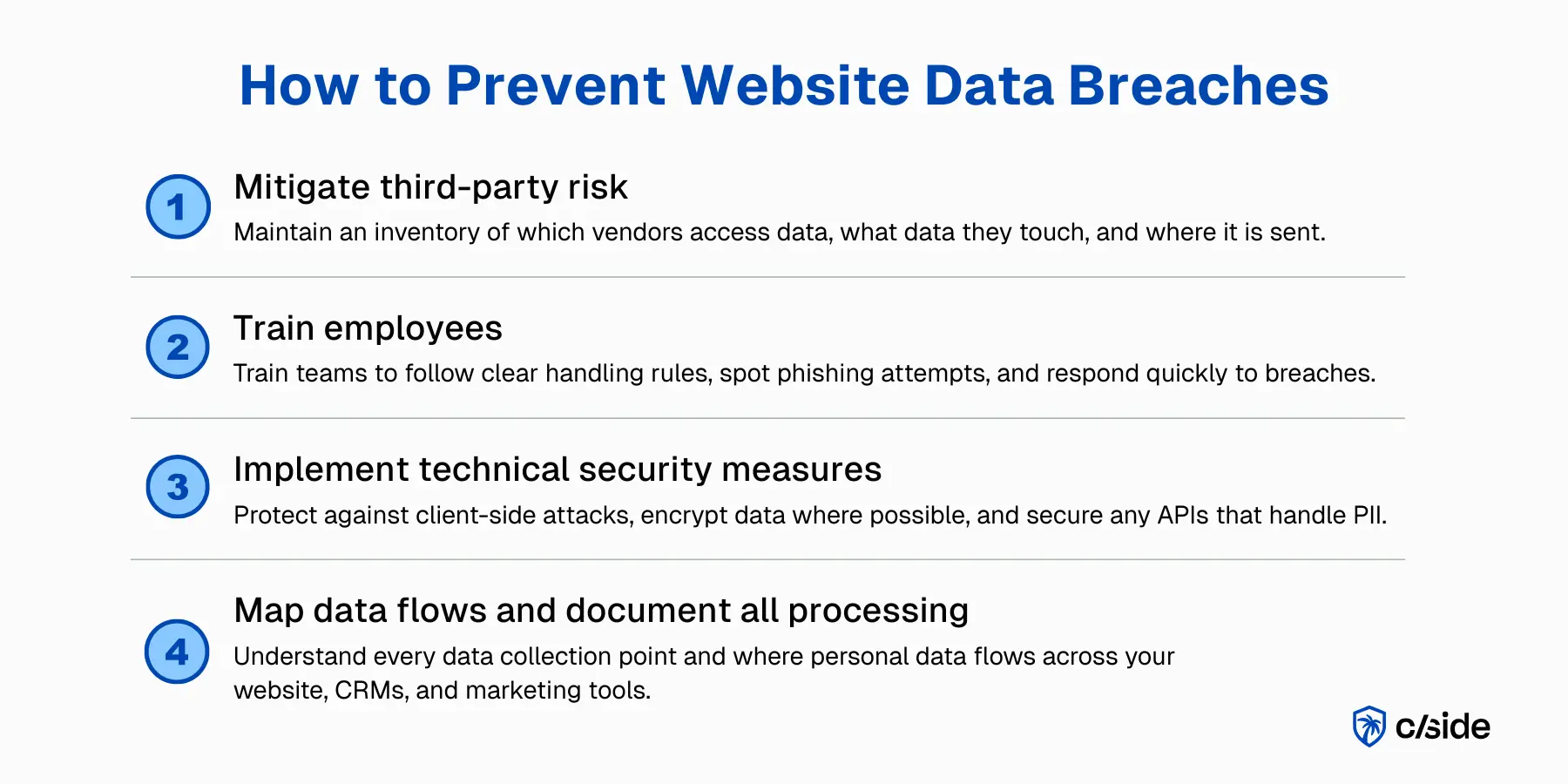
Fortunately, breach risk can be reduced enormously by addressing the blind spots that give rise to them in the first place. Say for instance, the client-side attack surface, where third-party scripts run in your visitors' browsers. Below are four steps you can take to prevent costly data breaches under GDPR and CCPA.
1. Govern third-party data trackers
- Inventory every third party service that processes or receives data from your site. This will include your analytics tools, marketing pixels, support widgets, CDNs, font libraries and identity services. Understand which third parties have access to data, what information they touch, and where it is sent.
- Analyze each vendor's privacy policy, security certifications and data handling procedures. Keep an eye for SOC 2 reports, ISO 27001 certification and clear data retention policies. It would be right to reconsider the relationship if a vendor can't show the necessary safeguards.
- Work out data processing agreements or DPAs. Under GDPR Article 28(3), DPAs must specify processing purposes, duration, data categories and processor obligations. You absorb full liability for vendor breaches without proper DPAs.
- Swap one-time assessments with ongoing monitoring. Keep track of what data scripts actually access and where they send it.
2. Prioritize internal training
- Create clear rules for how personal data collected via your website should be treated across departments.
- Train employees on GDPR and CCPA compliance. Help them recognize what constitutes personal data. Run phishing simulations that target credentials to help team members spot malicious attempts to access information.
**Build an incident response policy.**GDPR Article 33 requires breach notification to supervisory authorities within72 hours of becoming aware of a qualifying breach. Your team needs documented procedures for identifying, escalating and reporting suspected breaches
3. Implement technical security measures
- Protect your website from client-side attacks. Native browser controls like Content Security Policies help. However, this has security limitations and is difficult to maintain. CSP only monitors script domain sources and not script behavior. A better approach is to analyze behavioral patterns to spot signs of malicious JavaScript injections that steal personal data on your website.
- Encrypt data whether in transit or at rest. Use HTTPS or TLS for all connections and encrypt stored personal data - this is the bare minimum.
- Authenticate and monitor every API endpoint that accesses personal data. Always validate inputs, implement rate limiting and log access patterns. APIs connecting to third-party services deserve extra protection.
4. Map data flows and document all processing
- Document every personal data element your website handles. Forms, KYC flows, chatbots, account sign ups… Map where that data flows. CRMs or email tools. Third party services like ad trackers.
- GDPR Article 30mandates documented ROPAs showing how personal data is processed, the legal basis for processing, retention periods and sharing arrangements. These records help you understand what data was exposed.
- Manual audits struggle to keep pace with dynamic websites. Use an AI-powered web compliance platform to monitor changes continuously and flag violations before they become enforcement actions.
Extra tips
These are some extra steps you can take if you want to go the extra mile to integrate security practices:
- **Collect less data.**There's a reason why data minimization is a GDPR principle. It shrinks your risk area in case something goes wrong.
- **Watch the dark web for employee credentials.**Stolen login info from your employees or vendors usually lands on underground forums before it is weaponized. You can use threat intelligence systems to see if your company's data or credentials show up on marketplaces. You can take defensive measures before a bad actor purchases those credentials and coordinates an attack.
Run penetration tests. Compliance-driven pen tests are usually harder and more effective. Hire testers who will go after your client-side attack surface, not just servers. Tell them to try injecting scripts or phish credentials from staff.
Why Website Data Breaches Matter for GDPR and CCPA
There are ample reasons why preventing data breaches is paramount under both these regulations. Let's start with the financial aspect.
Under GDPR, you face fines up to €20 million or 4% of global annual revenue. CCPA even adds statutory damages between $107 and $799 per California resident who has been a victim of a breach. Since there's no cap on total penalties, a breach hitting 10,000 people could set you back $1 million to $8 million.
Apart from penalties, here is what else is at stake:
- Loss of customer trust: It's been reported that only 35% of organizations fully recover from data breaches. Lost business is perhaps the worst part of data breaches.
- Exposure to severe lawsuits: A data breach can expose you to several lawsuits. As an example, CCPA's private right of action lets consumers sue directly. Because of this, California saw over 2,500 data privacy lawsuits filed in the year 2024 alone
- Operational disruptions: The average breach lifecycle lasts 241 days, which can severely impact how you function as an organization. To put 241 days in perspective, think about eight months of investigation, remediation and regulatory scrutiny
- Risk of higher scrutiny and repeat audits: Once you're on the radar of regulators, expect repeat audits and greater scrutiny. The CPPA has confirmed that they have hundreds of open investigations. Many of them are targeting businesses that don't even know they're being examined.
Website Data Breaches vs Website Data Leaks: What's Different?
People toss these terms around together, but they are not the same.
A website data breach involves someone breaking in. This could mean an attacker exploiting a vulnerability or injecting harmful code to grab data they shouldn't have access to. There's intent behind it.
A website data leak usually doesn't involve hacking. It's mostly self-inflicted. Maybe one of your employees entered sensitive information into an LLM platform where the chat ends up publicly indexed. Or a third-party script is misconfigured and keeps sending data even after users have opted out.
Regulators treat both as reportable incidents under both GDPR and CCPA. Whether the data was stolen or leaked doesn't change your notification obligations.
Industry-Specific Tactics To Prevent Data Breaches
Personal data on websites is processed differently across industries. Here are some industry-specific tactics to prevent GDPR/CCPA breaches:
<thead>
  <tr>
    <th>Industry</th>
    <th>Common website breach / leak vectors</th>
    <th>Defense tactics</th>
  </tr>
</thead>
<tbody>
  <tr>
    <td>SaaS / Tech</td>
    <td>
      Over-privileged access, exposed APIs, or insecure third-party scripts.
    </td>
    <td>
      Enforce least-privilege access. Lock down APIs with authentication,
      rate limits, and monitoring. Continuously monitor client-side scripts
      for abnormal data flows.
    </td>
  </tr>
  <tr>
    <td>E-commerce</td>
    <td>
      Payment skimming, malicious ad pixels, data theft from forms.
    </td>
    <td>
      Use client-side integrity monitoring on checkout pages. Restrict scripts
      from accessing payment fields. Encrypt all transactional data end to end.
    </td>
  </tr>
  <tr>
    <td>Healthcare</td>
    <td>
      Human error, misconfigured systems, unauthorized access.
    </td>
    <td>
      Segment patient data by role with mandatory MFA for all access.
      Train staff on real-world data handling scenarios.
    </td>
  </tr>
  <tr>
    <td>Financial Services</td>
    <td>
      Credential abuse, session hijacking, third-party compromises.
    </td>
    <td>
      Apply zero-trust access controls. Monitor sessions for anomalies with
      platforms like cside. Regularly assess all vendors handling personal data.
    </td>
  </tr>
  <tr>
    <td>Travel and Hospitality</td>
    <td>
      Client-side skimming, legacy systems, insecure integrations.
    </td>
    <td>
      Monitor booking and payment flows in real time. Patch legacy systems
      aggressively and maintain visibility into third-party script behavior.
    </td>
  </tr>
</tbody>
Prevent Website Data Breaches with cside Privacy Watch
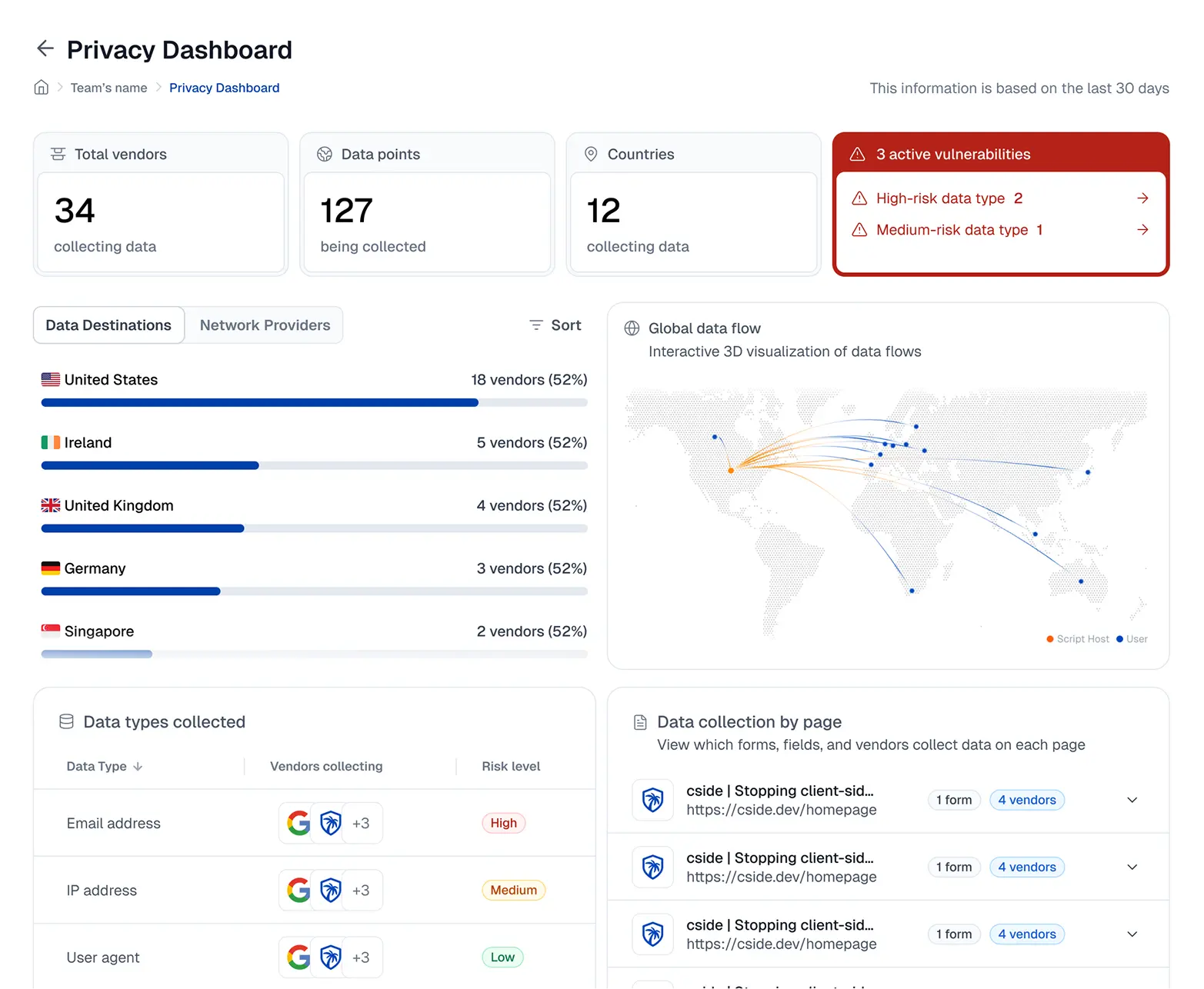
cside Privacy Watch monitors what data third-party scripts access and where they send it, giving you visibility into a risk surface that typically goes unmonitored until an incident or audit.
- Privacy Watch uses AI-enhanced detection to catch privacy violation risks on your website. You get immediate alerts when a third party vendor changes their scope of data collection or when there are signs of JavaScript injections that target personal data.
- Privacy watch generates documentation aligned with GDPR, CCPA, HIPAA and other regulatory frameworks. Demonstrate security safeguards against client-side attacks, purpose limitation on third party vendors, and keep privacy disclosures in sync with what actually happens on your website.
cside looks at a risk layer that traditional web security tools ignore. By monitoring browser-layer signals on user sessions teams get insight into hidden data trackers or misconfigured scripts that violate privacy policies.
Book a demo orcreate a free account to see how cside can help secure your client-side attack area.