No single tool makes you GDPR-compliant, most teams combine six categories of GDPR tool: website and client-side monitoring (cside Privacy Watch), consent management (OneTrust, TrustArc), DSAR automation (DataGrail), data security and encryption (cside, Thales CipherTrust), general compliance automation (Vanta, Sprinto), and data mapping (BigID). The same six categories are what vendors label GDPR management tools and GDPR automation platforms. The label matters less than knowing which category you are missing.
TL;DR: GDPR compliance tools
- No single tool: GDPR compliance does not live in one place. You might need a tool for consent, one for data requests, another for security, and maybe a spreadsheet for vendor risk. Fragmentation is where teams get confused.
- Where to start: Look at these tools to kickstart your selection process: Website monitoring (cside Privacy Watch), consent management (TrustArc), DSAR management (DataGrail), encryption/security (Thales CipherTrust), general compliance automation (Vanta), and data mapping (BigID).
- Size matters: GDPR and privacy compliance stacks look completely different depending on your company size. Low cost alternatives like CookieYes or manual processes with spreadsheets may cut it if your company is small (<50 employees), has low data volume, or a limited presence in the EU.
- All-in-one vs specialized: "All in one" tools are good for documentation automation. Specialized tools better for security and third party risk vendor management on your website.
- The client-side gap: Traditional privacy software covers a wide surface but does not look deeply at third-party vendor activity on your website, leaving an open door for over-collection and data breach entry points. Tools like cside solve this gap.
Short on time? See cside's continuous privacy compliance monitoring, or how cside enforces GDPR compliance at the browser layer. It covers everything below in one deployment.
For teams comparing DSAR providers, pick the tool that can prove where a person's data sits, automate access and deletion workflows, and track deadline evidence. The European Data Protection Board reminds controllers to respond within one month, so DSAR tooling is mostly about reliable discovery, routing, and proof.
| DSAR comparison area | What to check | Why it matters |
|---|---|---|
| Data discovery coverage | CRM, support, analytics, ad, warehouse, and website tracker integrations | A request can only be fulfilled if the tool finds the person's data across real systems |
| Workflow automation | Access, correction, deletion, opt-out, identity verification, and approvals | Manual spreadsheets break down when request volume or system count rises |
| Deadline tracking | One-month response timers, escalation, extensions, and audit logs | GDPR rights requests need evidence of timely action, not just task completion |
| Vendor and website coverage | Third-party processors, tags, pixels, and browser data flows | Website scripts often collect personal data outside traditional backend inventories |
If you are specifically evaluating AI-enabled privacy tooling for websites, compare this stack with our AI website privacy compliance tools guide.
New to the underlying problem? Start with what is web tracking for how the collection actually happens.
The Categories of GDPR Compliance Tools (and What They Do)
| Tool Category | What They Do | Recommended Solutions |
|---|---|---|
| Website & client-side monitoring tools | Show you what third-party data processors do on your website and help catch accidental data leaks or malicious client-side attacks. | cside Privacy Watch |
| Consent management platforms | Collect and manage user consent with banners, preference logs, and regional compliance settings. | TrustArc, Consent Mode Monitor |
| DSAR / data subject rights tools | Automate user data requests by finding relevant data, fulfilling requests, and tracking responses in one place. | DataGrail |
| Security tools | Protect personal data using encryption, access controls, or client-side safeguards. | Thales CipherTrust, cside Privacy Watch |
| General compliance automation tools | Keep policies, evidence, and controls up to date across GDPR and other compliance frameworks. | Vanta, Sprinto |
| Data mapping tools | Identify where personal data lives across your systems and keep processing records accurate. | BigID |
The challenge with GDPR is that compliance does not live in one place. You might need a tool for consent, another for data requests, and maybe a spreadsheet for tracking vendor risk. The selection process begins with understanding what each different tool does. These core categories organize what each type of tool is responsible for and when it makes sense to use them.
1. Website & client-side monitoring tools
Such tools focus on monitoring your website for privacy violations. This includes third-party scripts, trackers, and integrations (processors) that collect data in the background.
"Client-side" monitoring tools like cside Privacy Watch solve a gap left by consent management tools and traditional data mapping solutions:
- Protect against data exfiltration and client-side attacks that leak personal data
- Monitor all third-party trackers on your site: who processes data, what data do they touch, and where do they send it
- Monitor code changes from third party tools on your site that change processing scope. This keeps your privacy notices & documentation up to date
Data mapping platforms and CMPs have similar features, but they look at what vendors say they collect (policy documents) or surface-level activity in the browser.
According to research from Web Almanac, modern websites have an average of 23 external third parties present on a web page. Each of those is a security and privacy compliance risk.
A client-side monitoring tool like cside looks deeper at JavaScript code execution and is able to protect your website against malicious code injections that lead to data breaches.
2. Consent management platforms
Consent management platforms (CMPs) help you collect and manage user consent across cookies, trackers, and data collection activities.
Platforms like OneTrust and TrustArc have features to help you:
- Collect user preferences (cookie banners)
- Enforce cookie preferences (block rejected cookies)
- Document consent preferences to prove lawful processing
They are often the first part of GDPR that users interact with. When outdated or misconfigured, these can be a common source of compliance issues. For independent verification that consent signals are honored by every tracker in real browser sessions, see our consent management monitoring guide.
Comparing consent management platforms
The four most common consent management platforms for GDPR teams each serve a different profile:
| Platform | Best for | Google Consent Mode v2 | Free tier |
|---|---|---|---|
| OneTrust | Enterprise, multi-regulation | Yes | No |
| TrustArc | Mid-market, established compliance teams | Yes | No |
| CookieYes | Small to mid-size sites, fast setup | Yes | Yes |
| Axeptio | EU-first teams, design-forward experience | Yes | Yes |
OneTrust is the most feature-complete consent management platform. It handles consent, DSARs, data mapping, and vendor risk in one place, making it the default choice for enterprise legal and compliance teams managing multiple frameworks.
TrustArc is a strong choice for mid-market companies that want a single platform for consent plus a structured workflow for data subject requests. It has a longer track record with EU regulators.
CookieYes is the fastest path to a compliant consent banner for smaller sites. It auto-scans for cookies, generates the banner, and integrates with Google Consent Mode v2 without developer help. The free tier covers most small-business needs.
Axeptio takes a more design-forward approach to consent, with widget styles that feel less like a legal notice and more like a product interaction. It is widely used by French and EU-based teams that prioritize user experience alongside compliance.
All four generate the consent audit logs required to demonstrate lawful processing under Article 7 of GDPR. The deciding factor is operational fit: how well the CMP integrates with your tag manager and what reporting it surfaces for your DPO. Any of the above will satisfy a basic consent audit; the differences become visible at scale.
2b. Consent Mode Checkers
CMPs or cookie banners require an additional step that teams very frequently ignore. Platforms like Google Tag Manager and Microsoft Ads require additional setup for consent enforcement to work properly. This is typically called 'consent mode' within those platforms.
Platforms like Consent Mode Monitor check if Google Consent Mode is properly set up:
- Scans websites or GTM container IDs and flags tags with missing or incorrect Consent Mode settings.
- 1-click fix to apply corrected consent settings in GTM containers
This free Chrome extension is a good place to start. This saves you time compared to manually digging around GTM preview mode to see if consent is firing properly (which might require developer help).
3. DSAR / data subject rights tools
Data Subject Access Request (DSAR) handles requests that come from individuals who want to access, correct, or erase their personal data.
Platforms such as DataGrail make this easy by:
- Discovering where an individual's data exists across different systems
- Automate the actions to access, correct, erase, or opt out of personal data sharing.
- Track response timelines against GDPR's one-month response requirement
Doing this manually would entail tracking requests in a spreadsheet and chasing data across dozens of tools (ad platforms, CRMs, servers, third party trackers). DSARs automate most of the actions required to honor requests in a central tool.
Related guides
Dig deeper into the cluster:
- the best AI tools for website privacy compliance
- the most common GDPR compliance failures and how to prevent them
- how to comply with GDPR website requirements in 2026
- GDPR penalties explained
4. Security tools
Article 32 of GDPR requires organizations to implement technical measures to protect personal data from unauthorized access. It includes safeguards like encryption, access controls, monitoring, and regular testing of security measures.
Client-side protection tools like cside:
- Focus on website based attacks that target personal data.
- Evidence logs are automatically created to prove technical safeguards were put in place to prevent client-side attacks, such as the British Airways data breach that landed them a £20 million fine.
Encryption tools like Thales CipherTrust
- Encrypt data at rest, transit, and in use with GDPR specific access policies.
Access controls like Okta
- Enforces least-privilege access and sign-in rules to reduce unauthorized access from internal employees or compromised employee accounts
5. General Compliance Automation Tools
Platforms like Vanta and Sprinto automate evidence collection, policy tracking, and control monitoring for multiple frameworks including GDPR, SOC 2, and ISO 27001.
These platforms have features like:
- Centralized policy and control tracking so you can see ownership and reviews across frameworks in one place
- Evidence consolidation to connect systems and update compliance status
- Third party vendor tracking for non website data processors such as CRM tools or marketing outreach platforms
- Tracking for internal policies and employee training
6. Data Mapping Tools
Websites aren't the only platforms that collect or hold personal data. Your CRMs, email systems, and even unexpected areas like paper documents contain sensitive data. That's where data mapping tools like BigID and OneTrust come in. They discover sensitive data across systems and maintain an accurate record of processing activities.
GDPR tool selection tips from an expert
'All in one tools' are great for documentation. If you can handle consent preferences, DSARs, DPAs, ROPAs in centralized tools you'll have much less fragmentation when it comes to showing evidence. Fewer tools, faster prep.
Specialized tools are better for security and third-party risk. This is where many privacy platforms fall short. Compliance software was not built to prevent attacks, or to monitor code execution in the browser from third parties. You should look for dedicated tools when it comes to requirements around encryption, access control, or website monitoring.
Let AI do your job. Privacy compliance is full of repetitive structured work. This makes the field an obvious application of AI. Pretty much all major vendors include AI tools in their solutions. If the tool you are assessing doesn't show you measurable time that can be saved by AI, it might be worth looking at other options. For example, at cside, we use AI to help customers summarize what each third party script does on their site (including when script code is updated, or when new scripts are added).
Hidden Privacy Violations on Your Website from Third Party Data Trackers
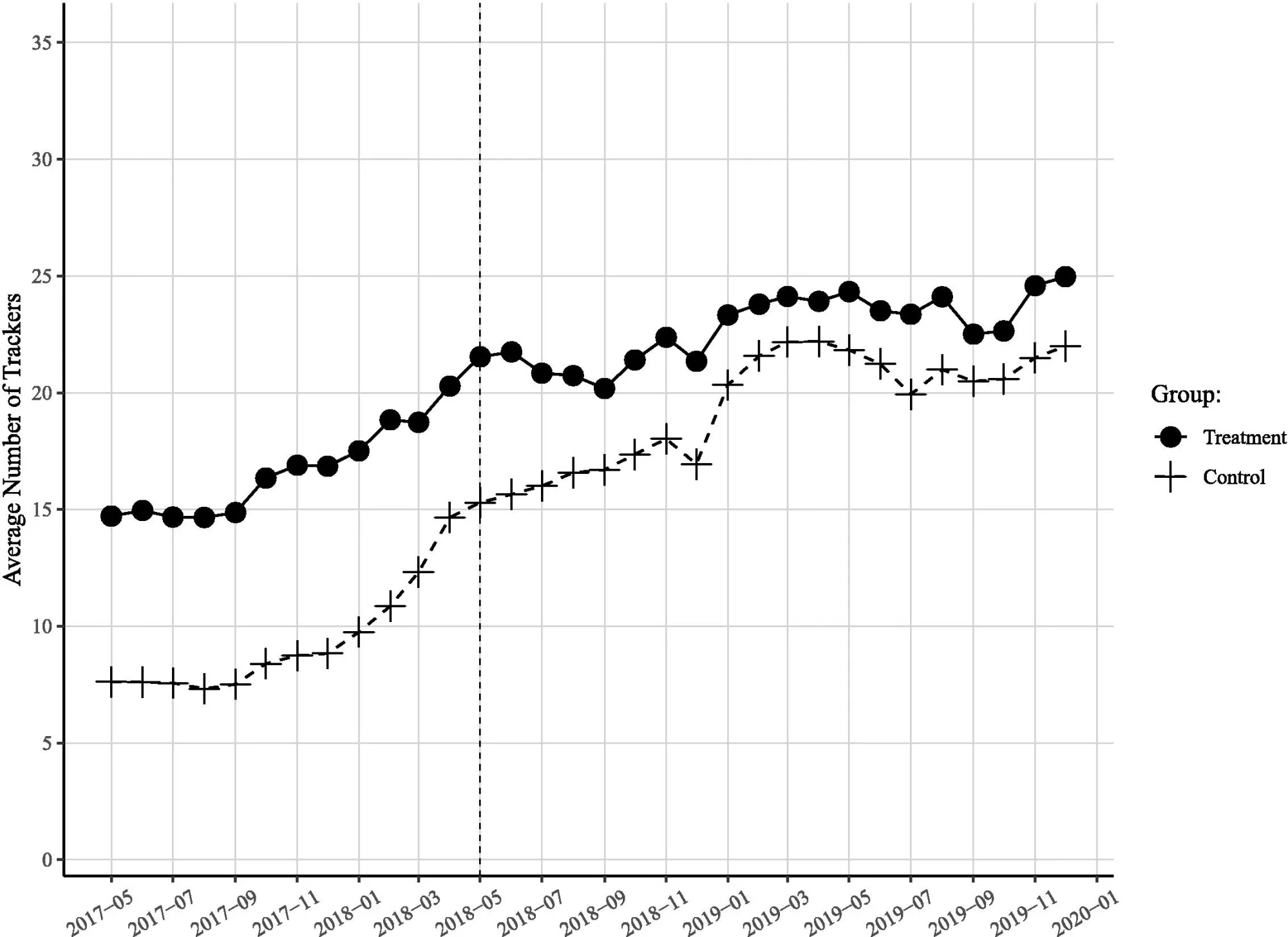
An academic study found that the number of data trackers on websites has steadily increased since the inception of GDPR. This is simply because third party tools offer critical business functionality that developers and marketers need.
That leaves privacy teams to manage dozens of vendors that access personal data, without seeing which data they access (emails, phones, health information) or where it is sent. A lack of control over third party scripts/vendor data processing has led to landmark GDPR fines including an €11 million fine for a German financial institution
Comparing the Best Tools for GDPR Compliance (2026)
cside Privacy Watch
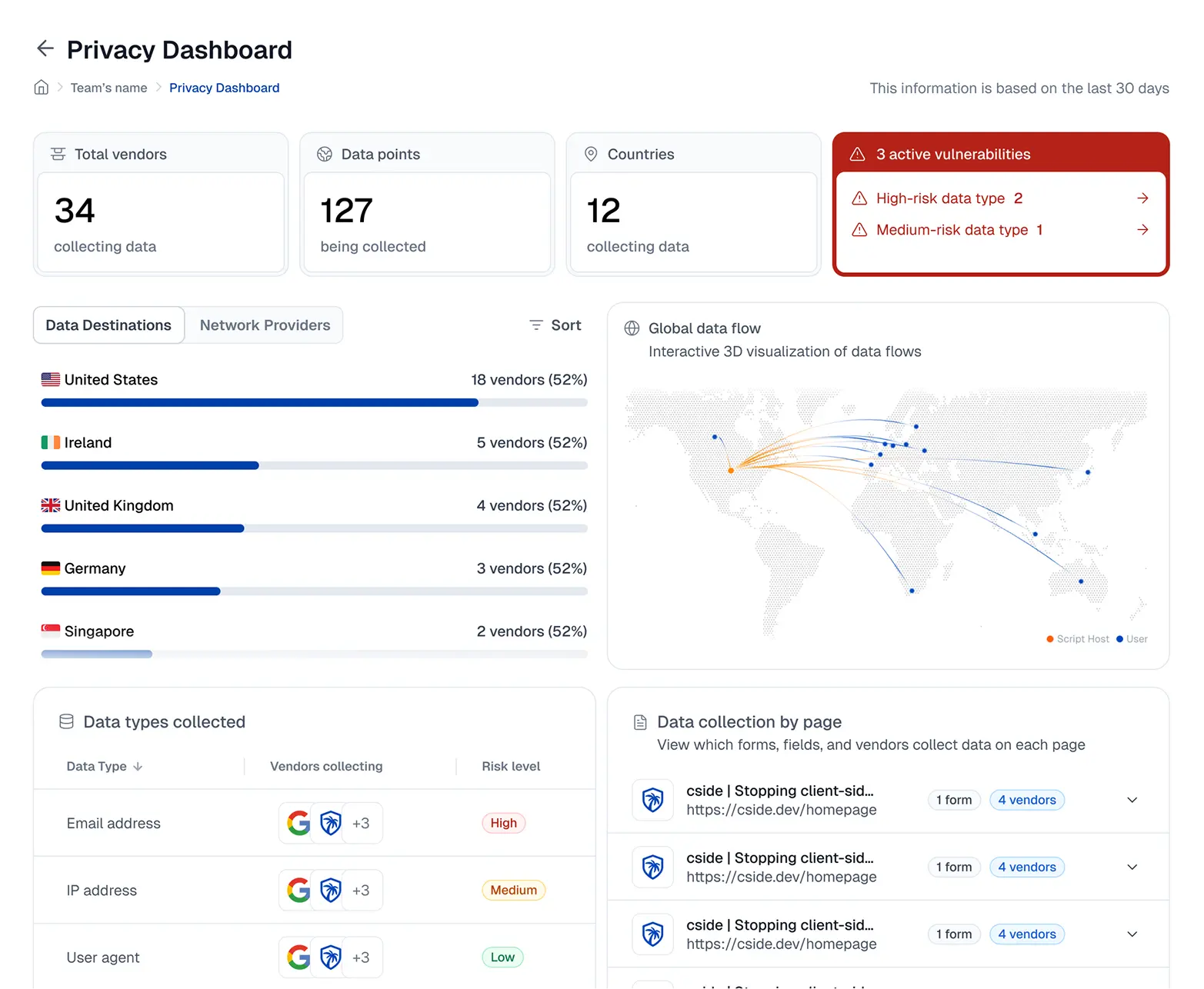
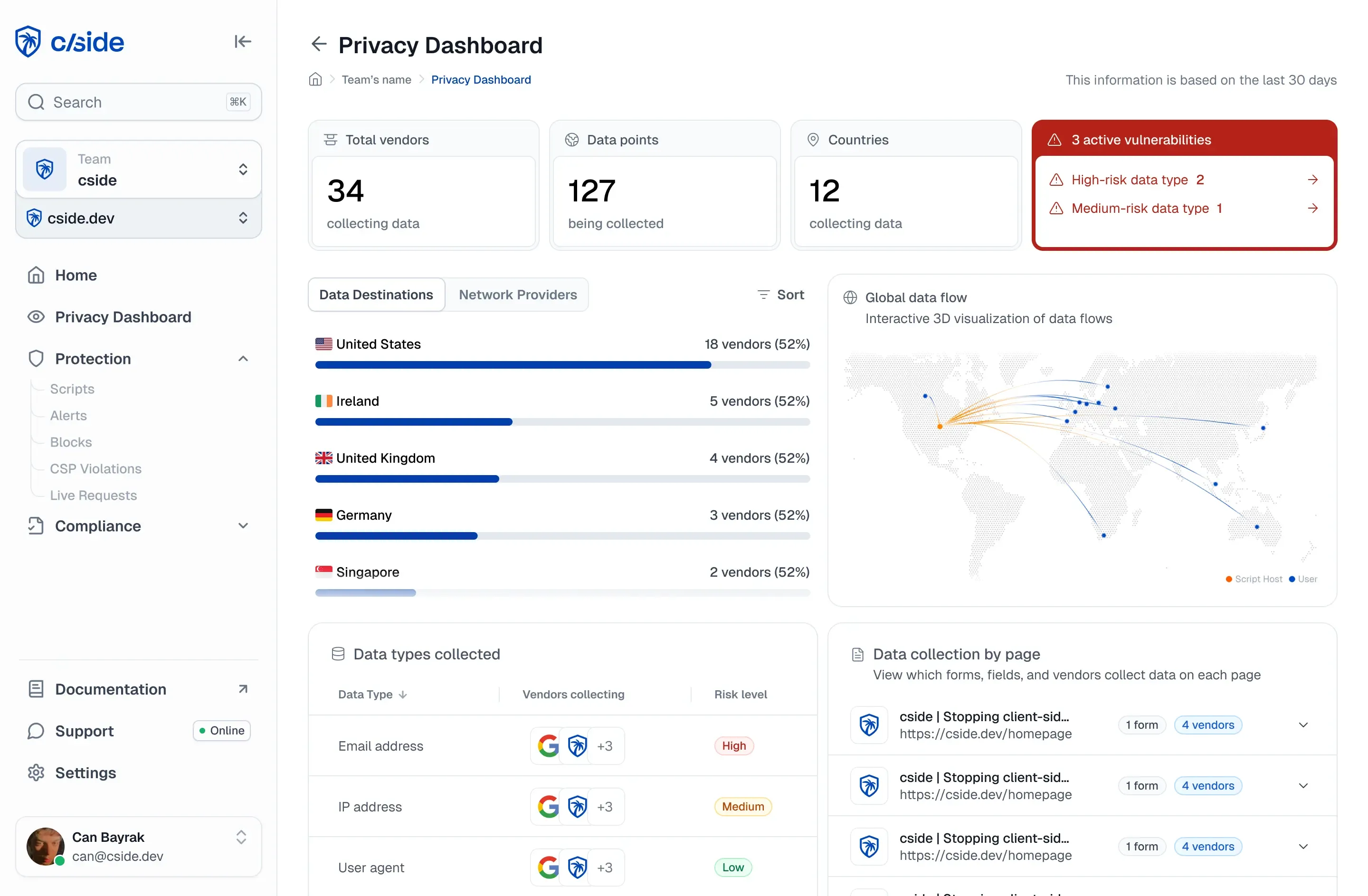
cside Privacy Watch Privacy Watch focuses on the hidden privacy violations that take place on your website. Data leakage from third-party scripts goes unnoticed until there is an incident or audit. 94% of modern websites use third party scripts but privacy teams don't see how these data processors work behind the scenes. Privacy watch shows you all the points that data is processed on your website (forms, chatbots, analytics tools), which third parties have access to what data, and where it is sent.
Key features
- Monitors what data third-party scripts access and where they send it
- Flags unauthorized or over-collection from scripts, plugins, or third party code
- Watch for vendor code changes that expand data collection
- Visually tracks cross-border data transfer
- Detects scripts firing before consent or outside approved categories
- Protection against client-side attacks to demonstrate reasonable security measures
Primary GDPR tool category
- Website and client-side monitoring tools
- Security controls
Helps with GDPR requirements
- Article 5- data minimization and lawful processing
- Article 25- data protection by design and by default
- Article 32- security of processing
along with otherGDPR website requirements.
Best for
Teams that rely heavily on third-party scripts, analytics, and marketing tools need visibility into what runs in the browser without slowing down development.
Other privacy frameworks supported
- CCPA/CPRA
- U.S. state privacy laws
- HIPAA
G2 rating
OneTrust
OneTrust is commonly used to manage consent and privacy workflows at scale. Teams use it to configure consent banners, store user preferences, and maintain records that hold up during audits.
Since it supports multiple privacy workflows in one place, it's often adopted by companies looking for a centralized approach to GDPR compliance.
Features
- Customizable consent banners by region and regulation
- Centralized consent and preference records for audit readiness
- Ongoing monitoring to keep consent configurations up to date
Primary GDPR tool category
- Consent management tools (CMP)
DataGrail
DataGrail automates privacy workflows like DSARs, vendor risk management, and records of processing. If you deal with frequent data requests or multiple systems, this platform reduces response time and compliance overhead.
Features
- Centralized intake and tracking of data subject access requests
- Automated workflows for request fulfillment and response timelines
- Vendor and system mapping to support ongoing privacy management
Primary GDPR tool category
- DSAR / data subject rights tools
BigID
BigID helps organizations understand what personal data they hold and where it lives. Use it to discover, classify, and map sensitive data across cloud platforms, databases, and internal systems. Getting such visibility simplifies adhering to GDPR documentation requirements and lets you respond better to data subject requests.
Features
- Automated discovery and classification of personal and sensitive data
- Data mapping across cloud, on-prem, and SaaS environments
- Support for records of processing and data minimization efforts
Primary GDPR tool category
- Data mapping tools
Vanta
Vanta helps teams manage ongoing compliance work by automating evidence collection and control monitoring. While it's not a GDPR-only tool, many companies use it to support GDPR requirements alongside frameworks like SOC 2 and ISO 27001. It's especially useful when compliance needs to stay current without constant manual effort.
Features
- Automated evidence collection across systems and vendors
- Continuous monitoring of security and compliance controls
- Centralized documentation to support audits and reviews
Primary GDPR tool category
- General compliance automation tools
GDPR software: what to look for
There is no single piece of GDPR software that covers the regulation end to end. When teams search for GDPR software they usually need one or two of the categories above, most often a consent management platform to capture and honor choices, and a client-side monitoring tool to prove those choices are actually enforced by the scripts running in the visitor's browser. The right GDPR software for you depends on where your risk sits: consent capture, data subject rights, cross-border transfers, or the third-party trackers that fire before consent. Start from your highest-risk obligation and add tools only where a real gap exists.
What GDPR tools are needed at different company sizes?
Most teams don't need a full GDPR stack right off the bat. You can start by covering the highest risk areas. Then, add to your stack as data volume and operational complexity grow.
We have an article breaking down tool suggestions If you are aU.S.-only company
Low-cost GDPR compliance stack for small businesses
If you're a small company (less than 250 employees) with limited data volume , you should focus on visibility and consent:
- Website monitoring to understand what scripts and third parties run on your site, like cside.
- Instead of OneTrust or TrustArc you can use lower cost CMPs like CookieYes.
- Simple internal processes for handling occasional data subject requests.
This setup covers common sources of violations without requiring a large budget.
GDPR tools for mid-market companies
Since you may deal with higher traffic, more vendors, and more frequent data requests, go for:
- Consent management plus automated DSAR handling tools, like DataGrail
- Client-side security tools like cside to reduce unseen data leakage risks
- A solution to create ROPAs (required once your company has more than 250 employees)
- Internal management tools like Vanta or Sprinto
- Lightweight compliance automation tools to keep documentation current
Your privacy compliance team might be small and lean. Here, the goal is to reduce tedious work and response time while maintaining consistent records.
GDPR tools for enterprise organizations
At this stage, you'll need-
- Enterprise-grade consent and privacy management platforms
- Enterprise grade security platforms for encryption, client side security, and access controls
- Data discovery and mapping tools to track personal data across systems
- Compliance automation and security tooling to support continuous monitoring and reporting
How do GDPR tools help during audits, investigations, or complaints?
Audits and investigations are rarely about catching a single mistake. They focus on whether a company can explain how personal data is collected, processed, and protected over time.
GDPR tools help by centralizing records, surfacing evidence quickly, and also reducing reliance on manual reconstruction when questions arise.
When a complaint is filed, your response time and clarity matter. Tools that log consent, track data requests, and monitor data flows make it easier to show what happened, when it occurred, and how you addressed the issue. This can significantly reduce back-and-forth with regulators and limit the scope of an investigation.
What do GDPR regulators actually expect companies to demonstrate?
Regulators want companies to show that privacy risks are understood, managed, and reviewed regularly. That means having controls in place that match the data type being handled and the real-world threats involved. These include-
- Clear records of consent, data processing activities, and user requests
- Defined processes for responding to access, deletion, and correction requests
- Reasonable security safeguards to protect against threats such as client-side data exfiltration
- Evidence of monitoring and regular review of privacy and security controls
- A documented effort to incorporate privacy into system and website design