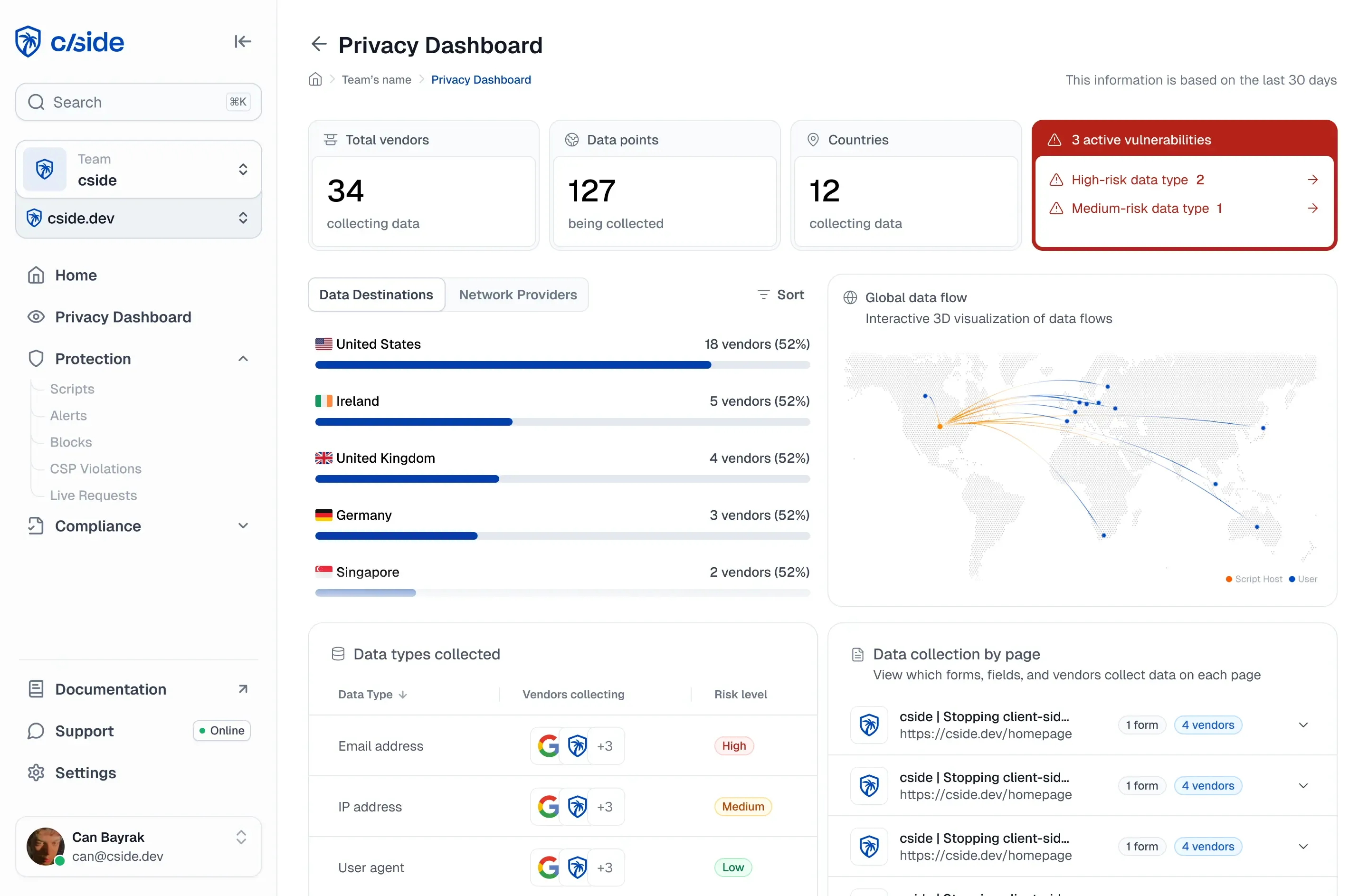

You can spoof almost everything a browser reports. A modern AI agent runs inside real Chrome, rotates through residential IPs, presents a clean fingerprint, and solves a CAPTCHA without slowing down. What it cannot fake convincingly is how a real person moves, scrolls, and types across an entire session.
That is what behavioral signals read, and it is the basis of behavioral AI agent detection. Instead of checking an identity once at the door, they watch how the visit actually unfolds: the curve of a mouse path, the rhythm of a scroll, the spacing between keystrokes, and the pauses an agent takes while a model decides what to do next. cside reads more than 250 signals from your own first-party JavaScript, on the live page, and the behavioral layer is the part automation struggles most to suppress.
This is a practical guide to those signals, why they work, and how to turn them into a decision.
TL;DR: behavioral AI-agent detection
- The problem: Fingerprint, IP, and CAPTCHA checks are point-in-time and spoofable. Behavior is produced live across a session and far harder to fake.
- The four signals: The behavioral layer has four parts: mouse trajectory, scroll cadence, keystroke spacing and typing rhythm, and an AI layer (reasoning latency plus AI-generated text).
- Why single signals miss: Modern LLM agents no longer rely on scripted input, so single-signal cadence checks miss them. The catch is cross-signal correlation.
- How cside fits: cside reads these signals from first-party JavaScript in real visitor sessions and feeds a real-time risk score into your login, checkout, and fraud stack.
- How to respond: Never block on one signal. Score on convergence and respond in graduated steps.
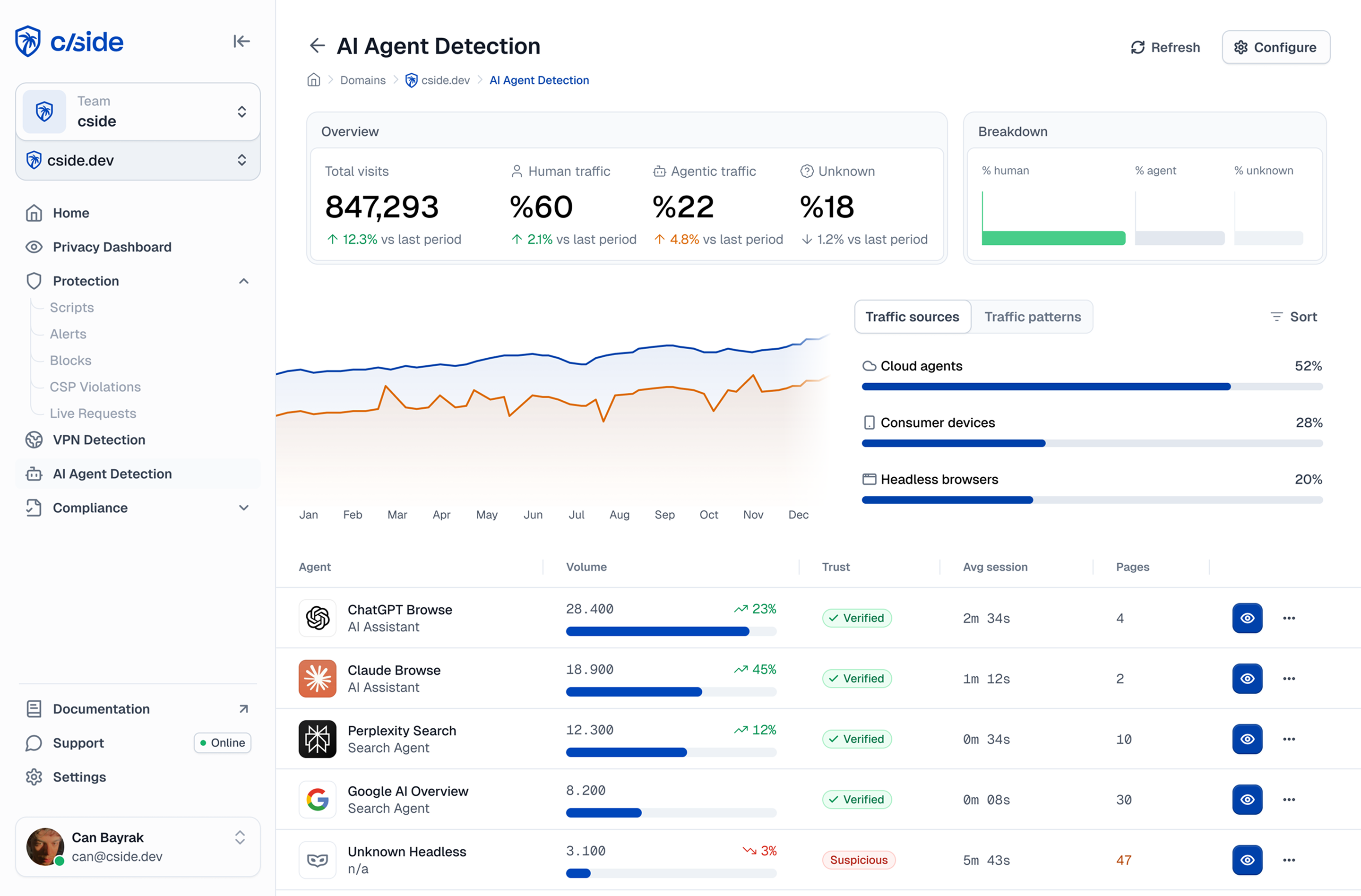
Short on time? See cside's AI-agent detection. It covers everything below in one deployment.
Why behavioral signals catch what fingerprinting misses
Behavioral detection reads how a session moves, scrolls, and types over time to separate real people from automation, rather than trusting what the browser reports at a single moment.
Static identity signals describe what a browser claims to be: its user-agent, platform, screen, fonts, and GPU. Every one of them can be rewritten. Anti-detect browsers exist to make a scripted session look like a fresh, ordinary device, and good ones stay internally consistent enough to pass a fingerprint check.
Behavior is different because it has to be produced live, every session, in response to your actual page. A real hand is governed by physics and a real brain by cognition. Mouse paths curve and overshoot, scroll speed rises and falls, and typing carries pauses, typos, and corrections. None of that is a value an operator can set in advance.
There is also a structural gap in one-time checks. A challenge tests the visitor once, at the door, and assumes everything after that is fine. That assumption is why visible challenges fail as a primary defense: a bot only has to look human for the length of the puzzle. Reading behavior across the whole session removes that blind spot.
None of this is new as a field. Analyzing keystroke and mouse patterns to tell people and machines apart is decades old. Keystroke-timing research goes back to the 1980s, and continuous authentication has used mouse and typing dynamics for years. What changed is the urgency. Now that AI agents drive real browsers at scale, the behavioral layer moved from a nice-to-have to the signal that actually separates a human from a capable agent.
| Property | Fingerprint / IP / CAPTCHA | Behavioral signals |
|---|---|---|
| What it checks | What the browser reports at one moment | How the session moves, scrolls, and types over time |
| Timing | Point-in-time, checked at the door | Continuous, across the whole session |
| Spoofable | Yes; anti-detect browsers rewrite it | Much harder; produced live in response to the page |
| Catches an agent in real Chrome | No | Yes |
The behavioral AI agent detection layers cside reads
cside groups interaction signals into four layers, weighted by how hard each is to fake.
| Behavioral layer | What a real person produces | What automation tends to produce | Why it resists faking |
|---|---|---|---|
| Mouse trajectory | Curved paths, micro-corrections near a target, physiological tremor | Straight lines or clean curves, identical velocity, same origin | Most mature layer in cside's stack; automation libraries have not reproduced human motion at scale |
| Scroll cadence | Short bursts with rising and falling velocity, pauses to read | Flat or step-function velocity, perfectly even intervals | Cheap to read and expensive to fake well, because natural reading rhythm depends on content the agent is not reading |
| Keystroke spacing and typing rhythm | Uneven intervals, characteristic hold times, backspaces and corrections | Near-zero variance, or an instant paste with no rhythm | The layer most detection stacks underuse, so it is rarely spoofed |
| AI layer: reasoning latency and generated text | Human think-time, human-written text | Inference round-trip pauses, model-generated text | Targets the agent's model itself, which scripted tooling cannot mask |
Mouse trajectory
Human cursor motion has structure that scripts rarely reproduce: micro-corrections near a target, acceleration and deceleration that follow Fitts's law, small lateral drift, and a physiological tremor that never fully settles. Automation tends to move in straight lines or mathematically clean curves, returns to the same origin, and reacts with identical velocity.
This is the most mature part of cside's behavioral stack, and the mouse-movement work is covered in depth in its own post. The short version: a behavioral model (cursor_v2) scores mouse motion against patterns automation libraries have not reproduced at scale. On controlled tests, it catches raw Playwright sessions at 98.2% recall and stealth-mode browserless sessions at 100%, at a human false-positive rate under 1% (see the headless browser detection method). Tooling that tries to learn human-like motion still leaves the cursor tells cside catches on Playwright and browserless traffic.
Scroll cadence
Scrolling produces the same kind of signal. Real users scroll in short bursts with a natural velocity profile: a push, a glide, a stop to read. Scripts that call window.scrollTo() or drive scroll through the DevTools Protocol produce flat or step-function velocity, perfectly even intervals, or jumps with no ramp. Scroll cadence is cheap to read and expensive to fake well, because natural reading rhythm depends on content the agent is not actually reading. cside reads scroll velocity and dwell directly from first-party JavaScript on the live page and scores it as one input into the convergence model, where a flat, content-independent scroll profile becomes meaningful only when it lines up with the other behavioral signals.
Keystroke spacing and typing rhythm (keystroke dynamics)
This is the layer most detection stacks underuse. Human typing is uneven in a specific way. The interval between keystrokes varies with finger travel and how familiar a letter pair is, the time spent holding each key sits in a characteristic range, and real input is full of backspaces and corrections. Scripted form fills go the other way: near-zero variance between keystrokes, or an instant paste of the whole value with no typing rhythm at all.
cside reads keystroke spacing and typing rhythm directly, measuring the variance in the timing between entries rather than the content of them. A field completed with metronomic precision, or filled faster than a human could physically type, is a strong signal on its own and a stronger one when it lines up with a linear mouse path.
The AI layer: reasoning latency and generated text
Scripted bots and LLM-driven agents fail differently, and the AI layer targets the difference.
An autonomous agent usually pauses between actions while its model decides what to do next. That pause has a machine signature: it is a round-trip to an inference step, not a person reading the screen and hesitating. cside reads the latency between entries and actions and flags the reasoning-latency pattern that agent-driven sessions leave, which looks different from human think-time even when the agent adds delays to appear more human.
The second AI signal is the content itself. Alongside behavioral timing, cside includes an AI-generated-text detection engine: when a visitor submits text through a form, cside scores whether a person wrote it or a model generated it. That turns the text of a support message, a review, or a signup field into another input for separating a trusted agent from an abusive one.
[MID_BLOG_CTA]
The misconception: behavioral analytics only catches scripted bots
The common objection is that behavioral detection only works against crude, scripted bots, and that a capable AI agent walks right through it. That was closer to true when the main tell was a hardcoded mouse.move(x, y) call. It is not true now.
Modern agents do not always use scripted input. Some drive a real browser and even train on human interaction traces to move and type more naturally. What they still cannot do is stay coherent across every signal at once. An agent can smooth its mouse path and still fill a form faster than any human. It can jitter its typing and still pause with a machine-perfect reasoning latency between steps. The catch is not one perfect signal; it is the contradictions between them.
No single signal decides: cross-signal correlation
Every behavioral signal produces false positives in isolation. Assistive technology automates input. People on trackpads move nothing like people on mice. A fast, practiced typist can look almost scripted. Blocking on any one reading would punish real customers.
So the model works on convergence. cside scores across 250+ browser, device, and behavioral signals and looks for internal contradictions. A session that claims to be an ordinary desktop but runs an automation control surface, types with no variance, and arrives from a datacenter IP is telling a story that does not hold together. One soft signal is a question. Several independent signals pointing the same way is an answer.
Where you read the signals matters
Behavioral detection is only as good as its vantage point. cside runs as first-party JavaScript inside real visitor sessions, on the live page, so it reads raw interaction signals directly rather than inferring them after the fact. Those signals become a real-time risk score you can feed into the moments that matter: login, signup, and checkout.
That placement is also what makes the signals actionable. Because the score lands in your own stack, you decide the response per request instead of accepting a single verdict from an outside box.
What to do when you detect an AI agent
Detection is only useful if it drives a graduated response. Not every agent is abuse; some automation is welcome, and telling humans, good bots, and malicious agents apart is the point of intent scoring.
- Instrument the behavioral signals at runtime, inside the session, alongside device and network context.
- Score on converging independent signals, not on the single strongest one.
- Allow known-good automation and real customers to pass untouched.
- Challenge or step up medium-confidence sessions with friction.
- Block or hold high-confidence abuse at login, signup, and checkout, and keep the raw signals and risk reason as an audit trail.
cside's AI Agent Detection and Bot Detection run this from inside the page: they read mouse, scroll, and typing signals, capture device and real-IP context, score intent in real time, and let your team allow, challenge, or block per request through the SDK.