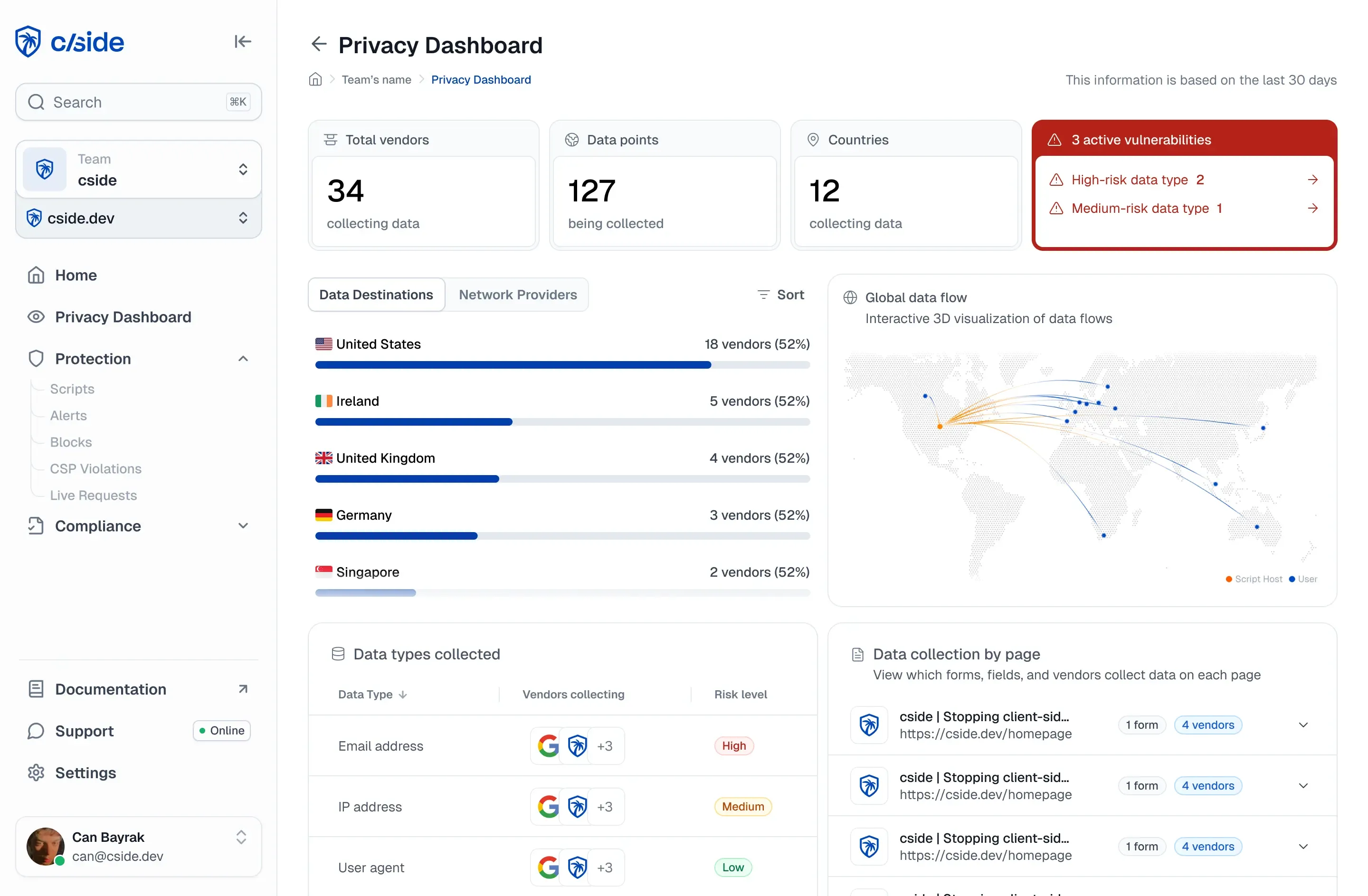

TL;DR: multi-layer client-side security stack for high-velocity ecommerce marketing tags
- Most scanners are just Playwright: Most ecommerce client-side vendors are just Playwright or Puppeteer with a fancy dashboard. In 2026 you can build one in Cursor in days, and attackers already fingerprint the scanner and serve it clean pages.
- Layered detection with LLMs: cside pairs an in-browser Script Method with a Scan Method backed by threat intelligence from thousands of sites and billions of visitors, then layers self-hosted open-source LLMs to auto-write compliance justifications with no data leaked to third-party AI.
- How to layer it: If a marketing team injects tags into Google Tag Manager without security review, add cside's Script Method for live behavior. If script installation is impossible, use the Scan Method. Serious sites run both plus a CSP endpoint.
Short on time? See cside's in-browser Magecart and skimmer blocking. It covers everything below in one deployment.
TL;DR:
- The problem: eCommerce sites have large amounts of client-side marketing, tracking and support tooling. Client-side tooling is inherently dynamic and serves different content depending on location and device, often while running active A/B tests. A static check does not suffice.
- Need: Fast paced eCommerce environments need AI enabled tooling to perform non-revenue generating tasks like compliance justification writing. The financial risk on an eCommerce brand as the result of an attack is severe. That risk expands the scope from compliance to active threat analysis.
- The best client-side security approach for eCommerce: cside is the best tailored solution for eCommerce brands through its fast to implement multi-layer security solutions using AI to minimize manual work.
What Client-Side Security Means in eCommerce?
Client-side security is the practice of protecting the JavaScript dependencies, user data and behaviors that run inside the browser of the visitor.
This includes:
- First-party scripts: JavaScript files loaded from your own domain
- Third-party scripts: from analytics tools, ads, chatbots, tag managers, A/B testing tools
- Inline scripts, embedded content like widgets and SDKs
- Data processed or fetched by the browser
Anything that happens after the initial HTML response by the webserver is a client-side action. Attackers increasingly use the browser to execute malicious actions in an attempt to obtain sensitive information. Where data is fetched from 3rd party domain, scripts often serve differently based on IP, request headers, time of the day, location etc.
For example: a marketing tool will collect different data in Europe from the USA for data privacy compliance.
What Security Practitioners See in eCommerce Environments
The business requires revenue. eCommerce sites often operate on tight margins and face various threats from friendly fraud to attacks aiming to obtain credit card information, user credentials, address information, telephone numbers and more.
Especially at high volumes of transactions, optimizing flows and feedback loops is a vital skill for a business. Marketing teams are constantly testing and implementing new client-side tracking using tools from startups to established large vendors.
The risk: lots of client-side scripts. Marketing teams injecting scripts into Google Tag Manager without security approval or even worse, 3rd party managed Google Tag Manager containers.
The priority is the business and often security isn't able to move quickly enough and calculated risk taking creates considerable risk.
How Client-Side Security Works at Runtime
Webpage renderings are unique and take into account dynamicness. A request from Europe will get a different script content from one originating from the US. A mobile device will get a different script from a desktop. This dynamicness is a feature, but bad actors and scripts with questionable privacy intentions use this entropy to hide their intentions. Therefore, a runtime solution is required to cover the gap.
How Security and Privacy Compliance Converge in eCommerce
For eCommerce, the risk of client-side scripts performing malicious actions is part of the problem. But customer data handling is generally a concern even by legitimate parties.
As such, the privacy compliance angle matters a lot.The most helpful solutions here offer both. Active runtime security for scripts performing malicious actions and trusted safe scripts collecting data that you may prefer they didn't collect.
With cside's solutions you can effectively manage which data each script can access, and also detect malicious scripts attempting non-standard or malicious actions
What does the right tool look like?
A layered approach is best. Especially if the solution in question is customizable and creates transparency and control where there was lacking control before.
That is why we built cside as a platform leveraging all the different layers available to date.
cside offers two complementary deployment methods, paired with multiple detection engines including open source Large Language Models for analysis.
- Script Method (Easiest): we check script behaviors in the browser and fetch the scripts on our side, then verify we got the same script. Your site traffic is never routed through cside. Easy to implement, no performance impact, and you can still stop script actions or block by URL, hash, or domain.
- Scan Method (Fastest): if you can't add a script to your site, cside scans it using threat intelligence from thousands of other websites with billions of combined visitors. Fast to set up and useful when script installation isn't possible.
We also offer a Content Security Policy endpoint so customers can layer browser-native enforcement alongside cside's JavaScript-based detection.
Another important factor is using a tool that leverages self-hosted, open-source AI models to reduce manual compliance tasks to a minimum while avoiding IP leakage to AI vendors.
Why Single-Layer tools fail in eCommerce
Solutions that rely on only one of the methods above are easily bypassed.
Most solutions in this space are simple website scanners. Vendors come up with fancy names like 'proprietary browser' or 'agent-less' but fundamentally it's a simple automated browser like Playwright or Puppeteer scanning a website. Today, in 2026, you can use a tool like Cursor to build a solution like that in a matter of days.
The problem remains: a bad actor sees the scanner and will not serve malicious content to it. The dashboard will show interesting looking data and therefore create a false sense of security but the script behaviors you have to worry about will not show.
Conclusion: Why a Multi-Layer Client-Side Security Model Is Required for eCommerce
Solutions like cside's Client-side security suite together with Privacy Watch and PCI Shield by cside cover the client-side attack vector best with the most comprehensive approach.
This makes it easy to achieve compliance while also protecting your customers and your business.
Ready to check cside out? Start for free or book a demo to have a chat with our team.