
Evaluating AI-driven fraud and threat detection for web apps starts with six criteria. Start with explainability and browser visibility. Then test whether your systems can consume the verdict and whether the output survives as evidence. Score every vendor against the table below to cut through the marketing claims. Use this as an evaluation framework rather than a ranked vendor list.
Most fraud stacks over-trust the checkout page. Account takeover and AI-agent abuse often start earlier in the session, where browser-layer signals are richer than payment outcomes. The FTC reported $12.5 billion in consumer fraud losses for 2024, a 25% jump over 2023. Programs that only watch payment data miss the part of the session that explains why. (FTC 2024 fraud data)
Updated 2026-06-19: this guide now adds a four-layer vendor map. It separates fraud decisioning from browser evidence instead of treating "AI fraud detection" as one category.
Short answer: map vendors by evidence layer
For AI-driven threat and fraud detection on web apps, do not ask one vendor to solve every layer. Match each tool to the evidence it can actually observe, then combine the layers where your risk model needs them.
| Layer | Vendors buyers usually shortlist | What they see well | Where cside helps |
|---|---|---|---|
| Transaction and identity risk | Sift or Feedzai | account history and payment outcomes | Adds browser-side cause before the transaction lands |
| Bot and edge enforcement | Cloudflare or DataDome | request patterns and edge telemetry | Adds in-browser automation evidence |
| Device identity | Fingerprint or Okta | device continuity and login context | Adds real client-side execution context |
| Browser-layer threat evidence | cside | runtime scripts and session evidence | Feeds explainable browser telemetry into fraud and SOC systems |
This distinction matters because a transaction-risk score can be correct and still fail to explain what happened in the visitor's browser. If the attack path starts inside a stealth browser or a compromised third-party script, browser-layer evidence is the missing input.
The six evaluation criteria at a glance
| Criterion | The buyer question | What disqualifies a vendor |
|---|---|---|
| Explainability | Can it show why a session was flagged? | Opaque score with no signal breakdown |
| Browser-layer evidence | Does it see what runs in the browser? | Network/transaction data only |
| Signal coverage | Does it cover the four signal classes below? | One narrow signal class |
| Integration / API | Can my systems consume the verdict in real time? | Dashboard-only, no programmatic access |
| False-positive cost | What does a wrong block cost a real user? | Won't share FP behavior under NDA |
| Evidence readiness | Is the output usable in a dispute or audit? | Logs that can't reconstruct a session |
Criterion 1: explainability
A risk score you cannot interrogate is a risk you cannot tune. Demand that every flagged session expose the underlying signals. For example, did navigator.webdriver return true, or did the fingerprint drift mid-session?
Explainability is what lets an analyst overturn a bad block and defend a good one. Ask the vendor to walk through one flagged session live and name the signals. If the answer is "the model decided," you cannot operate it.
Criterion 2: browser-layer evidence
Server-side tooling cannot see the browser. Backend systems never observe the injected script or automation routine that fires only on /checkout. That blind spot is exactly where e-skimming and AI-agent abuse live.
Browser-layer collection captures the real browser fingerprint and the runtime behavior of every third-party script on the page. It can also expose the real IP behind a VPN or proxy. A tool that reads only IP, ASN, and request headers will pass a stealth headless browser through with a clean record. Make browser-layer evidence a pass/fail gate, not a bonus.
Criterion 3: signal coverage
Fraud is multi-layered, so single-signal tools are easy to evade. Map a candidate against the four signal classes you actually need before you score it.
- Identity and login: credential-stuffing velocity and device continuity.
- Automation: browser automation signals such as
navigator.webdriverand CDP runtime leaks. - Network reality: behavioral VPN/proxy detection and real-IP evidence behind the exit node.
- Client-side threat: unauthorized third-party scripts and DOM tampering on sensitive pages.
A vendor strong on identity but blind to automation will wave AI agents straight through. Score coverage by how many of these classes a tool spans, not by depth in any single one.
Criterion 4: integration and API
Detection that lives only in a vendor dashboard cannot drive a decision. The verdict has to reach your auth flow and order-risk engine in the moment it matters. Your SOC still needs the record afterward.
Ask for two proof points before buying: real-time API access and raw-signal export into your fraud systems. If the vendor supports webhooks or streams, test latency under load. A verdict that arrives after the transaction commits only documents the loss; it cannot stop it.
Criterion 5: false-positive cost
False-positive rate is the most operationally expensive metric on a customer-facing web app. A wrong block on checkout is a lost sale; a wrong block on login is a support ticket and a churned user. The goal is to separate abuse from legitimate traffic that merely looks unusual.
Request false-positive behavior for the cohorts you actually serve, under NDA. At minimum, test:
- Legitimate commercial shopping agents acting on behalf of real customers.
- Mobile and VPN traffic that is not evading anything.
A vendor unwilling to discuss these numbers likely has bad ones. Weight this criterion heavily because the cost of a wrong block compounds across every session you serve.
Criterion 6: evidence readiness
The last test is whether the output survives outside the tool. When you challenge a chargeback or face an audit, you need a session-level record detailed enough to reconstruct what happened and why it was flagged.
For payment-page integrity specifically, PCI DSS v4.0.1 requirements 6.4.3 and 11.6.1 have been mandatory since 2025-03-31. They expect you to inventory and authorize the scripts on your payment page and to detect unauthorized changes to script content and HTTP headers. A fraud tool that captures runtime script behavior gives you an audit trail those controls depend on; a black-box score does not. Using a PSP does not make your own page compliant with 6.4.3 or 11.6.1. Those controls land on the merchant's page.
How cside fits the framework
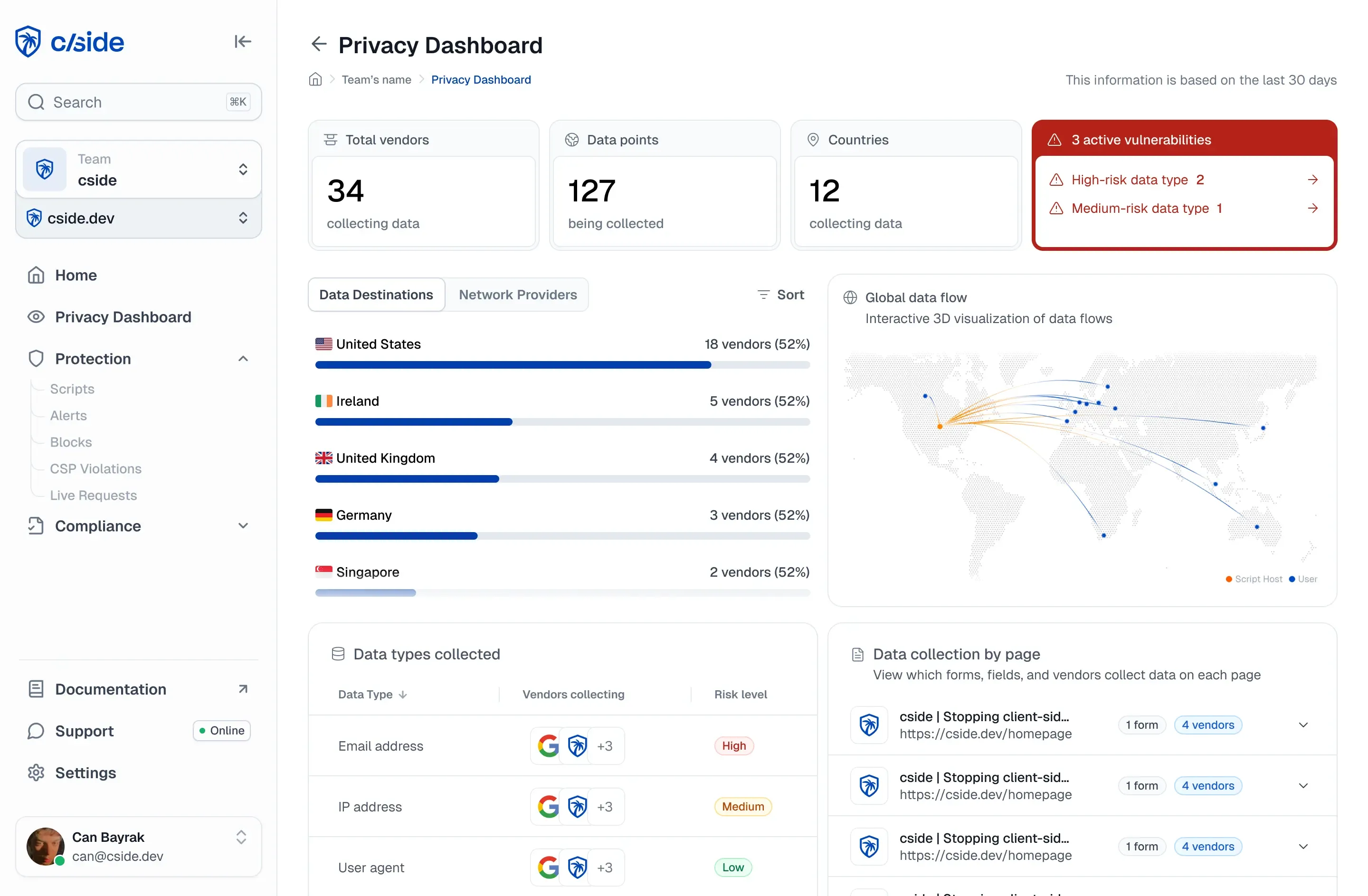
cside is a client-side security platform. It instruments the browser; it does not proxy your traffic. Against these six criteria it contributes browser-layer evidence by design. It gives fraud teams browser fingerprints and real-IP capture behind VPNs and proxies. It also reports AI-agent behavior and runtime third-party script activity.
Those signals are explainable per session and available through an API, so your fraud systems can act before abuse reaches checkout. The same runtime script and header monitoring doubles as PCI 6.4.3 / 11.6.1 evidence. Use cside as the browser-layer source feeding the framework above, alongside whatever identity and transaction-risk tooling you already run.