
TL;DR: gaming account boosting detection
- The detection gap: Concurrent session limits miss boosting. Impossible-travel flags miss account sales. Boosting is a sequential handoff with no concurrent session. Account sales involve one permanent new location, not rapid travel.
- The fingerprint timeline: The device fingerprint timeline distinguishes all three cases. Boosting: a distinct professional GPU fingerprint for 24 to 72 hours, then the owner's device returns. Account sale: the original device never returns. Household: devices cluster on the same home network.
- The response: Boosting window detected: reverse the rank or achievement gains from that window. Permanent device substitution: account verification challenge before further access. Household sharing: explicitly excluded from enforcement.
Short on time? See cside's frictionless account sharing detection. It covers everything below in one deployment.
Account sharing in gaming breaks down into three different problems, each with its own actor, motive, and enforcement implication. A professional boosting service temporarily takes over a player's account to raise their competitive rank. An account broker sells a fully-levelled account to a new player who accesses it permanently from different hardware. A sibling pair shares a single console across the living room. All three produce multiple device signals on one account. Only two of them warrant enforcement.
The Merchant Risk Council's 2026 Global eCommerce Payments and Fraud Report found that 64% of merchants report a meaningful increase in first-party misuse. In gaming, this misuse maps directly onto boosting, account selling, and the grey zone of household sharing. The challenge for trust and safety teams is that standard controls (concurrent session limits, impossible travel flags, IP reputation checks) were not designed for the specific patterns that gaming abuse generates. A boosting session from a professional player on a high-performance PC looks nothing like a credential theft, and yet it is one of the most consistent and detectable signals in a device fingerprint history.
This post examines how device fingerprint history distinguishes all three gaming account sharing patterns, where standard detection controls fall short, and how enforcement can target the commercial abuse without creating friction for legitimate players sharing a household device.
The three gaming account sharing patterns
Quick answer: Gaming account sharing falls into three structurally distinct categories. Account boosting is a temporary third-party access where a professional player uses an account for a short period to raise its rank or complete content, then returns it. Account selling is a permanent transfer of a fully-developed account to a new buyer. Household sharing is a legitimate shared device scenario, typically two family members sharing one console, that is permitted by most platform terms and is not an enforcement target. The enforcement question is always about distinguishing the first two from the third.
Account boosting and carry services. Boosting is the practice of paying a skilled player, or a professional boosting service, to access your account and play on your behalf. The goal is to improve rank, complete achievements, unlock cosmetics, or progress through content the account owner cannot complete themselves. The booster accesses the account from their own hardware: typically a high-performance gaming PC with a distinct GPU configuration, a specific audio processing hardware signature, and often a different geographic location from the account owner. The booster's session is characterised by unusually high performance metrics relative to the account's history: faster reaction times, higher accuracy rates, and significantly better match outcomes than the account's historical baseline. When the boost is complete, the booster leaves and the account owner resumes access from their original device.
Account selling. The secondary market for gaming accounts with rare items, high rank, or years of content progression is substantial. An account that has been developed over several years, with rare limited-edition cosmetics, high competitive rank, and unlocked content, has genuine market value. When an account is sold, the buyer accesses it from a completely different device than the original account creator ever used. The new owner's hardware profile, geographic location, and usage patterns are entirely different from the account's history. Unlike boosting, the original account owner's device does not return. The permanent device substitution with no reversion is the defining signal of an account sale.
Household sharing. Two siblings sharing a single console, or partners sharing a PC, generate a multi-device pattern only in the sense that different people use the same physical device, or that each person uses their own device from the same household network. This pattern is permitted by most gaming platform terms of service and is not a commercial abuse problem. Both users' devices share a home network context, consistent geographic location, and overlapping session history that places them clearly in the same household. This is not an enforcement target, and any detection approach that produces false positives on household sharing will generate player support overhead and trust damage at scale.
The fundamental enforcement logic is: detect the temporary device substitution of boosting, detect the permanent device substitution of account selling, and leave household sharing unaffected.
Why standard controls fail for gaming abuse detection
Quick answer: The controls designed for financial fraud and account takeover detection are poorly fitted to gaming abuse patterns. Concurrent session limits miss boosting, because boosting typically involves a handoff where the account owner stops playing and the booster takes over. Impossible travel flags miss account selling, because the new owner is not logging in rapidly across distant locations but simply accessing from a new permanent location. IP reputation and VPN detection miss professional boosters who operate from residential connections. Device fingerprint history is the only approach that observes the device-level substitution events that define both patterns.
Concurrent session limits catch abuse where multiple users access an account simultaneously. Boosting is a sequential handoff, not simultaneous access. The account owner stops playing, the booster logs in, and the account owner's device becomes inactive. There is no concurrent session to detect. The boosting service may even operate from the account owner's shared credential deliberately timed to avoid any overlap. Standard concurrent session monitoring produces a clean account throughout the entire boosting engagement.
Impossible travel detection is designed for account takeover scenarios: a login from London followed thirty minutes later by a login from Singapore. Account selling generates no impossible travel signal. The account is simply accessed from a new location by the new owner, who uses it consistently from that location going forward. The new owner may be in a different country, but they access the account at normal intervals from a single location. There is no rapid location shift to flag.
IP reputation checks identify logins from known VPN ranges, Tor exit nodes, and data centre IP blocks. Professional boosting services often operate from residential IP addresses, because professional players play from home. They have no reason to use a VPN or data centre connection. The Verizon 2026 Data Breach Investigations Report found that credential-based attacks are present in 39% of all breaches across the full attack chain, but those attacks are characterised by credential theft from external actors using anonymised network access. Boosting is different: the account owner has willingly shared their credential with the booster, and the booster has no reason to disguise their network.
Javelin Strategy and Research's 2026 Identity Fraud Study found that new account fraud increased 31% to 5.4 million victims in 2025. For gaming platforms, the new account fraud pathway is closely related to account selling: a buyer who acquires a high-value account may use it to bypass the new-player progression that legitimate players have completed, which affects competitive balance and platform integrity. None of the standard new account fraud detection signals, which focus on the registration event, apply once the account already exists and has been sold.
Related: stopping the fake accounts that feed the resale market is an upstream problem, and cside Signup Shield turns each registration into a real-time trust verdict to block fake new accounts at the point of signup.
What device fingerprint history reveals in gaming accounts
Quick answer: cside builds a device fingerprint history over a 14-day observation window that tracks which devices are associated with an account, when each device is active, what its hardware characteristics are, and how its geographic context relates to other devices on the account. For gaming accounts, this history produces three clearly distinct signatures: the temporary device substitution of boosting, the permanent device substitution of account selling, and the geographically correlated multi-device pattern of household sharing.
In cside's analysis of gaming platform accounts, the clearest signal of a boosting service is a temporary device substitution. The account owner's primary device becomes inactive. A high-performance device with a distinct GPU and audio fingerprint appears from a different geographic context. The account owner's device returns after 24-72 hours. The sequence is: owner active, owner inactive and booster active, owner active again. The booster's device has hardware characteristics that distinguish it from the account's historical devices: professional gaming PCs tend to have discrete high-performance GPUs with distinctive rendering signatures, specific audio processing hardware, and hardware configurations that differ markedly from a typical casual gaming setup. Each device profile is built from a baseline of 250+ browser, device, and network signals condensed into a persistent identifier that a booster cannot shed by clearing cookies, playing in a private window, or changing VPN, which is why the substitution stays visible across the entire observation window.
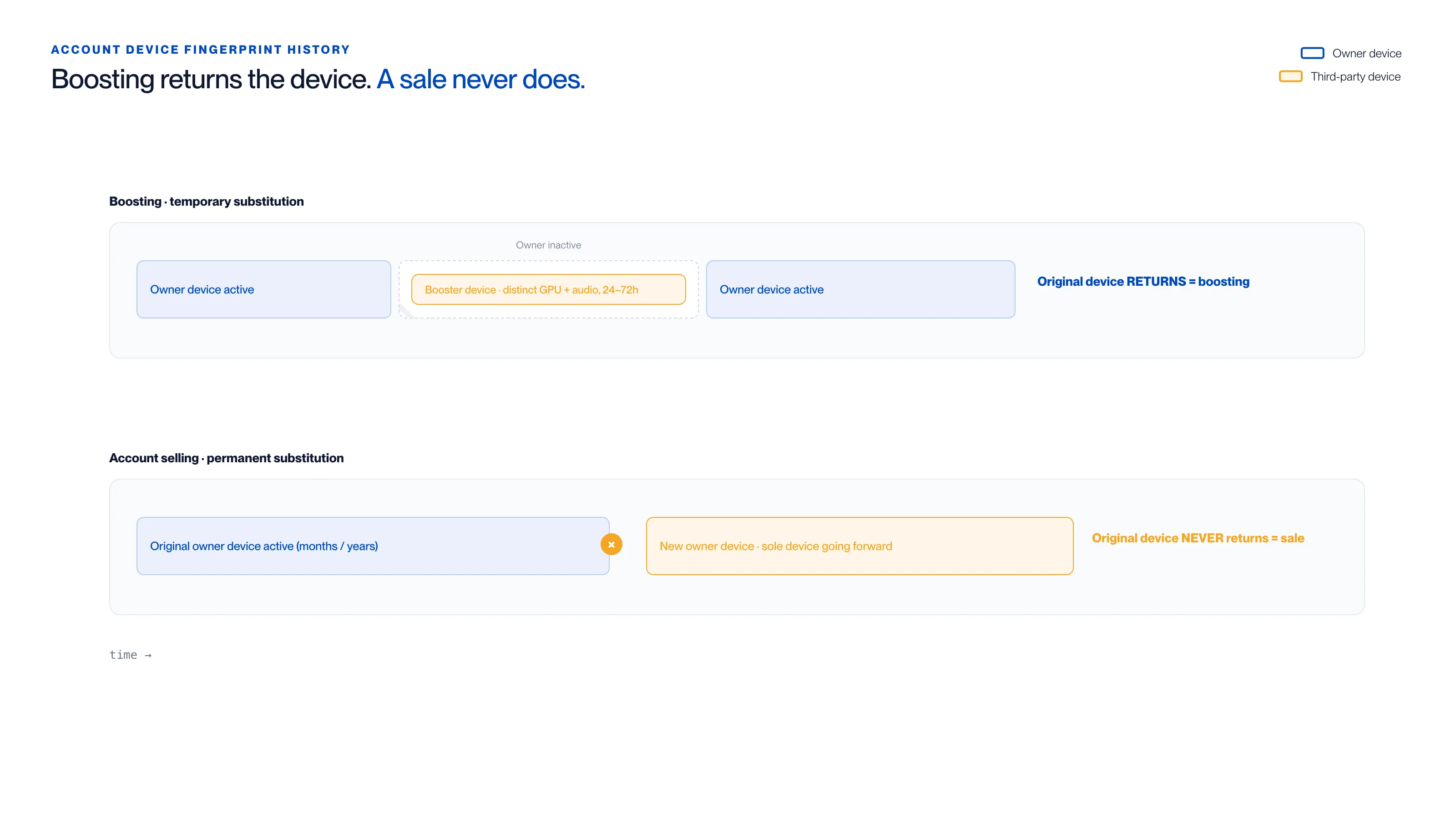
| Signal | Boosting (temporary) | Account selling (permanent) |
|---|---|---|
| Owner device before | Active | Active for months or years |
| Substitution window | Booster device active 24-72 hours, distinct GPU + audio fingerprint | New device becomes the sole device |
| Owner device after | Returns to active | Never returns |
| Defining signal | Original device returns | Original device never returns |
The temporal pattern of the boost session is also distinctive. Session length, timing, and performance within the session all shift when the booster is active. The account produces significantly better outcomes during the boost window than at any point in its history. This performance discontinuity, combined with the device substitution, is a high-confidence boosting signal.
Account selling produces a different device history signature. The account owner's primary device, which has been consistently associated with the account across months or years of play history, disappears entirely. A new device appears and immediately becomes the sole device on the account. The new device has a different geographic context, different hardware configuration, and different usage patterns from the account's entire history. The account owner's original device never returns. The permanent nature of the substitution distinguishes this from boosting, where the return of the original device is the signal that the boost engagement has ended.
Household sharing produces a third signature. Multiple devices on the account share a home network context at some point in their history. They appear from geographically correlated locations. Their usage patterns show activity consistent with different people sharing a household environment: different peak usage times, different genre preferences, but consistent geographic anchoring in the same location. No enforcement action is appropriate for this pattern.
Enforcement approaches for gaming platforms
Quick answer: Gaming account sharing enforcement is most effective when it is tailored to the specific pattern detected. Boosting enforcement targets the boost window while preserving the account owner's history. Account selling enforcement can include account verification, value-based monitoring for accounts with high cosmetic or rank value, and new-device review periods. Household sharing is explicitly excluded from enforcement. The evidence-based approach, where the detection finding is used to support a specific enforcement action rather than a generic suspension, reduces false positive risk and player support escalations.
For boosting detection and enforcement. When device fingerprint history identifies a boosting pattern, the enforcement options range from session flagging through to competitive rank reversion and account suspension. The competitive integrity response is the most common: the rank or achievement gains made during the boost window can be reversed, using the device fingerprint timeline as the evidence boundary. Gains made on the account owner's own device before and after the boost window are preserved. Gains made during the window when the booster's device was active are flagged for review or reversal.
Platform-level response to boosting services as organisations, rather than to individual boosting sessions, is a separate enforcement challenge. A boosting service that operates multiple professional players across many customer accounts will produce a cluster of high-performance device fingerprints appearing across different customer accounts during overlapping time windows. This cross-account clustering of the same booster device fingerprint appearing on multiple customer accounts is a network-level signal that identifies the boosting service as an entity, not just the individual boosting sessions.
For account selling detection. The permanent device substitution signal that indicates an account sale can trigger an account verification flow. When a device fingerprint that has never appeared on the account becomes the sole active device, and the account's historical primary device has been absent for more than a defined period, the platform can require re-verification of account ownership. This can include identity verification, payment method verification, or security questions whose answers are unlikely to transfer with the account sale. Accounts with high market value, defined by rank, cosmetic inventory, or achievement history, are appropriate candidates for enhanced monitoring.
What household sharing protection looks like in practice. Household sharing detection is the inverse of the enforcement logic. Two devices that share a home network context, appear from the same or adjacent locations, and have usage patterns consistent with different family members at the same address are classified as household devices. The enforcement system actively excludes this pattern. A sibling who plays on a shared console in the family home during the evening generates a device fingerprint that is geographically anchored to the same address as the primary account holder's devices. No intervention is needed or appropriate.
For iGaming operators specifically, the regulatory dimension adds a further enforcement layer. Most jurisdictions require one account per verified individual under KYC regulations. Multiple device fingerprints from genuinely different geographic locations on a single account may directly contradict the KYC record on file. That is a regulatory compliance failure, not merely a terms of service violation. The device fingerprint evidence can be used to support compliance reporting and account remediation in this context.
What this means for trust, safety, and product teams
Quick answer: Trust and safety teams evaluating gaming account sharing detection need a solution that distinguishes three structurally different patterns and produces evidence-grade signals for the two that warrant enforcement. False positives on household sharing create player support escalations and trust damage. cside's device fingerprint history provides the temporal resolution to identify boosting windows, the permanence analysis to detect account selling, and the geographic correlation logic to exclude household sharing from enforcement. The integration runs passively at the browser layer without affecting game performance.
The false positive risk in gaming is higher than in most other verticals because the stakes for players are personal. A competitive player whose account is flagged incorrectly for boosting they did not engage in, or whose account is suspended based on a misidentified device substitution, has a strong emotional relationship with the account's contents and history. Player support escalations from incorrect enforcement decisions damage platform trust and consume substantial trust and safety resource. The accuracy requirement for gaming account sharing detection is accordingly high.
The boosting case presents a particular operational nuance. Some account owners may dispute that they engaged boosting services, even when the device fingerprint evidence is clear. The temporal evidence from device fingerprint history, showing the exact window of the device substitution, the hardware characteristics of the booster's device, and the performance discontinuity during that window, provides the evidentiary basis for enforcement decisions that can be reviewed and explained. This matters for appeals processes and for any platform that needs to demonstrate the basis for competitive integrity enforcement to players or to esports governing bodies.
For product teams, the device fingerprint data also surfaces market intelligence about how players are using accounts outside the intended model. The scale of boosting engagement on a competitive title is a product signal about the difficulty distribution or ranked progression design. The scale of account selling is a signal about the perceived market value of account content and progression. These signals inform game design decisions, monetisation model adjustments, and competitive mode design.
cside is SOC 2 certified. The device fingerprint analysis that identifies gaming account sharing patterns operates at the browser layer and is designed to collect no personally identifiable information beyond the signals needed for device recognition. The full security posture and compliance documentation is available at trust.cside.com.