Approches courantes de la sécurité côté client
1. Politiques de sécurité du contenu (CSP)
Les CSP sont des outils natifs de navigateur qui définissent les domaines tiers autorisés à exécuter des scripts. Bien qu’utiles en théorie, les CSP présentent de sérieuses limites :
- Ils n'analysent pas le comportement du script, uniquement l'URL source.
- Ils ne parviennent pas à détecter les scripts dynamiques qui changent en fonction du contexte utilisateur.
- Les violations CSP provoquent des erreurs de console, ce qui frustre les développeurs et réduit l'adoption.
Comme on le voit dans l'attaque Polyfill il y a à peine 6 mois, faire confiance uniquement à une URL source peut être dévastateur.
2. Approches basées sur des robots ou « scanner »
Les outils basés sur des robots analysent périodiquement les sites Web pour détecter les scripts malveillants. Cette approche est cependant réactive et facile à contourner :
- Les attaquants détectent et transmettent facilement des scripts propres aux robots d'exploration, contournant ainsi la détection.
- Les outils d'exploration échantillonnent souvent le trafic, ce qui signifie que les attaques ciblant un petit pourcentage d'utilisateurs passent souvent inaperçues.
- Ils ne peuvent pas surveiller les sessions spécifiques à l'utilisateur ni capturer le véritable script affiché dans le navigateur.
3. Détection côté client basée sur JS
Les solutions basées sur JS surveillent les scripts au sein du navigateur mais souffrent de défauts majeurs :
- Ils fonctionnent essentiellement comme des pièges, mais les pièges sont visibles afin que les mauvais acteurs puissent contourner la détection.
- Cette approche manque de visibilité historique, ce qui signifie qu'elle ne peut pas suivre l'évolution du script au fil du temps ni fournir d'analyses légales.
Avec des réglementations telles que PCI DSS qui exigent fermement des contrôles côté client, ces techniques sont utilisées pour cocher rapidement la case d'audit. Mais ils n’offrent pas une véritable protection. Ils exposent les entreprises à des attaques sophistiquées qui évoluent plus rapidement que ces outils ne peuvent réagir.
Lisez un guide de comparaison et de sélection détaillé ici. Pour une évaluation technique plus approfondie de l'approche offrant la couverture la plus complète, voir quelle plateforme offre la surveillance de scripts côté client la plus complète.
Que rechercher dans un outil de sécurité côté client
Chez cside, nous avons redéfini la sécurité côté client en comblant les faiblesses des approches traditionnelles. Notre approche combinée Méthode Script et Méthode Scan permet :
- Analyse du comportement des scripts :
Contrairement aux outils qui échantillonnent le trafic ou s'appuient sur des flux de menaces, cside surveille le comportement et le flux de données de tous les scripts tiers. Cela signifie :- cside voit à quelles données les scripts accèdent et où ils les envoient
- cside surveille les manipulations DOM, les écouteurs d'événements JavaScript, etc.
- La possibilité de bloquer les scripts
cside vous permet de définir des politiques pouvant bloquer certains scripts en fonction de comportements ou de domaines sources. Les scanners ne peuvent pas bloquer les scripts. CSP peut bloquer les scripts mais sur la base de données limitées. Un vrai côté client sécurité L'outil vous permet de bloquer les menaces avant qu'elles ne deviennent des violations majeures. - Analyse de script basée sur l'IA
Notre plateforme exploite des modèles d'IA avancés pour analyser les scripts de manière intelligente et autonome. Contrairement aux flux de menaces statiques, cside détecte les modèles qui échappent aux outils traditionnels, notamment :- Injections de scripts dynamiques.
- Charges utiles évasives adaptées à des zones géographiques, des adresses IP ou des sessions utilisateur spécifiques.
- Impact sur les performances
La sécurité ne doit pas se faire au détriment de l’expérience utilisateur. Vérifiez l'architecture de déploiement de la solution de sécurité côté client que vous évaluez et demandez aux fournisseurs quelle latence leur outil ajoute à votre site Web. - Tableaux de bord de conformité
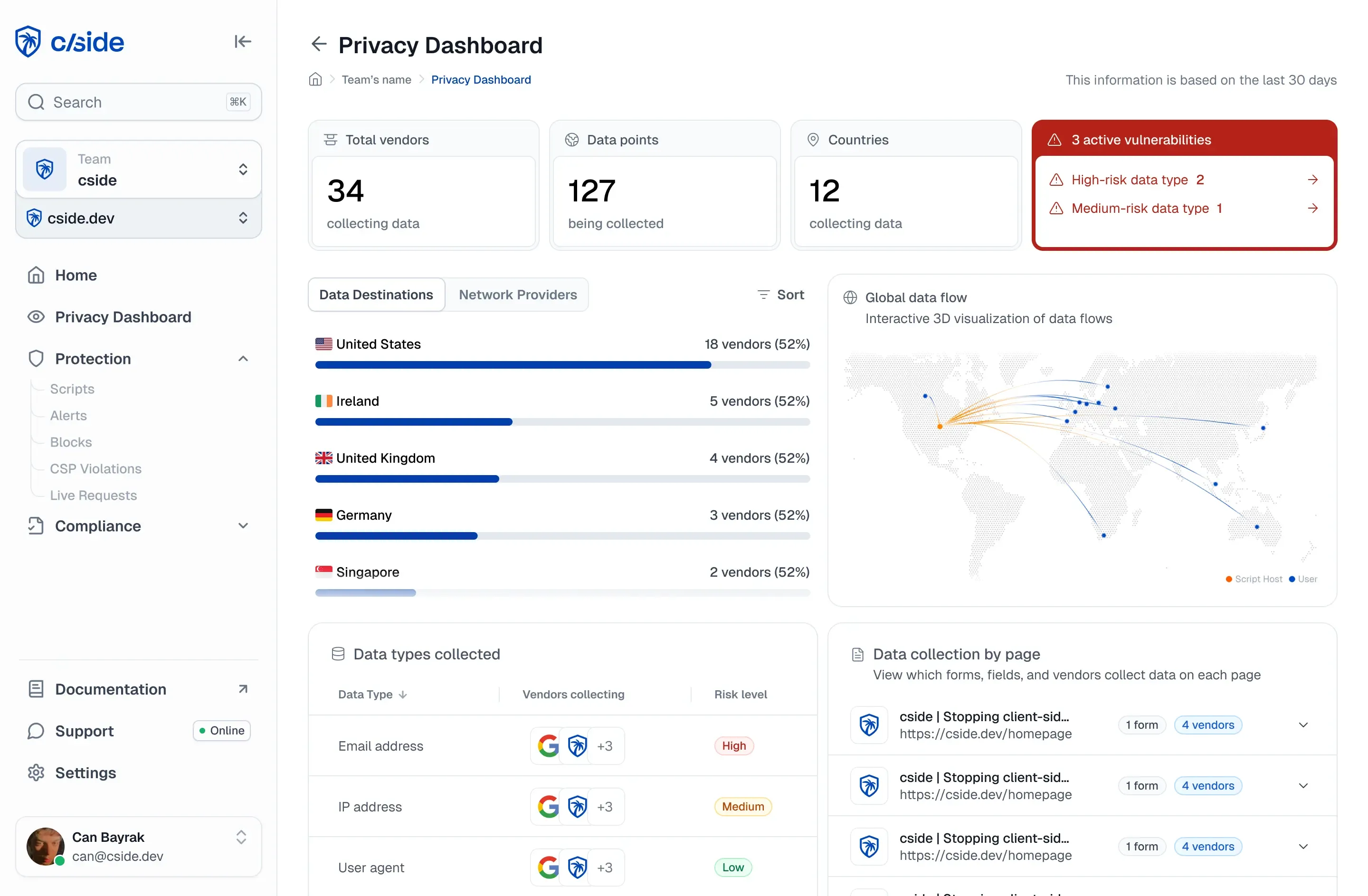
Pour répondre aux exigences de la norme PCI DSS 4.0.1, vous avez besoin de preuves formatées selon les attentes de l'auditeur. Le RGPD, le CCPA et d'autres cadres exigent des contrôles côté client pour la protection des données. Votre outil de sécurité côté client doit automatiquement mettre en forme les données collectées dans des formats spécifiques au framework. cside propose cela via des tableaux de bord, des rapports et des journaux de preuves prédéfinis formatés conformément aux exigences réglementaires. - Expérience utilisateur intuitive
Certains tableaux de bord de cybersécurité semblent encore avoir été créés en 2005. Il ne s'agit pas d'être jolis, il s'agit pour votre équipe d'accéder facilement aux informations dont elle a besoin. La plupart des équipes jonglent avec plusieurs cadres de conformité et surfaces de sécurité. Décrypter un tableau de bord écrasant ne fait qu’entraîner une surcharge mentale supplémentaire. Le tableau de bord de cside a été conçu pour être intuitif. Nous comptons le nombre de clics nécessaires pour accéder aux informations clés. Vos équipes de sécurité et de conformité reçoivent des notifications rapides et des informations exploitables.
Pourquoi c'est important pour votre entreprise
Si votre entreprise s'appuie sur des scripts tiers, gère des données sensibles ou traite des paiements en ligne, les risques sont alarmants. L’augmentation des attaques « Magecart » a prouvé que les vulnérabilités côté client peuvent coûter des millions en amendes et en perte de revenus.
Voici ce qui est en jeu :
- Conformité: PCI DSS 4.0.1 impose une surveillance continue des scripts sur les pages de paiement.
- Pertes financières: Les violations peuvent paralyser une entreprise avec des amendes directes et un désabonnement des clients.
- Réputation: 91 % des clients ne reviendront pas dans une entreprise après une violation de données.
Conclusion
Si votre entreprise gère des scripts tiers, traite des paiements ou valorise la confiance, le choix est clair : cside protège vos clients, sécurise votre entreprise et vous permet de devancer l'évolution des menaces.
Inscrivez-vous pour un forfait gratuit ou parlez-nous pour obtenir une recommandation personnalisée pour votre stratégie de sécurité côté client.