En bref : outils IA pour la confidentialité des données RGPD
- Les outils IA pour la conformité à la confidentialité web en 2026 couvrent trois catégories : gestion des bannières de consentement, découverte et classification des cookies, et (le plus récent) surveillance des scripts côté client pour les exigences de minimisation de l'Article 5 du RGPD.
- Les outils de consentement traditionnels ratent le problème des scripts tiers. Une fois que l'utilisateur a consenti, les règles du tag manager peuvent charger n'importe quel script que le fournisseur met à jour, sans que votre équipe confidentialité le sache.
- cside ajoute l'inventaire continu des scripts et les alertes d'accès aux PII par-dessus les contrôles de consentement. Cela comble l'écart entre ce que la bannière promet et ce que le navigateur du visiteur fait réellement.
Peu de temps ? Découvrez cside Privacy Watch. Elle couvre tout ce qui suit en un seul déploiement.
<thead>
<tr>
<th>Domaine de conformité</th>
<th>Conformité traditionnelle</th>
<th>Conformité assistée par l'IA</th>
</tr>
</thead>
<tbody>
<tr>
<td><strong>Visibilité sur les scripts tiers (côté client)</strong></td>
<td>
Analyses périodiques du site web et listes manuelles de fournisseurs tiers ; compréhension
limitée de ce que les scripts font réellement dans le navigateur
</td>
<td>
Inventaire continu des scripts, des données qu'ils touchent et de leur destination ;
cartographie automatique vers la base légale applicable
</td>
</tr>
<tr>
<td><strong>Flux de données côté client & détection des risques (côté client)</strong></td>
<td>
Conformité supposée sur la base des bannières de consentement et des politiques ; problèmes
découverts uniquement après des audits ou des incidents
</td>
<td>
Analyse permanente des flux de données côté client avec alertes instantanées en cas d'accès
inattendu aux données par des scripts, de contournement du consentement ou de comportement
risqué des scripts
</td>
</tr>
<tr>
<td><strong>Audits de confidentialité & collecte de preuves</strong></td>
<td>
Revues internes ponctuelles, captures d'écran, tableurs et collecte manuelle de preuves
</td>
<td>
Collecte automatique de preuves avec documentation générée par l'IA, prête pour l'audit
et mappée aux exigences réglementaires
</td>
</tr>
<tr>
<td><strong>Gestion du consentement & des politiques</strong></td>
<td>
Politiques statiques mises à jour manuellement ; risque élevé de dérive à mesure que les
fournisseurs et les finalités évoluent
</td>
<td>
Mises à jour assistées par l'IA des avis de confidentialité, de la logique de consentement
et des registres dès que le comportement du site ou les fournisseurs changent
</td>
</tr>
</tbody>
</table>
Votre site web peut sembler conforme, mais la réalité est que la plupart des équipes ne savent pas comment les scripts tiers traitent les données sur leur site. Des traceurs non autorisés ignorent le consentement, du code malveillant vole des informations, et des points de collecte de données (comme les formulaires) passent inaperçus. Il est pratiquement impossible de suivre tout cela manuellement, puis de formater les preuves dans ce qui ressemble à des dizaines de formats différents.
Heureusement, les outils de conformité à la vie privée intègrent tous l'IA pour gérer des tâches qu'aucun humain ne pourrait raisonnablement suivre. Vous pouvez identifier les modifications apportées aux scripts tiers, surveiller les signaux de consentement et signaler instantanément les flux de données inattendus. Cela remplace les audits de confidentialité périodiques par une supervision continue.
Dans cet article, nous vous montrons comment l'IA est utilisée dans différents outils de conformité à la vie privée et vous suggérons les meilleurs pour sécuriser la conformité RGPD, CCPA et HIPAA.
Pour une vue d'achat plus large par catégorie, utilisez notre guide comparatif des outils de conformité RGPD afin de mapper les outils de surveillance côté client, de consentement, de DSAR, de sécurité et de cartographie des données par usage.
| Catégorie d'outil de confidentialité | Meilleur cas d'usage IA |
|---|---|
| Surveillance côté client | Détecter le comportement des scripts, les traceurs cachés et les flux de données inattendus |
| Gestion du consentement | Maintenir à jour la logique de consentement, les divulgations fournisseurs et les registres de cookies |
| Opérations de confidentialité | Générer des preuves, router les demandes et réduire le travail de conformité répétitif |
En résumé
- La conformité à la vie privée des sites web devient de plus en plus difficile. De nouvelles réglementations entrent en vigueur chaque année (notamment des lois américaines au niveau des États en 2026) et les cadres existants se renforcent (comme le CPRA). Entre les scripts tiers, le respect des demandes des consommateurs et la mise en forme des preuves selon des réglementations en constante évolution, les équipes GRC peinent à suivre.
- L'« automatisation » a toujours été une fonctionnalité des outils de gestion de la vie privée, mais une collecte manuelle intensive de preuves a historiquement été nécessaire.
- L'IA est rapidement adoptée dans les outils de conformité car elle peut travailler avec le contexte et l'historique des activités pour automatiser les tâches répétitives bien au-delà de ce qui était possible auparavant.
- Les régulateurs attendent des équipes qu'elles comprennent comment chaque sous-traitant sur leur site web collecte des données, où il les envoie et s'il agit dans le cadre de sa finalité déclarée. Les outils de conformité traditionnels manquent de cette visibilité. De nouvelles plateformes comme cside utilisent l'IA pour surveiller cette surface de risque et prévenir les violations de la vie privée côté client pour le RGPD, le CCPA, les lois américaines des États et la HIPAA.
L'IA sera intégrée dans tous les outils de conformité RGPD pour les sites web
Tous les outils logiciels sont soudainement devenus « agentiques » ou « natifs IA ». Mais dans le domaine de la conformité à la vie privée des sites web, l'IA résout véritablement les tâches répétitives. Analyser votre site web, examiner les sous-traitants, formater les preuves pour les régulateurs, puis recommencer à chaque changement. C'est exactement le type d'effort manuel que l'IA peut vous épargner.
Les sites web évoluent en permanence, c'est pourquoi les régulateurs attendent des contrôles continus et la preuve que les mesures de protection de la vie privée étaient actives à tout moment.
Et si vous ne l'avez pas encore remarqué, les exigences côté client s'élargissent. Le RGPD n'est plus le seul cadre en jeu. Les lois américaines sur la vie privée au niveau des États et les signaux d'opt-out universels exigent désormais que les équipes comprennent vraiment comment les sites web collectent et partagent les données. Cela pousse les outils de conformité vers une surveillance continue et automatisée par l'IA.
C'est pourquoi 59 % des entreprises générant les revenus les plus élevés utilisent des outils d'IA pour les investigations de conformité.
Outils IA pour la surveillance côté client (conformité à la vie privée des sites web)
La surveillance côté client se concentre sur ce qui s'exécute réellement dans le navigateur de l'utilisateur, ce que la plupart des outils de conformité et de sécurité web ignorent. Les outils d'IA comblent cette lacune, suivent les scripts tiers, les flux de données et les comportements d'exécution pour révéler les risques liés à la vie privée.
Tâches répétitives que les équipes souhaitent automatiser
- Maintenir une liste à jour des collecteurs de données sur votre site web (chatbots, formulaires, outils d'analyse, outils marketing, etc.)
- Surveiller les modifications de code des scripts tiers qui ont un impact sur le traitement des données
- Examiner les scripts tiers pour détecter les risques de sécurité (prouver les garanties techniques)
- Formater les preuves des contrôles côté client dans différents formats pour les régulateurs (RGPD Articles 25, 28, 32, 15) (garanties de sécurité CCPA)
- Comprendre où les sous-traitants tiers envoient les données (transferts de données transfrontaliers)
Vous ne pouvez pas demander à votre équipe de faire tout cela manuellement tout en gérant toutes les autres exigences en matière de vie privée (comme la gestion des DSAR et des accès internes aux données).
Fonctionnalités IA qui automatisent la conformité côté client
L'IA prend en charge la surveillance et l'analyse continues que votre équipe ne peut pas assurer. Elle transforme des heures de vérifications répétitives en informations en temps réel. Les fonctionnalités IA courantes pour la sécurité côté client sont :
- Analyse continue des mauvaises configurations dans vos scripts tiers, cookies et traceurs susceptibles d'entraîner des violations de la vie privée
- Alertes instantanées pour les risques de sécurité pouvant exposer des données personnelles et provoquer une violation côté client
- Analyse automatisée du site web pour signaler les comportements en conflit avec les normes internes de confidentialité, le CCPA et les exigences RGPD pour les sites web
- Documentation de conformité formatée pour les exigences de plusieurs régulateurs
- Cartographie des traceurs du site web et des flux de données, aidant vos équipes à maintenir des Registres des Activités de Traitement précis
Quels outils IA puis-je utiliser pour la conformité à la vie privée des sites web ?
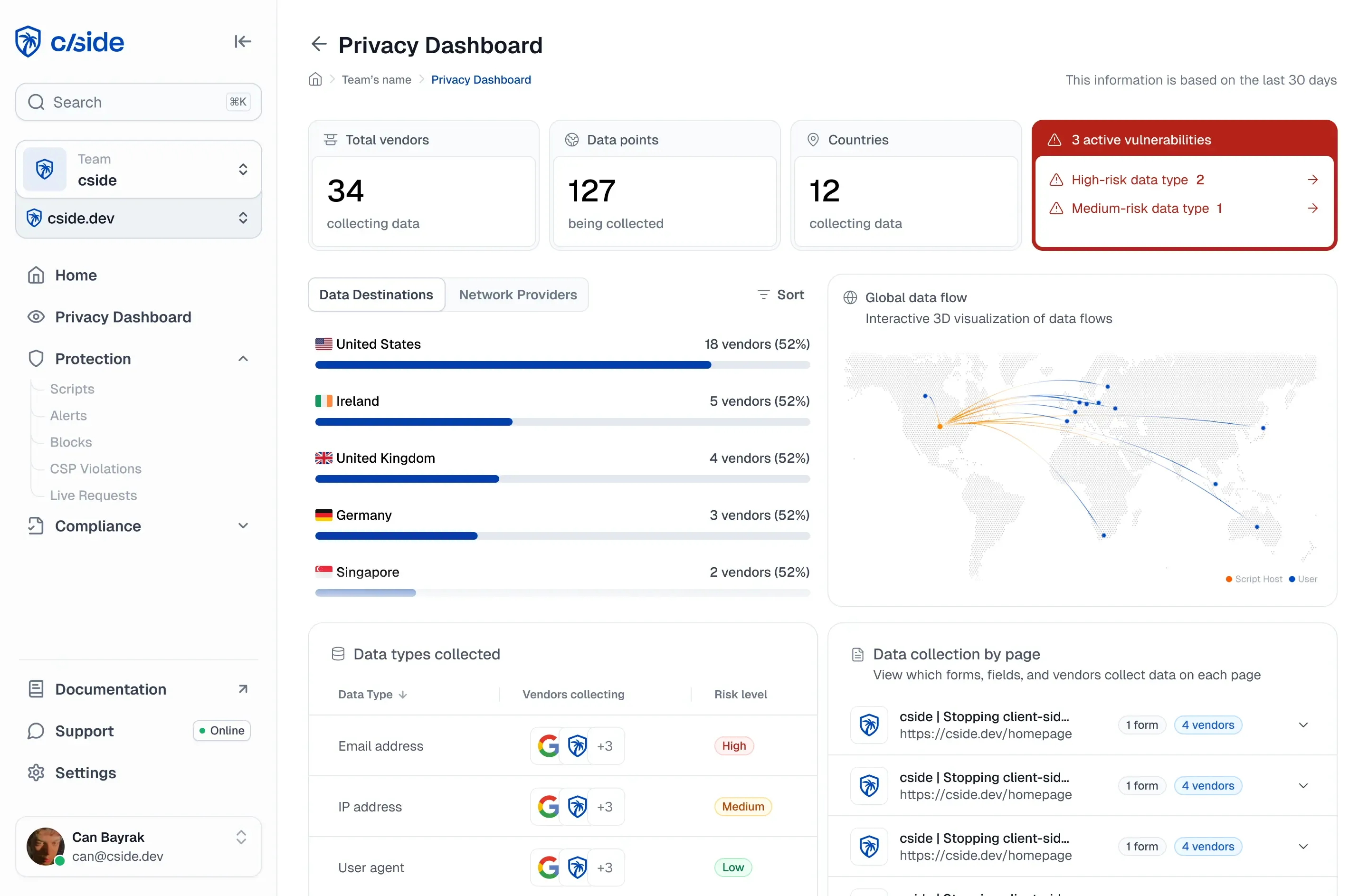
cside Privacy Watch
Même la plus petite menace peut engendrer des risques de conformité, et les bannières de consentement seules ne suffisent pas. Même si un utilisateur clique sur le bouton « refuser », des scripts mal configurés peuvent toujours accéder à ses données, créant des angles morts sur les DCP (données à caractère personnel) que les régulateurs (ou les attaquants) ne manqueront pas d'exploiter.
Pour une analyse approfondie de la façon dont la surveillance côté navigateur comble l'écart entre ce qu'une CMP enregistre et ce que les traceurs font réellement, consultez notre guide de surveillance de la gestion du consentement.
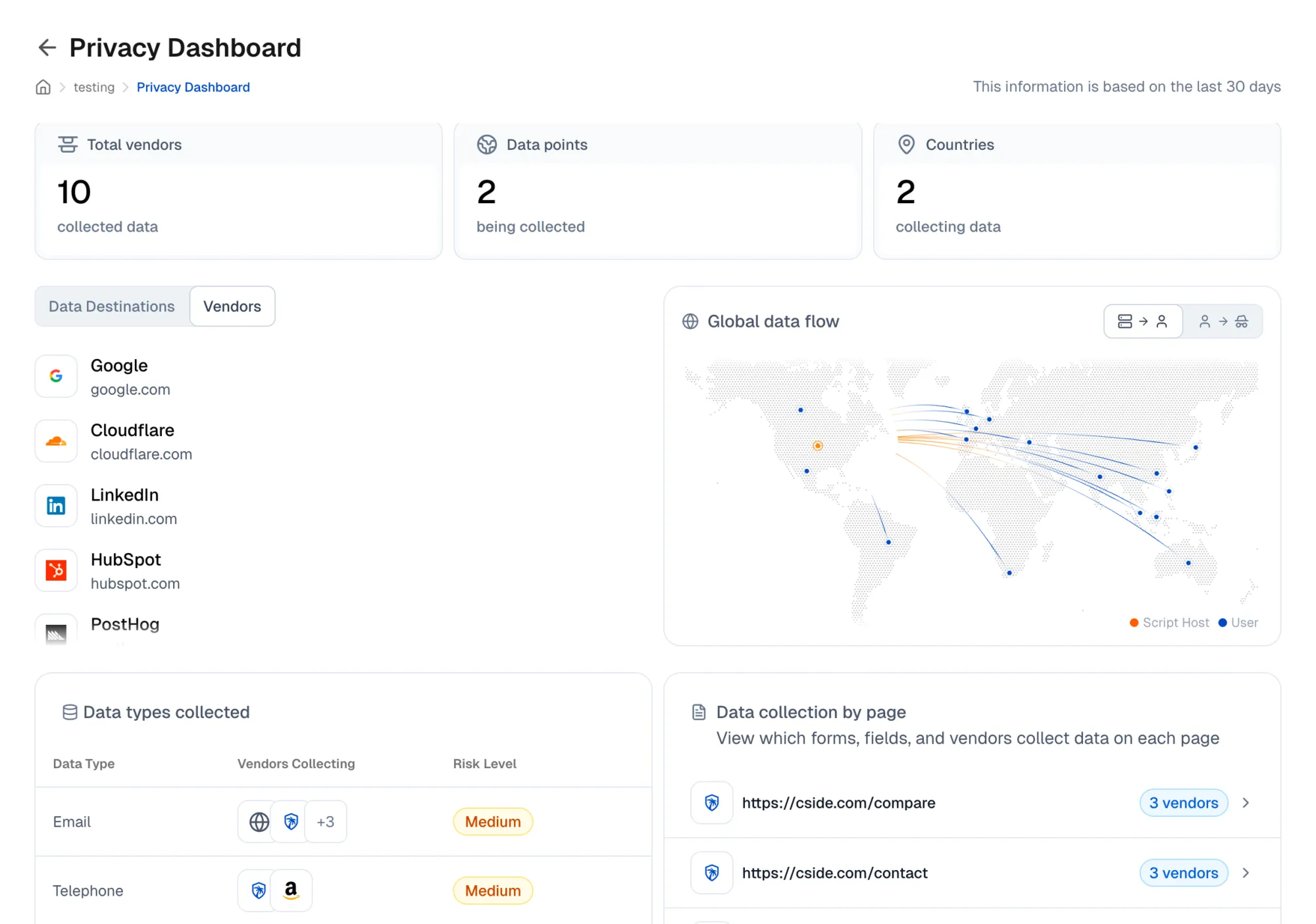
cside Privacy Watch surveille chaque script, signale en temps réel les angles morts et les risques, et vous aide à bloquer les flux de données indésirables grâce à des fonctionnalités alimentées par l'IA.
La plupart des outils de conformité ne regardent pas à l'intérieur du navigateur. Mais cside :
- Suit les données auxquelles chaque script accède et où ces données sont envoyées
- Propose des tableaux de bord clairs et un contrôle instantané des flux de données au niveau du navigateur pour répondre aux exigences du RGPD, de la HIPAA, du CCPA/CPRA, du TDPSA et d'autres réglementations sur la vie privée
- Remplace les audits manuels lents par des inventaires automatisés de cookies et de scripts
- Prévient les injections JavaScript malveillantes qui volent des données personnelles
Lecture connexe : notre comparatif d'outils de conformité RGPD pour 2026 · les erreurs de conformité RGPD les plus fréquentes et comment les éviter
Outils IA pour la gestion du consentement sur les sites web
L'application du consentement au titre du CCPA et du RGPD va au-delà de l'affichage d'une bannière de cookies. Vos sites web doivent suivre les choix de consentement en temps réel, mettre à jour les divulgations à mesure que les fournisseurs et les finalités de collecte évoluent, et traiter toutes les demandes des personnes concernées pour la conformité RGPD des sites web.
Tâches répétitives que les équipes souhaitent automatiser
La gestion du consentement et de la documentation relative à la vie privée est une tâche constante et minutieuse. Les équipes doivent suivre les choix des utilisateurs, maintenir les divulgations à jour et répondre aux demandes des personnes concernées, tout en gérant différentes réglementations régionales.
Manquer une étape peut entraîner des amendes et des sanctions au titre de la HIPAA, du CCPA et du RGPD, même si votre site web semble conforme en surface.
Voici quelques tâches de gestion du consentement que vos équipes peuvent automatiser avec des outils de conformité à la vie privée basés sur l'IA :
- Gestion de la logique de consentement aux cookies et des préférences pour plusieurs régions et cadres réglementaires
- Mise à jour des divulgations de confidentialité lors de changements de fournisseurs et de finalités de traitement
- Traitement des demandes des personnes concernées avec accès, suppression et rectification
- Registres précis des activités de traitement et autres documents de confidentialité
Fonctionnalités IA couramment utilisées
Concrètement, que peuvent faire les outils de conformité IA pour la gestion du consentement ?
- Création assistée par l'IA des Registres des Activités de Traitement
- Automatisation des flux de travail pour la réception, le routage et le traitement des demandes d'accès des personnes concernées
- Rédaction ou validation assistée par l'IA des avis de confidentialité, des divulgations et des messages de consentement
Quels outils IA puis-je utiliser pour la gestion du consentement sur les sites web ?
OneTrust
Ce logiciel de gestion du consentement alimenté par l'IA vous permet de :
- Appliquer des contrôles intuitifs pour que vos utilisateurs puissent gérer facilement leurs préférences en toute confiance
- Personnaliser les bannières et les centres de préférences à l'image de votre marque grâce à des modèles multilingues tenant compte de la géolocalisation
- Adapter automatiquement les expériences selon les régions et les appareils pour se conformer aux lois locales sur la protection des données
- Effectuer des tests A/B sur les mises en page et les messages des bannières pour optimiser les taux d'opt-in dans le temps
Ketch
Vous pouvez utiliser Ketch pour :
- Accéder à des modèles de politique personnalisables pour les bannières de contenu
- Mettre à jour automatiquement l'interface de consentement dès qu'une nouvelle loi de conformité est adoptée
- Maintenir un chargement rapide grâce à des codes de bannière légers
- Lier les préférences d'opt-out de chaque utilisateur à vos cookies et balises de site web
Transcend
Cet outil de conformité vous permet d'appliquer les choix de consentement des utilisateurs depuis les interfaces côté client jusqu'aux opt-outs côté serveur. Vous pouvez également utiliser les rapports de consentement pour maintenir la documentation de conformité.
Outils IA pour la conformité à la vie privée des infrastructures et des opérations internes
La surveillance des systèmes internes pour la conformité à la vie privée implique de suivre les contrôles d'accès, les modifications de configuration et les politiques de sécurité dans les environnements cloud et sur site. Les outils de conformité IA collectent en continu ces preuves et mettent en évidence les lacunes en temps réel.
Tâches répétitives que les équipes souhaitent automatiser
54 % des équipes consacrent plus de cinq heures par semaine à des tâches de conformité manuelles. C'est pourquoi 62 % d'entre elles signalent que leur processus de collecte de preuves d'audit est parfois sujet aux erreurs.
Votre équipe de conformité peut éviter cela et automatiser les tâches de conformité à la vie privée des infrastructures et des opérations internes, comme :
- La collecte continue de preuves de conformité dans l'infrastructure cloud, les systèmes internes et les outils de sécurité
- Le maintien de preuves de contrôles à jour
- Le suivi des modifications apportées aux contrôles d'accès, aux configurations système et aux politiques de sécurité
- La réponse aux questionnaires de conformité récurrents de vos clients, partenaires et auditeurs
Fonctionnalités IA couramment utilisées
L'IA aide les équipes à maintenir une surveillance constante de la conformité interne, en réduisant le travail manuel et en minimisant le risque de contrôles manqués. Elle collecte des données, analyse les lacunes et produit des rapports plus rapidement que tout processus manuel. Vous bénéficiez de :
- Collecte automatisée de preuves de conformité depuis les plateformes cloud, les systèmes de gestion des identités et les outils de sécurité
- Surveillance continue des changements de contrôles, remplaçant les évaluations ponctuelles
- Analyse des écarts assistée par l'IA par rapport à des normes telles que SOC 2, ISO 27001 et les exigences de responsabilité du RGPD
- Rapports automatiques prêts pour l'audit et synthèses de conformité
Quels outils IA puis-je utiliser pour la conformité des infrastructures et des opérations de confidentialité ?
Vanta
Vanta se concentre sur la conformité continue dans les infrastructures, les contrôles de sécurité et les systèmes internes. Vous bénéficiez de :
- Collecte automatisée de preuves depuis les fournisseurs cloud, les systèmes d'identité et les outils de sécurité
- Suivi continu des changements de contrôles dans des cadres tels que SOC 2, ISO 27001 et le RGPD
Drata
Cet outil de conformité est conçu pour maintenir votre état de préparation aux audits en continu grâce à :
- La surveillance des contrôles internes en temps réel
- La collecte automatisée de preuves mappées aux cadres de conformité
- Des flux de travail d'audit centralisés et des rapports de conformité en temps réel
Sprinto
Vous bénéficiez d'une visibilité en temps réel sur la posture de conformité interne. Le logiciel est doté de fonctionnalités IA :
- Création d'un Trust Center en direct qui maintient votre posture de sécurité transparente et défendable, avec du contenu alimenté automatiquement depuis des sources publiques
- Maintien d'un registre des risques en temps réel sur les systèmes internes et les fournisseurs
Outils IA gratuits pour la conformité RGPD des sites web
Il existe de nombreux outils IA gratuits ou à faible coût pour soutenir vos projets de confidentialité sur le web. Ces outils sont plus adaptés à la découverte initiale et à la validation des préoccupations. La conformité complète ne peut pas vraiment être atteinte en assemblant des outils gratuits. Ils peuvent toutefois vous aider à lancer votre feuille de route de conformité ou à comprendre votre exposition.
Outils gratuits d'analyse de sites web et de scripts
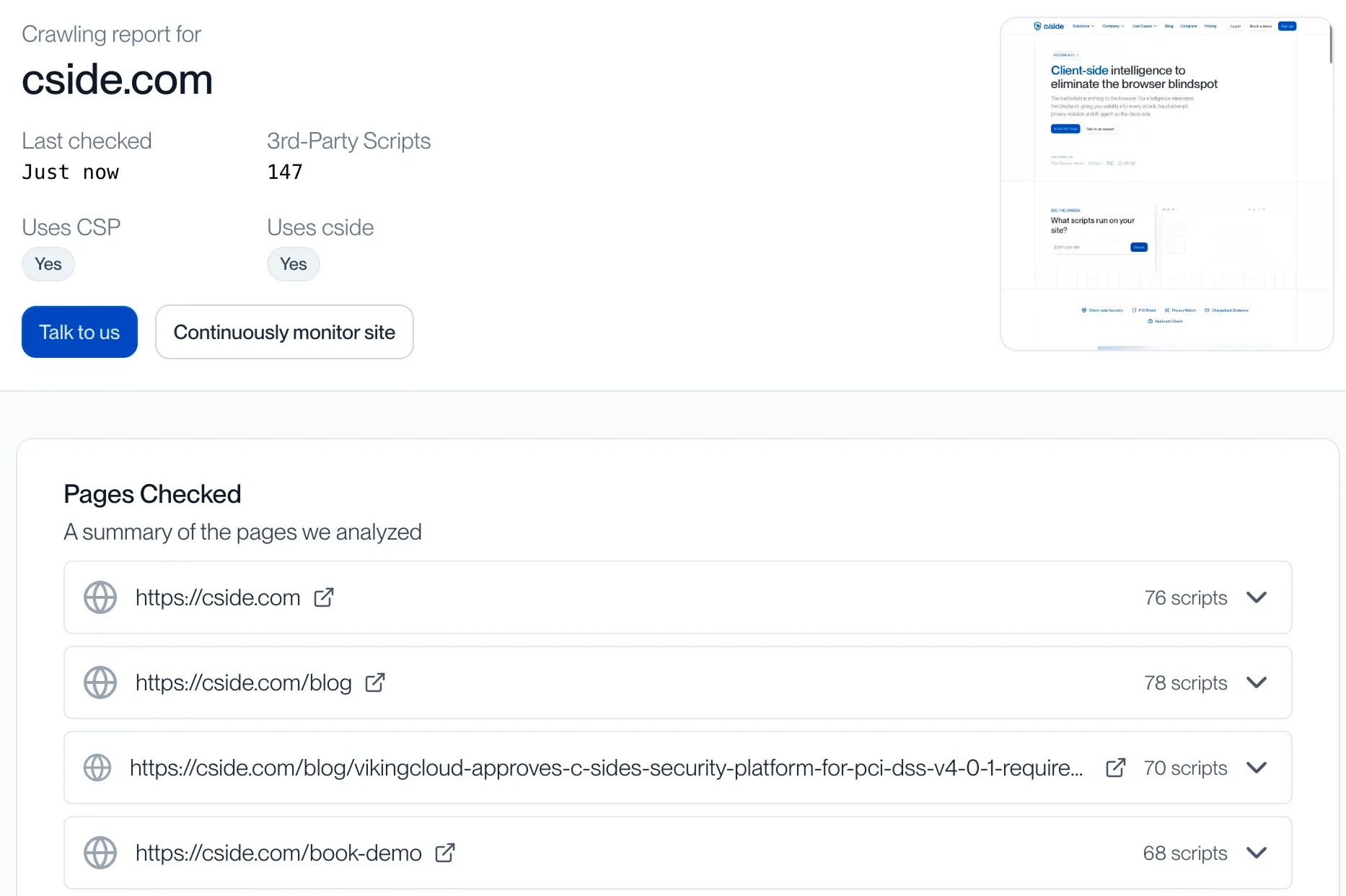
cside propose une analyse gratuite de site web qui vous montre les traceurs et les fournisseurs qui collectent des données sur votre site. L'analyse vous aide à obtenir un instantané ponctuel des risques liés à la vie privée et des flux de données dans le navigateur. Elle :
- Met en évidence les risques potentiels liés à la vie privée et à la sécurité associés à ces scripts
- Identifie les cookies, les services intégrés et les traceurs
Vous pouvez configurer l'analyse sur le plan gratuit à vie de cside. Ajoutez simplement votre domaine et commencez à voir les données côté client pour le RGPD, le CCPA, la PCI DSS et d'autres cadres. Passez à un plan supérieur à tout moment pour bénéficier d'une conformité complète, d'une surveillance continue et de fonctionnalités de sécurité.
Outils gratuits de bannières de cookies et de consentement
Les bannières de cookies gratuites sont essentielles pour les petites entreprises qui ont besoin d'une conformité RGPD légère (comme les entreprises américaines qui souhaitent être prudentes). Elles affichent des bannières de consentement, collectent les préférences des utilisateurs et enregistrent les choix de consentement de base. Ces outils soutiennent les exigences de base du RGPD et de l'ePrivacy en appliquant une logique d'opt-in ou d'opt-out en surface.
Voici quelques outils gratuits que vous pouvez utiliser :
- Silktide : Idéal pour créer des bannières de cookies simples et légères gratuitement
- Ketch : En plus de la surveillance de la gestion du consentement, Ketch vous permet également de générer des bannières de cookies gratuitement.
Les outils gratuits ou à faible coût sont limités en matière d'application du consentement, et ne suffiront probablement pas pour une conformité complète au RGPD ou aux lois américaines des États. Même les bannières de cookies « sans code » doivent être intégrées à Google Tag Manager et à d'autres éléments du site web pour fonctionner correctement.
Modèles de confidentialité générés par ChatGPT ou des LLM
La rédaction de documentation sur la vie privée est souvent bloquée parce qu'on ne sait pas par où commencer. Les outils IA avec modèles vous aident à franchir ce premier obstacle. Vous pouvez produire des ébauches utilisables d'avis de confidentialité, de politiques de cookies et de divulgations.
Utilisez-les pour créer une version initiale des documents de conformité, puis ajustez les détails en fonction des pratiques en matière de données, des fournisseurs et de la révision juridique.
ChatGPT peut accélérer la documentation de confidentialité RGPD. Rédigez une invite détaillée décrivant les données personnelles que votre site web collecte, pourquoi vous les collectez et quels tiers les reçoivent. Ou alimentez-le avec des données provenant d'une analyse gratuite de la confidentialité du site web pour obtenir une divulgation de confidentialité plus précise.
Ajoutez ensuite ces éléments comme base et demandez à ChatGPT : « génère un brouillon d'avis de confidentialité conformément aux exigences de conformité RGPD. Assure-toi d'obtenir les informations depuis le texte officiel du RGPD sur EUR-Lex."
Une fois le brouillon obtenu, révisez-le et validez-le avec un accompagnement juridique et les pratiques de collecte de données côté client de votre entreprise.
Vous pouvez utiliser Termly pour générer un document de politique de confidentialité conforme au CCPA, au RGPD et au CalOPPA. AI lawyer propose également des modèles de politique de confidentialité avec un générateur IA. Les modèles de politique de confidentialité de GenialAI sont également utiles.
Remarque : Nous ne suggérons * pas * qu'un avis de confidentialité généré par un LLM sera entièrement conforme ou accepté par les régulateurs de la vie privée. Ce sont de bons points de départ pour les petites entreprises (moins de 10 employés).
Outils IA spécifiques aux cadres de protection de la vie privée
Les exigences en matière de vie privée semblent écrasantes lorsqu'on examine chaque loi séparément. Le RGPD, le CCPA et d'autres cadres ont des règles différentes, mais ils s'articulent autour de thèmes similaires : contrôle du site web, gestion du consentement et traitement des processus internes.
Cette section explique comment les fonctionnalités IA s'intègrent dans chaque cadre, afin que vous puissiez comprendre quelle partie de vos opérations de confidentialité chaque outil peut soutenir.
Outils IA pour la conformité RGPD
Vous pouvez utiliser des outils de surveillance IA des sites web pour le RGPD (comme cside) pour :
- La surveillance continue en temps réel de tous les scripts tiers s'exécutant dans le navigateur afin de détecter les accès non autorisés et inattendus aux données
- La minimisation des données côté client en empêchant la sur-collecte ou la collecte non autorisée sur votre site web (RGPD Art. 5)
- La visibilité sur les données personnelles auxquelles chaque script accède et où il les envoie, y compris les points de transfert de données transfrontaliers (RGPD Art. 44-46)
- Des alertes immédiates pour les modifications suspectes des scripts tiers qui tentent d'extraire des données personnelles, avec un historique des versions pour revenir à des versions sûres
- Des rapports de conformité prêts pour l'audit avec des journaux détaillés et des preuves pour soutenir les exigences de transparence et de responsabilité du RGPD
Vous pouvez utiliser des outils de gestion du consentement IA pour le RGPD (comme OneTrust, Ketch) pour :
- La gestion centralisée du consentement sur le web, les applications et les systèmes avec une logique alignée sur le RGPD
- La réception, le routage et le traitement automatisés des demandes d'accès des personnes concernées
- La rédaction et la mise à jour automatiques des avis de confidentialité, des bannières de cookies et des divulgations
Et des outils d'opérations de confidentialité RGPD assistés par l'IA (ex. Sprinto) :
- La cartographie automatisée des données, des politiques et des contrôles par rapport aux exigences du RGPD, réduisant l'interprétation manuelle et les lacunes de couverture
- La surveillance des contrôles et des configurations, détectant les dérives et les écarts de conformité en temps réel
- La collecte automatisée de preuves reliant les vérifications techniques aux garanties du RGPD
Outils IA pour la conformité CCPA et les lois américaines des États
Vous pouvez utiliser les fonctionnalités IA de cside pour l'automatisation de la surveillance CCPA des sites web :
- Appliquer les préférences d'opt-out telles que le Global Privacy Control (GPC) avant l'exécution des scripts, prévenant ainsi les violations de la vie privée
- Enregistrer des journaux forensiques pour soutenir les investigations et les révisions
- Suivre les transferts de données transfrontaliers entre pays
- Prouver les garanties techniques contre les attaques côté client
Il existe des outils de gestion du consentement avec fonctionnalités IA tels que OneTrust :
- Flux de travail pour les demandes de droits des consommateurs incluant la réception, la vérification d'identité, la découverte des données, la suppression et les réponses sécurisées
- Liens et interfaces « Ne pas vendre mes informations personnelles » intégrés qui communiquent les choix d'opt-out aux utilisateurs
- Cartographie des données avec des étiquettes spécifiques au CCPA
Et Sprinto propose des fonctionnalités d'opérations de confidentialité assistées par l'IA compatibles avec le CCPA :
- Contrôles de conformité préconfigurés pour les exigences du CCPA
- Suivi des configurations et des paramètres de sécurité pour signaler les dérives de conformité
Choisir les outils de conformité IA en matière de vie privée et les logiciels de conformité vie privée
Tous les outils de conformité IA en matière de vie privée ne sont pas construits pour le même problème. Certains catégorisent les données personnelles au repos, d'autres surveillent les flux de consentement en temps réel, et un troisième groupe surveille ce que les scripts du navigateur font réellement avec les données utilisateur à l'exécution. Lors de la sélection d'un logiciel de conformité vie privée, associez l'outil à la surface de conformité que vous devez couvrir.
- Outils d'inventaire de données (OneTrust, DataGrail, Osano) cataloguent les données personnelles dans vos systèmes pour la gestion des DSR et la preuve de registre des traitements.
- Plateformes de gestion du consentement (Cookiebot, Termly, Usercentrics) gèrent les bannières de cookies et la capture du consentement.
- Surveillance de la vie privée à l'exécution, Privacy Watch de cside surveille ce que les scripts tiers font réellement avec les données utilisateur dans le navigateur, attrapant les violations de consentement, l'exfiltration de PII et le tracking non autorisé que les bannières de consentement ne peuvent détecter seules.
Pour les équipes sous RGPD, CCPA ou CPA, la pile de logiciels de conformité vie privée la plus solide combine les trois catégories.